Decomposition

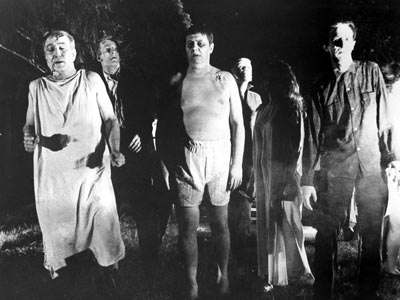
The following video report addresses a number of issues recently raised on this blog: apocalypses, zombies, fear, and humor. Zombies, of course, have been clawing their way to the top of the monster pile for a few years now. Media analysts have suggested that they represent the triumph of the working class—no sartorially suave vampires these—instead they are spattered with blood and gore, multitudinous, and clumsy. Having watched the most recent apocalypse come and go, and having been a victim of an unstable economy for several years of my professional life, I think zombies represent something else. Instead of being the triumphal usurpers of vampiristic free markets, zombies represent the breakdown in culture we are experiencing in the present.

If history gives us anything to go by, we know that powerful world empires ebb and flow. The Persians succumbed to the Greeks, and the Romans could not stop the Goths. The Holy Roman Empire was dissected into the nations of the modern European Union (roughly), and the sun now sets regularly on the British Empire. The United States, the capital of the zombie craze, has perhaps passed its zenith and the zombies know it. Since the 1970s we’ve watched as religious extremists have made a mockery of a political system that had already grown problematic. Like decaying corpses that won’t go away, the factors that propelled the United States to a place of prominence have been undermined so that the non-undead can continue to feather nests already stuffed with down as high as Babel. In the constant see-sawing of political parties the imperialist trends of the obscenely wealthy have rocked their way into the dominant. Is it any wonder that zombies are brainless, yet insatiably driven?

What does it feel like to watch the azimuth decline on a great empire? It is difficult to say. History, as the aphorism states, is written by the winners. Revisionist history has become quite fashionable to those who find that the facts refuse to bow to their worldview. Zombies are those who, historically, do the will of their masters without question. Instead, the zombie of the twenty-first century bows to no master. Pure selfish survival is its sole aim. Perhaps the CDC is too late, the zombies have already overrun us.

Newsy.com’s Report


Tackling the Tabernacle

Over the weekend a student question led me to think about the inconsistencies of ancient thoughts of holiness and how it fits into a naturalistic world. The question concerned the tabernacle as described in the Torah. The Levites were responsible for the grunt work of physically breaking down and carrying the holy furniture such as the menorah, table, incense altar, and ark of the covenant. One of the reasons for this was that the holiness on a sacred object clung to anything or anyone that touched it, causing a potentially catastrophic mix. At the same time, there were also prohibitions against touching the furniture or even seeing it. By the time the poles were inserted to avert the former danger, the latter prohibition would have already been violated. How did they do this?

Overall, the Israelites did not push ideas to logical extremes. In other words, the extension of holiness to other objects (and people), while it clearly happens, does not always follow a logical direction and culmination. If special ritual precautions were taken, the danger of approaching holy objects was removed or at least temporarily neutralized. Since there is not logical way out of this conundrum, the Bible itself simply doesn’t address the issue. “Don’t ask, don’t tell” also apparently applies to the holy. When describing set-up and take-down procedure for the tabernacle, the Bible simply ignores this puzzling issue.

Probably the most salient point of all concerning ancient texts is that concerning intent. If the Torah is describing literal, historical events then this is a scientific problem to be resolved. If, however, the tabernacle is a foreshadowing of the temple in the wilderness, a literary metaphor reflecting Israel’s history back into a non-historical setting, then the question becomes a literary one. No archaeological evidence exists for the exodus or wilderness wanderings of the Torah, causing many to suggest they were not so much historical events as they might have been theological explanations. They are “foundation stories” like those all nations have. These stories helped to explain why the monarchy failed to achieve perpetuity – the chosenness of the Israelites only lasted so long but not forever – according to those who are theologians.

I appreciated the question. It is only by thinking seriously about the implications of Bible stories that we are able to get a handle on what might have been originally in mind for those who gave us our religious heritage.

Gabriel L. Fink's tabernacle from WikiCommons


Father Abraham

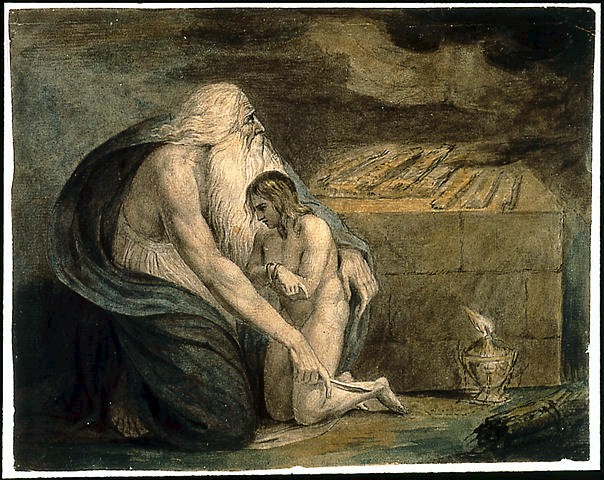
“Father Abraham had seven sons; seven sons had Father Abraham.” So began a camp song that I learned many years ago. The song always confused me because, no matter how I did the math, Abraham did not have seven sons. Abraham has a way of causing confusion. The story of Abraham contained in Genesis is complex and perplexing. He is presented as a man who experiences extraordinary occasions and then doubts what he learns from them. He is wealthy and timid, yet leads troops against an alliance of five armies. God speaks directly to him, and he remains in self-doubt. He always does what he is told, although he takes initiative once in a while as well. As Genesis tells it, he is the father of Ishmael and Isaac (and six others).

Historians have a somewhat different assessment. The only evidence we have for the historical existence of Abraham is Genesis. Although other ancient documents mention Abraham they clearly received their information from either Genesis itself or its oral sources. A prince powerful enough to route five kings might merit a reference in some clay annals somewhere, one might expect. Yet history is silent. Most historians require either multiple-source attestations or official, non-literary documents to support the historicity of ancient characters. Abraham simply doesn’t qualify. Those Genesis stories are foundation myths just like those common to all cultures. They represent self-understanding, not necessarily actual origins.

Nevertheless, religiously minded debates continue to flair around him. Abraham, through Isaac, is considered father of the Jews. Christians, courtesy of Paul, consider themselves adopted children who inherit over the natural born. Muslims sometimes trace their ancestry to Abraham’s first-born, according to Genesis, Ishmael. Abraham does not exit the stage as a single man, however. He bears in his person the promise of land, a very real commodity, granted by God himself. So the story goes. We have little trouble declaring other ancient (or not-so-ancient) characters legends or myths when they have no direct bearing on the historical origins of religion. Wars are not fought over Heracles or Theseus, after all. Because of Abraham’s inheritance, however, as the singly chosen ancestor receiving the divine favor, all major monotheistic religions wish to claim him. They are often willing to kill to make that claim real. Myths do have serious real-world applications. And I still haven’t figured out that bit about seven sons. Three seem to be far more than enough.

Abraham at sixes and sevens


Our Myth of History

“Myth” is a difficult word to define. In the ancient world, however, reality, or truth, was expressed in terms of myth. Today we assume that myth is “untrue” or false. This dichotomy often leads to an unfortunate undervaluing of ancient texts and stories. At root the problem is that we are on the far side of a paradigm shift. This podcast addresses the question of how we might try to understand myth in a way that fits with the modern outlook. Since historical veracity is the modern paradigm, it stands to reason that history has become the mythology of present-day thinkers.