Angels Aware

Having triggered myself by watching a horror film one weekend, when my wife and I tried to settle on a movie I suggested a comedy.  That’s how Good Fortune came to my attention.  My initial thoughts went to Michael, the 1996 movie where John Travolta plays the titular angel.  Good Fortune was Aziz Ansari’s director debut, and he was also the film’s writer.  I quite liked Parks and Rec and I have a soft spot for movies with a religious theme.  The basic idea here is that Gabriel (not the archangel) is a low order guardian angel responsible for protecting people from texting and driving.  One of those he saves, Arj (Ansari), is down on his luck.  A wannabe documentary maker, he’s working odd jobs and sleeping in his car.  The problem is that Gabriel is inept.  He’s good at stopping texting accidents, but has no experience directing people’s lives.
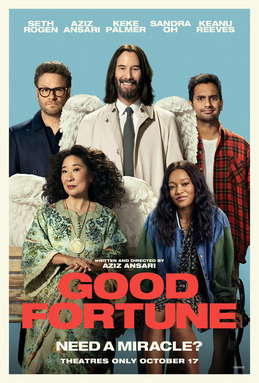
Things grow complicated when Gabriel breaks the rules and ends up showing Arj what life is like for his former ultra-wealthy employer, Jeff.  The two switch places, Arj remembers the past, but Jeff does not.  Living the life of the very rich, Arj decides he doesn’t want to switch back.  Jeff regains his memory, but unless Arj agrees—because of free will—Gabriel can’t switch them back.  Gabriel loses his wings and his angelic status.  As a mortal, he has to learn to eat, get a job, and experience human life.  Being a comedy, things end up as they should be.  There are a number of chuckles here, but nothing too profound.  I have to wonder, with my usual caveat, whether a deeper understanding of religion might’ve made the film stronger.

Angels continue to be huge in pop culture.  The problem is, how angels are perceived in the Abrahamic religions is poorly understood by the average person.  Angels are messengers and never, in the biblical world, people with wings.  (Gabriel has wings in the film because, of course, that’s how we tell an angel.  The previous weekend my wife and I rewatched Dogma, and, of course, the angels all have wings.)  Here, as in movies such as A Wonderful Life (which it resembles) angels can give humans a vision of the future.  That makes for good stories, but it doesn’t track with how angels are understood in the biblical context.  I see from a quick search that a few books by McFarland and Wayne State University Press (both publishers known for film studies) address angels in cinema.  I wonder how many of them take the Good Book into account.

Unexpected Gifts

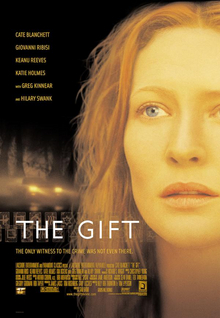
Sometimes horror movie therapy doesn’t go the way expected.  (No surprises there, so no snarky comments, please.  No therapy is “one size fits all.”)  This was brought home to me when watching The Gift.  I was attracted to the speculative aspect of the premise and although it came out over twenty years ago I hadn’t heard of it before.  Although there are speculative elements—at least two ghosts—it is largely a human drama and one that hit me unexpectedly.  As a public service for those who also practice horror movie therapy, I thought I’d consider it here.  (Then call my regular therapist.)  Annie Wilson is a psychic in rural Georgia.  She gives readings for donations to help supplement Social Security since she’s a widow and she has three young sons.  I don’t know why this didn’t start the warning bells a-jangling, but when it was over I realized her situation was like mine, growing up.  (My father was alive, but nobody knew where he was, otherwise I’m on board.)

A violent neighbor, scarily played by Keanu Reeves (forever Neo in my mind), keeps threatening the family since he’s a wife-beater and Annie recommends his wife leave him.  Then a woman is murdered and her body is in his pond (or better, bayou).  Annie realizes that this threatening bully, who’s convicted of the crime, is actually innocent.  Her lawyer, however, doesn’t see the problem—the guy was a menace to society and he’s locked up.  Annie, however, insists on finding the truth.  I have to say that this movie genuinely scared me.  I almost stopped watching.  It wasn’t the speculative part, though.  It was the human part.

Religious locals accuse Annie of being a witch and a Satan-worshipper.  She is, however, simply trying to get by in a society that has failed her.  Having an unstable neighbor threatening her kids doesn’t help.  What’s so scary is that this isn’t far from real life.  For those of us who grew up poor, safety nets are few and the weave is very, very loose.  And you’re made, even as a kid, to feel the social stigma of the crime of being poor.  Annie has a good heart.  She tries to get a man wrongly accused released from jail, knowing that he’ll probably begin threatening her again, if not actually harming her.  Society, however, doesn’t really care.  Raising three small children on welfare on your own isn’t easy.  And, in fact, those kids may well grow up needing therapy.  Even if it’s watching horror to try to make sense of life.