Lovecraftian Layers

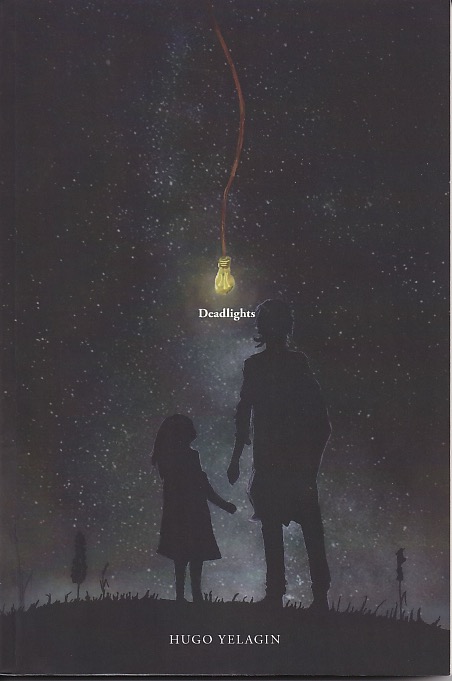
Lovecraftian dreams dominate Hugo Yelagin’s Deadlights.  A few major themes are addressed in this debut novel.  One, which always stands out to me for some reason, is the search for the father.  Maxwell Corvid, a former medical student at Miskatonic University, is returning home to his father’s once grand estate.  Accompanied by a banker who delights in pointing out that his father’s debts, Maxwell learns he’ll inherit debt rather than anything substantial.  Accosted by a brigand, the two leap into a huge sinkhole that has taken the estate.  Maxwell finds himself among moldy people transforming into fish (Lovecraftian, as I say), but befriends a young girl who knows her way around.  They find the banker and brigand and begin trying to solve the strangeness they encounter in this world.  A couple other major characters enter the tale, but I don’t want to give any spoilers.

While novels that heavily feature dreams aren’t my personal favorites, this dark fantasy intrigues you into turning pages.  I really couldn’t guess the ending, and, like a dream, not everything wraps up neatly.  The amazing thing about H. P. Lovecraft is that his vision has inspired so many others to grapple with his worlds.  Many modern writers find the call of Cthulhu irresistible.  The sloshy, watery fear of being transformed into something you’re currently not.  This, I think, is a second theme.  Transformation.  Realizing maybe the way you see someone isn’t the whole of that person.  And, of course, the theme of light.  This sinkhole world is dark and occasional lights help the characters to see.  And they learn that those different from themselves aren’t necessarily evil.  (Although one or two might be.)

I’m not sure I’d consider this a horror novel, although there are monstrous sorts in it.  It doesn’t try to scare like many horror novels do.  It does have a gothic setting, but the timeframe isn’t specified.  Lovecraft tends to conjure the Victorian period in my imagination, but his stories probably reflect his own time, as opposed to an earlier one.  I acknowledge my own weaknesses as a reader, and as someone with historical training, knowing “when” gives me a useful framework within which to paint a story in my head.  But then again, in worlds dominated by dreams that may be a moot point.  It’s just that, in my own canvas of this story, I do wonder what was, in this Lovecraftian world, really real.

Filming the Void

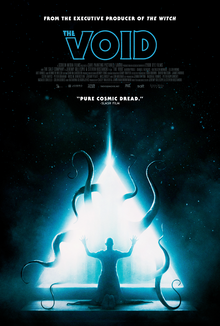
Once you move away from major studios, it turns out that Lovecraftian horror is rather prevalent.  Seeing that The Void was rated higher than many offerings on FreeVee, well, why not.  It was compared to the intellectual works of Benson and Morehead, but to me it matches more closely with Older Gods.  Like many movies in this genre, The Void isn’t easy to follow and having commercial interruptions doesn’t help.  (In movies made for television, directors know to offer cues at specified times to allow for a break.  I’m not sure that those at FreeVee, or Tubi, or Plex, or their ilk, or even Hulu, know how to do this well.)  So there are these mysterious cultists—somehow “new religionists” just doesn’t seem to cut it—who apparently want to bring about the apotheosis of their leader in a rural setting. 

Meanwhile a local sheriff finds a young man fleeing from a couple of guys who are killing people and takes him to the hospital.  This hospital, however, is being closed down and there’s only a skeleton crew there to handle emergencies until it can be decommissioned.  Once the guys trying to kill the young man arrive, the hospital is surrounded by the cultists.  By the way, there will be spoilers—just saying.  It never is adequately explained how these killing guys know who these cultists are, unless it happened so fast that I missed it.  In any case, all trapped in the hospital there’s the problem with a monster that has tentacles (Lovecraftian) that takes over the body of a nurse, then a tries to get a state policeman.  Lots of axes and gunfire, and the numbers in the hospital are reducing.

It turns out that the kindly old doctor is the leader of the cult and he’s trying to raise the old gods so that he can bring his daughter back to life.  The sheriff, who’s been the protagonist all along, knocks said doctor into the eponymous void, leaving only two people alive in the hospital.  It’s not really explained where the cultists, who made it into the hospital, went.  Nevertheless, this is a good example of horror and religion (which is ironically Lovecraftian).  The doctor’s unconventional religion is the cause behind the hospital mayhem, and, apparently the killings being conducted by the interlopers are attempts to stop it.  As a horror film it’s effective, if a bit disjointed.  It seems that there’s still a lot to unpack from films that try to bring Lovecraft’s ideas onto the silver screen, major studio or not.