Sun Shines

The world is a much stranger place than we are taught in school.  Even as a kid I was drawn to the weird and uncanny.  Yes, I was teased by others.  The mocking response is one that is intended to bring outsiders to conformity.  Nobody likes being shunned.  A friend, knowing my continued interest in the unusual, sent me a piece that mentioned, among other things, the Marian apparitions at Conyers, Georgia.  On October 13, 1998, while I was ensconced at Nashotah House, an event took place of which I’d never heard.  It was similar to the “miracle of the sun,” known worldwide as part of the phenomenon witnessed by between 50,000 and 70,000 people at Fátima, Portugal.  Both events included several solar anomalies.  The Catholic Church, always reticent toward modern miracles, didn’t claim Fatima as an official one.  In 1998, on the farm of Nancy Fowler in Conyers, the phenomenon was repeated in front of 100,000 witnesses.  Interestingly, the Wikipedia page on the apparitions doesn’t mention this.

News reels and Polaroid photographs (which can’t be tampered with) show something clearly unusual happening with the sun.  There are videos on YouTube that present these.  I’m always a bit skeptical of any modern videos, however, since so much can be faked.  There is no source whence the curious might go to find a rational, but not debunking, description.  Mainstream science dismisses such things out of hand—they can’t happen, so they don’t.  Faith-based treatments are also suspect.  The fascinating thing, to me, is that I was at a religious, quasi-Catholic institution at the time and heard nothing of it.  Television reception at the seminary was notoriously poor, and although the internet existed, the seminary had not yet jumped on the bandwagon.  At least not to the point of say, getting news online.

The article my friend sent was making the point that when large crowds of credible witnesses see something we should pay attention.  With events that don’t regularly repeat—the problem of occasional phenomena—setting up scientific observation doesn’t work.  For instance, ghosts tend not to show up when actual scientists (not those who play them on television) set up equipment.  One conclusion is “that’s because ghosts don’t exist.”  Another, however, is that they don’t act on cue.  And scientific experiments take both time and money and aren’t wasted on things that have a high probability of not showing up.  Our world is full of weird things like this.  All of us have had something we’ve brushed off as “just one of those things.”  But when 100,000 people see something, I’m curious as to what it was.

Medjugorje Matrix

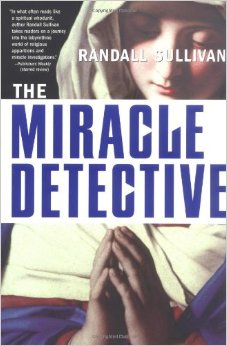
Miracle Detective“Expect a miracle,” Oral Roberts used to sign off, “and a miracle is yours today.” Physicists tend to be a bit more hard-nosed about the issue. In a mechanistic universe miracles are disallowed. How can you predict the outcome of any experiment or scenario when the whim of the divine could change the results? Nevertheless, most churches at least hold out the possibility of the rare miracle either set in centuries far past, or even occurring today. Randall Sullivan’s The Miracle Detective is, therefore, an almost unbelievable book. A reporter for Rolling Stone, Sullivan began investigating Marian apparitions. Although in the popular mindset, even among skeptics, such things are seen as promotions by the church to shore up the faithful, as Sullivan points out, the Catholic church is extremely cagey regarding miracles. It might be easier to convince a physicist than it is the Vatican, that a miracle is occurring.

Spending part of the tragic war in Bosnia-Herzegovina, Sullivan interviewed most of the six children who claimed to have visions of Mary at Medjugorje. While he remained skeptical of what he found, it is at times a decided head-rush to read his book. We tend to dismiss non-academic reporting of events by hoi polloi as unsophisticated, or superstitious. The events at Medjugorje, however, have been thoroughly tested by physicians and communist-appointed scientists and have left them scratching their heads. In some cases, getting them to convert to Catholicism. Rome, however, did not give its seal of approval to what was happening there. Sullivan, not religious himself, but open-minded, found the investigation compelling, if not life-changing. In this lengthy account, the reader is drawn into a rational world where something mysterious is clearly happening. A world that both the church and the academy deny might exist. And yet, something incredible stands on record nevertheless.

Lourdes, Fatima, and numerous lesser-known locations boast erstwhile visions of Mary that include miracles in their wake. Although the events in Medjugorje were unfolding the year I started college, majoring in religion, I had never heard of them until I read The Miracle Detective. As Sullivan notes, at times it seems better not to know about such events because they disturb a comfortable worldview where intrusions from the outside just don’t happen. Life, however, includes many incidents which we simply take off the table because they don’t fit into our scientific paradigm. The implications are just too discomfiting. Climbing off the bus after having read several chapters of the book was like stepping back into a world somehow so effaced that I felt there must be something on the other side. Many of those experiencing these miracles were barely Catholic, or were not religious at all. And yet something happened to them, causing them to wonder. And that wonder is catching for those who read the strangely compelling account of an open-minded, if accidental, miracle detective.