2016 in Books

As is my custom on this last post of the year I’ll be revisiting the books that made an especial difference to me in 2016. I record most books I finish on Goodreads, and I welcome friends in that venue. I draw on their recollection for what I’ve read and all of the books I mention here have individual posts on this blog. Use the search function. It’s free!
screen-shot-2016-12-30-at-4-50-39-am

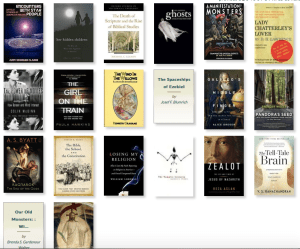
The first important book was Scott W. Gustafson’s At the Altar of Wall Street. If you missed this one, it is well worth your time. Economics has become a religion. If you doubt that, look at 11/9 and tell me so. Philip Gulley’s The Quaker Way was also an early read that’s worth revisiting. November has made many of these books more important than they seemed at the time. Whitley Strieber and Jeffrey Kripal’s The Super Natural will expand the minds of those who allow for unconventional possibilities. And Marc Bekoff’s Minding Animals will remind us we’re not alone on this planet. The Soul of an Octopus by Sy Montgomery was a book I really couldn’t put down, and a nice complement to Bekoff. Marcelo Gleiser touched a chord with The Simple Beauty of the Unexpected, a book worthy of anyone who wants to consider how science and humanity might cooperate for everyone’s benefit. While not really a reading-through book, Tristan Gooley’s The Lost Art of Reading Nature’s Signs is important and worthy of attention.

In the realm of monsters, Elizabeth Baer’s The Golem Redux was a fantastic introduction to a Jewish legend that I revisited in three more books over the year. Several other monster books followed, but especially memorable were Carol Clover’s Men, Women, and Chainsaws, and Maya Barzilai’s Golem—please be patient with me regarding this one. I haven’t written a post on it yet, since an official review has yet to be published. Alexandra Petri’s A Field Guide to Awkward Silences won her an instant fan. I’ll read anything she writes. I didn’t give Alice Miller’s The Drama of the Gifted Child the attention it deserves. It’s kind of a personal thing. Kyle Arnold’s The Divine Madness of Philip K. Dick was utterly fascinating, looking at another person Miller would have found intriguing. Also on the topic of writers, Melville’s Bibles by Ilana Pardes spoke deeply to me.

For fiction, highly recommended are Amy Tomson’s The Color of Distance, Peter Rock’s My Abandonment, Emily St. John Mandel’s Station Eleven, Toni Morrison’s, The Bluest Eye, Pete Hamill’s Snow in August, and Jennifer McMahon’s The Winter People. Less profound, but thoroughly enjoyable were Jonathan L. Howard’s Carter and Lovecraft, and Jasper Fforde’s The Woman Who Died a Lot (reading anything by Jasper Fforde is time well spent). My childhood favorite, Lester del Rey’s Day of the Giants retains its magic.

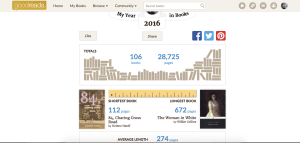
According to Goodreads, I finished 106 this year. Along the way I finished the 2016 Modern Mrs. Darcy reading challenge. Many of the books were excellent, and this shortlist represents those that idiosyncratically stick out in my mind. Please participate in a show of hope for the future: make 2017 a year of reading.
Monsters and Men

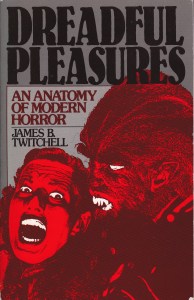
dreadful-pleasuresHorror films are something you either “get” or you don’t. I have no empirical evidence for that, but then again, “getting” is hardly a precise verb. In my recent desire to find some explanation for my own fascination with the genre, I turned to James B. Twitchell’s Dreadful Pleasures: An Anatomy of Modern Horror. This is a smart book. Twitchell, an English professor, knows to include Gothic novels in his accounting for this strange addiction. He has several insightful things to say about the differences between terror and horror. He gives a fairly complete analysis of the “big three”—vampires, Frankenstein monsters, and werewolves/wolf men/Jekyll and Hydes. Still, at the end, I have to wonder if he really “gets” the monsters he explores. Part of this is his early admission that he didn’t grow up with monsters, but that he was introduced to them academically. Another part of it is his sometimes dismissive style when talking about movies that meant a great deal to us monster boomers when they came out. Either you get it or you don’t.

Still, I recommend this book for those who want to make sense of some of the hidden dynamics of classic monsters. That the analysis is sexual should come as no surprise. Twitchell finds evidence for a sublimated incest in many of his creatures, but the true fan knows there is more to them than that. The monster does indeed cross boundaries—that’s what monsters do, after all—but that’s only scratching the surface with their claws. Of course, the book suffers from having been written perhaps a little too early. Although there is protest to the contrary, horror films have grown up considerably since the 1980s. Not all of them, of course. The same thing could be said of the kids I knew in high school.

Having a single theory to approach a phenomenon is respectable. So respectable that it’s called Occam’s Razor and everyone is expected to shave with it. I’ve never liked shaving. The more I reflect on reality, the more it seems to me that answers are more complex than single causation. Sometimes the simplest answer isn’t the most parsimonious. Sometimes there is far more going on than meets the cyclops’ eye. In my experience, limited though it may be, the horror movie has unexplored dimensions. One of them is the coping ability that they offer when evens such as 11/9 occur. There’s no simple way to understand monsters, but if we see them around enough, we might just be able to survive them.


Scary Pictures

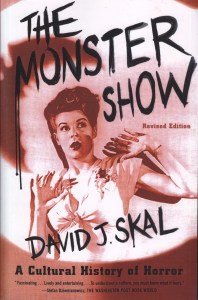
monstershowThroughout its history, until quite recently, one of the most serious natural enemies to the horror movie was the religious establishment. At times this antagonism seems well placed as horror films often take theological concepts and stand them on their heads. Within the last few years, however, thinkers of religious thoughts have come to an uneasy accord with some horror movies as vehicles for the kind of thinking promoted by traditional religions. The first half of this dynamic appears clearly in David J. Skal’s The Monster Show. Written before any kind of detente had been reached, his book chronicles skirmishes between the Production Code, religious groups, and even women’s collectives, against what was considered indecent and degrading. We have come to realize, however, that we are the monsters. We are the degraded. And seeing these films can lead to a strange sort of solidarity.

Most classic monsters, after all, have their origins in religions. Even the most recent of the lasting undead—Frankenstein’s monster and zombies—have origins in religious thought. Mary Shelley’s novel was subtitled The New Prometheus, a reference that anyone in the early nineteenth century would have understood. Zombies, on the other hand, are a product of vodou. Religion can’t get along very well without its monsters, and despite their less-than-stellar looks, their screen appeal is undeniable. Maybe it’s just we don’t like our dirty liturgical laundry being hung out where anyone might see it.

Skal’s treatment doesn’t stop at the cinema. He has a chapter on modern vampires, and Stephen King has earned his own chapter (or at least most of one) as the poet laureate of the novelistic form of the genre. More often than religion, Skal traces what’s happening in the monster world to the larger social issues of the day. Quite rightly so, as scary movies go nowhere without a receptive viewership. Looking around these days it’s easy to be scared. Even what was once a grand occasion of debate over higher principles as we ponder our next leader has become a farce in one of the parties that could make its own horror movie. Hitler, it is said, was a huge fan of King Kong. Large apes manhandling women never seem to go out of style. Some call it horror. Others try to get away with saying it’s politics. While the daily commute grows more and more dangerous, and the rhetoric grows even worse, is it any wonder we like to dim down the lights and watch monsters that we know really can’t get us at all?


Mysterium Tremendum

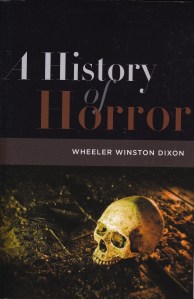
HistoryHorrorFor those of us accustomed to ancient things, horror movies are remarkably new. That doesn’t mean, however, that they are scarce or even easy to understand. While it is beginning to erode, the academic derision of popular culture has long avoided the decidedly low brow genre of horror. It doesn’t know what it’s been missing. Wheeler Winston Dixon’s A History of Horror is an insightful attempt to make some order out of a century of monsters and mayhem. Beginning at the stage when “horror film” was still just a demonic gleam in some vampire’s eye, Dixon points out that from the very earliest experiments with movies “horror” was a popular trope. It seems only natural that the idea of a full-length scary movie would be the expected development. What happened in Universal Studios in the 1930s is that business began making money out of monsters. Where there’s money, there be monsters.

Dixon takes us through the early days into the tired era in the 1950s when life was, apparently just so darned good that people weren’t really thinking about monsters. (Dixon’s analysis is a bit more sophisticated than that.) Horror films matured in the 1960’s and spun out of control in the ‘80s. His book continues up to the first decade of our current century. There’s obviously a lot that can be said about this, but what caught my attention, naturally, was how quickly religion entered the discussion. Those of us who approach horror with an open mind know that religion is its next-door neighbor. Indeed, one of the nihilistic aspects of the proliferation of horror movies since the 1980’s has been the lessening of this getting to know the neighbors. Horror, as Dixon notes, seems to have devolved to brutality and cruelty with no real message.

I’ve never been a fan of gore. I’ve watched my share of slashers, I suppose, but they’re not my favorites. Horror can—in the best of its offerings—be very profound. Indeed, it can even inspire thoughts not so terribly far from those generally classed as religious. For what is worship if not carefully managed horror? The concept of the holy as mysterium tremendum underscores this dynamic. Part of this connection is the appeal to emotion. Horror movies make you feel something, and that is a large part of their appeal. They can be more, however. A smart horror movie will feed your brain rather than just having zombies eat it. Academics, eventually, will catch up with it. Dixon starts to show the way.


Let Us Prey

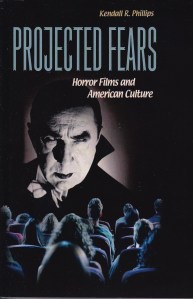
ProjectedFearsI grew up with horror films. Not that my mother encouraged or approved this behavior, but I was a kid with a lot of phobias. With no father around to protect us from what dangers might lurk out there, I tried to learn how to cope by watching others face monsters. That innocent childhood pass-time, like most simple pleasures, disappeared into the adult world of analyzing and being serious and making money. Then it came back. After a series of unsuccessful relationships the old rejection phobias led me back to my beloved monsters. I suspect that’s why I like reading about horror films so much—it’s an exercise in self-understanding. Kendall R. Phillips’ Projected Fears: Horror Films and American Culture is a pleasant Saturday afternoon’s viewing, but for adult monster boomers like myself. Phillips admits up front that academic respectability is hard to come by for horror movies, but that is starting to change. We are beginning to read the script.

Phillips walks the reader not only through the ten movies he’s selected, but also through what was happening in American culture at the time. The horror movie proper is not yet a century old, having begun with Universal’s 1931 monster pair of Dracula and Frankenstein. Phillips shows that what scares a culture changes over time. Indeed, one gets the sense that it is horror movies that lead us in our fears. Highlighting ten culturally significant films, this book guides us through the highs and lows of the last century. The last entry in the book dates from 1999, nicely encapsulating what made us afraid during a most remarkable and, if we’re honest, a most messed up century. Clearly those who purvey horror will have their own choices for significant entries. Phillips does an admirable job of justifying his choices: Dracula, The Thing from Another World, Psycho, Night of the Living Dead, The Exorcist, The Texas Chainsaw Massacre, Halloween, The Silence of the Lambs, Scream, and The Sixth Sense. Each reflects its age, and each impacted its culture.

It should come as no surprise that religious elements—both in culture and in the movies—are up for discussion here. Consciously or not, religion deals with our fears and frequently moves us into the realm of horror. Now that we’ve entered a new era—much has happened already this millennium—the nature of our fears has been changing. To assess cultural impact we need some distance. Books like this help us to understand ourselves, but only after sufficient time has passed. I am confident, however, that when future analysts look back on this insane time that they will find unexpected answers to questions we can only begin to utter. We stare at the monster in the room with us, paralyzed and unable to scream. Or even text. And they will note that religion played a role in our nightmares even as we expected technology to save us.


Mature Monsters

When I first began this blog, generally focused on religion, I felt the need to justify posts about monsters. Now, some seven years and several books later, I have come to assume monsters and religion are close kin. Many scholars who explore monsters are those in that amorphous field of “religious studies” who’ve come to realize that terror and the sacred are not far apart. In fact, the Bible contains many stories that could be understood as horror, if taken literally. When my wife sent me a story in The Guardian, “Guillermo del Toro: ‘I love monsters the way people worship holy images’” I once again found the connection reinforced. In the article by Jordan Riefe, del Toro comes more than once to religious themes as he describes his fascination with the macabre. Here’s a guy about my age who’s not afraid to admit that he likes the scary stuff and has, indeed, become famous for it.

Feejee_mermaidI have to admit that Guillermo del Toro has a way of pressing my buttons. I’ve watched a number of his films and they can be scary even with subtitles to read. Perhaps the reason is that del Toro understands implicitly the tie between religious thinking and the monstrous. An invisible man of infinite power whose revealed will comes in contradictions is certainly a source of fear. So is a child who wears a burlap sack painted like a mask over his head. Known for his fear-inducing creatures, del Toro was raised a Mexican Catholic. He ties this upbringing with monsters in this story. Riefe records him as saying, “I felt there was a deep cleansing allowing for imperfection through the figure of a monster. Monsters are the patron saints of imperfection.” In a mythical world where perfection rests only with divinity and people are told to be perfect, monsters are certain to emerge.

Until quite recently horror was considered a lowbrow genre by academics. As such it wasn’t really worthy of exploration. Perhaps it isn’t surprising, then, that scholars of religion—the new lowbrow—were among the first to take their disfigured friends seriously. Science tells us there are no monsters. We live in a rational world with evolution taking logical steps—if unguided—to more efficient means of survival. That doesn’t stop us from lowering the shades as night draws on. The monsters may be in our heads, but we might also find them in our souls. When we’re informed that such souls are nothing more than imagination we have a very good reason to be afraid indeed.


Nightmares

I spend a lot of time thinking about monsters. Could there be any more statement of the obvious? The deeper issue, however, is why. Why am I, among countless others, drawn to the monster? This may not be politically correct—I apologize in advance—but that which is unusual naturally draws our gaze. Humans, along with other conscious creatures, are curious. (There’s another trait that reductionism hasn’t adequately explained; we’d be far more secure sticking with what we already know works.) The out-of-the-ordinary will keep our attention although we’re told not to stare. The monster is defined as something that isn’t “normal.” We’re captivated. We stare. Indeed, we can’t look away.

477px-Frankenstein's_monster_(Boris_Karloff)

The media play into this with their coverage of Trump. I realize I risk participating in that rude behavior by even addressing the topic, but as I hear intelligent people everywhere asking why Trump has captured the imagination I have to ask, have you seen the headlines? Newspapers that don’t endorse him run huge headlines when his name is in the news. It’s horrible, but I can’t look away. Historians scratch hoary heads and wonder how Hitler came to power. Populism combined with an undereducated population in a democracy may be an equation that political analysts should try to solve before it’s too late. Meanwhile, my thoughts turn to monsters. Ugly, large, and threatening, they rampage through my dreams and now my waking reality. I watched in horror as the electorate lined up behind Reagan. Bush, I told myself, was an aberration. Until the second time. Then I realized it was the summer of Frankenstein indeed.

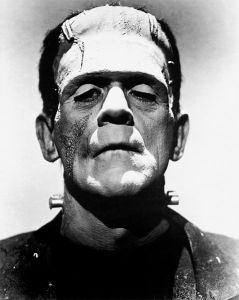
From my youngest days I recall the antipathy that my classmates showed toward school. I didn’t mind school that much, or at least the learning part. Gym I could’ve done without. I never did get the socializing thing down. Feeling a bit like Frankenstein’s monster myself, I realized I was a pariah (that was a vocabulary word). When did monsters shift to being worthy of emulation? The monsters of my childhood were to be feared, and curious creatures will always keep an eye on that which causes fear and trembling. The media say we don’t want Trump but they give him all the air time he could wish and more. In headlines in massive, almost misshapen letters. They’ve expended their superlatives on what they tell us we shouldn’t see. They have, perhaps unwittingly, played into the very hand bitten by that which it feeds. I can’t help it. I’m staring.


What Vampires Abhor

IMG_2731

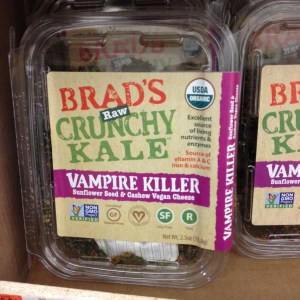
It began as an innocent trip to the grocery store. I was in the produce section seeking the various vegetarian foodstuffs I need to make it through the week when I came across a monster. Well, more precisely, the mention of a monster. Brad’s Crunchy Kale. Vampire Killer variety. Now, I’m not the world’s expert on vampires; I’m a dilettante at best. Still, I’ve never heard of kale as a vampire bane. (The store didn’t have wolfbane on offer, that I could see.) But this advertising ploy made me wonder about the use of vampires, and other monsters, as means of selling food. The Count Chocula family of breakfast cereals is perhaps the most famous example. Kids love their monsters. Especially with milk. Perhaps Brad is trying to get kids hooked on kale? Start them early on the right path and they’ll not soon depart from it.

Walking through the aisles I didn’t see much else that related to monsters. More the daily bread than the undead. After all, this was just post-Easter and people won’t be thinking about ghosts and ghouls until the other equinox rolls around. The brighter half of the year is a time for sunnier prospects. Monsters go into hibernation. Long, light-filled days are ahead. Why are we putting Vampire Killer on the shelves now? I looked at the ingredients. Garlic didn’t seem to feature prominently among them. I had to admit to confusion. And a desire for garlic bread.

Food, so scarce in many parts of the world, is something we need to decorate to get the attention of the modern consumer. Who’d buy a bunch of generic green, leafy stuff that requires some preparation—you at least have to wash it. And even then it might not protect you from vampires. Try a little packaging. All you have to do is open and eat. Rather like a vampire, actually.

We used to shop in one of those stores where they eschew fancy packaging and you pay for grains and dry goods by the wholesome, unwrapped pound. There seemed to be little ambiguity about what you were getting then. But we wish to be entertained by our food. This could be part of Buffy’s buffet, could it not? I find myself having to hold up a crucifix to stop from dropping it into the cart. There are vampires out there, I’m just sure of it.


Monster Epistemologies

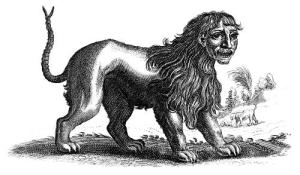
A friend ensures that I see internet stories of hidden monsters. Not hidden in that you can’t find them, but hidden in that my freedom to explore the web entails only weekends and even some of those are very busy. In any case, a bestiary from Mental Floss landed on my virtual desk recently and I couldn’t wait until the weekend to check it out. A bestiary is a list of strange creatures, what we might today call monsters, some of which reflect a world not well explored and others which reflect religious, or—admit it—superstitious ideas. In the days when travel was limited and news was slow and unreliable, garbled accounts of strange beasts were compiled in bestiaries. The tradition continues today, as is evidenced by this article by Paul Anthony Jones.

Whenever I see monster stories like this I ask the question: did they really believe such things “back then”? Some of these monsters clearly have analogues in the natural world, but part of my brain reminds me that we are destroying species faster than we can count them in the rainforest, and who knows what we have yet to uncover? Is it really a matter of belief or is it actually a matter of knowing how we know? The fancy word for the latter is “epistemology.” As I used to ask students: how do you know that you know? Has that changed since the days of the bestiary? Knowing about medieval monsters seems to have been the acceptance of the reports of those who, if they hadn’t actually seen the beast, had at least talked to someone who knew someone who had. It is the authority of the senses. Or of reliable reporting. Seeing is believing.

Martigora_engraving

Fast forward to a day of popular cryptozoology. We have monster hunters of many sorts on television. Some claim evidence for what they have seen. Lighthearted laughter is the common response. Monsters just don’t fit into our worldview anymore. Our epistemology has become more circumspect. If it doesn’t come from a lab, like a genetically modified organism, we have no reason to believe it exists. We’d like to create our own monsters, thank you. It’s at times like these that I like to reflect that a bestiary doesn’t sound so different from a breviary. Both are medieval sources of knowledge. Our modern epistemology seems to have grown a little too narrow to see a world that is full of wonder. Unless, of course, it’s on the television. Seeing is believing.


Lovecraft Legacy

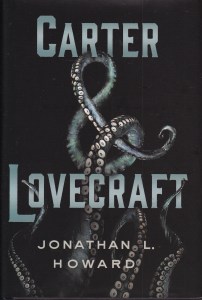
CarterLovecraftHistory can be a funny thing. Take the way it treats some people. H. P. Lovecraft wasn’t famous in his lifetime. In fact, his isn’t exactly a household name even now. His creation Cthulhu lurks grandly in the internet, and even Lovecraft himself is finding mention in some literature courses, despite his lack of literary finesse. Yet, fiction is being written about him. I just finished Jonathan L. Howard’s new novel, Carter and Lovecraft. While H. P. doesn’t appear as an acting character in the novel, he is related to one of the protagonists in a way that is essential to the story’s plot. I won’t give away any spoilers here, but the novel takes over where Lovecraft, the non-fictional character, left off.

Lovecraft, famously, was an atheist. Nevertheless he spun a mythic world of Old Gods that has become canonical in its own right. His stories veritably teem with religious themes as well as monsters. In fact, in Howard’s treatment of the mythos, the religious elements still show up. As I’ve noted before, one need not be a theist to be a capable theologian. Fiction like that of Lovecraft, or that of Howard, inherently holds a kind of numinous quality. In fact, fiction frequently does. In reading, we allow ourselves to be drawn into another world. What could be more religious than that? The beliefs of the writer, it seems, may not ultimately matter.

At one point, at least, in Carter and Lovecraft the sentiment becomes explicit. One of the characters contemplates starting his own religion, only to realize that he’d have to write a holy book. That, he decides, would be a lot of work. As one who dabbles in various forms of literary art, I can take his point. There is something wondrously exhausting about giving birth to words. And those words make worlds. When you stop to think about it, that’s kind of a religious thing to do. I’d recommend Carter and Lovecraft to H. P. L. fans. It’s not a Cthulhu-fest, but it is an enjoyable, compelling tale that raises questions which, if not handled carefully, will quickly turn theological.


Mere Monsters

While my colleagues and I wait to hear if our monster session will be approved, my thoughts naturally turn to the taxonomy of monsters. One of the perennial problems in the study of monsters is that definitions vary widely. We might all agree that a werewolf is a monster, but what of Cthulhu? Or of a horribly deformed, but completely natural animal? What about demons? Should we all agree that we know what a monster is, how do we divide them into categories for easy study? One way of doing this might be to rely on binaries. For example: natural monsters versus unnatural monsters, living monsters versus undead monsters, monsters from earth versus monsters not from earth, monsters created by humans versus naturally occurring monsters, fictional monsters versus monsters reported in nature. It soon becomes obvious that monsters are a widely divergent group of creatures.

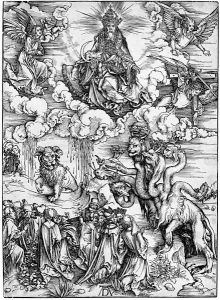
Monsters have won an enduring place in popular culture. I think of The X-Files. Apart from the “mythology” of the series, many episodes featured a weekly scary monster. The same is true of Sleepy Hollow, now in its third season. Monster movies, although perhaps taking a back seat to super heroes of late, are regulars on the silver screen. We just can’t seem to live without our monsters. I’ve mentioned in my many posts about monsters that the connection with religion is so obvious that it hardly requires apology. But a deeper question has occurred to me. It has to do with the nature of religion (itself not well defined).

439px-Durer,_apocalisse,_12_il_mostro_marino_e_la_bestia

Religions exist to deliver people from the trials they face. Offering Nirvana to break the endless cycles of reincarnation, or Heaven when we die after one go-round, religions claim to give us something of an assurance that things will work out. (Mostly.) In the light of this, why does religion give us monsters as well? Surely they are more than mere metaphors for the misfortunes of daily life. There has to be something more to it. What that more is, I’m not certain. I’m not even sure of how to approach the question. Monsters will, for me and many other Monster Boomers, remain a guilty pleasure that we are pleased to be able to address as adults. I am becoming more and more convinced that the more we learn about them, the more we learn about religion itself. And perhaps also about those who give shape to religious thought.


Religious Monsters

Some colleagues and I are working to meet a deadline. I suppose I use the word “colleague” rather grandly, since they both have teaching positions, nevertheless, we have a common goal. We are fascinated by monsters and we’d like to see the American Academy of Religion dedicate a small section of its large annual meeting to them. We’d do all the work. At first glance, this might seem an odd topic for the serious study of religion. The fact is, however, that monsters are a part of human experience—at least in our imagination—and the conceptual space overlaps considerably with religion. Many monsters have their origins in religious thought. Some theorists go further than that and suggest the very concept of “monsters” comes to us, courtesy of religious beliefs. We can see it time and again in popular culture; the movie or television show, or novel that features monsters ventures into the territory of religion.

The reason for suggesting that this relationship be formalized is the fact that, although this connection exists, it has not be given adequate study. Monsters are the denizens of childhood imagination. When we grow up we leave our monsters behind. But not really. We just stop talking about them. With our mouths. The film industry knows that a horror film will generally draw in the lucre. Halloween has become a major commercial holiday. Stephen King is a household name. I’m not sure why all of this is so, but I think it might have something to do with repression. When we grow up we are taught there’s no such thing as monsters. Those who refuse to relinquish those beliefs are ridiculed. We have more important things to do. Things like making money. Deep down, however, we may still believe.

The fantastic and belief are intimate companions. In fact, belief is at the root of much of our experience. That’s not to say there are really monsters in the night, but at some level we believe there are. And we also believe that infinite deities control this infinite universe that may be only one of many multiverses. It just seems likely. Evidence may point in the other direction. Empirical proof is lacking. And yet, we believe. I’ve discovered a number of colleagues over the years who share this academic fascination with monsters and religion. I don’t know if we’ll be approved by the powers that be, but at least we will have begun to raise the question. What lurks behind it is a matter of belief.

397px-Arminianism_as_five-headed_monster


Monstrous Intentions

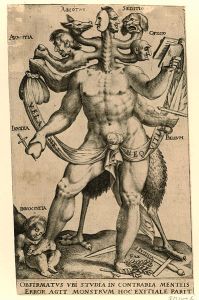
Atlas Obscura is one of those websites where you could spend all day and feel like you’ve just traveled the world. Featuring less know locations, and strange spots that you might like to visit, sometimes it also has stories about monsters. Well, at least one story about monsters. A friend of mine recently shared Cara Giaimo’s story about thirteen lesser-known monsters from history. While none of these are likely to keep you up at night, they do demonstrate the endless imagination people devote to the unknown. Monsters, like religion, defy easy categorization. Is something that’s “too big” or “too small” for its type a monster? Is it a monster if it is a mix of things that don’t normally come together? Or is it merely a matter of baleful intention? What doth a monster make?

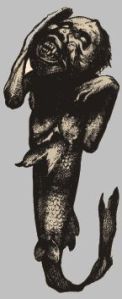
Taking a page (almost literally) from John Ashton’s Curious Creatures in Zoology, the Atlas Obscura page runs down some monsters once believed to have existed. Some of them, despite our flattened world seen only through the eyes of rationality, were actually reported to have existed. The “monster” of Ravenna, for example, was apparently a sad case of a medieval/early modern birth defect that, in the popular imagination took on monstrosity. We now know that birth defects may contain throwbacks to earlier stages of evolution, or that genetic coding may contain mutations. None of this suggests any evil intention on the part of anybody. Accidents of nature may be the saddest kind of monster of all.

Screen Shot 2016-01-27 at 5.42.32 AM

A surprising number of the monsters from Ashton’s sampler here are mixes between human and animal. Indeed, that mix is still a potent force, theologically. One of the loudest voices speaking out against evolution is the one that says people are “not animals.” Having grown up with that belief, it took a couple years of college to convince me that we fit into the greater biological scheme of things. We fear that which resembles us, but is not quite us. Perhaps part of the mystique is that we haven’t quite yet learned to be humane to one another. Being a monster may just have more to do with what one does with prejudices than it does with physical features of their bodies.


Books of 2015

Screen Shot 2015-12-28 at 3.38.16 PM

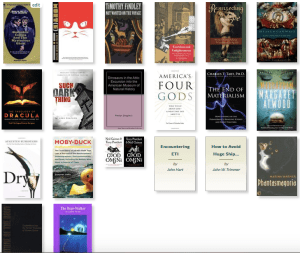
It’s the end of 2015 and looking at my records on Goodreads it looks like I read 100 books this year. That tends to be my goal mark, but after twelve months of reading I like to think back over which were the books that have made the biggest impact on me over the year. Joe Bageant’s Deer Hunting with Jesus remains on the most important list. It is joined by Andrew Newberg’s How God Changes Your Brain, Spencer Wells’ Pandora’s Seed, Alice Dreger’s Galileo’s Middle Finger, and Paul Levy’s Dispelling Wetiko. Bageant, Dreger, and Levy especially address some of the root causes of social ills and even make suggestions about how to address them. Newberg offers advice on how to improve brain functioning and Wells taps into the ever-important issue of care for our planet. I read some good academic titles as well: Diana Walsh Pasulka’s Heaven Can Wait, Darren J. N. Middleton’s Rastifari and the Arts, and Ronald Hutton’s The Triumph of the Moon.

Screen Shot 2015-12-28 at 3.37.33 PM

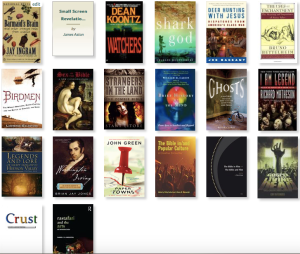
Being a religionist, books with supernatural themes are always of interest. Among these I found intriguing Michael Murphy’s The Future of the Body, David J. Hufford’s The Terror that Comes in the Night, Ardy Sixkiller Clarke’s Encounters with Star People, and Jeannie Banks Thomas’s Putting the Supernatural in Its Place. It seems important to have reasonable people address unconventional issues. These are related to books on monsters, noteworthy among which were: M. Jess Peacock’s Such a Dark Thing, Kim Paffenroth’s Gospel of the Living Dead, Brenda S. Gardenour Walter’s Our Old Monsters, and Lisa Morton’s Ghosts. Long ago I realized that I no longer needed to justify including monsters or the supernatural categorically with religion. They share too many roots to be separated out artificially.

Screen Shot 2015-12-28 at 3.36.54 PM

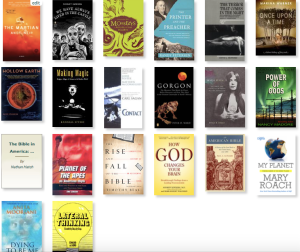
Finally, it was also a year of novels. Pride of place here goes to Robert Repino’s debut, Mort(e). I am compelled to mention Margaret Atwood’s MaddAddam, John Green’s Paper Towns, Shirley Jackson’s We Have Always Lived in the Castle, and Valerie Martin’s The Ghost of the Mary Celeste. Although I’m not much of a fantasy reader, Tod Davies’ The Lizard Princess has stayed with me since reading it. For any of these books you’ll find an individual blog post from this year. That’s not to say that other books I read weren’t good. Nearly every book I post on Goodreads has a write-up here. I tend to like most books I read, although I’m occasionally disappointed when a book does’t reach its full potential. 2015 was a rich year of reading and I’m looking forward to a very literate 2016.

Screen Shot 2015-12-28 at 3.35.38 PM


R’lyeh Reality

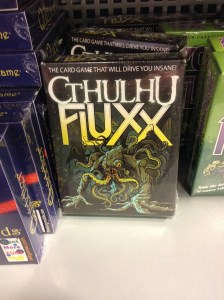
It’s always a sign that I’ve been too busy when I lose track of Cthulhu. Few created deities receive the attention of the web like the terror dreamed up by H. P. Lovecraft. The internet has created an environment, like the bottom of the sea, where the old gods may lie dead but dreaming, ready to reawaken. It was with great pleasure that I was pointed to Cthulhu for America. At last, a presidential candidate who is willing to admit that he is merely a myth. His agenda of destruction and domination is not at all hidden. If only real politicians would be so honest!

In a world with millions of diversions, it amazes me that Lovecraft’s nihilistic creation has taken on such popular interest. Perhaps it’s because those of us who grew up with monsters have now reached a dubious sort of adulthood where we are bossed around like children and given only those limited freedoms that capitalism will allow. We can’t go into public places without seeing heavily armed guards in fatigues. We can’t get into work without electronic chips in cards to keep us safe from those of our own nation. We can’t fly without being scanned like a week-old loaf of bread. We can’t even store our own files on our own personal computers any more since some software company would rather charge us for the privilege. At least Cthulhu says what he wants. Orwell may have had his Big Brother, but Cthulhu is an obvious overlord who wants nothing but his own satisfaction.

IMG_1551

Watching the circus of candidates vying for position, I can’t help but think of Rome before the fall. Historians are still debating the causes—lead poisoning may be too easy a way out. Perhaps it is, as Lord Acton declared, the result of power itself. Those who taste it can’t stop eating it until every microscopic crumb is devoured. It’s shameful to watch. I’m embarrassed when Dumb and Dumber sounds intelligent next to the utterances from political talking heads. Cthulhu would have none of it. Although the website is a parody, it, like all myths, is truer than what we often call reality.