
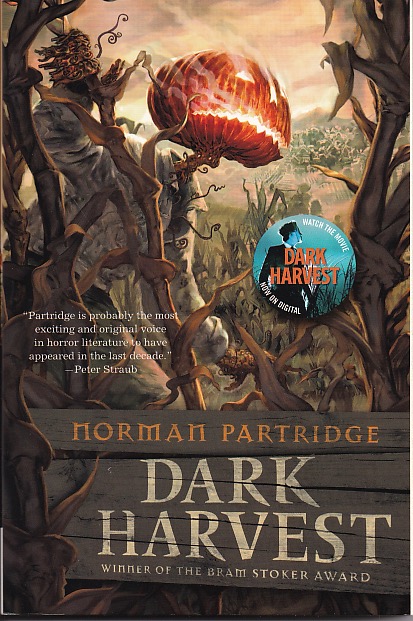
Dark Harvest literally sat atop my literal “to read” pile for almost a year. Norman Partridge’s book came into my possession sometime after Halloween last year but I wanted to wait until, well, harvest season to read it. It’s a very good choice as autumn really begins to settle in. It’s a story with its own world and its own rules. In a small town in a farming community, a dark ritual is kept alive by a powerful group of local citizens. On Halloween night, a specially grown pumpkin atop a crucified scarecrow, comes to life. One of the people from town cuts the scarecrow down, carves it a face, animates it with candy, and hands it a butcher knife. The October Boy, as he’s known, heads to town. Meanwhile, the local boys between 16 and 18 are sent out with makeshift weapons to stop this monster. If it makes it into the church before midnight, serious consequences will follow. The boys, hungry from a week of fasting, prowl the night, looking to be the winner who takes October Boy down. All of this is overseen by the town’s cop. Things can get out of hand on Halloween night.
This is a horror story with heart. I won’t put any spoilers here, but I will say, as in the best of horror, the monster isn’t who you think he is. This elaborate game has taken its toll on the town for generations. This Halloween, however, four people are out to stop it. Supernatural horror that pays off the suspension of disbelief, Dark Harvest is also an emotional tale. It’s a story of loss and one about the high cost of observing convention for convention’s sake. Having the ending set in a church brings religion and horror together nicely. And it also raises some deeper questions for those who care to steer that way. Sacrifice is a major theme in the story.
I’m glad I waited until Halloween season to read this one. A short book, it doesn’t take long to get through. And it presses the right buttons for the season. Partridge is an author who really gets what the autumnal setting can do for a horror story. I enjoy good horror set in winter or summer as well. (Okay, so spring too.) There is, however, something special about novels that engage seriously with harvest time. Harvest has always had a deep symbolic value that’s often overlooked in what is, inherently, a spooky period. I really appreciated the author’s afterword as well. I’m glad I waited for the right season.

