Eating Sin

Although a good example of religion and horror, and a member of Holy Sequel, The Order isn’t a great movie.  For a plot that delves into Catholicism, it doesn’t have a great understanding of religion.  It misuses the term “theosophy,” to boot.  So, Fr. Alex is a Carolingian priest, one of two remaining.  He says the mass in Latin with his back to the congregation.  Then he’s sent to Rome by a corrupt Cardinal to investigate the suicide of his mentor.  Before setting off for Italy he invites his last fellow Carolingian, Fr. Thomas, to come.  A woman who escaped a mental institution after shooting him during an exorcism also comes.  Once the investigation begins, Fr. Alex determines a sin-eater killed his mentor.  The Cardinal gives him a special, ritual knife that is needed to kill the sin-eater.  His associate, Fr. Thomas, knows how to get underground Catholic knowledge leading to said sin-eater.
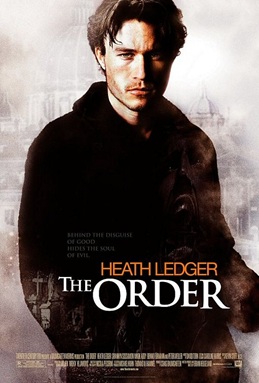
The sin-eater convinces Fr. Alex to seek what he wants.  The priest wants the girl who tried to kill him, so he renounces his vows to sleep with her.  The sin-eater wants to die—he’s been at this for five centuries and is weary.  He attacks the girl, making it look like suicide, so Alex has to eat her sin to get her to Heaven.  He then kills the sin-eater.  The corrupt Cardinal had made a deal with said, dead sin-eater, that if he arranged for the sin-eater’s release, he’d become Pope.  Alex, who has now taken over as the sin-eater, foils this plan and decides to use his now power for just causes.

All fairly convoluted.  Of course, the sin-eater idea would be picked up a few years later in the Fox series Sleepy Hollow.  That’s where I was first exposed to the concept.  A sin-eater is a folkloric concept going back at least to the seventeenth century, mainly in the British Isles.  It has been under-explored by academics (it has “history of religions thesis topic” written all over it).  It’s an interesting idea but isn’t handled well in this movie.  There’s the trope of esoteric Catholicism at play, and interestingly, The Da Vinci Code came out that same year.  Dan Brown’s novel played into the Zeitgeist regarding things the Catholic Church didn’t want laypeople to know (supposedly).  The novel sold an obscene amount of copies.  For all that, we’re no closer to learning the actual history of sin-eaters.  Thesis topic calling!

What You Eat

The future of Sleepy Hollow is uncertain. The successful FOX television program has suffered the slings and arrows of outrageous scheduling over the past year and speculation abounds that the current fourth season may be its last. It has been, in my experience anyway, one of the most literate supernatural horror shows ever. Books and reading abound and an interracial team fights evil week after week. Having done some research on the first season of the program, I continue to be surprised just how detailed the homework of the writers is. My wife sent me a story from Atlas Obscura on the “sin eater.” This is a term, I readily confess, that I never heard before the introduction of Henry Parrish to Sleepy Hollow. Ichabod Crane, guilty over the death of a freed African American freedom fighter, ingests poison to kill himself and severe his connection to the Headless Horseman. Abbie Mills, believing there is another way, locates the sin eater.

The idea is fairly simple, if unorthodox. A sin eater can literally devour the sins of another. In Sleepy Hollow this comes at a considerable cost, but the article by Natalie Zarrelli demonstrates that this too reflects research on the subject. There were, it turns out, sin eaters in the early modern British Isles. Often a poor person with no other options, a sin eater would consume bread placed on the chest of the deceased, incorporating, in an almost Christ-like way, the sins of the recently passed. The dead could then be safely buried, forgiven, while for a pittance a poor soul could walk around with someone else’s sins in his or her body. Sounds like capitalism writ large, to me.

Watching Sleepy Hollow I had assumed this idea was invented for the show. Like so many details, however, it turns out that some digging had brought an obscure historical practice to the surface. Sin eating, as the article makes clear, was never sanctioned by the church. People have often worried that official religion might not deliver the salvation it so readily promised, bound up with rules and rites as it was. Here was a sacrament of the people. Bread could be visibly consumed and symbolically, or literally, sin with it. The sin eater was paid, making this a legal transaction. Although sin eating is thought to have died out, it seems that with the recent, high-level resurgence of evil-doing, perhaps it is a practice that should be recalled. In many ways Sleepy Hollow has been ahead of the times since the beginning.

IMG_1960_2