Picking on Poltergeist

It’s not nice to pick on the elderly, I know, but Poltergeist is one movie where I disagree with the critics.  One of my “old movies,” I saw it sometime back in the eighties and although there were scary scenes, it felt rather lackluster to me.  That doesn’t mean that I haven’t watched it several times, of course.  As one of the horror films that my wife will see with me, we pulled it out this October and it just felt silly to me.  Part of the reason is that it doesn’t seem to have the style of either Steven Spielberg or Tobe Hooper.  The story is a bit too protracted and apart from the over-the-top ending it’s not clear what the “poltergeists” are.  I’m probably forgetting what it was like to see it in the eighties when it was new and fresh.
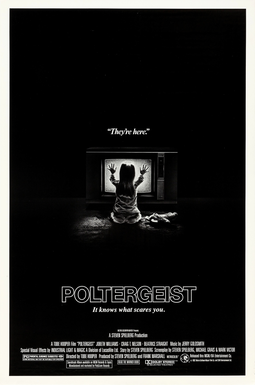
Or maybe it’s just that far scarier movies have come out since then.  Reading about it afterwards, it was strange to see how highly rated Poltergeist is among critics.  For me, the problem  was partially the illogic of parts of it.  A tree tries to eat a kid and the authorities aren’t called?  The neighbors didn’t see anything.  If the whole development was built on a graveyard, why does only one house show it?  And after many years have passed?  Naturally, the movie does have some classic moments.  When Marty (who is a rather silly character, along the lines of scientists in a John Carpenter film) pulls off his face, that was shocking the first time.  And Zelda Rubenstein does a great job as the psychic.  Much of the rest of it doesn’t make sense.  Why decide to stay that last night, given what’s happened before?  Of course, without that night there’s no climax.

The fault must be my own.  Or maybe it’s just that I’ve seen enough movies now that the input of two directors with different visions seems to’ve pulled the film in too many directions.  It feels much more like a Spielberg movie than it does a Hooper film.  Where’s the Texas Chainsaw Massacre (also an old movie) subtlety and social commentary?  Of course, Hooper’s next film was Lifeforce, which, although fun to watch, also seems not to know where it wants to go.  I know that Poltergeist was a formative movie in the horror genre.  It was a big budget success.  Perhaps the relative dearth of religious explanation hurts it.  There’s plenty of talk of when happens when we die, but it doesn’t have the backing of the conviction of a Fr. Merrin or even (God help us!) Ed and Lorraine Warren.  Or maybe I need to let go and just watch it for fun.

Not Full

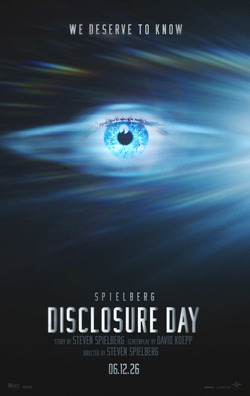
Disclosure Day may not be Steven Spielberg’s best movie, but it is a good one.  Part of his space trilogy after Close Encounters and E.T., it too comes back the the theme of aliens and posits what it might be like if those holding the secrets ever release them.  Although not a horror film, it makes use of the Bible—not surprisingly since real-life discussions about disclosure often ask about its effects on religion.  In the movie, the Wardex Corporation, part of the military-industrial complex, is the keeper of the secrets.  They reverse-engineer alien technology, and get to keep what’s found from recovered UAP wrecks.  More powerful than the police, they stop and kill without compunction.  They control the highest level of secrets that the government has—even those beyond the president.  (Spielberg clearly did his homework here, even working in the bit about Jackie Gleason making the claim to have seen alien bodies.)

A couple of Wardex employees, Hugo and Daniel, smuggle out the video proof of the nearly eight-decade cover-up and they plan to release everything to the media.  A weather reporter, Margaret, sudden becomes psychic and receives an alien message while on air.  Wardex has kidnapped and roughed up Daniel’s girlfriend, former novice nun Jane, to force him to return the stolen data.  (Religion plays a big role here.)  Noah, the head of Wardex, uses advanced technology to track Daniel, Jane, and Margaret, as they are trying to meet up.  When Margaret and Daniel finally do connect, Hugo reveals that they’re both “experiencers”—they’d been abducted as children and had been given extraordinary gifts.  Margaret’s abilities are such that she can break into and walk out of a secure military base with Daniel in tow.  As they prepare to show the evidence at Margaret’s Kansas City news station, Wardex shuts them down but Jane delivers a device that allows the broadcast to take place.  The world, which is on the brink of Armageddon—World War Three—stops to listen and begins to realize that we need to work together to save the human race.  

The plot is a bit complex to summarize fully, but this gives the general picture.  Disclosure Day is a hopeful movie.  The theme has been addressed by proponents of real life disclosure before: sharing this kind of information might well save us.  And the religious community, represented by Jane’s former monastery, is perfectly okay with this development.  There’s a lot to say about such a film, and I try to constrain my word counts here.  It’s the kind of movie that grows better with reflection—the writing is a bit trite in places—and the alien tech is a bit hard to believe.  Of course, we don’t know what off-world tech can really do.  But at the end of the day, religion plays a major role in the truth being revealed.  Worth thinking about.