
Although a good example of religion and horror, and a member of Holy Sequel, The Order isn’t a great movie. For a plot that delves into Catholicism, it doesn’t have a great understanding of religion. It misuses the term “theosophy,” to boot. So, Fr. Alex is a Carolingian priest, one of two remaining. He says the mass in Latin with his back to the congregation. Then he’s sent to Rome by a corrupt Cardinal to investigate the suicide of his mentor. Before setting off for Italy he invites his last fellow Carolingian, Fr. Thomas, to come. A woman who escaped a mental institution after shooting him during an exorcism also comes. Once the investigation begins, Fr. Alex determines a sin-eater killed his mentor. The Cardinal gives him a special, ritual knife that is needed to kill the sin-eater. His associate, Fr. Thomas, knows how to get underground Catholic knowledge leading to said sin-eater.
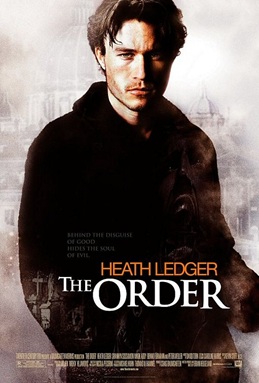
The sin-eater convinces Fr. Alex to seek what he wants. The priest wants the girl who tried to kill him, so he renounces his vows to sleep with her. The sin-eater wants to die—he’s been at this for five centuries and is weary. He attacks the girl, making it look like suicide, so Alex has to eat her sin to get her to Heaven. He then kills the sin-eater. The corrupt Cardinal had made a deal with said, dead sin-eater, that if he arranged for the sin-eater’s release, he’d become Pope. Alex, who has now taken over as the sin-eater, foils this plan and decides to use his now power for just causes.
All fairly convoluted. Of course, the sin-eater idea would be picked up a few years later in the Fox series Sleepy Hollow. That’s where I was first exposed to the concept. A sin-eater is a folkloric concept going back at least to the seventeenth century, mainly in the British Isles. It has been under-explored by academics (it has “history of religions thesis topic” written all over it). It’s an interesting idea but isn’t handled well in this movie. There’s the trope of esoteric Catholicism at play, and interestingly, The Da Vinci Code came out that same year. Dan Brown’s novel played into the Zeitgeist regarding things the Catholic Church didn’t want laypeople to know (supposedly). The novel sold an obscene amount of copies. For all that, we’re no closer to learning the actual history of sin-eaters. Thesis topic calling!

