Eyes Meet

Although the category of “least concern” for extinction is applied to the pileated woodpecker, they are nevertheless astonishing birds.  I’ve seen them a number of times and their large size can be breath-taking.  Their bright red crests make them hard to miss, but many people rarely see them.  I’ve noted before how our rotting wooden fence attracts carpenter bees, and therefore woodpeckers.  Two years ago when I went outside to investigate a tapping—or was it a rapping?—I startled a pileated woodpecker on our fence and for a moment the two of us looked each other directly in the eye.  I saw a dinosaur in that bird.  What really stuck with me, though, was the connection between two beings who look into each other’s pupils.  Scientists tend to tell us that we’re all nothing but atoms, but looking into any other creature’s eyes belies that.

Not my backyard, and not a good enough zoom lens…

When I’m out jogging I find that you can get fairly close to an animal if you don’t look it directly in the eye.  When you make eye contact they take off.  Scientists will use the ultimate fudge factor of “instinct” to explain this, but I think there’s more than that going on.  If you doubt this, I have an experiment for you.  Find someone you love and/or trust completely.  Sit and intentionally stare into each other’s pupils.  See how long your can hold that gaze.  It’s difficult.  We keep our secrets in our heads and we try to avoid eye contact with those with whom we’re not entirely comfortable.  Even with those we love it’s tricky.  We even have the phrase “eye contact.”  Think about that.  When we really look into another’s eyes, what is really going on?  Is there any way to know?  

We have all experienced the sensation of being stared at.  It’s very real, despite what scientists tell us.  In many cultures it’s understood to be rude to stare at someone.  We are a profoundly visual species.  We don’t ascribe the same intimacy to being listened to, for example (except at certain private times).  We fairly easily shut out many sounds on a regular basis.  Even though we’re social creatures, tasting, smelling, and touching others isn’t a normal part of the day for many of us.  But we sure know when somebody looks at us unduly.  And other creatures respond in similar ways.  The other day I jogged very near a deer—almost close enough to touch—because its head was hidden behind a low branch full of leaves.  We couldn’t see each other’s eyes and therefore it was unafraid.  I still remember that woodpecker’s dinosaur eyes, and it flew off immediately after our eyes met.
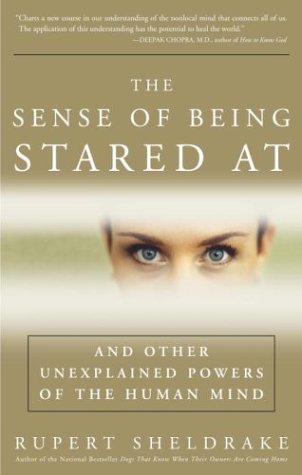

Sacred Gaze

SenseofBeingStaredAt Rupert Sheldrake raises the ire of some of his fellow scientists. Science has increasingly allied itself with a strict kind of materialism, although, as Sheldrake repeatedly points out, evidence for such absolute materialism is lacking. This is not to challenge science, but simply to note that we may not yet have all of the data. The Sense of Being Stared At considers possible scientific explanations for unconventional situations we all experience from time to time. Who hasn’t felt eyes on them and turned around to find somebody looking? A number of other “impossible” scenarios also find their way into this intriguing book. Sheldrake suggests that such phenomena can start to be explained scientifically if we allow that the mind is not the same thing as the brain. Sure beats a Christmas party with B. F. Skinner, where every present is inevitable.

Materialism feels threatened when spooky action at a distance occurs. As Sheldrake points out, however, we are willing enough to accept it if an invisible “field,” one that we can’t even feel, is posited. Take magnetism, for example. Few people doubt that magnetism is a real force. We’ve never actually seen it, but its effects are clearly visible. Taking this as a starting point, Sheldrake suggests that various psi phenomena involve such fields. The scientific studies that have been undertaken on many of these “spooky” scenarios show statistically that chance may be safely ruled out. And, if the experience of many ordinary people counts for anything, even our pets and other animals may possess minds.

Ironically, the mind (with its taint of being associated with religious concepts such as the soul) is one of the most contentious phenomena in science. Many materialists deny its existence, suggesting it is merely some epiphenomenon of our brains’ electro-chemical processes. Yet these scientists still, one presumes, insist on being treated with respect and being paid for their work, although these mere trifles are just odds and sods clinging to the edges of a materialistic abyss. To me, work like that of Rupert Sheldrake is crucial for an honest assessment of the evidence. Maybe not everyone accepts that dogs know when their “owners” are coming home, and maybe Sheldrake’s morphic fields have yet to be confirmed, be it is clear, when all the evidence is considered, these phenomena do actually happen on occasion. Instead of simply dismissing something because it shouldn’t be, or can’t be, according to materialism, why do we find accepting the evidence so frightening? Is it perhaps the fear of being watched?