
Yesterday I ran across a graphic on the Awilum blog that juxtaposed the tower of Babel with the Burj Dubai, the world’s tallest structure, to be completed next month. Perhaps it is a “guy thing,” but I can’t stop being fascinated by very tall buildings. An inveterate acrophobe, I avoided New York City until I was in my twenties and I was gritting my teeth the entire visit the first time I went to the top of the Empire State Building. Although they frighten me, I can not keep away from them. Driving through Chicago while living in the Midwest, I always kept a wary eye on the Sears Tower, lest it should fall my way. When the Society of Biblical Literature met in Toronto, I braved the CN Tower and even stood on one of the thick glass plates that give a bird’s eye view of the ground far, far below. Now there is an even taller building that fully deserves the name “sky-scraper.” At 818 meters, the Burj Dubai in the United Arab Emirates soars far beyond other efforts at the ultimate masculinity. It will be nearly twice as high as the Empire State Building when it is completed.
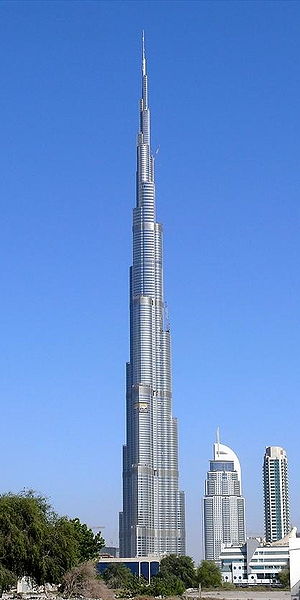
Gnu view from Wikipedia
Joseph Campbell, the late mythographer from Sarah Lawrence College, has had an enormous impact on the study of myth. As a specialist in Ugaritic mythology I find many points of disagreement with his assessment of mythic symbiosis, yet he once said something that has stayed with me ever since. In his Power of Myth video, he states that societies show their values by their tallest buildings. This statement is perfectly justifiable — the amount of resources required to erect enormous buildings does show a dedication to a quasi-divine purpose on the part of a society. Campbell’s example was the medieval cathedrals, and for anyone who has visited a medieval town this is easily affirmed. (St. Vitas Cathedral in Prague and St. Andrews Cathedral in Scotland confirmed this for me.)
The Hebrew Bible, however, casts another view on tall structures. Buildings such as the Tower of Babel are the ultimate in a Judaic assessment of hubris. Genesis 11 makes short work of Babel, stating that God has to stoop down to see this great effort, yet he feels threatened by it nevertheless. Our towers today demonstrate our conspicuous consumption, yet I can’t help but be impressed. Where some see only shifting sand atop endless pools of petroleum, other visionaries see the tallest structure on the planet. Just thinking about it, I find myself clenching again. I don’t plan a visit there anytime soon, but it is in the neighborhood of Babel, for those who speak the language.
 Steve A. Wiggins
6 thoughts on “Towers of Babel”