A Sigh for Cybele

As we fall out of the holiday season into that distinctly chilly and sometimes cheerless February, Cybele comes to mind. Over the past several weeks I have added posts focused on the holidays associated with December and January. In the course of my research for a children’s book on American holidays (not published), I was astonished at how frequently Cybele appeared among the origins of current holiday practices. Having researched ancient Near Eastern mythology long enough to complete a doctorate in the field, and to write a book on an ancient goddess (Asherah), the lack of reference to Cybele in my sources was unexpected. I pushed this question mark to the back of my mind, but as I was reading H. P. Lovecraft’s story “The Rats in the Walls,” I found Cybele once again.

Cybele eventually became a major Roman goddess, although she was never among the Greek Olympians. Her importance shows in her connections with several Roman festivals and practices of antiquity, some of which have survived even to the present. Greco-Roman adherents to Cybele worship considered her to have been of Phrygian origin. Many scholars, however, see in her name and character echoes of a Semitic goddess named after Gebal, or the native name for Byblos in Phoenicia. If so, she is one further piece of the puzzle connecting the classical world with that of the fertile crescent.
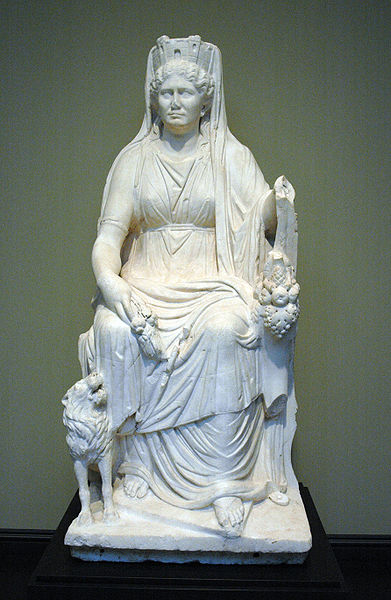
Wikipedia Commons Cybele

A standard title for Cybele was Magna Mater, or “great mother.” As such, she was frequently associated with the earth itself, widely considered to have been a primordial female deity in the ancient Near East. In many respects she resembles Asherah, although the two are never explicitly identified. In myths where she is associated with Atys (later Attis), she becomes the spouse of a “dying and rising god.” She is prominent in festivals around mid-March, at the time of the renewal of fertility in the Mediterranean basin. Matronly, stolid, and powerful, Cybele lurks in the background of religious sensibilities. Her association with spring offers something to look forward to as the overly long, yet short, month of February starts to become visible.

One thought on “A Sigh for Cybele

  1. Lucia Adams

    Hi I really enjoyed reading through your articles. The mother goddess is everywhere – my religious take on it is this:
    After the desecration of God’s Creation by satan, God turns away from Man. His wife is unable to comprehend them now thrown into a life without all the mercies that were previously bestowed on Adam and Eve; she ventures out to teach them how to care for themselves. It takes years and years, and she teaches them different ways of reaching God, constantly trying to make an impression on Him. Eventually it seems like she convinces Him to take at least one nation and try to make them follow Him; the Jews. At this time The Holy Couple start travelling Israel, but she finds that now that He has “come ‘round” they need to shift the focus on Him, as she is the one worshipped. The heavy-handedness of her destruction in Israel is then vetted, and He becomes the Object of Praise. I think that much of Asherah is lost in the hidden depths of religion and what is deemed appropriate for Jews and Christians is not that God could be so like them, that He would have the desire to have a wife. But the thought of Yahweh having His Asherah always makes me smile.

    Like

Leave a reply to Lucia Adams Cancel reply

This site uses Akismet to reduce spam. Learn how your comment data is processed.