Aye, Robot

Being a “biblical scholar,” having an interest in robots might seem counter-intuitive. I was intrigued by the topic as a youngster, but convinced that if what the Bible said was true it deserved nothing less than full attention, I let my formal study of science lapse (although I kept an active reading life on it). Now, through the interest of my daughter, I have found myself mentoring budding young engineers, mostly by helping put things away and correcting grammar. Yesterday we took our robots outside for the local street fair. Almost always the response we get from local people is “Robots? Our school has robots?” Well, partly correct. The schools house the robots, but our robotics club is largely self-funded, so the robots might be said to belong to the team rather than the school. In any case, yesterday the robots played soccer in the street for the amusement of festive fair-goers.

People often fear “soulless machines.” They run by predetermined rules, set down explicitly in computer code, and do only what they are programmed to do. Some fear artificial intelligence for this very reason: what if robots or computers are programmed to think? Does this make them something more than physical machines? The standard, religiously biased, answer is that the soul, or even mind, is a uniquely human possession. Animals may act on instinct, some may qualify as having a limited mind, but definitely not souls. That would simply cross too many boundaries. When asked to produce a human soul for scientific scrutiny all religions come up blank. We don’t actually know what a soul might be – an everliving component that God might throw into Hell or spoil in Heaven seems to be the general gist. And it makes our moral choices for us.

In the Bible if any animal (say a bull) gores a person to death, and that bull had a prior reputation, not only beast but master could be put to death. It seems that the bull has a bad moral intention. If robots hurt people, in violation of Asimov’s first law of robotics, they are treated as acting with moral intention. We project souls onto them for the convenience of condemnation. If an animal, such as a zoo gorilla, saves a human child, that animal receives the treatment of a souled being for a while, until the act is forgotten. It seems that souls are immaterial components of a closed system used to reward or punish an individual. How much of themselves do humans have to put into their robots before they can have souls as well?
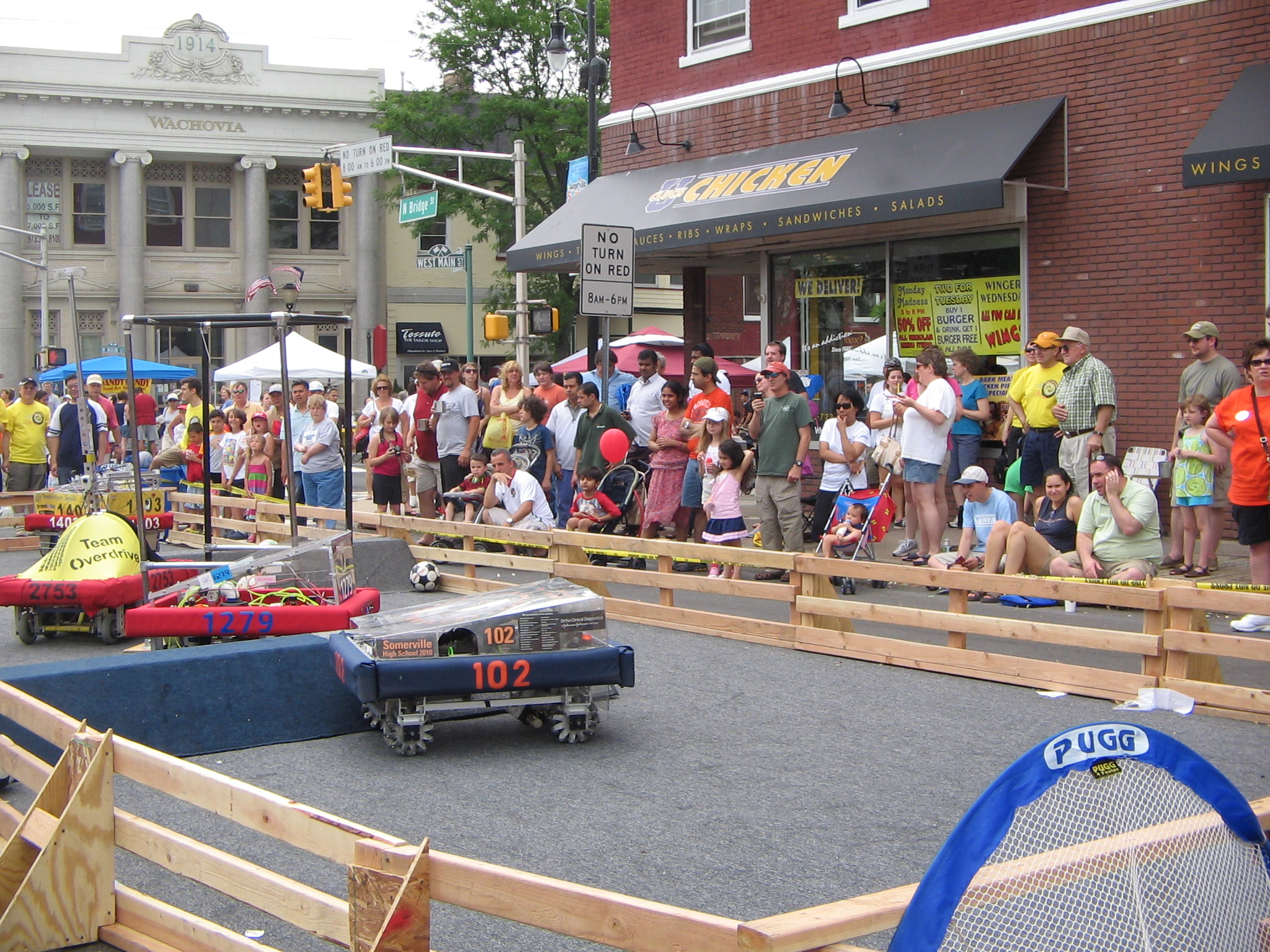
Robots among the people

4 thoughts on “Aye, Robot

  1. Jonathan

    1. Our three year old daughter has a pink marionette bird that she loves as much as if it were alive. She knows darn well that I’m pulling the strings, but she talks to it, gives it hugs, and insists that it sleep in a nest beside her bed. We treat ‘Pinky’ like a real live critter, even though he clearly doesn’t have a soul, and she knows it’s not even alive.

    2. I also have one of the original model ‘Robo Sapiens’ that were in the stores at Christmas time. It’s essentially a remote-control car that I can program a few more complex commands into, but it looks like a person. Right now it lives on a shelf unused because of how clumsy and useless it is at most simple tasks. When it comes down, the Toddler knows that I’m the one making it work. If I were prepared to argue that it has a soul, it’s no more complex of a soul then Pinky — only what I put into it.

    3. Our Roomba vacuum cleaner is much more sophisticated. It figures out where all the obstacles in a room are through its own senses. It only relies on me for routine maintenance (cleaning the brushes and emptying the bin) and charging. Someone brighter than me has programmed the thing, but it’s still the same principle as 1 and 2 above. However, despite rationally knowing better, we still treat it more like a pet than a tool. It’s less anthropomorphic than the other two, so I have to add a LEGO cockpit for a minifig driver. For all that, it will sometimes do stupid things, get caught in narrow corners, and cry for help.

    4. We recently watched YouTube clips of the BigDog robot, watched it scrabble for better footing on an icy parking lot. Still the same principle; far more sophisticated programming, but behind the scenes, there’s a person pulling the strings through lines of code. I’m not sure that the Toddler understands that it’s not alive, though.

    5. My home computer could certainly run the Roomba software, and possibly with the right upgrades, even the BigDog software. But it’s just a featureless white box on a desk with a screen. If there is such a thing as a silicon soul (with different levels of complexity) does looking human (or even cute) affect the judging of souls? What happens to the soul of the computer I threw on the scrap heap, or the myriads of tortured Tickle Me Elmos?

    Like

      • Jonathan

        And if a desktop computer running the robot’s firmware without controlling an actual robot is a disembodied silicon ‘soul’, does clicking ‘Force Quit’ amount to appicide?

        Like

        • Henk van der Gaast

          Classic post and responses.

          Should be featured in a classic list on Wiggins net!

          I am sure dear old Isaac would have had his humour lifted reading you two.

          Like

Leave a comment

This site uses Akismet to reduce spam. Learn how your comment data is processed.