
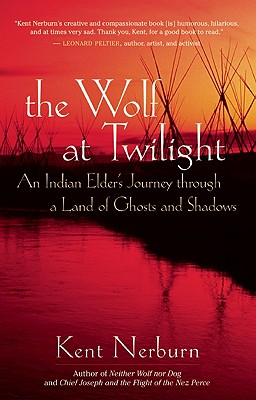
Last week I finished reading The Wolf at Twilight by Kent Nerburn. To be transparent here, I’d picked up the book at a Borders’ closing sale based largely on the subtitle: An Indian Elder’s Journey through a Land of Ghosts and Shadows. It sounded like a good book for autumnal reading. The first chill breezes of fall swept through Manhattan last week, and I curled up with the book on the bus. I’m not sure what I expected, but what I found was nothing short of epiphanic. Those of us who’ve spent long years in religious studies, no matter what specific branch, know of the deeply spiritual writings of Native Americans. Black Elk Speaks is a classic often required in Religion 101 and it is still as potent today as it was back when first penned. The danger, which Nerburn clearly states, is in assuming a mystical kind of stereotype for a very real people who have continually been—and still are—hidden away as an embarrassment of the United States’ melting pot image.
The Wolf at Twilight is a follow-up to Nerburn’s Neither Wolf nor Dog, a book that I have not read. In that original narrative, Nerburn describes his encounters with “Dan,” a Native American, Lakota elder. The Wolf at Twilight is the story of how Dan finds closure in locating the resting place of his sister, from whom he was separated at childhood. The journey, spiritual though it may be, is a wrenching one. Speaking from my experience, many children grow up in America learning only cursory pieces of the large and tragic mosaic of how the Native Americans were treated by own government. The story of Dan is one of clashing worldviews where any system that stands against the ideal of private ownership—sadly embodied in the Christian settlers of this nation—is inevitably shredded, and, if embarrassing enough, hidden from future generations. Our ancestors did a great disservice to our fellow human beings, in the name of religion. Manifest destiny had an overly healthy dose of the divine right of Christians in it. An idea poisonous to anyone who might challenge the concept of personal gain.
As a neophyte in this field of reading, I was sickened by much of what I read here. It will take more than a single post to outline some of the more poignant inconsistencies between Christian practice and preaching perpetrated upon those who were here before us. A people forcefully converted to a religion that was openly oppressive to them reveals the dark underbelly of missionary zeal and the truth of the evils religion can hide. Or even justify. Often Dan decries the religion that believes all the answers are in a black book. What was done to his own family in the name of Christianity led to several restless nights for this reader. Kent Nerburn writes with the conviction of a man haunted by an experience of rough reconciliation. From the title, I had expected maybe werewolves or specters to roam this book, but instead what I found was much more terrifying. It was the naked lust for personal gain—a monster that no crucifix or prayer ribbon can ever banish or dispel.
 Steve A. Wiggins
4 thoughts on “Who Are the Wolves?”