The Price of Religion

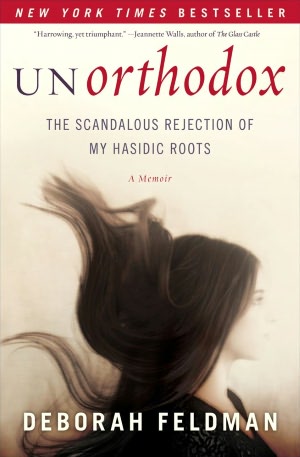
Gender is a religious construct as much as a biological one. The study of religion has brought me face-to-face with the reality that religion appeals to many women and to those who would manipulate them. Lately I’ve taken to reading the memoirs of women who’ve discovered the abuse their faith has doled out to them and who’ve taken moves to reclaim their lives. This past week I read Deborah Feldman’s Unorthodox: The Scandalous Rejection of My Hasidic Roots. As someone who has spent much of his life reading and re-reading the Hebrew Bible that gave fuel to the Mishnah that gave fuel to the Talmud that gave fuel to the Hasidic movement, I found Feldman’s narrative gripping. Some branches of Judaism, like some branches of Christianity, try hard to separate themselves from society. Their cloistered lives become secretive, and often by the standards of secular culture, incomprehensible. While reading this wrenching account of sexual domination, I kept wondering why Feldman didn’t try to escape. At the same time I already knew the answer.

I was raised by a religious mother who found her faith both a source of rules and a source of comfort. Unaware that religion can be a trap, women are frequently its victims. In a society that still refuses to give females equal opportunity for earning a living, is it any wonder that religions offer alternative routes that equally entrap? How do you appeal to a higher power when that higher power is, by biblical definition, male? Who will help you out when the largest religious structures in the world are male constructs? Yes, lately some religions have opened themselves to female leadership, but almost always at the cost of splitting off of factions that claim seniority and sanction from the beginning, when, they claim, only men ran this show. Deborah Feldman was trapped in a religion where her life, down to her hair and clothes and reading, was programmed by male expectations. In this continuum between religions we find the same progression in a series of degrees where men make the rules.

Many who read Unorthodox, I suspect, will see it as a condemnation of Hasidic Judaism. It is not. As Feldman makes clear, she has retained her Jewish identity, but she has let it evolve into a place where she is finally free to express herself. Gazing over the religious landscape, I see this as a place that many women find themselves. The very religions that had formerly held them down, however, continue to be male preserves. Even if women may join the club of bishops, clergy, or rabbinate, they do so with the constant reminder that they are only invited guests in what was once a masculine world. The world of men never voluntarily relinquishes its grip. As long as people are considered in the image of God they will always be by default male and female only as an afterthought. To conceive it any other way would be very unorthodox indeed.

18 thoughts on “The Price of Religion

  1. Karen Loewen

    It’s always interesting to hear your perspective. You’re a virtual member of our Book club, which is thus far an exclusive women’s group!

    Like

  2. Shelly Davis

    I was with you all the way to this point: “As long as people are considered in the image of God they will always be by default male and female only as an afterthought. To conceive it any other way would be very unorthodox indeed.” For starters, orthodoxy itself is a male construct that serves to establish and reinforce male definitions, power and authority. Perhaps that is why, as a female, I have little use for it. And, as patriarchal as the Hebrew Bible is, (and the New Testament too, for those of us who consider ourselves Christian), we do have the first creation story in Genesis that suggests God creates human beings (in Hebrew “earth creatures”) in God’s image, . . . male and female. This story does not say only males are created in God’s image. And, in this creation story, there is no ordering of the creation of humanity with either male or female coming first and the other as an afterthought. Simply because these ancient texts were created and transmitted, and for centuries, only commented on or interpreted primarily, by men steeped in patriarchal cultures does not mean that God is male. God, by definition, transcends all that is human, and that most definitely includes gender.

    Like

    • Steve Wiggins

      Thanks, Shelly. Our views are not far apart. As you no doubt know, I have little use for orthodoxy either as it is a human (and male) construct. I did not intend to imply that only males are in God’s image, but only that from an orthodox point of view it is often presented so. I appreciate the comments!

      Like

  3. Hi Steve. Thanks for the book review. I will definitely check out Unorthodox. Though not Jewish, I also had an upbringing in which everything about my life was programmed by male expectations, right down to whether or not I should be taught to throw a baseball. Breaking away and developing my own identity was no small task. I look forward to reading about Deborah’s experience.

    Like

  4. As critical as Ms Feldman is of her Hasidic upbringing, anyone who thinks that women who continue to live very happy lives in the Hasidic community are the exception to the rule and not the rule, is drinking Ms Feldmans Kool Aid. Hasidic women have clearly defined roles, but so do Hugh Hefner’s female housemates. The Hasidic women’s relationships and families are way more rewarding, long lasting, stable and productive though. Modern society’s myth that there are no clearly defined roles, behavior patterns and sex specific expectations in male/female relationships is another form of Kool Aid being imbibed by many.

    High numbers of highly successful childless women who made the feminist mistake of choosing career over family, regret it dearly at the end of their days. Highly intelligent elderly Hasidic women regret absolutely nothing. They are of the most satisfied women I know.

    Ms Feldmans brothers and sisters in theory, the 1% of the community who choose to leave, are just that, 1%, and have been 1% throughout history. Her book doesn’t focus on anything new. Just the 1% same old, same old, who are the noisy drop in the bucket.

    A non Hasidic Admirer of Hasids

    Like

    • Steve Wiggins

      Thank you for your perspective. My point, of course, is that women are often marginalized by their own religion, whether Hasidic, Catholic, Baptist, or Muslim (or any other variety of faith). I am always wondering what the other 99% are thinking, although the world will never know.

      Like

  5. nsfd

    @Incomplete Data
    How do you know it’s only 1% of the people who think that way? You think it’s only 1% because indeed you don’t here from them. And why don’t you hear from them, because they fear they have too much to loose by speaking out. The ones you claim are the ‘noisy drop in the bucket’ are the courageous ones. Trust me there are many more people out there who feel trapped in their religion, and as Steve says the world will probably never hear from them…

    Like

  6. “although the world will never know”

    We cant ever assume the total truthfulness of anything written for public consumption or not. Writers from all backgrounds dont always offer their true opinions and feelings, and publishing houses modify to what will sell. Motives, motives, motives.

    We can only guess about degree of truthfulness of the spoken and written word, and usually theorize to match what fits our needs best.

    Like

  7. Phill

    People reading Ms Feldman’s book are being trapped into thinking that Hasidic life is a cult which dominates its members and degrades women.Off course that is all false as are many other stuff she wrote proven to be lies. For the secular world its an interesting read it opens a window into religious Jewish life.But in reality she over exaggerates and in some cases simply lied in order to make it more interesting.How Simon and Schuster sunk so low publishing it is beyond me.

    Like

    • Steve Wiggins

      Thanks for weighing in, Phill. I consider no religion to be a cult, however; I have never yet found one that treats women equally with men either.

      Like

    • Steve Wiggins

      Yes, Incomplete, true equality may not be achieved but if the creator is just we must try to establish equality as best we can.

      Like

Leave a comment

This site uses Akismet to reduce spam. Learn how your comment data is processed.