
In the on-going loss of touch between academia and the world outside, we forever hear of the triumphal march of secularism. Academics are often loath to see the habits of the laity as being of much significance. In the book industry, however, publishers have to pay attention to what the public reads. This is one reason, I’m discovering, that some academics find it difficult to publish. Some research topics just don’t reach the wider readership’s interest. It’s an editor’s job to try to match readers with books. Among the tools we use are magazines such as Publisher’s Weekly and the Library Journal. Although it is impossible to say what people are actually reading, these periodicals trace buying and checking-out habits. And it doesn’t take a genius to see that books somehow tied to religion are frequently at the top of the list. One of the great industry trackers, Bowker, even has three distinct databases for book sales: children’s, academic, and Christian. Religion, in other words, is of tremendous interest.
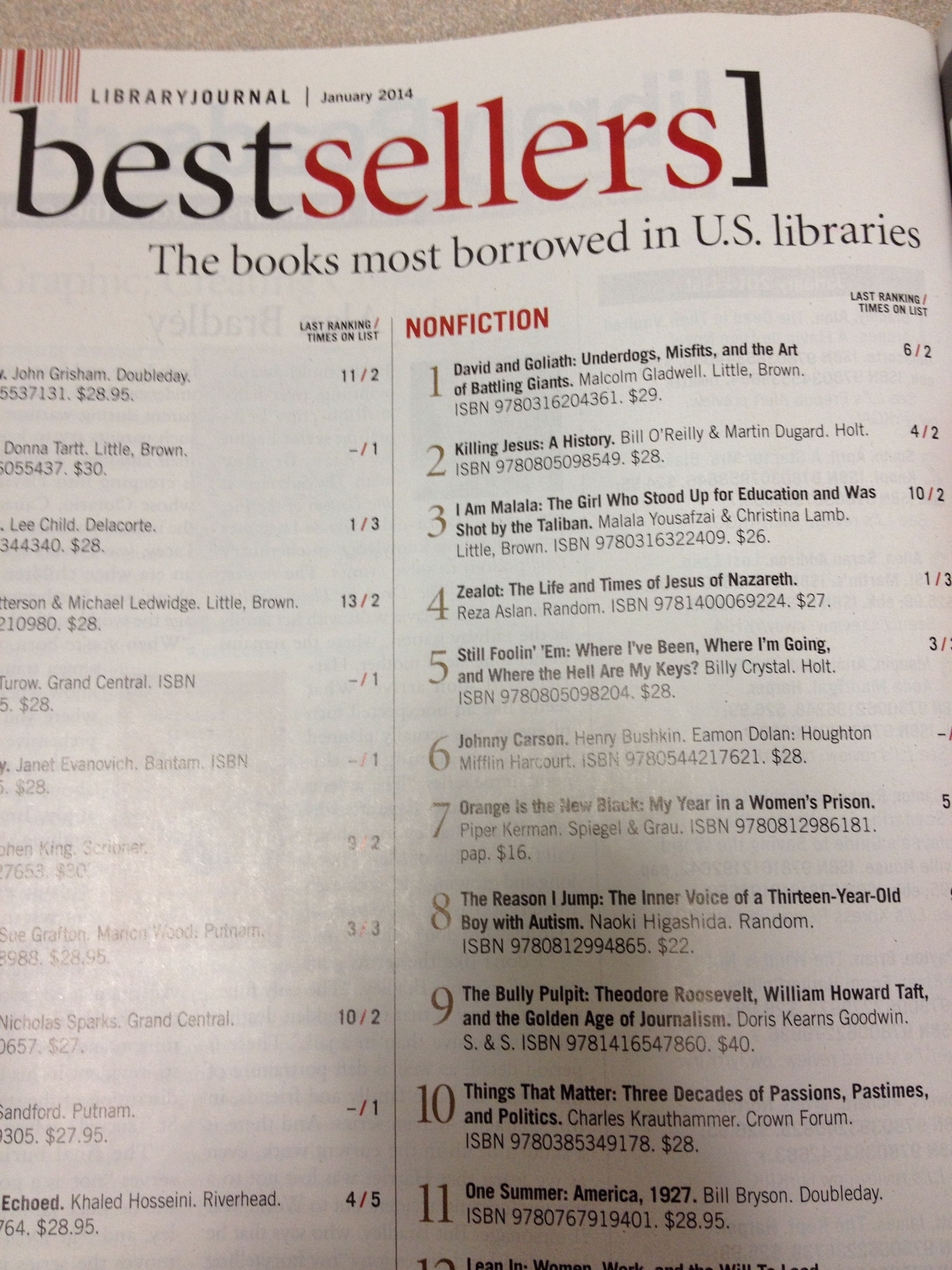 In the January issue of the Library Journal, for instance, there is the list of top books checked out of libraries since the last reporting period. Topping the non-fiction lists? The top four spots are occupied by books tied in some way to religion: David and Goliath, Killing Jesus, I Am Malala, and Zealot. People want to know about religion. Academics just don’t want to hear it. As a perpetual bride’s maid, metaphorically speaking, of the higher education that jilted me almost a decade ago, I hopefully watch hiring trends as the rejection letters pile up in my inbox. It is a diminishing pool. Look at the industry reporting tools: religion is irrelevant at best, puerile or worse when it comes to measuring maturity. People are dying over it, but we’d rather just not know. No wonder they call it the ivory tower—spotless as, well, a bride.
It is often a surprise to many academics how few people buy their books. As someone who had written a couple of academic tomes, I know how I daydream that my work on some obscure topic will take off and suddenly appear in the Library Journal, or Publisher’s Weekly. In actuality, the reading public will decide on the basis of what publishers make available. A writer such as myself, an independent scholar, lacks credibility and is not asked to write books. And universities aren’t hiring scholars of religion much any more. Some seminaries have even moved more toward the secular in their hiring practices, since, universities tell them, that’s the direction things are going. Those who buy books, or check them out from libraries, however, are telling a much different story. But we are much too sophisticated to look for signs among the laity. The more we progress in knowledge, the less we really know.
 Steve A. Wiggins
2 thoughts on “Disconnect the Dots”