
Kill List is a movie that I wish came with some interpretative material. It’s a touch hard to follow. The basic idea is that Jay and Gal are Army buds who take a job as hit men. Jay is married, but not exactly happily. Gal’s girlfriend leaves him early on. It seems that Shel, Jay’s wife, knows what he does for a living but seems strangely unconcerned. Jay is recognized by his victims, but he doesn’t know why. He becomes insanely brutal on the second of their third jobs, torturing his victim before killing him and then going after his accomplices (not on the eponymous kill list). At this point Gal and Jay want out of the deal but their unnamed employer won’t release them. Jay is presented as a man traumatized by a past military action. He fights frequently with Shel but is very devoted to their son. Spoilers follow.
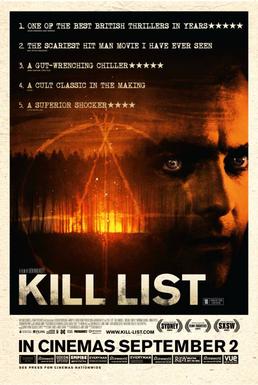
The last job is a hit on a member of parliament. The MP, however, is in a folk religion group that requires human sacrifice. Jay begins shooting them but he and Gal are outnumbered. Gal is killed and Jay is subdued. He then has to fight a hunchback in front of the masked believers. He frees the knife and kills the hunchback only to discover it is his wife with their son attached to her back. A rather bleak ending for a rather bleak film. Kill List is generally considered folk horror. That is to say that fear derives from both the landscape (less rural in this example) and from the native religion of the non-Christian traditions. What exactly this religion is is never specified, and it seems that, unbeknownst to himself, Jay is a pretty major player in it.
Perhaps not surprising for a film titled Kill List, this is quite a violent movie. The somewhat constant fighting of Jay and Shel is unnerving in its own right, and Jay’s berserker-like attacks are also disturbing. There is a religious element involved, however, beyond paganism. The first victim on the hit list is a priest. The reason’s not explained, but the expected religious imagery is there. This is never tied in with the folk religion exposed at the end. Although effective as a horror film, it leaves quite a few questions unanswered. That being said, this Euro-horror is one that I’m unlikely to go back to. I’m not even sure who made the recommendation to me in the first place. Folk horror is a fascinating genre and this movie has been compared to The Wicker Man in that regard. Only in the latter case the plot was easy enough to understand.
 Steve A. Wiggins