Unlikely Heroes

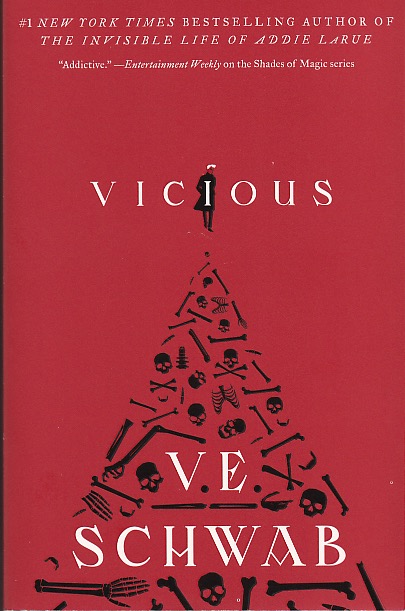
I discovered Vicious by V. E. Schwab on a list of dark academia novels.  I’m glad I did.  The dark academia comes in because the protagonist Victor and antagonist Eli meet in college.  Eli has already stolen Victor’s girlfriend, and he has a thesis idea that postulates EOs (Extra Ordinaries) gain their ability from near death experiences (NDEs).  Determined to prove this, he and Victor try to kill each other, with consent, so that they can be revived to see if they have special abilities.  They do.  Victor’s parents, self-help book writers, have no time for him while Eli is very religious.  They soon become enemies.  Victor’s ability is controlling pain, both his own and that of others.  Eli can heal nearly instantaneously from any injury.  Ten years later Victor is in jail and Eli has become religiously convinced that he has to kill EOs.  He finds a college woman who controls minds and together they get away with murder.

The book is quite well written.   I’ve read plenty of novels that were a plod to get through, but this one never lost my interest.  The tension builds to a pretty high level at some points.  And yes, there is blood.  I think dark academia is an appropriate classification here, and perhaps low fantasy.  There are horror elements, but the abilities of the EOs make it feel like a superhero movie.  Thoughts of The X-Men kept coming back.  In any case, Victor escapes from prison with his cellmate and goes on the hunt for Eli, who’s been systematically murdering EOs because they go against God’s laws.  They discover Sydney who has an ability on which the entire story turns.  With the page-turning power of a thriller, Vicious was a book I always looked forward to picking up again.

I’m not going to give any spoilers here—the novel is well worth reading.  I was intrigued by the way Schwab used the religion angle to motivate the killer.  Those who come back from death, the plot suggests, have something missing that was there before.  This, combined with his religion, gives Eli the motive for killing.  Of course, his morals were problematic to begin with.  Selfish and narcissistic, he ignores Victor’s needs from the beginning.  Even when being saved by the woman who controls minds, he’s never grateful.  Religious but completely oblivious to his own moral failings, he develops a God complex.  This adds a depth to what might otherwise be simply a speculative action story.  With, of course, dark academia stylings.


Annabelle yet Again

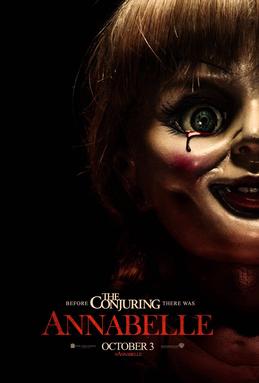
Over the past decade, sometimes with years between, I’ve been viewing the original Twilight Zone episodes.  In the way that firsts so often do, it influenced much of what would come after.  Recently when my wife was out of town, I was going through season five in the evenings.  I reached “Living Doll,” an episode I never remember seeing before.  The haunted/possessed doll/dummy has a long pedigree, of course.  I’ve discussed it several times on this blog; memorably it occurs in Dead of Night.  An earlier Twilight Zone episode, “The Dummy,” raised the specter in season three.  And, of course, Child’s Play took the idea and ran with it.  And ran.  And ran.  The highest grossing horror series in cinema, of course, is The Conjuring franchise.  It features, in more than one installment, the doll Annabelle.

The story behind Annabelle, purportedly, goes back to the 1970s when Ed and Lorraine Warren took the demonic “conduit” from the hands of a nursing student.  She was concerned that the doll moved on its own.  The student and her roommate had a psychic tell them the Raggedy Ann doll had belonged to a girl named Annabelle.  Of course, the Warrens saw this as a demonic case and famously locked the doll in a glass holder in their occult museum.  Annabelle, apart from having her own spin-off series, appears in the very first Conjuring film.  Since the Warrens passed on, the doll circulates in tours, drawing in those attracted to this particular kind of thrill. 

The Twilight Zone episode “Living Doll” is aptly credited with giving us the creepy doll Talky Tina as a blended family struggles to integrate.  The unsympathetic step-father, Erich, seems unsympathetic to the fact that his young daughter Christie is feeling rejected.  Her mother buys her a Talky Tina and Erich immediately complains about the expense.  The doll famously tells him it will kill him.  And it does.  The interesting thing is the girl’s mother’s name is Annabelle.  This gets me to wondering if some psychic a decade later had seen this episode and, perhaps subconsciously, drew the name from Jerry Sohl’s ghostwritten episode for Charles Beaumont.  It wouldn’t surprise me.  The Twilight Zone was an immensely influential series.  In the late fifties and early sixties, television had seen nothing like it.  Of course, haunted dolls, dummies, and puppets already inhabit those first steps into the uncanny valley where we know they’re not really human (AI, anyone?) but they look like they could be.  Only Annabelle knows for sure.


Everything Theory

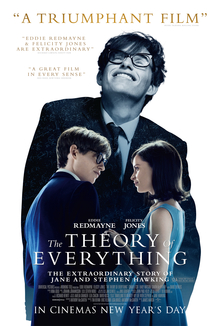
Many years ago I read Stephen Hawking’s A Brief History of Time.  More recently in time, I’ve become a fan of dark academia in several of its forms.  One of those forms is the biopic of famous, often challenged, academics.  The Theory of Everything is offered as such a biopic.  The darkness is, of course, Hawking’s Motor Neuron Disease.  The movie was critically acclaimed, and watching it made me think it was from before a time when academia fell under sustained fire from various governments.  So much of what we know of the world, indeed, the universe, derives from those rare individuals paid to pursue the life of the mind and take the rest of us the places they discovered.  In the case of Hawking, it seems that without his tragic disease his fame may well have never taken off.  Few people, in my experience, are really interested in physics or cosmology.

The movie, of course, dramatizes the life of Stephen and Jane Hawking.  It deftly focuses on the dynamics and strains of their relationship.  The academic part also plays a role, of course, but this is more of a personal story.   As usual, such films make me miss the academic life I’ve been denied.  I was never good enough at math to manage a career in the sciences.  Some of us have brains that focus much more clearly on the humanities (which, of course, sustain the heaviest fire from critics, despite being the grounds upon which higher education itself was founded).  Many, if not most, dark academia biopics focus on scientists or mathematicians.  Perhaps their lives are naturally more dramatic.  Their discoveries are more often newsworthy.  (Newsworthiness is, however, not the sole measure of importance.)  I’m wandering off topic (how human of me!); this is a very good movie.  It does play off of the fact that Hawking’s atheism was a bit of a difficulty for Jane’s Anglicanism.  Interestingly enough, she was a humanities student and did, in real life, earn her doctorate in literature.  Hers, while not as famous, would also be a life worthy of dark academic exploration.  

The acting in The Theory of Everything is pretty incredible.  And the film does make you interested in learning more about these very human people caught in a tragic, but somewhat heroic, situation.  Ironically, the religion and science fields perhaps come closest in cosmology.  This shows up in the final lines of A Brief History of Time, and continues to be a point of discussion in academia, both dark and light.


Books and Years

Someone, somewhere, on some social media post pondered whether to divest themselves of their yearbooks.  For those of us who try to make sense of our lives, that would seem like a foolhardy thing to do.  It happens that for a project I needed to check something in my Grove City College senior yearbook.  A couple of unexpected things happened.  One was that I found a poster for a Larry Norman concert I attended tucked inside the cover.  I’d forgotten that I had the poster, although I remember parts of the concert quite well.  Including getting to meet Larry Norman in person.  At that point in my life he was the most famous person with whom I’d ever shook hands and talked.  The second thing is I realized that my years at GCC represent the beginning of an ultra-right conservative shift.  For the school, not for me.  You can tell through yearbooks.

Grove City was always a conservative place.  Even I (very naive at the time) was surprised to learn that the yearbooks was called Ouija.  Evangelicals know that an ouija board is a demonic gateway.  I did ask about it and found out that the title simply came from the French and German words for “yes.”  Nothing Spiritualist about it.  I’ve come to doubt that explanation.  The idea of learning your future love/spouse has been associated ouija boards for generations.  Indeed, looking back at yearbooks, unless you’re one of those people who married a high school or college sweetheart, is a romp through early crushes.  Some of the women I dated, or tried to date in college, populate its pages.  For me college was really one of the first steps in growing up.  I was hopelessly naive in high school.  So yearbooks and romance go together.

My freshman year the yearbook was changed its longterm name.  My copy still has Ouija on the cover, but thereafter it would be only The Bridge.  This too was a romance-inspired title since the tradition was that you couldn’t be called a “Grover” until you’d been kissed (heterosexually, of course) on Rainbow Bridge.  (I wasn’t a Grover until my senior year.)  I have to wonder if this wasn’t part of a growing conservatism that has made the college so right-wing today.  We’d gone from Ouija to Bridge, still predicting whom it might be that we’d wed.  I keep in touch with very few fellow Grove City students.  A couple are Facebook friends, but most have gone their own way and I went mine.  For many, I suspect, if they bothered to crack open their yearbooks, they would be shocked to learn this former classmate prefers Ouija to Bridge now, these many years later. 


Monster Frankenstein

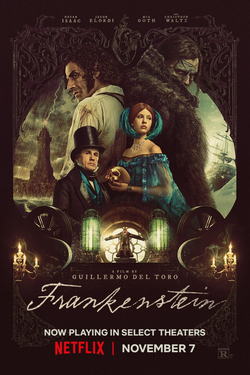
There have been any number of film adaptations of Frankenstein.  Guillermo del Toro, as an auteur, has a distinctive style.  I wan’t quite sure how well the two might mix.  I’d been avoiding his 2025 Frankenstein for that reason and because it’s two-and-a-half hours long.  Even rainy weekends don’t always have that big a block of time to spare.  When I finally found the time I found it an interesting departure from Mary Shelley’s story, but, as with most del Toro films, well made.  And the Bible appears in it as well.  This, of course, is part of the whole horror mystique.  Other versions of Frankenstein have played with the idea of the creature’s superior strength but del Toro adds the distinct element that Victor Frankenstein’s creation can’t die.  When he’s killed, he recovers.  He becomes the unstoppable pursuer.

The movie also makes clear that Victor is the real monster.  It is he who kills Elizabeth and then blames it on his creation.  Likewise, when his benefactor is accidentally killed, Victor blames the creature.  The dialogue focuses on religion and death—the Bible reference isn’t gratuitous—and in an interview del Toro noted that Frankenstein is, for him, religion.  Like many del Toro horror films, it doesn’t share the feel of much of modern horror.  For example, there are no jump startles and the presentation is more like a drama or adventure movie than it is a horror one.  There is gore, however, and a monster, both of which place it into the expected category.

Another theme that runs through this rendition of the iconic horror story is that of reconciling with a problematic father.  Victor’s father is cruel and demanding.  He, in turn, becomes cruel and demanding with his creature.  Both “fathers” believe they have the right to dictate the future of their sons.  Victor, while brilliant, is emotionally poorly equipped for his role as surrogate parent.  In the end the creature reconciles with his imperfect but repentant dying father.  With large themes such as this, and the religion and death dialogue, it’s natural enough that this movie attained critical recognition.  And the acting is sincere, with characteristic del Toro sympathy for the monster.  Both monsters, in this version.  The creature and Victor both undergo a kind of redemption by the end of it all.  While not emotionally wrenching—the basic storyline is perhaps too well-known for that—this is a monster film with heart.  This is, of course, a del Toro hallmark.


Creating Realms

I have to confess that I’ve never attended a writers’ conference.  I haven’t been to any big fan fic gatherings such as ComicCon either.  I did attend Steampunk City a couple years when we lived in Jersey, and was even a presenter one year.  I met the organizer and chatted about the concept, but it disbanded soon after.  The reason I raise this is that I recently learned about Realm Makers, a conference for Christian speculative fiction writers.  This brought me back to the culture wars and how evangelical Christianity, especially, has a very selective filter for what’s okay and what’s not.  And that got me to thinking about C. S. Lewis and how he’s been coopted by the evangelical camp, although he was a good Anglican who smoked, swore, and enjoyed time down at the pub.  (If you’re unfamiliar with the evangelical movement, any one of those three things could get you thrown out of the club.)  Let’s start with Realm Makers.

The Eagle and Child, Oxford; one of Lewis’ hangouts

Noting the difficulty Christian writers of speculative fiction have fitting in with typical fan conventions and secular writers’ groups, Realm Makers is a place between worlds.  Writers often tend towards a certain earthiness that evangelicals might find off-putting.  And, I imagine, large fan conventions have all kinds of potential hazards.  At the same time, many evangelicals discourage speculative fiction, especially horror.  Realm Makers is a place for fantasy and sci-fi writers to gather with like-minded colleagues.  The website doesn’t foreground horror, however.  That’s one speculative area that many—either evangelical or secular—aren’t comfortable hanging around.  It’s pretty easy to see how Realm Makers appeals to a specific cross-section of writers.  And so on to C. S. Lewis.

Lewis was clearly a believer although he was culturally very British.  He, like Amy Grant, had crossover appeal.  I see him referred to by secular writers and fans quite often.  Narnia is an idea that appeals to many and for those really into speculative fiction, his space trilogy is a kind of Christian sci-fi fantasy that’s well written and even accepted by some who tend to avoid the softer side of the field.  Being a writer of the unusual can be a lonely occupation.  I know other writers, and many of them tend to keep to themselves.  I also know quite a few who enjoy conferences and all they have to offer.  Steampunk City was several years ago now.  I attended while working on my one steampunk novel (unpublished).  It was fun hanging out with people who enjoyed the speculative.  One thing nobody seemed to be asking is who believed what.  It was all about having a good time.