Burton and Bats

Among the directors I more or less trust, Tim Burton seems to share my aesthetic sensibilities much of the time.  Some of his films I don’t really care for, but I have seen the balance of his feature offerings.  Since I’ve been watching Burton, and since we have DVDs of the Batman anthology that started the present movie trend featuring both Batman and the Joker, I decided to watch it again for the first time in many years.  Certainly the last time was before I began blogging.  Before Burton’s 1989 movie, the last Batman feature film had been in the sixties and it was campy.  The idea of making Batman serious drama representing a disturbed hero was quite the buzz at the time.  Of course Burton and his followers were eclipsed by Christopher Nolan, and Heath Ledger’s Joker outshone that of Jack Nicholson, but Burton’s film isn’t bad.
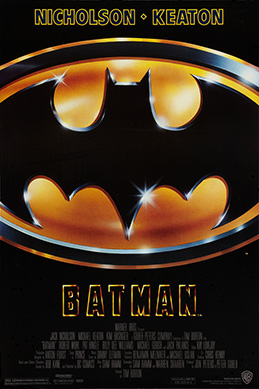
The pacing is a little slow.  Things have speeded up in the intervening years, however, and attention spans have shortened.  Michael Keaton does a good job playing a pensive Batman.  Nicholson was, for those of us who grew up in the sixties, a satisfyingly unhinged Joker.  The sets also stood out to me.  Burton concocted a gothic Gotham City that I appreciated.  And strangely, although it’s been at least a decade and a half, there are scenes I remembered precisely.  The nod to comic book origins with the Joker’s excessively long pistol struck me both in the eighties and now as strangely nonsensical.  After the build-up of the Bat-plane, it’s brought down by a single bullet?  Overall, however, the movie holds up pretty well.  Nolan’s trilogy is better, but then, Ledger’s Joker is a legend.

I mentioned that a DVD anthology exists.  I remember well going all over trying to buy a copy in the early 2000s.  Mainly it was because my wife and I had watched the original film and Batman Returns in the theater but we hadn’t bothered with Batman Forever and Batman and Robin.  The latter two, after both Burton and Keaton had left, weren’t very good.  I watched the two on my own after finally finding the DVDs and have never had any desire to see either one again.  They’d received poor reviews in the first place, but I really don’t like dropping things in the middle.  Burton’s Batman is darker than some of his other work.  So much so that it startled me a little upon rewatching the film.  It did, however, kick-start an interest in bringing these characters back to the big screen and, although tripping a time or two (that pistol!) was still satisfying to watch as the days shorten.

Strange Academy

Things have changed in academia.  Fifteen years ago, after my ouster from the classroom and research crowd, scholars studied such things as monsters, horror, and exorcism at their peril.  Not taken seriously by “rational” thinkers, such phenomena were largely considered a waste of time and effort.  Much of that is beginning to change.  And not just in religious studies.  Religion is an apt discipline to examine prodigies and unusual experiences, but I’m seeing more academic disciplines drawn into the discussion.  Philosophy, history, sociology, and even law, ponder how belief in supernatural beings fits in the bank of human knowledge.  This is something that AI has no hope of “comprehending” (as if it’s doing anything more than pretending).  These are very human concerns and, it turns out, they may be more rational than previously assumed.

Such things entered academia as pop culture was reevaluated as worthy of study.  Although ephemeral, what has the interest of the masses is important to understand.  Horror is increasing in visibility and more and more people are admitting their interest in it, at least occasionally.  A lifelong lover of the weird, had I known that this direction was available, in my former life, I would’ve been one of the first to sign up.  Horror, as we now call it, has been around since the Bible and before.  Ghost and monster stories were part of the earliest civilizations.  Often they’re simply there—assumed rather than postulated.  Many people today, some of them quite educated, also believe that there’s more to the world than what fits comfortably in the laboratory.  Although my last several books have been written for nonspecialist readerships, employed academics are writing for that more rarified readership.

Perhaps the thing that’s truly changed is that studies about such things are being published.  Various academic presses, it seems, have ventured into the “what if” territory.  We’re all asking if maybe the world is stranger than we were taught in school.  Our knowledge in technology has grown at what feels like an alarming rate, while our understanding of the shadowy side of our psyches, and the world itself, is only starting to get underway.  In my personal reading I keep trying to steer away from university presses to the world of trade publishing, but with the new interest in the strange, I find myself being drawn back.  You like your explorers to have a bit of skepticism, and an open mind.  Seems like the academy is starting to welcome such thinkers.  I’m glad to see this happening, because the world is a very strange place. If only it’d happened a little sooner.


Undersea Series

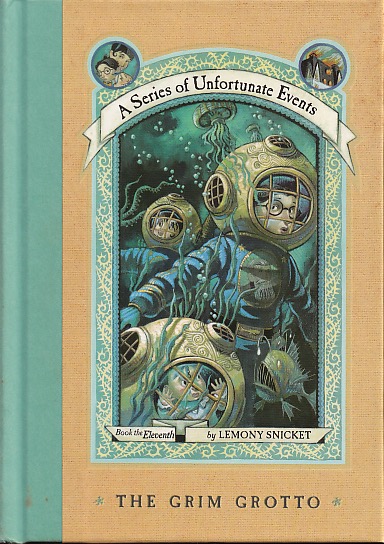
As A Series of Unfortunate Events goes on the volumes become more adult in their complexity.  The writing is still recognizably Lemony Snicket, but the laughs are fewer and the plot is thicker.  Although The Grim Grotto is perhaps the one book (post book three) that I remembered the best so far, there was much I’d forgotten.  Rescued from the Stricken Stream by a submarine named Queequeq, the Baudelaires meet Fiona Widdershins, the step-daughter of the eccentric captain.  She becomes Klaus’ first love interest, just as Quigley Quagmire had for Violet in the last book.  Searching for the missing sugar bowl to help the V.F.D. against the schism, they encounter the eponymous grotto where Sunny is poisoned.  One of the things I remembered clearly from reading this some two decades ago was how worried I was for Sunny, although I knew she couldn’t be killed off.

Literary references abound in this volume.  The Herman Melville references are obvious enough, but I was impressed that Handler gives a brief lesson on Plato’s cave analogy and brought in several other literary figures as well.  Contrasting Melville with Edgar Guest (and I admit that I had to look up Guest) is brilliant.  Guest wrote optimistic poetry which earns him the scorn of Snicket.  Indeed, when Count Olaf shows up, late in the story, the crew of his submarine (in a riff on Jules Verne’s 20,000 Leagues under the Sea) wears suits with Guest silhouettes on them, as opposed to the Queequeq Melville images.  The book also introduces children to the poetry of Lewis Carroll and T. S. Eliot, and I’m sure that there are others I’m forgetting at the moment.  It’s a service to young people to stimulate their interest in other writers.  I’d forgotten that “briny beach” comes from Carroll.  Even the tedious bits of this volume service a didactic purpose.  There may be spoilers below.

Not that The Grim Grotto is without humor.  Apart from the roasting of Guest, the reference to the Mediocre Barrier Reef was a laugh out loud moment.  And the tying together of loose threads.  The hook-handed man is Fiona’s brother.  Josephine’s family ran the destroyed aquarium, and Mr. Poe shows up near the end only to be eclipsed by Kit Snicket.  There is so much to like here.  Including the thin line between good and evil that the children keep coming back to.  Returning to the series after two decades with only the movie to partially remind me of the tale has been enjoyable so far.  Even though they weren’t part of my own childhood, I’m glad to make their reacquaintance now.


CronenDrome

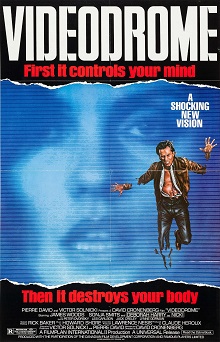
David Cronenberg is an auteur.  Even before I knew his name I’d watched a couple of his films and I’ve been trying to do some backfilling as I can.  Videodrome finally became available at no extra cost, and I wish that I’d been able to see it before writing Holy Horror.  Before I get to that, however, maybe a little explanation is in order.  Videodrome is a broadcast signal that alters reality when someone views it.  Max Renn runs a sleazy television station and he finds Videodrome while looking for new salacious content.  After that, reality and hallucination and new reality become confused.  With Cronenberg’s characteristic body horror, Max’s abdomen becomes a kind of video player and he’s sent to kill a rival of Videodrome.  At least that’s what I think was going on.  He then begins working for New Flesh.

There’s slime and blood and bodies.  Parts of it reminded me of Cronenberg’s later eXistenZ, and even The Fly.  Guns that become bodies and bodies that become weapons.  There’s also a fair amount of philosophizing and social commentary over the role of television.  Specifically, the role sex and violence on screen has on viewers.  (Televisions turn into bodies too.)  The biblical angle comes in after Max has been programmed and reprogrammed, for and then against, Videodrome.  He becomes “the video word made flesh.”  This modified quote from the opening of John’s gospel is significant in his conversion experience.  The plot is a bit confusing, but we see Max transform from a man in control of his own destiny into the pawn for a sinister organization that claims to be trying to do away with those who are inspired by onscreen sex and violence.

Videodrome is a movie that has re-become strangely relevant in the era of scrolling.  One of the characters, Brian O’Blivion, believes marathon viewing makes television replace everyday life.  Ironically, many people experience this with their phones now.  The movie came before cell phones, or at least cell phone popularity.  Certainly before they had screens built in.  Videodrome was well received in the early eighties, and interestingly, my own viewing of it had to await various streaming deals to align.  (And who doesn’t subscribe to a streaming service or two these days?)  The main service I use was charging $15 for it the last time I’d looked.  Then on a weekend after chores, suddenly you could watch it for free, with commercials.  Like a fly, I’m easily drawn into the trap. Perhaps I’ll be scrolling before long.


Democracy

We interrupt this reflection of horror-themed posts to ask, beg, plead with you to vote tomorrow—if you’re eligible to do so in the United States.  One thing I’ve learned over the past couple of decades is that polls cannot be trusted.  The future of democracy rides on this election.  Some people have asked me why I don’t write more about politics.  I used to.  That was before they began driving people insane.  Shock-jock techniques don’t work well for a presidency, and I don’t doomscroll.  I barely read headlines.  I try to use my time more productively than worrying about the very dangerous state we’ve been in for two years now.  Tomorrow is our chance to say if we’re happy with the way things are going.  A pointless war in Iran.  An ego-soothing congress.  Prices that make being middle class feel somewhat lower on the scale than it used to.

Polls lull people into complacency.  They’re based on samples and samples are, well, only samples.  I’ve bitten into chocolate chip cookies (vegan) and come up with samples that distort the number of chips used.  Charts and graphs and projections don’t bring results.  Voting does.  And please, if your polling station uses electronic voting machines please read the print ticket before hitting submit.  In some early voting tampering has been discovered.  One thing we know about con-artists is that they cheat in any way they can.  Please don’t let them cheat you on this.

It takes quite a lot of effort for me to break my embargo on writing on the state of the world.  It has become such a fractious place in a short number of years.  Back when I started this blog in 2009, the world seemed like a fairly stable place.  Yes, we’d had shallow Republicans as presidents before (the party began its slow collapse with Nixon), but we’d managed to weather the storm.  A new danger reared its head in 2016 and one man has kept himself in headlines, whether in or out of office, ever since.  A decade is long enough.  Please make a plan for getting out to vote tomorrow.  I’ll get back to my usual posts on books, movies, horror, and home-grown philosophy after this, a source of sanity in this world gone sideways.  If there’s a country to come back to, I might crawl out from under my rock in a couple more years.  But for the moment, please dust off your voting shoes and get to the polls tomorrow.


Fear Not

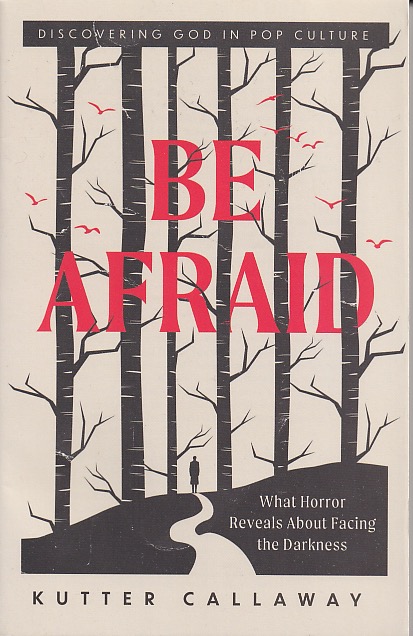
It takes quite a lot to get me to buy a book from InterVarsity Press.  This is something I think Kutter Callaway would probably understand.  My childhood was haunted not only by my family circumstances, but also by fundamentalism.  When I learned I could run, I did.  When Be Afraid showed up on Theofantastique, however, I didn’t hesitate.  Some of us have found healing and a positive message in some horror.  I agree with Callaway that some series, or concepts, are too nihilistic to really get anything out of.  In this fascinating book, we are given a tour through some dark places by someone who’s still evangelical, but who admits to watching, and even enjoying horror.  And being in California, he can actually meet and interview some of the people who make the films that guys like me watch.

I understand this book began as a podcast.  Since my biggest fear these days is running out of time—I’ve got so much I want to get done!—I have trouble finding time for podcasts.  My stack of books to read miraculously never grows any smaller, no matter how many volumes I pull off the top of the stack.  I started this book a little skeptical, but I was soon won over.  Callaway advocates “fearing rightly,” and he knows something many won’t admit: we’re all afraid.  Some of us tamp it down pretty securely, but others of us stare it in the face until we have to flinch.  And a good number of us grew us in conservative Christian households.  One of the things I found interesting following the author through the contours of his fears is that a number of people who work in the horror film industry have, or still, identify as Christians.  I learned that Wes Craven was raised in a strict Baptist household and attended Wheaton College.

One of the recurring themes on this blog, as well as in my own books, is that religion and horror are closely related.  I explore this through my mini-reviews of horror movies and of various books.  I know some of the actually employed academics who work in the field.  And I’ll freely admit that the end of my teaching career at the hands of “Christians” has colored my own experience of horror.  This little book turned out to be a fascinating read.  And it led me to trust that the author wasn’t trying to covertly convert me.  If you have a religious background and are curious about horror, I’d recommend it.