Under the Plague

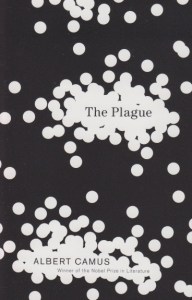
Some events transform a society.  While we keep waiting for things “to get back to normal,” many of us have already come to realize that there is no normal to which we can get back.  That’s my main impression after reading Albert Camus’ The Plague.  The story is set in 1940s Algeria where the Bubonic Plague breaks out in a single town that has to isolate itself from the rest of the world.  As the months and realizations of long duration develop, the emotions the characters go through are very much in line with what seems to be happening with Covid-19.  Indeed, that’s why the novel seems to be going through a surge of popularity right now.  I’ve always associated Camus with the great existentialist writers, but that slipped to the back of my mind while reading this poignant story.

Existentialism is all about making one’s own meaning in a meaningless universe.  This is precisely what Dr. Rieux does in Oran as his former life becomes one long ward call of service to the town.  He befriends characters who represent the best and the worst of human nature as they respond to the pressures of isolation and boredom.  Camus pointedly notes that despite the equalizing forces of death and hardship, the rich manage to make sure they have it better than the poor although they all end up in the same common grave.  There are morals to this story, and it’s clear that “leaders” in Washington have never read it.  Literature quite often teaches important lessons, but to get at them you have to read.

Rieux befriends Tarrou and it seems to me that Tarrou’s lengthy monologue on why he has volunteered to stay in Oran and help those who are suffering is the main message of the book.  Tarrou understands the lessening of suffering, the attempt to bring peace, as the main purpose of human beings.  He says at one point that it’s like becoming a saint.  Despite the ways saints are often worshipped these days, that is at the heart of their canonization.  Care for others.  Rieux points out that Tarrou doesn’t believe in God, and yet, as the story winds down it is clear that he has become a kind of savior figure.  The novel is disturbing in its simplicity and in its timeliness.  It would seem that if we’re to get anything at all out of being under the cloud of a modern plague that we need to take the view that others matter, despite what Washington says, perhaps even more than ourselves.
Learning To Shift

Beliefs have a way of shifting with time and learning.  A regular part of my job is to spend time on college, university, and seminary websites.  Indeed, an editor in my field has to know quite a bit about institutional affiliations.  No matter how much secularists dislike it, our institutions of higher education tended, historically, to be founded by religious organizations.  That’s not unexpected since the very idea of higher education grew organically from the concept of monasteries as the places that preserved learning.  Many, if not most, universities have grown away from their founders’ faiths.  Harvard University, for example, was founded largely for the supply of Congregational and Unitarian clergy.  Not officially affiliated, it nevertheless owed its founding vision to religious needs in the colony.  The fact of moving away from religious traditions is understandable in the cases of universities because learning is essentially a secular enterprise now.

Seminaries are a little different.  When searching for my first (and, to date only) full-time teaching job, I was acquired by Nashotah House because I was Episcopalian.  All the faculty were.  I’ve been turned down for a good many jobs over the years by seminaries silently stating that I wasn’t Catholic, Presbyterian, Methodist or ________ (fill in the blank).  Ironically, as I’ve come to know many seminary faculty members through work, most of them are not of the same denomination as their institution.  Quite often they are Bible faculty, which, when you think about it, is pretty surprising.  Denominations, especially Protestant ones, draw their lines in the sand over their interpretation of Scripture.  

All of this leaves me wondering what it really means to belong to a religious body.  After Nashotah House sympathetic Episcopalians were difficult to locate.  Even those in the academy seemed to accept my sudden disappearance with a studied lack of curiosity.  I’ve sat on the sidelines for a decade and a half now, watching others play the game.  Some win.  Many do not.  Some have denominations that open up for them.  Others do not.  Looking back at the origins of higher education, those of us who studied the original academic field are now considered non-essential even among the non-essentials.  And yet society feels like it’s reeling because of its lack of understanding regarding what religion is.  There are few places to go to learn what your particular brand teaches.  But then again, beliefs do have a way of shifting over time.


Biblical Museum

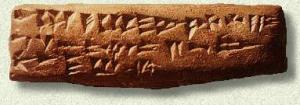
The Museum of the Bible has never successfully steered itself away from controversy.  Just a couple weeks back a story on NPR reported that federal authorities have determined that one of the MOB’s tablets of the Epic of Gilgamesh is a stolen artifact and it must go back to Iraq.  While I don’t question the decision, I was a bit surprised that the Feds knew or cared anything about cuneiform documents.  My academic specialization was Ugaritic, which is a language that was written in cuneiform.  I quickly learned after my doctorate that no jobs exist for Ugaritologists, so you have to style yourself as a biblical scholar.  The Museum of the Bible seems quite aware of the connection, but don’t go there looking for tablets.  They belong elsewhere.

There is a public fascination with cuneiform, it seems.  That doesn’t translate into jobs for those who know how to read wedge-writing since universities have become places of business.  Their product—what they sell—is called “education” but in reality it is accreditation.  Anyone who’s really driven can get a fairly decent bit of knowledge from the internet, if it’s used wisely.  The most reputable sources are behind pay walls of course.  What kind of civilization would give away knowledge for free?  Anything can be commodified, even the knack for reading dead languages.  One of the perks you pick up by studying this stuff officially is that artifacts really belong where they were found.  Unprovenanced pieces are now routinely ignored by specialists because they’re so easily faked.  That doesn’t stop those who can afford to from buying them.  Right, Mr. Green?  You’ve got to beware of the seller, though.

A few years back many of us watched with horror as extremists destroyed ancient artifacts kept in Syria’s museums.  These were objects we’d spent years of our lives studying, and which cannot be replaced.  They were “at home” where they belonged, but where some, at least, clearly didn’t appreciate them.  Those of us who’ve studied ancient history recognized such behavior, I’m afraid.  We’d read about it in documents as ancient as the artifacts being sledgehammered right there on the internet.  Or you can buy such documents illegally sold and put them in a museum dedicated to a book that says somewhere that “thou shalt not bear false witness.”  Such are the ironies of history.  But then, as its provenance shows, that sentiment is apparently a museum piece as well.

Photo credit: Chaos, via Wikimedia Commons


Sinning

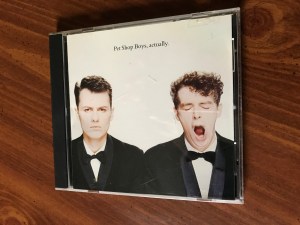
The other day I was searching through the CDs we have and came across the Pet Shop Boys’ album, Actually.  Curious, I googled them and was surprised to learn that they are considered the most successful British pop duo ever, by some metrics.  Who knew?  I lost track of them after 1987.  As I played the album—and synth-pop really isn’t my style—I began to wonder why I’d bought it.  Then “It’s a Sin” played.  The Pet Shop Boys’ second number one hit from ’87, that song was part of my personal history that has led, indirectly, to my last two books.  Let me set the scene:

In 1987 I graduated from seminary.  I was just a small town boy, having grown up in rural northwest Pennsylvania.  My exposure to big cities was limited, and that was one reason I’d chosen Boston for said seminary.  It was there that I began to realize just how much popular culture referenced religion.  “It’s a Sin” is emblematic in that regard.  Everything the boys want to say or do is a sin.  Sounds like Calvinism to me. Still, the song was heard by millions.  I bought the album because of it.

As I recall, there were several pop artists singing about religion at the time.  Joan Osborne’s “One of Us” was still eight years away, but it was becoming obvious to me that people took religious cues from pop media.  I once described the ability to find references to the Good Book as “Bible radar.”  If you’re raised in that culture you learn to spot religion in the most unlikely places.  The concept of sin is a purely religious one.  We all have consciences (I hope) but to make an act Hell-worthy requires religion.  And according to some forms of Christianity just about everything is a sin.

That idea lay dormant for decades.  I read novels and found religion embedded in them, often in biblical form.  I saw it on television.  And in movies.  Even horror movies.  While I sometimes elected to expose myself to intentionally religious media, these references often came from secular sources.  As I began to research this, I came to realize that religion is intricately woven into the fabric of society.  Try to tease it out to isolate it and the cloth starts to come undone.  We like to think of ourselves as more sophisticated than that, but the truth is at some level we still believe it’s a  sin.


Weathering Frights

It reminded me of a nightmare.  The box, containing a book, was soaked through.  A sudden thunderstorm had come before we knew the box was even there on the porch and memories of several boxes of rain-ruined books came back uninvited.  Water and books just don’t mix.  This particular book, I knew, was Peter Thuesen’s Tornado God, which I had ordered back in December and which has just been released.  The irony wasn’t lost on me.  My own second book, Weathering the Psalms, was a rather inelegant treatment on a similar topic and I’ll discuss Thuesen’s book in further detail here once I’ve read it.  The point is that no matter how arrogant we become as a species the weather just remains beyond our control.  The rainbow at the end of this small storm was that although the packaging was soaked, I found the box before the book itself had time to get wet.

My research, ever since my first book, has largely been about making connections.  The weather is so quotidian, so common, that we discuss it without trepidation in casual conversation.  It is, however, one of the most dangerous things on our planet.  Severe storms kill both directly and indirectly.  Cyclones, typhoons, and hurricanes can do so on a massive scale.  So can their dramatic opposite, drought.  Snow and melting ice caps also threaten life, as do floating chunks of ice in chilly oceans.  It’s no wonder that the weather has been associated with gods from the earliest times.  Even today literalists will say God is in the sky although meteorologists and astronomers can find no pearly gates when they look up.  We just can’t shake the idea that weather is some kind of reflection of divine moodiness.

As weather becomes more and more extreme—it’s already a system that we’ve tipped seriously off balance—I suspect more and more people will start to assign it some kind of divine agency.  This June we’ve already gone from shivering mornings with frost on the roof to nights when sleep is impossible because it’s so warm and humid, all within a matter of a couple of days.  And this isn’t that unusual.  Wait’l the gods really get angry.  Weather is closely related to the water cycle, of course.  We can learn about such things from books.  We can’t take them out during a storm, however, and homeownership is all about keeping water out, or only in prescribed locations indoors.  When the delivery driver leaves a box on your porch, however, it remains within reach of the storm gods.


George Floyd

Perhaps for the first time in four years, 45 is beginning to see people are unhappy.  Very unhappy.  The pontiff—excuse me—president wanted a photo-op with the Good Book at a nearby Episcopal Church and had crowds of protesters tear-gassed so the he could make himself look righteous.  My wife pointed out that this was an example of the Bible as a Ding, and she was right.  (If you don’t get the reference, it’s explained in Holy Horror.)  Moreover, it is a clear abuse of power.  Not only have thousands of Americans been needlessly dying from COVID-19, the violence against African Americans is caught time and again on police body-cams.  People are rightfully protesting and the racist-in-chief doesn’t like it.

It doesn’t work unless you open it.

With echoes of Tiananmen Square he’s now threatening to send the military against protestors.  It’s far easier to strike out at people while holding a Bible in your hand than it is to learn empathy.  We’ve been isolating and masking ourselves for over two months now and not one word of sympathy has come from the White House incumbent.  Instead of trying to calm racial unrest, he tweets to conquer, not realizing that divide and conquer is meant to be used against enemies of your nation, not your own people.  Never had we had a president who has so openly played favorites and made not even a pretense of being a leader for the entire country.  He is a figurehead of his base only, which is, it seems to me, a violation of the oath he swore on that selfsame Bible not even four years ago.

Pandering to such a Ding is an abuse of Holy Writ.  After unrest over George Floyd’s murder had entered its third night the response from 1600 Pennsylvania Avenue was silence.  How far is it from here to Tiananmen Square?  Is it not possible to admit error and realize that the economy is going like the Titanic’s maiden voyage and just about everyone knows someone who’s died because of the virus or who’s been racially profiled by one of the “good people on both sides”?  No, grab the Bible and clear the rabble who won’t shout “Hosannah” when he rides his ass outside a church whose door he’s seldom darkened to show his base he really is a Bible-reading man.  Was this some bizarre parody of Jesus clearing the temple or just a mockery of the man who said “By their fruits you will know them”?  There’s only one answer to that.  How different the world would be if Bible-believers actually read the book they love to thump.  


Still Evolving

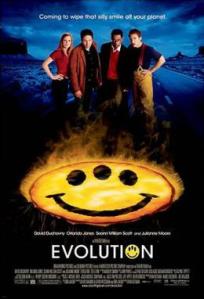
Evolution, the 2001 movie, I mean, is good escapism.  Thinking back on 2001, instead of a space oddessy, another piece of news—another national crisis, in fact, dominated.  The film kind of slumbered in the background until we could sort out what it meant to live in, ironically, an unsafe world.  That’s precisely what the movie was about.  I wasn’t thinking that when I recently pulled it off the shelf.  I was simply wanting some fantasy to relieve the daily pressure of living in stress mode.  Besides, it has some of the best alien monsters you could hope for in a comedic setting.  Soon, however, the parallels began to appear.  A source of contamination from outside.  A growing threat.  A government that doesn’t know what to do and that can’t admit its mistakes.  It all seemed eerily familiar.  Dr. Allison Reed is even from the CDC.

Life isn’t constant crisis.  Funnily enough, when Democrats are in office there seem to be far fewer of these large-scale troubles.  “There will be signs,” I guess, “in the sun, moon, and stars.”  The thing about signs is that we’ve left the reading of them up to Fundamentalists.  And Fundamentalists don’t believe in evolution.  Or science.  Or modernity.  Idealizing medieval thinking does come with a price tag.  So I reach for the remote.  While the government has lots of money that it spends on its own volition, the crisis grows.  The alien menace is set to spread across the country.  Although beginning in a different geographical location, all that red on the map sure looked familiar to me.  How little has changed in the last two decades.  Evolution came out before smartphones even evolved.

Meanwhile, practically unnoticed, the U.S. Navy has been saying UFOs are real.  The story, muted and subdued—we’ve got more immediate concerns, such as getting reelected—has been on major reputable media.  When they land on the White House lawn we’ll ask the aliens if they have respirators and masks aboard.  Preferably the kind with face-shields.  In the movie the monsters are aliens.  They’re like an infection, and even hazmat suits can’t keep you safe.  The solution, of course, isn’t fire-power, but a good shampooing.  Now I know you still can’t go to the salon in lots of places, but washing up at home seems to be pretty good advice.  We put the movie on for simple escapism, but there’s no escaping the fact that we now live in an alien environment.


Straining Andromeda

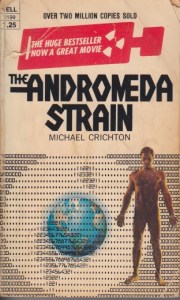
As corona-life settles into just the way things are, I pulled out my copy of Michael Crichton’s The Andromeda Strain.  I read this in high school, and, judging from the state of my copy I originally found it in the book bin at Goodwill.  I actually didn’t remember how the book ended, but some of the scenes—particularly the bizarre suicides that the virus first initiates—stayed with me.  I really felt no compunction to read it again until our daily reality was one of infection, protection, and fear.  In other words, the time was right.  I can say that I found Crichton’s confident prose a bit overblown at times, especially given the resolution of the crisis, which I will not give away here.  Some of the rest of you may want pandemic-themed reading, after all.

Something I had forgotten, and since this is near the beginning I don’t mind giving it away, is that the Andromeda Strain was brought to earth by military intentions to develop new biological weapons.  Although the death toll is nowhere near what that of COVID-19 has been, the potential lethality of the strain is what keeps the compressed five-day story tense.  That tension makes for quick reading, and it seems pretty clear that some of the ideas here have been used for other pandemic story-lines.  I’ll write about one of them later this week.  The extraterrestrial life form of Andromeda is cause for discussion in the novel, but the explanation is never clarified.  Crichton’s later novels improve on this score.

A clear point in the novel is that the government, although aware of and complicit in the experiment, lacked the foresight to successfully see it through.  Governments are only human, after all, and can function effectively only when those with superior abilities are in charge.  Looking out for oneself and exploiting others are not superior abilities.  We can see the result of this with our own, nonfictional pandemic.  Still, the novel does raise the specter of dabbling in things we don’t fully understand and can’t, in any real sense, control.  The thread of the plan being military in origin isn’t fully seen through, but it does raise the larger question of morals.  Some of us go through ethical training for our jobs.  Some of us have it often.  It’s obvious, however, that the real deficiency of governments tends to be their lack of ethics.  In this current day and age that qualifies you for the sobriquet of evangelical Christian.  And now we have our own strain to deal with.


Old Inspiration

Moving is a process that really has no end.  I suppose if working folks took a few weeks of staycation and really concentrated, getting everything unpacked might be a possibility.  Although our move was nearly two years ago it didn’t happen that way, and the self-isolation of the pandemic has led to only more time drains, not fewer.  We still have boxes waiting to be unpacked, and, of course, like many people we store memories in boxes.  Life is an accumulation of things that aren’t valuable but somehow aren’t disposable either.  While putting some things away in my study after work recently I spied something that has been in storage probably since I graduated from college.  I stopped and stared at it because even glimpsing it took me back instantly to my childhood.  What was it?  A devotional card.

The memory it prompted was sad, in a way.  We didn’t have much money when I was growing up (some things never change), so what we could afford was inexpensive stuff.  My faith, rather than being the optimistic, happy kind of fundamentalism, was rather the fearful, wrath of God kind.  I was a scared little boy.  Phobias ran deep and wide.  I bought cards like this to assure me that things weren’t so bad.  This particular card has three reassuring verses from the Bible, all taken out of context, on the back.  Seeing the card reminded me of the several others I once had.  Our homelife wasn’t peaceful, and I often had to retreat to where I could look at my devotional cards for reassurance.  At college I started to grow optimistic only to have my career prove that I was right at the beginning—life is scary and insecure.

I picked up the card.  I put it on my desk.  My mother had returned it to me, I recalled, when she moved into the trailer park.  A box of my stuff had been left at home (unfortunately not the box with all the 1970s baseball cards I had as a kid).  And two or three of the devotional cards had been tucked into it.  When she gave me the box I didn’t have time to sort through it.  The vacation time was all used up by driving all the way there and back, and so it got loaded on the truck with everything else, the flotsam and jetsam of a childhood spent being afraid.  This card was only one of several, and if I’m honest I’ll admit that it has reopened a box that may have been left by Pandora.


White Whales

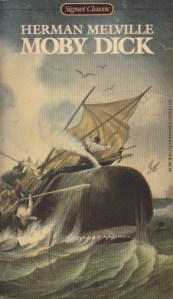
Every once in a while I return to Moby Dick.  I’m not sure why exactly Melville’s classic has such a hold on me.  Perhaps because I first read it while living in Boston.  For a land lubber like myself being so near the ocean was a kind of epiphany.  I read the novel as part of a course on wisdom literature in the Bible.  Harrell Beck, who was an influential person in my life, insisted that if wisdom themes were truly wisdom they would be found outside the Good Book.  We were assigned a list of modern novels from which to choose and I selected Moby Dick.  The thing that immediately struck me about the novel was just how biblical it is.  Ahab and Ishmael aside, the many references to Jonah and Job and incidental asides referencing scripture made this an intense reading experience.

I started reading it for the fifth or sixth time just before the pandemic became a crisis.  It is a large book and I didn’t want to rush through it.  I tried to pause and appreciate it this time around and I noticed just how remarkable it was that a man who made much of his life as a laborer, without any higher education, was so incredibly literate.  Classical references that I had to look up, and citation of sources blend together in a story that is compelling as it is unsettling.  Long explanations and descriptions are part of the tale, and the soliloquies are so philosophical that you have to sit back in a reverie after reading them.  I’ve read many novels in my life, but no others like Moby Dick.

As metaphorical stories go, the book is remarkably natural.  The descriptions of whales are as scientific in their own way as they are literary.  For an author with no scientific training this too is remarkable.  Indeed, a good part of the draw of Moby Dick is Herman Melville himself.  Although I have gathered a few degrees over the years, in my mind I am, like Melville, unlettered.  I’m sure he would’ve understood.  The fiction I write, although in a very different style, is a tip of the hat to him.  Friends used to tell me that nobody writes like that any more and that no publishers would show an interest.  The latter has proven to be true, and so much more’s the pity.  We could use more novels like Moby Dick.  And were my days not even fuller during the pandemic, I might even have a few moment to pursue my own white whales.


Tent Pegs

Among the many things that have happened during the pandemic to fill my time, I was invited to join a virtual book discussion group.  While the idea of reading groups has always appealed to me, there’s always the matter of who gets to choose the book.  I’m well aware from both what I post here on this blog and from my Goodreads account, that my reading tastes are eccentric.  I’m also very aware of how little time life really encompasses and I try to make it count.  Work takes up much of it, and beyond that biological necessities such as sleep, and household chores also weigh in.  All of which is to say I didn’t choose The Tent of Abraham to read.  It chose me.

The subtitle—Stories of Hope and Peace for Jews, Christians, and Muslims—pretty much describes what the book is.  Authored and edited by Joan Chittister, Murshid Saadi Shakur Chishti, and Arthur Waskow, the book focuses on the story of Abraham that ties the three monotheistic traditions together.  It is an exercise in creative exegesis, and sometimes eisegesis.  Given the point of the book, eisegesis is okay here, perhaps even necessary.  The reason for much war and hatred is the credulous, literal belief in our founding myths.  Abraham isn’t an historically attested character.  The stories told about him in ancient religious texts differ.  And although he doesn’t always come across sympathetically, he is always seen as a friend of God.  We’re not ever given a satisfying reason for that friendship, it just is.  Abraham is kind of a scary guy, as some of these stories make clear.  He’s not above abandoning his lover and child in the wilderness.  Nor attempting to murder his only remaining son.  Or passing his wife off as his sister to save his own skin.

Interspersed with these tales of imagination and horror, are scriptural versions (and by scriptural I mean biblical and those from the Quran and Hadiths), as well as real life stories of death in the Middle East conflict.  These are difficult stories to read.  Much of the violence between faiths comes down to conflicting claims of ownership.  As the book makes clear, if people resolve to celebrate difference rather than to distrust the other we can all live together in peace.  The only thing lacking to make this happen is the will.  Unfortunately, the conflict draws its energy from religious beliefs, or, more precisely, politics using religion to get its ends.  And for that one doesn’t have to travel all the way to the Middle East.


More than Sand

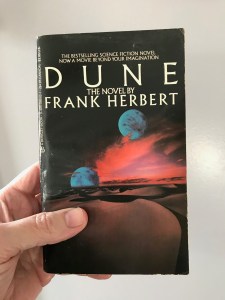
My sci-fi roots may be showing, but when John W. Morehouse posted a story on TheoFantastique’s Facebook page about Dune, I had to follow up.  The story was from Wired magazine, and the title asks “Should There Be a Religion Based on ‘Dune’?  Although I grew up on Poe, science fiction was my favorite genre as a kid.  Frank Herbert’s classic was published when I was only three, but it was experiencing a resurgence before the movie came out.  Dune was  complex world building.  It was immersive, and compelling.  The movie, I felt, didn’t do it justice.  I’m not surprised that people are now wondering if it shouldn’t become a religion.  Other sci-fi-based religions do exist.  Star Wars and Avatar have both developed fan bases that consider the films their religion.

Movies have a way of becoming part of our reality.  The other day I was reflecting on how much my frame of reference for life is based on movies.  I quote from them frequently.  I draw wisdom, and sometimes just plain inanity from them.  But I remember them.  I spend a lot more time reading than I do watching movies.  If a book is engaging I’ll remember it well, but it isn’t unusual to forget—although I hope it’s still there somewhere in deep storage—a book that failed to make much of an impact.  I suppose that’s true of movies too, but I recall my first viewing of The Jungle Book in theaters.  How those hypnotic snake eyes scared me!  And there was a film whose title I can’t recall, but I remember it was vignettes of Hans Christian Andersen stories, I believe.  One was called “The Tinderbox.”  I still remember it well although I was probably about five when I saw it and I never watched it again.

This staying power of movies suggests their religious potential.  People today, I suspect, are less concerned with the antiquity or bona fides of a religion than they are with the practical issue of whether or not it works for them.  Does it bring them near some sense of transcendence?  While the Wired article doesn’t seriously suggest a religion based on Dune, I sometimes ponder how the wisdom of ancient religions is often entombed in forms and structures that “true believers” mistake for the actual essence of the religion itself.  Sci-fi based religions reach for the newly created realms of transcendence.  They are filled with wonder.  But it will only be a matter of time before that awe fades into arguments about which canonical version is literally true.  It’s happened before.


Leg Up

It’s amazing how often J. D. Vance’s Hillbilly Elegy comes up in conversation.  The book struck a nerve.  Reading it wasn’t easy because there were so many shades of my own childhood that I felt uncomfortable at several points.  Not from the same circumstances as Vance (his family seems to have been better off than mine, from the descriptions), I was more a hillwilliam (shoutout to the author of Verbomania for the portmanteau) than a hillbilly.  We weren’t educated people, but my mother’s family wasn’t as poor as the one she married into.  We were socially mobile alright, but in the wrong direction.  Anyone who hasn’t come home from school to find carp swimming in the bathtub simply can’t understand.  The way of the poor is inscrutable, but something Vance gets spot on—it is almost impossible to improve yourself without a leg up.

The chapter where this really hit me was as he was describing how easy his life was after being admitted to Yale Law School.  He made connections and learned to work them.  That part never came in my case.  Like Vance I grew up without a father.  Unlike him, I didn’t have grandparents to come to the rescue.  It’s a long story, but when I left home my life became a search for a father figure only to discover than nobody really wants to help somebody else’s kid.  Although I was accepted into the high profile schools, I had no one to coach me to go there.  Even now people barely recognize Edinburgh for the wonder that it is.  It didn’t connect me the way Yale Law apparently does.  My career has been in freefall a time or two because of this lack.  As Vance explicitly notes, when you grow up poor you don’t have the training or family experience to know what to do.

Many people, I realize, are much worse off than I was growing up.  What Hillbilly Elegy, written by a Republican, shows is that the government simply does not care for the poor.  In what used to be the wealthiest nation on earth there is a tremendous amount of poverty.  Vance has a keen analysis of what the abnormal psychology of want does to people.  I grew up more of a Pennsylvania redneck than a full-blooded hillbilly, but many of the same lessons apply.  While some of us can muster the willpower to escape, we know we are in the minority.  We learn as adults that others don’t share our concern for those who struggle daily to get by.  This is an important elegy, and if only it were read seriously by those able to make policy there might be some glimmer of light in these dark hills.  The right leg up can do wonders.


Resurrectionists

“Resurrectionists” was the name given to those who supplied the black market for human bodies when medical science had scant access, back in the eighteenth and nineteenth centuries.  They’d rob graves, and sometimes kill their own victims, for the money medical schools paid for cadavers.  It’s just business, some would say, I suppose.  It was illegal, however, and carried its own death penalty at times, if a resurrectionist were caught.  I was surprised to learn that somehow the United States has learned to do large scale resurrection.  Clergy, hang up your stoles—the government’s got it covered!  I discovered this in the most unlikely of places, the World Health Organization’s daily situation reports.

Like many people I wonder when COVID the 19th’s reign of terror will end.  I don’t trust anything that comes out of the White House, so I look to WHO.  The daily situation reports give the recorded number of cases of the virus, which, despite progress, keep going up.  The US, as always, is the world leader.  In addition to giving the number of cases, the website also records the numbers of deaths.  This is a sad and sobering statistic.  Additionally, it informs reader of how many new cases and how many new deaths have been recorded in the last 24 hours.  Here’s where I learned of our godly ability.  On Tuesday the number of new deaths in the United States was -1696.  This represents a mass resurrection indeed.  If only we’d share the knowledge with the rest of the world.

Here’s the insidious nature of statistics and governments who abuse them.  Stalin famously noted that one death was a tragedy but a million deaths are a statistic.  The US isn’t the only nation to play with the numbers—we’re all just statistics after all—but it is a matter of record that the Trump administration wouldn’t let the Diamond Princess land, although in American waters, because it didn’t want those cases listed as part of our stats.  So it still stands.  They are listed, of all the nations of the world, as “Other.”  Lest there be any doubt, the Tuesday WHO situation report ended with a note that American authorities “retro-adjusted” the figures.  You’d think that we’d want to announce with trumpet blast that we’d figured a way of retro-adjusting 1696 deaths.  For those of us listed as non-essential employees this is perhaps meant as a ray of hope.  Our work may be just icing, and we may be a single digit in our uncaring government’s eyes, but we can be brought back from the dead by political fiat.


Divided by Eight

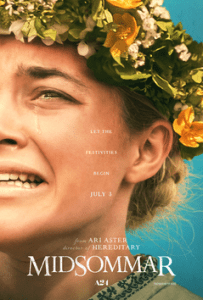
Analogies are useful, but never precise.  When Midsommar came out last year, people were saying “It’s like Wicker Man.”  It’s a good analogy, but not precise.  The plots have quite a bit in common and both are part of the genre that we might call intellectual horror.  Midsommar is a slow burn where you know from the beginning that something’s not right, and you can’t quite figure out what.  I’ll try not to give away too much, in case, like me, you’re late in seeing it.  It involves a group in Sweden, the Hårga, who celebrate a Midsummer ritual every 90 years.  A group of five graduate students—and the writers of the movie actually do know what grad school is like—go to study the ritual.  In central Sweden, far enough north that it’s never really night, they discover a pleasant group of white-garbed believers who use a combination of drugs, sleep deprivation, and folk magic to get the pawns into place.

What fascinates here is just how a fictional religion, with some basis in reality, becomes the vehicle for horror.  The deaths of three of the students are all in the service of a belief system that involves runes, fertility rites, scriptures, and ritual suicide.  It’s self-aware enough that one of the students compares it to Waco early on.  If there were no exotic religion here, there would be no horror.  Tragedy, yes, but horror, no.  The entire energy of the genre draws from four of the students (the fifth is from the community in Sweden) not knowing what is going on.  The village of the Hårga is isolated, and there is no law to keep them within the bounds of secular behavior.  By the end of the film you feel that secular is much safer than religious.

Midsommar foreshadows much of the horror in the illustrations that the community readily supplies.  Paintings show what is coming although the viewers, like the students, don’t know what they’re seeing at the time.  Some of the horror is based on shock, but the director doesn’t stoop to startle scares.  Well, maybe once.  This is horror that you can see coming and you’re fully aware that it’s because the white-robed ones truly believe.  The ending is similar to Wicker Man and the message is much the same.  Religion, when taken too seriously, leads to the sacrifice of those deemed outsiders.  And you don’t have to go to Sweden to find it.