Fly by Night

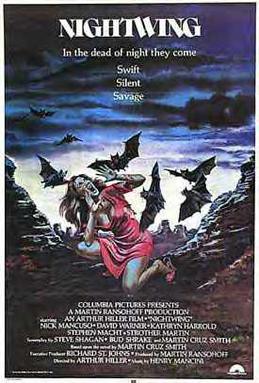
Nightwing is a movie I learned about by reading Stephen King’s Danse Macabre.  The idea has merit but falls below the expected level of any horror film of the era—and I’m a fan of seventies horror.  Those in the know suggest that this was supposed to be Jaws with vampire bats in the era when horror movies started to re-realize the dangerous potential of nature itself.  A basic problem underlies the dull pacing, non-indigenous actors playing Indians, and fatally overstuffed plot: vampire bats aren’t dangerous.  Bats are highly advantageous to the ecosystems in which they thrive and the idea that six or seven bites could drain a person of blood is ridiculous on the surface and looks rather silly in execution.  At least the later movie Bats (also bad) had genetically mutated mammals.  Eco-horror can be effective.  Natural bats are difficult villains, though.  

So, on Hopi lands an elderly priest summons the end of the world.  Releasing a god, the bats form the precursor to a native apocalypse.  Two tribes with differing views of white drilling rights on their lands argue over this while killer vampire bats attack.  They kill a group of Quaker missionaries.  Luckily, a British vampire bat killer is after the swarm.  He travels around killing bats, which, he says, are pure evil.  The deputy of the “good” tribe, which resists white incursion, eventually teams up with the bat killer because he saved his girlfriend who was going to leave him for medical school.  For some reason, two kinds of plague (including bubonic) are released but when the tribal priests all die during a rain dance it’s because of natural causes.  The leaders of the two tribes keep trying to catch each other out.

As the movie plods along, making the viewer root for the bats, the several dropped plot lines are left dangling like so many participles at the end.  The plagues?  Red herrings.  The tribal conflict?  Unresolved.  The special poison brought in to kill the bats?  Unused.  Total number of people killed to justify a wholesale bat massacre?  Nine.  Anytime I’m viewing a horror movie and I find myself repeatedly glancing at my watch, I know that something’s off.  It’s October and bats are a typical aspect of Halloween decor.  Nightwing, however, just doesn’t make them scary.  The movie was based on a novel which I’m now strangely tempted to read.  By all accounts, even though the author was partially credited with the screenplay, the book, as usual, is better.


Nibbles

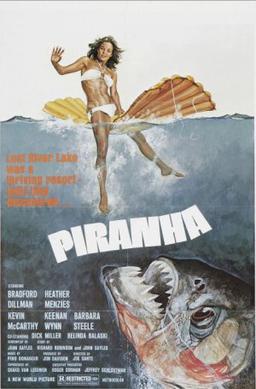
With a career as prolific as Roger Corman’s was, it’s difficult to keep up.  I knew his horror movies mostly from the sixties and maybe early seventies.  Having stumbled upon Humanoids from the Deep, which he produced rather than directed, I was pointed to Piranha.  I knew about this movie, of course, but never had a reason to watch it.  Well, Corman rabbit holes are easy to tumble down.  Corman was the executive producer of Piranha and since I was already splashed with water-themed horror, well, why not?  As with Humanoids, it has a different feel from movies Corman directed, but some of the trademarks are there.  Piranha has so many shark-sized holes in it it’s not difficult to believe that it was exploiting the popularity of Jaws.  In fact, the movie opens with one of the characters playing a Jaws video game.

So the government had been weaponizing piranhas to help in Vietnam but when the war ended they kept the program going.  A woman who finds missing persons releases these fish into a Texas mountain stream.  Anyone on the river is in danger and, of course, it flows past a new resort that is having its opening weekend downstream.  The government wants a coverup because the colonel in charge has invested heavily in the new resort.  You get the picture.  Lots of people screaming in the water and a gratuitous use of movie blood and a story that keeps the viewer asking “why?” The film has a way of somehow steering just clear of bad movie territory.  Also, it becomes obvious, that even without appropriate music cues, this is a horror comedy.  I lost track of how many unanswered questions there were within the first fifteen minutes.

Piranha is a sort of fun knockoff from Jaws.  There’s nothing really profound here, although one scene did make way for a little social commentary.  When Maggie (the skiptracer) wants to distract an army guard with her feminine wiles, she wonders if he might be gay.  This was in 1978, well before “don’t ask, don’t tell,” and she asks with a pre-Trumpian nonchalance that it’s downright refreshing.  Otherwise it’s pretty much your typical exploitation film.  The concept has led to a couple of remakes, so watching swimmers getting nibbled to death obviously has some appeal.  The plot is so outlandish that there’s nothing scary here, even though it’s clearly horror.  There’s even a scene with some stop-motion animation of a creature in a subplot that’s simply dropped.  There are worse movies for summer escapism, given that we’re now post-pre-Trump again.


O Deer

I spent my tween and majority of my teen years in a house that backed up to some rather extensive woods.  We lived on the edge of town.  I spent quite a bit of time wandering among the trees and deer were never an unusual sight.  Opening day of deer season was a literal school holiday, but I was never a hunter.  Since we’ve killed off many deer predators, cars may be their biggest natural enemies these days.  I recently found deer droppings in the yard of my current house, right next to the newly mown down hosta.  I see deer all the time while out jogging.  A few years back I even saw a doe giving birth in a secluded glen along the trail.  I guess we do kind of live at the edge of town here too, but the woods don’t begin until across the road, and the jogging trail, and they aren’t as extensive as those I grew up with.

I’ve started to notice that deer are creatures of habit.  These are the common white-tails that predominate around here.  I often see them in the same area while on my crepuscular jog, sometimes multiple days in a row.  The other day I saw a young buck up on its hind legs to reach some low leaves on a tree.  I’d never seen a deer do that before.  There’s a spot a little further on where a doe and her two, sometimes three, fawns hang out.  I’ve seen them several times.  Recently they were in their accustomed place and when I reached the end of the trail and headed back, they were still there.  These deer aren’t too skittish around people and sometimes I can get quite close before they bolt off.

This particular day, however, I learned something.  Deer can vocalize.  I knew that elk did, but I’d never heard a white-tailed say anything.  Even when giving birth.  I thought they were completely silent, and as an introvert I tend to understand.  Coming back, the doe had crossed the trail and two fawns were on the other side as I approached.  The young ones ducked into the trees and one of them called for its mother.  I almost stopped in my tracks.  I didn’t know that white-tails vocalized.  I had to consult the internet when I got home just to make sure I had actually heard what I thought I had.  I’m at an age where motivating myself to get out and jog at first light isn’t always easy.  But when nature makes it a learning opportunity, well count me in.  

Image credit: USDA photo by Scott Bauer, public domain, via Wikimedia Commons

Cat Tales

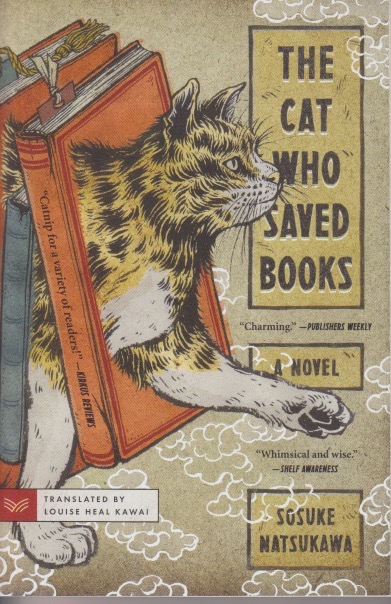
Sometimes I go into an independent bookstore and just look what’s on the shelf.  Often this ends up being an attempt to find a book that isn’t monstrous in length.  Much of what’s currently on offer is long, but I grew up reading 128-page paperbacks (not great literature, granted) that set my expectations.  Now, I do read long books.  Since books and movies are staple topics for discussion on this blog, however, I need to keep things moving in both kinds.  All of which is to say that I picked up Sosuke Natsukawa’s The Cat Who Saved Books because it was short.  This particular bookstore was one where I know and trust the owner’s taste.  I’d bought Haruki Murakami’s works there before.  I really didn’t know what I was getting into this time, though.  I like cats.  I like short books.  I like the Japanese authors I’ve read.  So.

The BISAC code on the back of this one didn’t state that it was fantasy.  I like some fantasy fiction, but my tolerance is limited.  The fault is mine entirely; I own that.  I enjoy speculative fiction and a book with a talking cat felt like it might fit that niche.  I thought the story of The Cat Who Saved Books was good, and the message was sound.  But it felt a bit trite.  The previous Japanese author I’d read was Murakami, and he’s pretty incredible.  I can give you a taste of this book, however, and raise a question about it.  A teenage boy is left taking care of his grandfather’s bookshop after his guardian dies.  A talking cat appears and leads him to four labyrinths where the boy has to rescue books that are being misused.  His arguments to save them don’t seem profound, but something might’ve been lost in translation.

The question is that one of the characters claims to be a book almost two-thousand years old that has had more influence than any other book. Was this the Bible?  Interestingly, nearly every book mentioned in this novel is from the “western canon.”  I have to wonder if this particular book, which is a rather severe character, is the Good Book.  I don’t suspect there’s any way to find out, really.  Still, it seems to fit the sense that Natsukawa uses.  This is an innocent enough fantasy novel.  I guess I prefer my fantasy to have solid rules laid down so that I have an idea what to expect.  But then again, my perspective is that of a primarily western reader, and one who craves short books now and again. I’m open to learn.


Big Bites

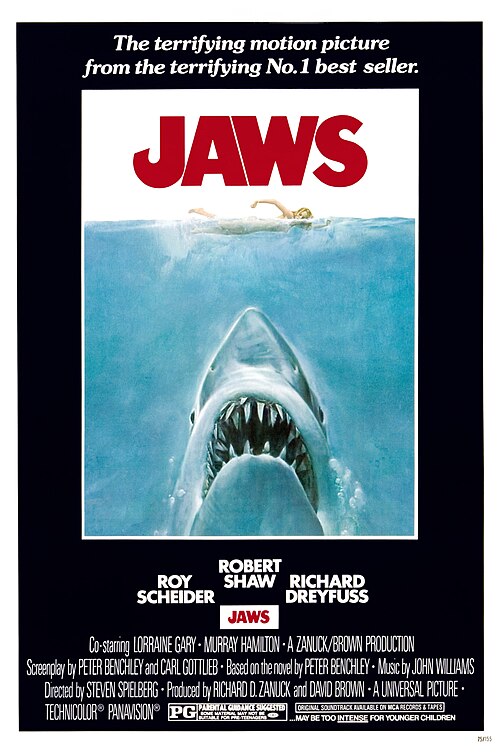
Although Jaws takes place on or near the fourth of July, it’s not holiday horror.  Holiday horror draws its source of fear from the day, and although Mayor Vaughn—like many politicians—insists holiday income is more important than a few lives lost, the fear derives from the shark.  I can’t remember when I first saw Jaws.  It couldn’t have been during its initial theatrical release (I was too young), I do know that I read the book first.  I wasn’t expecting Hooper (then my favorite character) to survive.  I was also surprised when I heard people starting to refer to Jaws as horror.  When I first saw it, whenever that was, I wouldn’t have called it horror—it’s just a movie about a shark.  Since thriller and horror bleed into each other I’m more open to the designation now.  Besides, animal attack horror is its own well-established category these days.  Jaws, half-a-century old this year, is experiencing a comeback but the shark never left.

JAWS, 1975

My wife surprised me by suggesting we watch it last weekend.  We’d seen it together on television many years ago.  A number of analyses have been appearing in the media, highlighting the importance of the movie, and I noticed a few things watching it again.  Probably the most obvious shift, for me, was finding Quint the most engaging character.  I don’t know how many times I’ve read Melville’s Moby-Dick, but it’s been at least two times since seeing Jaws the last time.  The connection was much clearer with this viewing.  Quint is after sharks because of their attacks on crewmen of USS Indianapolis in World War II.  Quint was a survivor but his life’s mission is revenge on sharks.  So much so that he smashes the radio to prevent Brody from radioing in an SOS.

So here was a confluence.  I watch horror movies.  My favorite novel is Moby-DickJaws falls somewhere between the two.  The mainstream success of the latter may have been an early contributing factor to the grudging admission that horror can be good cinema.  Just in the past two or three years standard media outlets have been valorizing some horror and in this summer’s movie season, eyes have turned back to Amity and its local Captain Ahab and great white.  The great white shark, mainly feared because of this movie, is considered a vulnerable species.  As with Moby Dick, I felt sorry for the animal, watching the movie.  Both seem to have revenge on their minds as well, whether it’s a holiday or not.


Dead, Not Sleeping

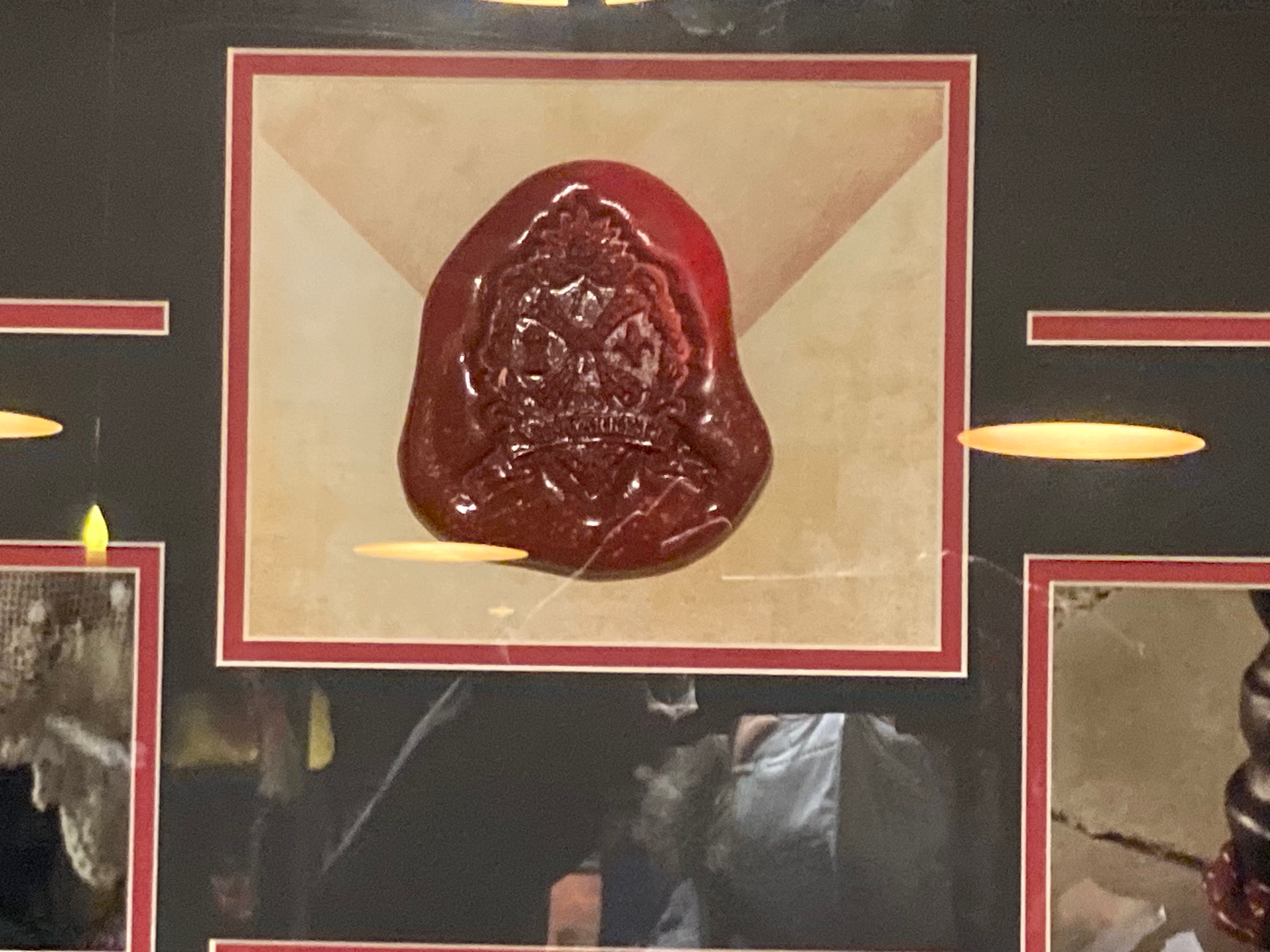
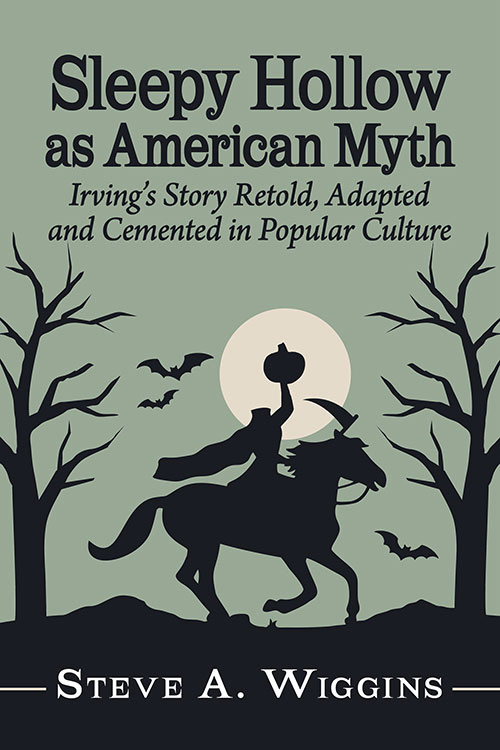
A Nightmare in New Hope is a fairly intimate space.  The owner told us that the collection will change and grow, given that he’s still collecting.  Having a particular interest in Tim Burton’s Legend of Sleepy Hollow—having a book (ahem) on the subject coming out soon (cough)—I was particularly anxious to see what props they had.  To make sense of this it helps to have seen the movie, but you’ll catch on, even if you only know the Disney version of the story.  There were three main items from the movie that they have on display.  One is the wax seal used for the Van Garrett will, used as the movie opens.  The seal is quite large.  Of course, movies substitute props from time to time, blended by celluloid magic.  CGI doesn’t leave as many tracks.

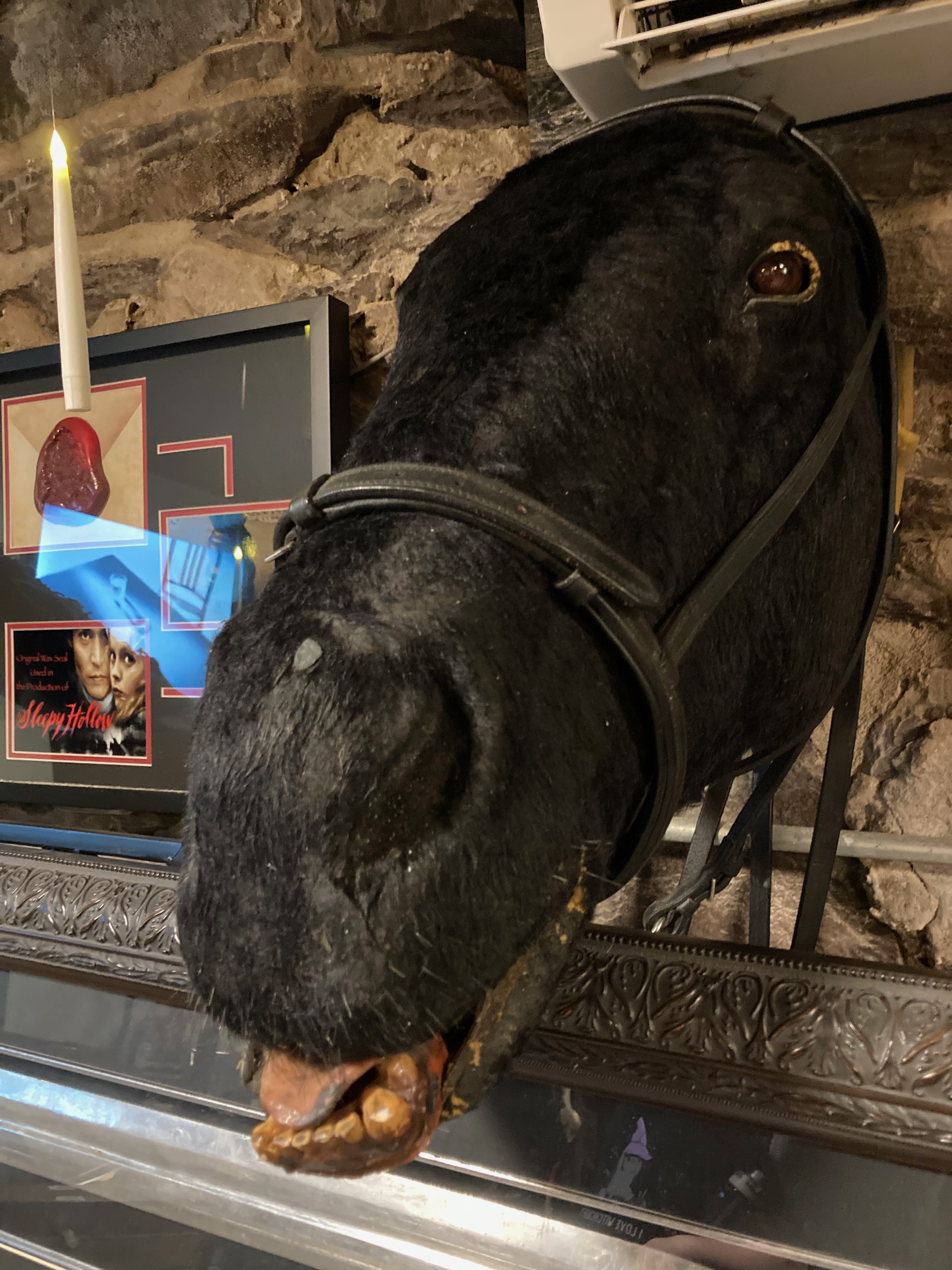
The second artifact is one that wouldn’t have occurred to me to have even existed.  This was the animatronic horse’s head for Daredevil, the Headless Horseman’s mount.  There are a couple scenes in the film involving horse acting, and I’d just assumed that trained animals were used.  Being up close and personal with this artificial head, a couple thoughts came to mind.  One is that right next to it, it’s quite obvious that it’s artificial.  The second thought was just how much thought and effort goes into a big-budget movie.  For a few seconds of a close-up horse head, this model had to be constructed and used and then set aside.  I asked the owner about how such things were acquired, and he noted that production companies don’t keep everything.  He also noted that movie artifact prices have skyrocketed.  Both because horror is now popular and because CGI, as noted, doesn’t leave tracks.

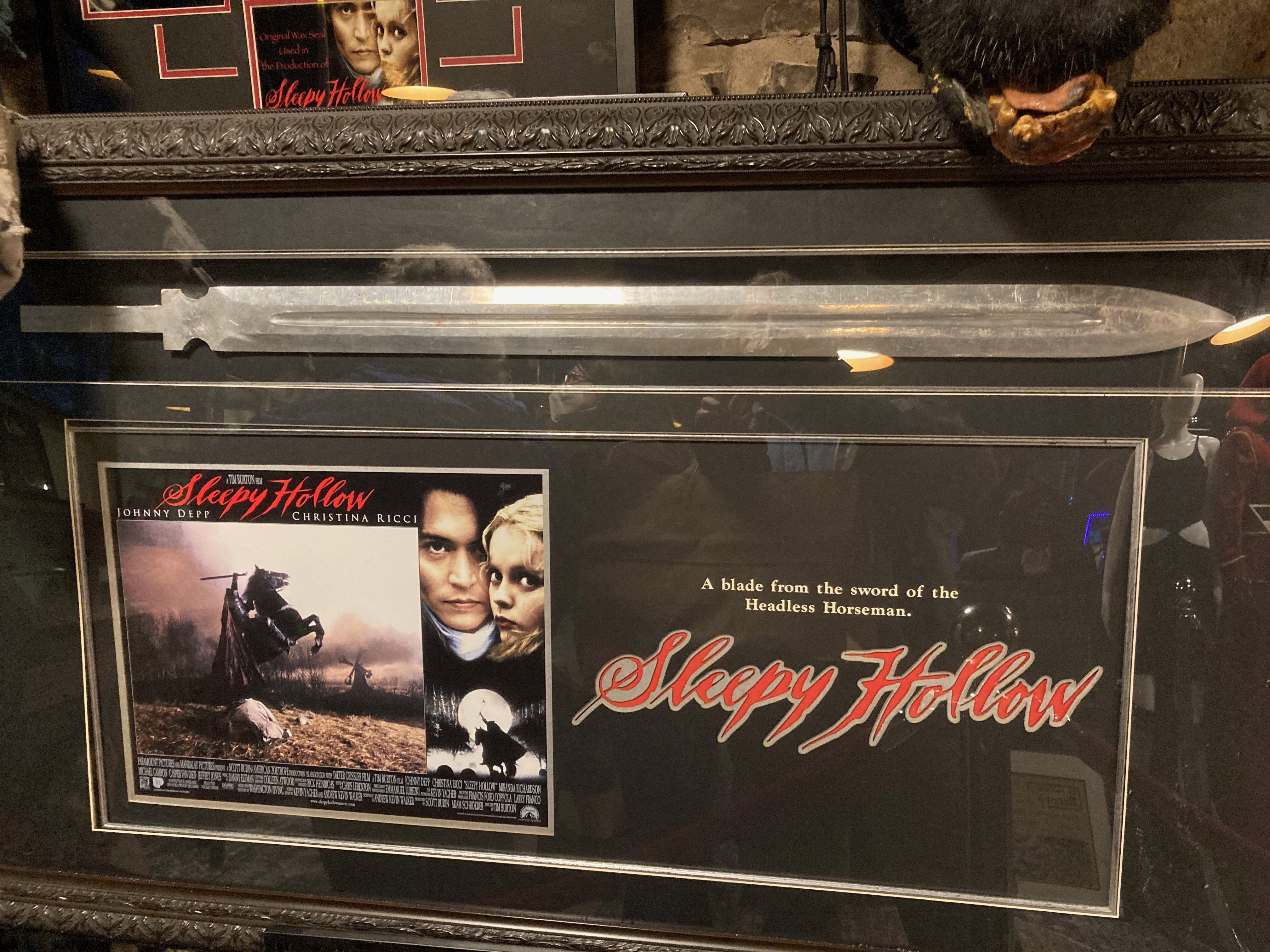
The third, and most proudly displayed Sleepy Hollow piece is the Headless Horseman’s sword.  This appears in the movie far more often than either Daredevil’s head or the wax seal.  One of the aspects of Washington Irving’s story I discuss in Sleepy Hollow as American Myth is that the Horseman’s weaponry changes over time.  I won’t say more since, like museum owners, those who write books hope that they well sell a few copies.  I’ll be revisiting A Nightmare in New Hope from time to time.  For the items on display, I’d seen probably 90 percent of the movies, and a few of them I’d discussed in some detail in either Holy Horror or Nightmares with the Bible.  Of course, the Sleepy Hollow book is forthcoming (ahem).


Pseudo-documentary

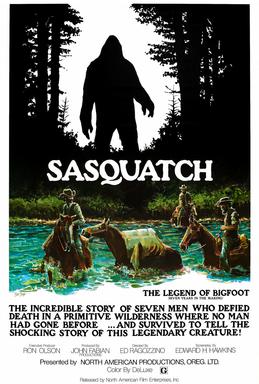
Documentaries have an honored place in visual education.  Of course, there are some who want to spice them up a bit with dramatic re-enactments.  These are sometimes called docudramas.  Then there are those who fake the documentary style to make mockumentaries, generally as a species of comedy.  Sasquatch: The Legend of Bigfoot is none of these.  A pseudo-documentary, it comes with “The Beast” collection I’ve mentioned before a time or two (mainly to excuse my bizarre viewing).  It presents itself as a documentary, but pretty much everything about it is fake.  The only real people are Roger Patterson—the movie shows his famous Bigfoot film—and perhaps the miners at Ape Canyon.  Oh, and Teddy Roosevelt.  In any case, the movie follows seven men as they make their way into remote British Columbia where “the computer” tells them sasquatch likely live.

The pseudoscience is easily enough spotted early on, but the movie never lets up its purported intent to bring low-budget proof back from the wilderness.  I’m not sure how the actual wildlife footage was captured.  In this slow-paced horror film there is quite a bit of actual nature thrown in.  I also wondered how they managed to get a cougar to attack a horse train and a bear not to maul one of the incompetent actors.  These two scenes aren’t special effects, and it strikes me as being either foolhardy or that trained animals were used.  It doesn’t seem to have had the budget for the latter, but a real mountain lion does land on one of the horses before quickly making an escape.  Although shot at night, the bear attack doesn’t seem entirely fake.  These things kept me wondering.

After about two months of horseback riding the crew makes it to the computer-predicted sasquatch homeland.  Bigfoot attacks the camp at night—no question that this one is fake—and after all these weeks of riding they decide to leave the next day.  Getting there is, apparently, most of the fun.  Fun, however, isn’t a word I’d use to describe this movie.  The hokey caricature characters (the old-timer, the dopey cook, the injun, the scientist—who does nothing but measure a thing or two) are worth a pseudo-laugh or two but the story struggles to keep the viewer awake on a cold weekend afternoon.  I kept wondering, in the Pennsylvania chill, how the weather in northern Canada was better in late September than it was around here in April.  I had to remind myself that Bigfoot was big in the seventies.  Big enough to handle both documentaries and fiction, and movies that are the latter, pretending to be the former.


Not Schrödinger’s

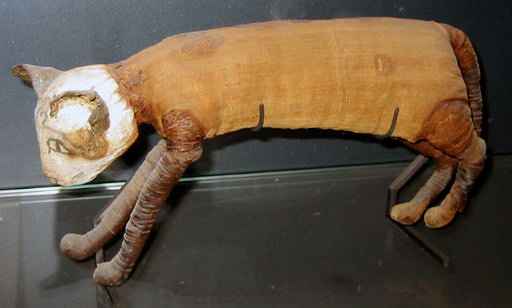
It’s quite a dilemma.  It’s Schrödinger’s cat without the box.  Well, it’s a dead cat in my yard.  It’s not my cat and I only know about it because the next-door neighbor saw it while out mowing.  (It’s on the thin strip between our houses and we seldom make our way over there.)  Death is always a problem.  I don’t want to bury it since it looks like it was a pet.  Said neighbor is the only one I know around here but I know some pets have tracers/implants to help owners know if something happens.  So I tried calling the local animal control companies.  They don’t deal with cats.  There is a county service, in the next town over, but we’re across the border in a county that doesn’t deal with cats or dogs.  The DOT won’t get involved unless they’re on the street.  The local municipality also handles them only on the street or sidewalk.

Now, I own a shovel and I’m not afraid of hard work.  I am a bit squeamish, though.  I’ve handled half-squirrels from some hawk with eyes bigger than its stomach.  I also have to take care of dead birds and squirrels that get into the garage.  This is a bit bigger than I’m used to.  I’m not even entirely sure if it’s a cat, really.  Once an opossum got into our compost bin and the fur looks like it could be an opossum.  It doesn’t smell bad, though, and possums don’t have the most pleasant bouquet even when they’re alive.  The flies seem to like it okay, however.  The space between our houses would be challenging for the turkey vultures I see around daily.  They must be mad with frustration circling up there.  If it’s somebody’s pet I’m sure they’d like to know, but it’s looking like I’ll be digging—but you’re supposed to call Angie first, right?  In case of buried cables?

Death is entirely natural.  Ironically, I live two blocks from a pet crematorium.  I wonder if they make house calls?  Then again, it wouldn’t be cheap.  We expose ourselves to loss when we bring pets into our families.  My own beloved childhood beagle was hit by a car.  Meanwhile, I know that we shall all meet on that beautiful shore, by and by, and when we do I hope someone recognizes their cat from this side of the vale of tears.  Or at least outside of Schrödinger’s box.

Image credit: Greudin, public domain, via Wikimedia Commons

Thinking of Home

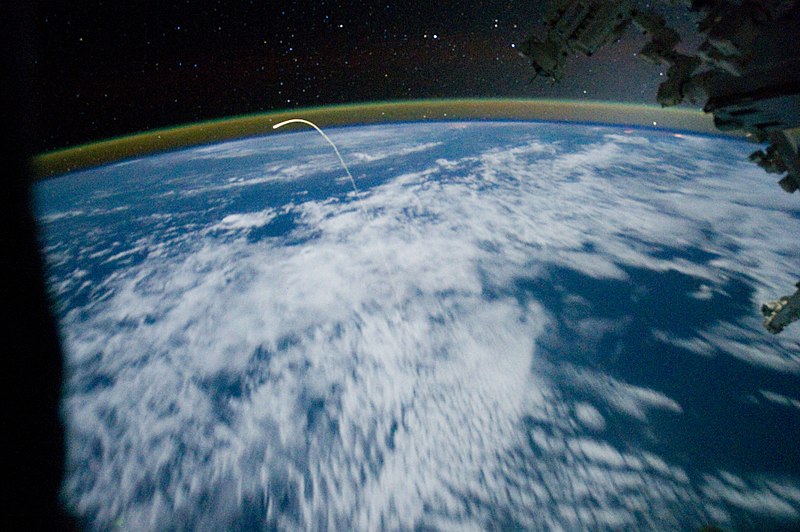
The earth, and even life on it, will, I’m confident, outlive our petty desires for money and being the king of the hill.  Scientists are getting tantalizingly close to demonstrating something that many of us already know—life exists elsewhere.  Chemical signatures of life appear as close as Venus and as far as K2-18b.  I suspect our universe is full of life.  And life is more than just rationality.  We’re creatures driven to survive and that level of will appears to be universal.  As Ian Malcolm says, “Life will find a way,” or something similar.  Earth Day should be a celebration but under too many Republican presidents it has become a plea to please stop intentionally harming our planet.  I grew up in that distorted religion known as Fundamentalism.  I learned that the destruction of the world was necessary to force God’s hand with the second coming.  The planet was here to exploit and waste since he’ll be back any day now.

Unlike many of my cohort, I decided to learn more about that perspective.  The more I learned the more shocked I became.  A warped and twisted message had been passed along as Gospel truth, and that the care the creator bestowed upon creation was merely a smokescreen to hide Jesus’ return.  I still believe we are not capable of completely destroying the planet.  Life will continue with or without us.  Life is persistent and hopeful.  That doesn’t mean we shouldn’t take care of it.  Earth Day has become a rallying point for those who see the world sensibly.  We have so much wonderful life on this planet.  In our arrogance and in our tendency to take mythology literally, we have assumed the worst.  Why not take care of what we were given?  Jesus may not come back, but perhaps the Lorax will.

There are ways to live sustainably on this planet.  It does mean that some of the richest will need to surrender some of their wealth and power.  We need to learn the habits of requiring less and appreciating more what we have.  Like most people born into the world in this era, I struggle against the desire for new things.  Novelty is natural to such curious creatures as ourselves.  But there are other such curious creatures too.  They have a place here, even as those which seem to have no curiosity do.  It’s a planet big enough for all of us.  We just need to be sensible about it.  And remember the earth today and be thankful for our home every day.

Image credit: NASA/ISS Expedition 28, public domain from Wikimedia Commons

O Levels

Out jogging last week, I was thinking about a harsh interview I once had.  It was in Manhattan.  The woman interviewing me made no attempt to hide her disdain.  I’m not sure if it was for me personally or what I represent.  She did not smile at all, not even for the usual niceties.  She asked me whether I was better at speaking or writing.  I said they were about equal.  “No,” she briskly corrected.  “Which is it, one or the other?”  This came to me while jogging because I was reflecting that public speaking and writing are really the only two things I’m any good at, and I have worked on both for my entire life.  These years later I still can’t say which is stronger.  That was appreciated by my students and fellow scholars in my teaching career, if reviews are anything to go by.  I like to communicate.  (My wife might say too much so.)

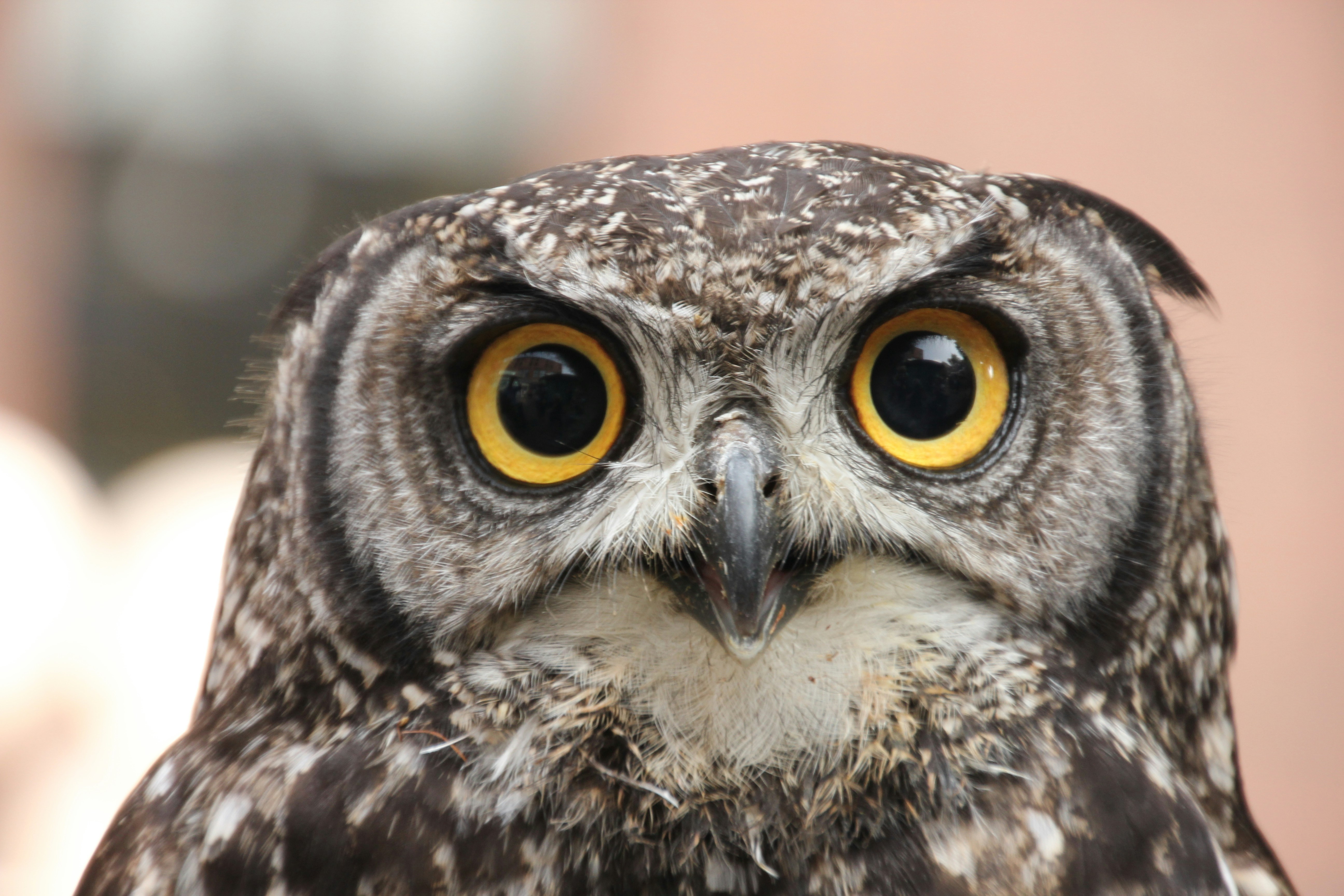
Owls are difficult to spot in the wild.  Just last week I’d seen only my second in some sixty years.  This was a screech owl.  It’s not unusual to hear them when jogging at dawn.  This time my right ear picked up on it more than my left as I jogged past a grove of trees.  I looked but saw nothing.  The trees were budding and some had small leaves already.  I reckon I’ve seen my fair share of bald eagles.  They’re large and they’re pretty obvious when they’re in the area.  Owls are more secretive.  Good at hiding.  I reached the end of the path and turned around.  As I reached the stand of trees, now on my left, it screeched again and I saw a blurred flapping of wings as it disappeared in flight.  I couldn’t identify this owl in a line-up, but then again, that’s not something I’m good at. The voice is distinctive, however.

The person hiring is a bald eagle.  Bold, aggressive, and sometimes literally bald.  I’m more like that screech owl.  Their public speaking is distinct and isn’t really a screech at all.  I can’t speak for their writing ability.  Life is our chance to come to know ourselves.  We may think we have it figured out in our twenties, but each score of years makes you question past assumptions.  Two things I always thought would be part of my career—public speaking and compelling writing—have both fallen by the wayside.  At least professionally.  What we say to others has an impact.  Especially if we’re eagles.  All things considered, however, I would rather be an owl.

Photo by James Toose on Unsplash

More Rats

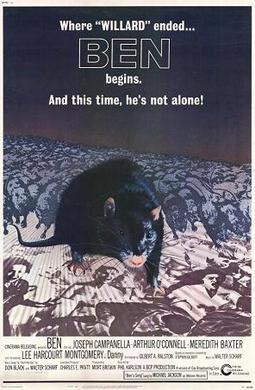
I’ve asked other survivors of the 1970s if they knew that the Michael Jackson hit “Ben” (his first solo number one recording) was written about a rat.  Most had no idea.  The song is the theme for the sequel to Willard, namely, Ben.  Now, I have a soft spot for seventies horror movies.  Before the days of streaming I repeatedly looked for Willard in DVD stores and never did find it.  I eventually found it on a streaming service and even wrote a Horror Homeroom piece on it.  One winter’s weekend with not much going on, I finally got around to seeing Ben.  Neither are great movies, but I’ll give them this—people in my small hometown knew about them.  Everyone I grew up around knew that “Ben” was a song from a horror movie.  In case you’re part of the majority, Ben is the chief of the intelligent rats who turns on Willard at the end of his movie.

An incompetent police department and other civil authorities can’t seem to figure out how to exterminate rats when they begin attacking people.  A little boy, Danny, has no friends.  He is apparently from an upper-middle class family, and he has a heart condition.  Ben finds him and the two become friends.  Danny tries to get Ben to lead his “millions” of rats away from a coming onslaught, but for some reason Ben decides to stick around and nearly get killed.  In the end, badly injured, Ben finds his way back to Danny.  Cue Michael Jackson.  It really isn’t that great of a movie—the number of scenes reused during the tedious combat scene alone belies the pacing of a good horror flick.  I felt that I should see it for the sake of completion.  Check that box off.

It’s a strange movie that ends up with viewers feeling bad for the rats.  They’re not evil, just hungry.  They do kill a few people (poor actors, mostly) but it’s often in self defense.  The best part is really the song, and the premise behind it—boy meets rat, boy falls in love with rat; you know how it goes.  Michael Jackson famously loved horror movies, and as many of us have come to realize there’s not much not to like.  This movie is pretty cheesy (with the rats attacking a cheese shop, but only after an unintentionally hilarious spa scene) but it has heart.  And it has a fair bit of nostalgia for those of us who grew up in the seventies.


Call Me AI

Okay, so the other day I tried it.  I’ve been resisting, immediately scrolling past the AI suggestions at the top of a Google search.  I don’t want some program pretending it’s human to provide me with information I need.  I had to find an expert on a topic.  It was an obscure topic, but if you’re reading this blog that’ll come as no surprise.  Tired of running into brick walls using other methods, I glanced toward Al.  Al said a certain Joe Doe is an expert on the topic.  I googled him only to learn he’d died over a century ago.  Al doesn’t understand death because it’s something a machine doesn’t experience.  Sure, we say “my car died,” but what we mean is that it ceased to function.  Death is the overlay we humans put on it to understand, succinctly, what happened.

Brains are not computers and computers do not “think” like biological entities do.  We have feelings in our thoughts.  I have been sad when a beloved appliance or vehicle “died.”  I know that for human beings that final terminus is kind of a non-negotiable about existence.  Animals often recognize death and react to it, but we have no way of knowing what they think about it.  Think they do, however.  That’s more than we can say about ones and zeroes.  They can be made to imitate some thought processes.  Some of us, however, won’t even let the grocery store runners choose our food for us.  We want to evaluate the quality ourselves.  And having read Zen and the Art of Motorcycle Maintenance, I have to wonder if “quality” is something a machine can “understand.”

Wisdom is something we grow into.  It only comes with biological existence, with all its limitations.  It is observation, reflection, evaluation, based on sensory and psychological input.  What psychological “profile” are we giving Al?  Is he neurotypical or neurodivergent?  Is he young or does his back hurt when he stands up too quickly?  Is he healthy or does he daily deal with a long-term disease?  Does he live to travel or would he prefer to stay home?  How cold is “too cold” for him to go outside?  These are things we can process while making breakfast.  Al, meanwhile, is simply gathering data from the internet—that always reliable source—and spewing it back at us after reconstructing it in a non-peer-reviewed way.  And Al can’t be of much help if he doesn’t understand that consulting a dead expert on a current issue is about as pointless as trying to replicate a human mind.


Littlefoot

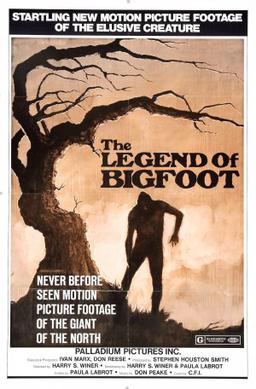
A film is an object.  Just like a book, a film exists and waits for someone to discover and promote it.  The vast majority of both don’t make the cut and exist in obscurity.  The Legend of Bigfoot by Ivan Marx is one of those obscure films.  I only knew of it because it was included in the DVD pack called “Beast Collection,” which I’ve already mentioned a time or two.  This set of movies is united by a few different themes which have little to do with one another.  The “Bigfoot Terror” disc includes Marx’s Legend although there’s no terror here and it presents itself as a documentary.    Interestingly, this movie actually had a theatrical release.  Of course, the mid-seventies were a high-water mark for Bigfoot interest in general, prior to the current phase.  Marx followed up his movie with a couple sequels and to his dying day claimed that his Bigfoot footage was authentic.

As far as the movie goes, it is just plain bad.  The wildlife footage, shot by Marx, is actually impressive a time or two.  Most critics dismiss his Bigfoot footage as a hoax, a view supported by the fact that the bona fide Bigfoot researchers he worked with eventually distanced themselves from him.  The movie is rambling and dull but intriguing at the same time.  It’s amazing, for example, that he was able to get this into theaters at all.  But what drove the producers of “Beast Collection” to include it, beyond it perhaps having been cheap and bit of filler on a disc claiming “approx. 5 hours of yeti scares”?  Well, it’s an object.  And it fits the theme of “yeti” but not really that of “Terror.”

There’s not a ton of information on Ivan Marx online.  IMDb has a mini-bio of him, noting the others who worked with him.  Even his wife, Peggy, who appears in the film, gets a little IMDb notice.  Such movies as this are hopeful artifacts.  Those of us who struggle against obscurity can take heart that, although probably a hoax, a movie that would otherwise likely have been forgotten made its way into a schlocky collection of horror movies to be purchased by the gullible and the hardcore.  As I mentioned in my post on Search for the Beast, I bought the collection to see Zontar: Thing from Venus, which, at the time, was available nowhere else.  I got what I wanted, and oh so much less.


Pet Theory

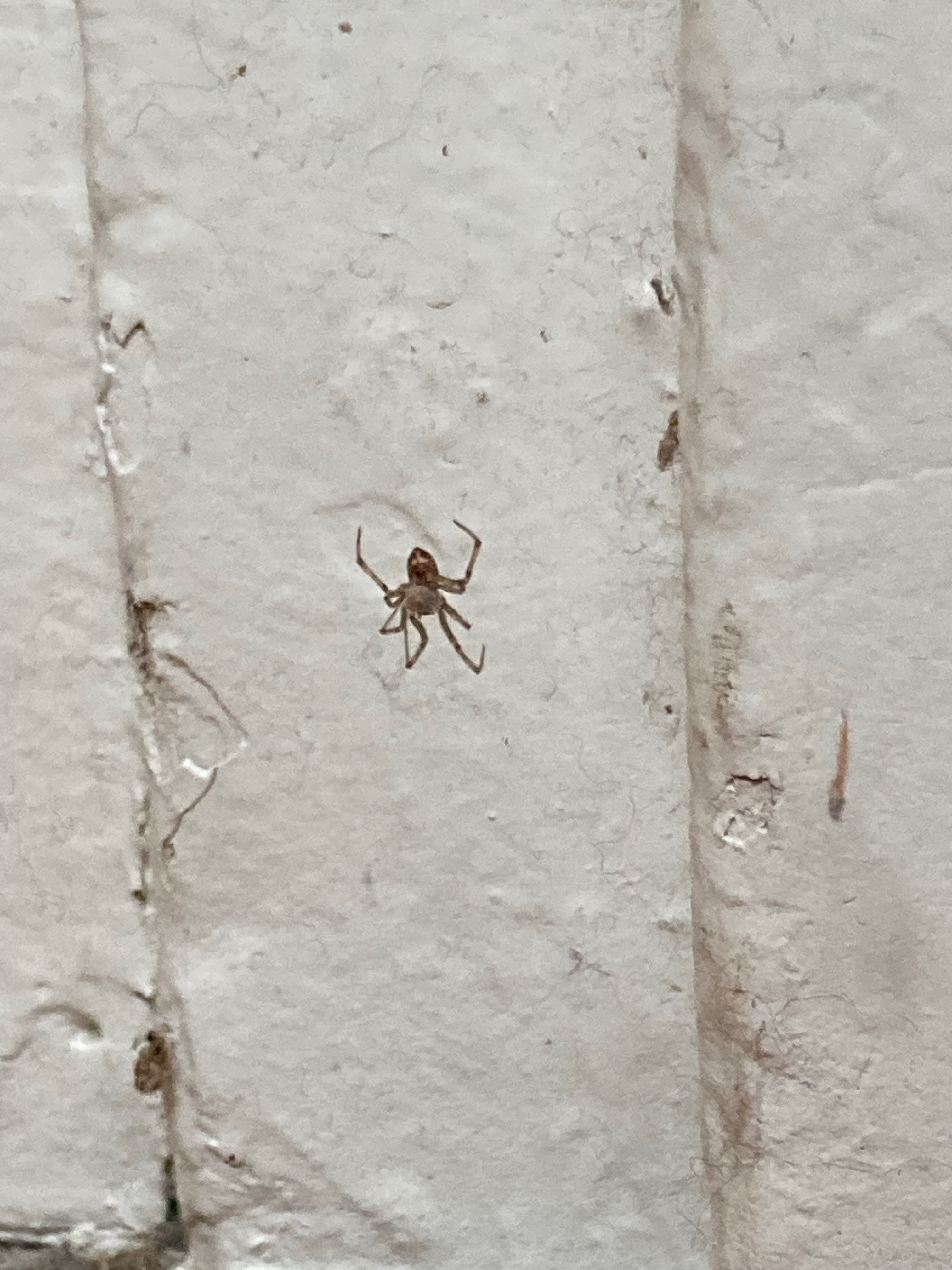
We don’t have any pets.  At least not beyond the spider near the sink that I don’t have the heart to release outdoors in winter temps.  But I have had.  I think the reasons our pets mean so much to us is that they’re like people in so many ways, but nonjudgmental.  They accept us with all our quirks and despite occasional—generally unintentional—neglect.  A recent family text chain about the sad occasion of having to put a dog down got me musing about my history of pets.  We get remarkably attached to them.  Growing up we had dogs, cats, birds, turtles, guinea pigs, fish, and we tried a short-lived attempt at hamsters.  My wife grew up with a cat but became allergic after leaving home, so we had to avoid furry pets when my daughter was young.

We had fish, hermit crabs, and a bird.  The bird, a parakeet named Archie (short for Archaeopteryx), was with us at a difficult time.  Things weren’t going well at Nashotah House, but I had no idea that I was in the cross-hairs.  Archie was a suspicious bird.  We tried to get him to talk (mostly “nevermore”) but he wouldn’t.  I tried to get him to perch on my finger—my Mom could get birds to do it—but he only ever bit me.  Still, he was part of the family.  When the seminary axe fell, he moved to two different apartments with us, remaining solitary but stolid in tumultuous times.  In the second apartment he stopped singing.  My daughter thought something was wrong, but we knew from a previous trip to the vet that we couldn’t afford another.  I was unemployed and my wife had to look for a better-paying job.  Then I found Archie dead.  That day is still, all these years later, very difficult for me to think about.  How we cried.  How we snuck back onto land owned by the seminary to bury him in the woods.  How empty our small apartment felt.

Emotions are difficult things, but they’re what bind us together as humans.  We all know loss and sadness.  Many of us have poignant memories of pets who, although we supposed we’d outlive them always thought they’d be there at least another day.  Is there anything that brings us more together?  We think anyone who doesn’t shed a tear at Old Yeller is somehow not really human.  Certainly less human than our adopted animal family members.  How wonderful not to be judged by someone who knows us perhaps better than we know ourselves.


CSI: Backyard Edition


Dateline: January 24.  Location: Backyard.  It was clearly a crime scene.  There were prints in the snow.  Blood.  Signs of a struggle.  The marks hadn’t been there the evening before, so I knew I was looking at a recent offense.  Two indentations in the snow, about 10 yards apart.  Too far for a small animal to have leapt.  A third impression, closer to the second.  Clear feather imprints in the snow.  Earlier on the day in question, I had observed a hawk in the white pine across the street.  Two angry blue jays strafed the interloper, but he appeared unintimidated.  He fluffed his feathers and surveyed the area, including, I presume, my back yard.  In his own time he left, in an unmarked flight.

In the morning, rabbit tracks.  The first impact had been violent.  Debris had been raised from under the snow blanket and scattered toward the southwest.  No footprints leading away from the site.  This led me to conclude the victim had been lifted into the air.  But why the second impact site?  There had been a struggle.  The victim, presumably of the Lepus genus, had tried to make a stand.  The second impact site had bits of blood toward the west.  Neither of these first two scenes of investigation bore any indicative hints to the identity of either the victim or the perpetrator.  I did not have the means to test the blood.  No tracks led from either impression.  The third site clearly involved a struggle.

Impressions of feathers, spread at least two-thirds of a meter across, remained clearly visible in the snow.  Between these wing prints evidence of a scuffle.  Perhaps an argument ensued.  No feathers or fur remained on site.  I had to piece this together before the snow began to melt.  What I am labeling site 1, the initial strike, was near a bush under which rabbits are frequently observed to rest.  A hawk, confident of its ability, swooped down in the night and apprehended the rabbit.  The victim fought back, enforcing an unscheduled landing.  Site 2.  Blood was drawn.  Site 3 was an easy rabbit’s leap from site 2.  Perhaps the rabbit escaped.  The wing and claw marks on the snow suggest that the victim did not survive this third attack.  No solid physical evidence could be recovered.  It was just too cold outside to go and look personally.  I am not paid enough to do that kind of work.  Or I could have it backwards.  Site 3 could be the initial strike, but my reconstruction seemed more likely  Either way, the backyard would, however, never feel safe again.