Bes Leave It Alone

One of the constant enjoyments of teaching is the interactive learning that takes place. I tell my students that I learn from them just as they learn (hopefully) from me. One place this has been happening regularly is in an Ancient Near Eastern Religions class I teach. Students have to provide weekly class reports on somewhat obscure deities that I chose for them to research. One of the groups was assigned Bes, the minor Egyptian protective deity, and their research had uncovered the suggestion that Bes may have originally been a cat-deity. As Halloween approaches with its plethora of black cats, I found this connection to be fascinating.

The Egyptians domesticated the cat, and revered it. The nimble catcher of vermin (although, in all fairness, vermin are only doing what vermin have evolved to do), the cat was seen as a protector. When in need, why not call upon a deified cat, an everlasting cat, if you will? It makes sense that Bes with his stubby proportions and bewhiskered face, often portrayed poking his tongue out, might have evolved from a feline original. His iconography often features leonine imagery as well. We may never know his true origins, but Bes was widely recognized in the ancient world as an effective protector.
Bes

Back in 1987 I volunteered as a digger at Tel Dor in Israel. This was my first exposure to archaeology, and I loved every bit of it. The digging, the expectation of discovery, the honest physical work, the endless bouts of Herod’s revenge — well, some parts were better than others. One of the artifacts I discovered was a sky-blue faience head of Bes intended, apparently, to be worn on a necklace (there is a hole drilled through his head). I also found two bronze seed-beads that went with the necklace in the same matrix. Often I have wondered who, in an Israelite context, wore that amulet of Bes and what fate befell the wearer nevertheless. Bes is paradigmatic of our trust in help from beyond, but every once in a while even Bes ends up being dropped in the dirt only to be dragged out again by some future cat.
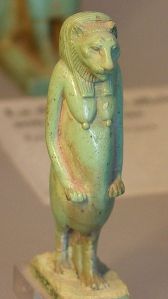
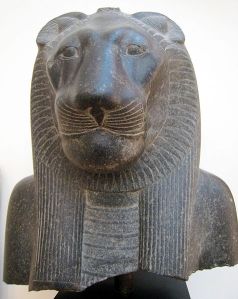
Evolution of Egyptian Cats

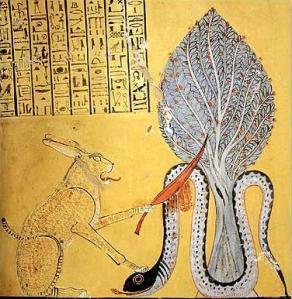
The Egyptians were the first people to “domesticate” cats. Perhaps taking their cue from their pets, they very early venerated cats as divine. Cats were, however, working animals that controlled vermin and poisonous creatures that violated the principle of stability that the Egyptians so valued. From the earliest records of the Old Kingdom we find the goddess Mafdet portrayed as a cat. Her name translates to “swift runner” and she was protector of Pharaoh, and thus of all Egypt. She was also associated with justice, a role reprised by Puss-in-Boots in Shrek 2. The hearts of evildoers were ripped out by Mafdet and brought, like a dead bird or mouse, to the Pharaoh.

Mafdet? (Don't give your kitty knives!)

Mafdet? (Don't give your kitty knives!)

Mafdet’s fame declined with the rise of Bast, or Bastet. Bast (“devourer”) was also an early goddess, associated with the sun, and like Mafdet, she was a fierce protector. Her cult was centered in Bubastis, a city named for her. The guardian of Lower Egypt, she kept the kingdom safe from cobras, scorpions, and presumably hair-balls. Unlike the gentle kitties of today, she was also represented as a lion, a goddess of war.

Bast, all grown up

Bast, all grown up

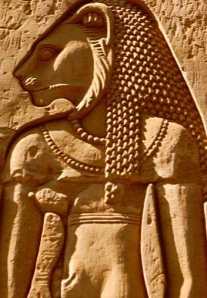
Bast’s fortunes faded with the rise of Sekhmet, the warrior goddess of Upper Egypt. With a name translating to “powerful,” Sekhmet was yet a third feline protector. She was also a lion-shaped goddess whose breath created the desert. (I have worked for human beings who could justifiably make that same claim.) Like Bast, she wore the sun on her head and became Egypt’s version of the violent goddess. Ancient peoples all feared the raging goddess, no matter what name or shape she took. Perhaps they always expected bad behavior from men, so when female deities got in on the act it was all the more powerful.

Sekmet with the breath that sank a thousand ships

Sekmet with the breath that sank a thousand ships

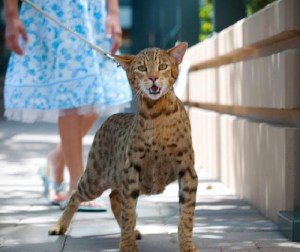
Where does evolution go from there? Is it merely coincidence that the Ashera Cat is part African Serval (as was perhaps the original Mafdet) and that it is being billed as the royal cat? I think not! Cats have a long pedigree with the divine, and from what I’ve been reading, Ceiling Cat has a very wide following. Evolution of the Egyptian cat, it seems, takes us from the Old Kingdom right up to Lolcats.


Origin of Dragons

The ancient Greeks often take the credit for concepts they borrowed from the Ancient Near East. When casting about for the origin of dragons, a staple, if unstable, element of ancient Semitic myths, the credit often lands in ancient Hellas. Those of us influenced by western culture prefer the Greek versions of myths because they tend to be (mostly) coherent and do not have large gaps like those scrawled on fragmented clay tablets. Also, the word “dragon” traces it etymology to ancient Greece where it apparently derives from the verb drakein, “to see clearly.” Often commentators suggest that the rationale for the name is that dragons guard treasure and need to see clearly to do so.

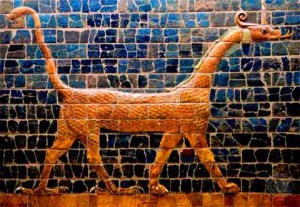
Babylonian dragon

Babylonian dragon

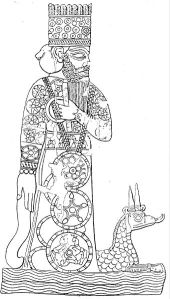
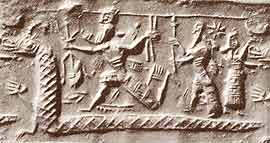
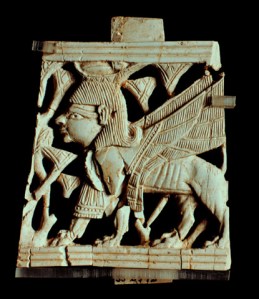
Dragons, however, actually first appeared, like so many western civilizations concepts, in Sumer. In the ancient world, what we would recognize as dragons are always associated with water. Water is an uncreated element, existing as the primordial substance from which everything emerges. It is personified as a dragon that must be subdued for creation to take place. Images of the dragon from somewhat later time periods in Mesopotamia already depict the familiar form we still recognize as draconian.

Marduk astride Tiamat

Marduk astride Tiamat

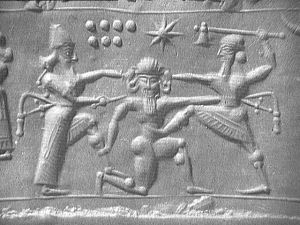
The Bible has its share of dragons as well, although they never actually existed. Tannin, whose name probably relates to serpentine features, is regularly cited as a biblical dragon. Leviathan, as described in Job 41, has scaly skin, lives in the water, and belches fire (perhaps having taken lessons from televangelists). These characteristics probably played into modern conceptualizations of the dragon. Fire breathing, however, is first attested with Humbaba, the Cedar Forest guardian of the Gilgamesh Epic. Humbaba is not a dragon, but he may be the ancestor of our fire-breathing Leviathan. Some ancient iconography may also show fire projecting from the mouths of dragons as well.

Humbaba (center) on a bad day

Humbaba (center) on a bad day

Traditional Mesopotamian dragon

Traditional Mesopotamian dragon

I would even venture to suggest that the origin of the name dragon could go back to ancient West Asia. The idea of seeing clearly reminds me of the ancient cherubim. According to Ezekiel, they are full of eyes. This complements their role as guardians of the thrones of ancient deities. Cherubim are Mischwesen composed of lions, eagles, humans, bulls, or any other spare parts lying around. In my imagination it doesn’t take much to shape them into dragons, the original watchers.

A true cherub

A true cherub

No matter who coined the word, dragons have been with us from the beginning of human civilization and continue to live on in popular culture. Maybe they are, like the unruly waters, truly uncreated.


Of Cats and Goddesses

During one of my periodic forays into current Asherah lore on the web, I discovered a new breed of cat. Well, actually, I didn’t discover it, I just became aware of it. Because of a misspelling on a website I learned that the Ashera (trademarked name!) is the most expensive cat in the world, retailing for $22,000. A blend of three species (the mind boggles), the African Serval, Asian Leopard, and domestic cat, this feline comes in at least three varieties, including the especially appropriate Royal Ashera. If you’ve come into an inheritance and want to waste a few grand, take a look at Lifestyle Pets to see the wonder.

According to Kirta she has a temper!

According to Kirta she has a temper!

Curious, I searched to find if anyone would tip a hand as to where the name of the cat was derived. Choosing the name of the queen of the Ugaritic divine world seemed a little too much coincidence for me, but then again, homophones happen. When the Prince of Egypt, Dreamworks’ answer to The Ten Commandments, was released, I had several people ask me why the Israelites were singing about “Asherah” after they crossed the Red Sea. I had to watch the movie very closely, but I figured out that they were singing “I will sing,” which, in Hebrew, sounds suspiciously like “Asherah.” I never did discover Ashera’s origins.

Cats, however often maligned as associated with witches and vampires and other creatures of the night, are certainly among the most divine of domesticated pets. If I were free to purchase an animal companion the Ashera would be in the ranking (after I’d won the lottery, of course). Whether intentional or not, who would not want to own a cat named after the only goddess to be mentioned in connubial relations both to El and perhaps even to Yahweh? (The latter association, like the naming of the cat, is entirely open to question!)


The Lady or the Lion

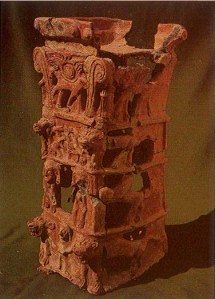
Ancient West Asian society utilizes a striking image that causes no end of confusion — the lady and the lion. Although not always identified, the lady generally appears to have been a goddess. Pairing a female figure with the most ferocious predator known in that society ripples with significance; there can be no question that the cultures involved were patriarchal, a fact of life in that part of the world at that time. If it was a man’s world, why depict the glorious lion with the feminine? Because we fear what we cannot control?

The infamous cult stand from Taanach

The infamous cult stand from Taanach

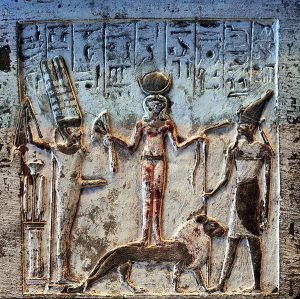
Ostensibly the rationale for this correlation may be traced back to Ishtar, the goddess sine pari of ancient Mesopotamia. The exact reason for her leonine associations is unknown yet she is among the fiercest females connected to warfare and strife in the ancient world. Her lion companions ranged over the realms of the Levant where other goddesses also assimilated her imagery. Curiously, one goddess who has no specifically leonine attributes is Asherah, the consort of the god most high, El. In Egypt the fierce goddess associated with war was Sekmet, often portrayed with a curiously male lion head.

Min, Qedeshet, and Resheph — a ménage à trios?

Min, Qedeshet, and Resheph — a ménage à trios?

In an earlier post I suggested that the biblical prophet Amos may have known that lionesses generally make the kill. Could it not be that although most women were locked out of public power structures in the ancient world they still may have retained the utmost respect and reverence of the populace? Long before male monarchs claimed titles such as “Lionheart” even gods would tremble before an enraged goddess. Morphed through time and continued patriarchal culture, the connection once again recurs in Frank Stockton’s The Lady or the Tiger where the metaphor has lost its teeth and the lady is no longer the source of destruction, but of male desire. Has the male prerogative once again usurped feminine independence? If only Ishtar or Sekmet could have been behind door number three!

Behind door number 3

Behind door number 3


Shades of Asherah

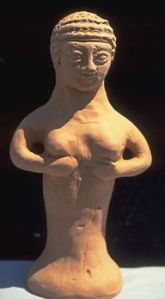
When my book on Asherah was first published in 1993, some reviewers criticized my humble effort to sort out the identity of this goddess without resorting to iconography. As I had anticipated this, in the text itself I provided what I thought was a reasonable rationale for my decision. It is a sad fact that ancient polytheists seldom captioned their imagery. Some images so clearly resemble the character of deities described in the myths that correlations are almost certain. Asherah, alas, lacks that privilege.

Could be anybody's mommy

Could be anybody's mommy

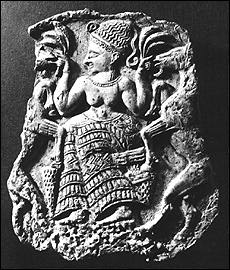
No item from ancient West Asia has yet been recovered that bears an inscription identifying the portrait as Asherah. We simply do not know what the ancients believed she looked like. This hasn’t prevented modern scholars from assigning an Aserah value to certain favored artifacts with a great deal of certainty. So much certainty, in fact, that we don’t know which certainties to trust. If iconic emblems for Asherah existed, that might provide a way of connecting images to the goddess. Unfortunately, snakes, lions, and “twigs” — the usual suspects — could fit just about any goddess with a little twisting. So we are forever left with iconic ambivalence.

May be Asherah, but what's with the goats?

May be Asherah, but what's with the goats?

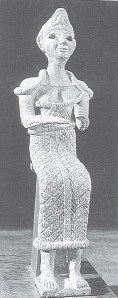
Of all the artifacts recovered from the Levant, where Asherah was actively worshipped, only one, it seems to me, is a potentially clear match. Not as alluring as the Asherahs of popular imagination, she is actually described as a matronly figure, the consort of patrician El. The El images that seem beyond question illustrated him comfortably seated on his throne of state, hand raised in a sign of blessing (or waving good-bye). One image found at Ugarit presents a feminine counterpart in posture and pose. This is likely the image of Asherah. Younger, sexier goddesses need not apply. This one instance reminds us of just how little we know of the immense divine world of Ugarit. If we are careful in our explorations, however, there is much to be learned.

Like hubby like wifie

Like hubby like wifie


Animal Alarm

Where was Moses when the lights went out?

Where was Moses when the lights went out?

After undergoing a bout of oral surgery earlier this week, even before the nitrous oxide wore completely off, I pulled George Orwell’s Animal Farm off the shelf for a re-read. I hadn’t read it since at least 1984. It was even more disturbing reading it this time just off the Bush-Cheney years, and I realized that the Napoleons and Squealers are still with us. As a prophet Orwell may not have always got the dates right, but he was clever at spotting trends.

In this reading of Animal Farm a minor character leaped out at me. Among the tame, but non-domesticated animals was the raven Moses. Moses is the special favorite of farmer Jones and tells the animals of Sugarcandy Mountain vaguely up in the sky, where conformist animals go when they die. When the rebellion takes place, Moses flies off and remains absent until near the end of the story when the situation has deteriorated. Once again he is back to tell the others about Sugarcandy Mountain. The connection between Moses and Mount Sinai is transparent, although the heavenly connection is slightly misplaced.

The Hebrew Bible (certainly in the period of Moses) does not recognize what will become the Christian concept of Heaven. Like many ancient West Asians, they supposed that Yahweh lived “up there” at times (at other times he lived in the temple, or on the world at large, or atop some mountain). The “heaven” they knew of had no place for dead humans; the afterlife was a concept that developed very slowly. Moses’ motivation for the ancient Israelites, however, also resonates in Animal Farm, even as it does in the startlingly similar film Chicken Run — freedom. Freedom is the pipe-dream of many religions, but even as early as Moses those dreams run into regulations. Religions have laws long before they have heavens. Perhaps Orwell was onto something after all.


For the Love of Aqhat

It seems that a new season of The Simpsons is upon us. With the release of season twelve on DVD last week, recession-ridden families everywhere are piling up on their couches to be entertained. Initially I had a hard time accepting The Simpsons; I had seen too many failed adult cartoons to give me much encouragement that this would be something worth wasting my time on. Surprisingly, it became clear after just a couple of seasons that The Simpsons was witty, smart, and surprisingly ethical. This final point was so pronounced that Mark Pinsky wrote a book focusing on it entitled The Gospel According to The Simpsons (Westminster John Knox, 2001). As to be expected in a book with a foreword by Tony Campolo, it was a little devious, but still retained a kind of sugar coating. Nevertheless, I found the book worth reading.

Bart after the birds?

Bart after the birds?

The Simpsons frequently pokes fun at all of us who take ourselves too seriously. Most of the time it is evident that the writers have done their homework as well, pulling in sometimes obscure references to classical or biblical literature. Recently while watching the episode entitled “Bart the Mother” I was struck by an ancient theme which was surely accidental. In the episode, Bart, trying to prove himself to the neighborhood bully, shoots a mother bird with a b-b gun. Guilt immediately sets in and Bart is haunted by his cold-blooded act. In a dream he sees a bird tribunal doling out the punishment for his crime — having his face pecked off. I’m sure this owes more to Hitchcock than to Ugarit, but I can’t help shaking the idea that the scene is somehow informed by the Epic of Aqhat. In one of Ugarit’s classic stories, Aqhat is given a divine bow that is coveted by the goddess Anat. When he won’t relinquish it, Anat has Aqhat pecked to death by raptors, “twice upon the noggin, thrice upon the ear!” Ugarit remains shrouded in cultural obscurity, so no easy cultural reference can point to it. Everyone has seen Hitchcock’s The Birds.

The story of Aqhat, although sadly broken, is a classic of ancient literature. So much more to pity is that it remains nearly as unknown today as it was while buried under the ground for three and a half thousand years. A colleague of mine approached Penguin a few years back trying to pitch the idea that they sell a translation of the Ugaritic texts in their classics series. They flatly turned him down on the basis of “no public interest.” If the publishers won’t put these world heritage classics out there, how will there ever be interest generated? Perhaps those of us bitten by the Ugaritic bug simply circulate in circles too small to have any impact on what the world thinks. Beyond a few souvenir-hawking vendors in Syria and a few crusty scholars sheltered away in dusty academic libraries, nobody knows the story. It seems that Aqhat’s fate is equally grim — pecked to death by birds and completely forgotten because the story just doesn’t possess sales potential.


This Fair’s for the Goats

“County fair, county fair, Everybody in town’ll be there, So come on, hey we’re goin’ down there …” Thus begins the chorus of Bruce Springsteen’s little-known song “County Fair.” (It is one of the bonus tracks on The Essential Bruce Springsteen.) The haunting melody of what might otherwise be a carefree summer song is enhanced by the fact that my wife has been staffing a couple of 4-H County Fair booths over the past weeks and I don’t get to see much of her with the long hours. While at a recent fair she pointed something out to me that, not having much experience on a farm, I had never known. Abattoirs employ goats in a specialized animal herding role. The animals in a stockyard, usually sheep or cattle, get familiar with the goat and learn to follow it. The goat is trained to lead them to their deaths while it is spared. The industry term for this animal is a Judas Goat.

It's a goat's life

Slaughter House Rock

Although the origin of the name is obvious, the practice strikes me as insidious, if justifiably biblical. Training an ignorant animal to lead more gullible animals to their premature demise — it sounds a little too much like Pat Robertson to me! Is this sending in a goat to do a man’s job? Then to saddle the poor creature with the title of Judas, as if the poor thing planned it! Yet another reason to be glad I’m a vegetarian!

The Bible is pervasive in and paradigmatic for our culture. I might even term it endemic. As many children grow up without the biblical force-feeding that many of those in my generation had, these images and metaphors may eventually go extinct. Or perhaps there will always be a goat to lead them back to a Bibliophile culture. The county fair itself might be instructive. Originally instituted in Roman times as periods of relaxation from labor (rather pointless for those of us not gainfully employed), fairs evolved into opportunities for individuals and companies to display their wares and goods. From a practical point of view there is little you can see at the fair that you can’t find quicker or cleaner on the internet. But the internet lacks that human element. Perhaps we are really all just glad to go with the crowd sometimes without even asking where the goat is leading us.


Thy Will Bee Done

Today I had to do battle against the bees. That’s the way I must steel myself for the task of mass specieocide. Watching those little tiny creatures struggling, kicking their six legs and antennae into the air, trying to get the poison off is heartrending to me. They are, after all, only trying to do whatever it is that yellow-jackets do. But it is a heat wave right now, and without central air we need to open windows as much as possible, and today they tried to invade people air space. I had to do something. So standing over the carnage of an Ezekielian valley of damp exoskeletons, I recalled the bees of the Bible. (May their entomological souls rest in peace.)

Bees are one of the more innovative weapons in the divine arsenal. They are used to chase people away, like God’s little army of armored stinger missiles. And as in any arms race, it is numbers that count. Hundreds of them to the one human being holding a putrid can of chemicals trying to defend home against their incursions. In the book of Judges, the one prominent female judge is Deborah. Her name translates to “bee.” She is the bane of the Canaanites. So much so that general Barak (“lightning”) refuses to go to war without her. Bees were a potent curse in ancient times as well, strong enough to drive a family from their home.

Bee careful around this one, because love hurts!

Bee careful around this one, because love hurts!

A Sumerian cylinder seal depicts what appears to be a divine scene with a killer bee goddess (not an Africanized killer bee, but a slang killer bee). One wonders what the worshippers must be thinking. Perhaps they too had watched Phase IV when they were kids! Bees could also be benevolent. Honeybees provided a rare treat before sugarcane had been discovered, and even Israel’s “promised land” flowed with milk and honey. So like most of life, bees were ambiguous. They bore all the markings of the divine: a wonderful sweet residue, nice trendy color scheme, but a painful sting that could even be fatal. Gifts of the gods are like that. So no matter how humane my temporary solution may be, I still feel like I’m taking on the gods.


More Biblical Cats

In the Bible there are no cats. This silence is odd since cats have been associated with humans for over 9,000 years. Large felines, of course, appear in the Bible; lions and leopards prowl sacred writ, but nary a housecat. In a world of subsistence farmers, the concept of a “pet” is also absent — an animal as part of the household is yet another mouth to feed. The closest we get to biblical pets is in Nathan’s parable to David about Bathsheba. Here the “pet” is a lamb — a potential source of wool and almost certainly a funeral involving roasting and possibly mint sauce.

The Israelite view on animals is difficult to assess fully. Clean and unclean classifications seem to relate to predatory behavior and “fitness” for an environment. As a notorious but useful predator, cats could have been somewhat of a religious embarrassment. Having tamed feral cats, I know that the key is to make repeated offerings to a cat (by the way, this is the advice of Old Deuteronomy in Cats). Being quite self-sufficient, cats can find what they need without human, or divine intervention, thank you. Perhaps feline behavior resembles that of the gods a little too much for people inclined towards henotheism?

In the beginning was the cat

In the beginning was the cat


The problem with predators is no one knows what they’ve been eating. Predation involves bloodshed and blood pollutes. Look at what the cat dragged in! Biblical cats are victims of argumentum ex silentio — we can never know why they don’t merit a mention. As carnivores they are necessarily unclean. By the Middle Ages, for reasons still unclear, the church and superstition rendered cats as the familiars of witches. Ironically the associated killing of cats likely helped to spread the Black Death because of the removal of the flea-bearing rodents natural predators. In most ancient cultures cats are credited with supernatural powers. Since the Bible strictly guards this privilege, perhaps cats stepped just a little too close to divine prerogatives to merit a mention in the Good Book.


Everlasting Cats

“The mystical divinity of unashamed felinity, round the cathedral rang ‘Vivat!’ Life to the Everlasting Cat!” I’m not sure if this is T. S. Eliot, Andrew Lloyd Webber, or a chimeric mix of the two, but it is an interesting bit of mythology. My daughter is the consummate Cats fan and has been asking me to write a post on Cats and religion. When I read (or hear) the above lines of poetry, I must confess, my mind wanders to Xenophanes who stated that if horses could draw they would draw their gods like horses. Ditto for cats.

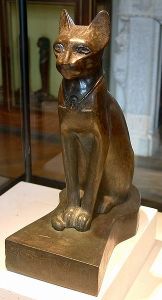
Everlasting cats, however, have their roots deep in religions of the ancient world. Although the word “cat” never occurs in the Bible (“dog” is there plenty of times, with even a “bitch” or two) cats are certainly within the biblical culture. Eternal Egypt knew of an everlasting cat — Bastet, the “cat goddess.”

Bast to see this as an everlasting cat

Bast to see this as an everlasting cat

Hailing from Bubastis, Bastet (I just can’t call her Bast, since it sounds like slathering meat with some kind of ambiguous liquid, something I can’t stomach as a vegetarian) seems likely to have some connection with the sun. Regarding yesterday’s post, the ancient Egyptians had a plethora, a veritable superabundance even, of solar deities. Bastet was called the Eye of Ra. She was also associated with war, appropriate enough to anyone who’s read Erin Hunter’s Warrior series. As a goddess, Bastet qualifies as an everlasting cat.
Little Bastie doesn't seem so playful any more

Little Bastie doesn't seem so playful any more


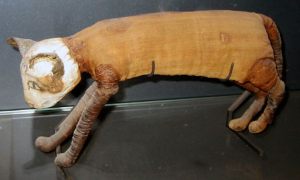
So do the numerous cat mummies from ancient Egypt. Preservation of the body was an aspect of realizing life beyond life for the Egyptians. It would also obviously help to keep the mice out of heaven. T. S. Eliot was C. of E. (Church of England, not Copt of Egypt) and had a savvy sense of wit. Ignoring the biblical snubbing of cats, he named the wisest and most respected of Old Possum’s Practical Cats with a biblical name — Old Deuteronomy. Although I am not a cat owner (is anybody really a cat owner?), I do have great respect for felines, mystical or not. And I am not alone as long as the ancient Egyptians kept a mummy or two around and an Eye of Ra to keep that solar barque on its course.


Religious Origins

There’s no question that religion is a distinctly human phenomenon. Although the concept of “religion” is used to lump together all kinds of belief and praxis systems around the world, it is now an aspect of every culture ever studied. When on an interview recently for a religion teaching post, I pondered whether to be entirely frank or to play it safe: should I discuss the origins of religion or a more conventional topic? (I went the safe route and did not get the job, if anyone wonders if there might be a moral to all this…)

For several years now I have been exploring whether it is possible to trace religion back to the animal coinhabitants of our planet. While my musings have taken me from singing Neanderthals to mourning penguins, it has become quite clear that at least the most basic levels of religion also exist in what is often termed “lower” life forms. My epiphany began while watching David Attenborough discussing the purpose of birdsong. Religion and music have been nearly inseparable in human experience (if one can overlook some extremist reformers). My thoughts turned to elephants who “bury” their dead with branches and penguins who clearly mourn the loss of their young — watch March of the Penguins if you doubt it! Death and religion have walked the long and disjointed journey of humankind hand in bony hand. By the time we get to primates we find baboons stopping to watch the rising sun (an act the ancient Egyptians supposed to be solar worship) and chimpanzees raging against thunderstorms as if they despise Baal even more than Hosea. A bonobo was recently documented as uttering the word “yes” to a keeper’s question, officially making her more articulate than some clergy I’ve known. Even today there are churches that still call their leaders Primates! For those who doubt that animals are capable of worship I would suggest the true acid test — purchase a dog.

The C of E's newest primate?

The C of E\’s newest primate?

We guard far too jealously that which makes us better than our animal companions. As observation and research progress and that line in the speciological sand grows ever more effaced, I wonder why religion might not have its roots in our very animal nature. While reading a book on biblical flora recently, I pondered if a even larger step back might be taken. Consider the heliotropes, for indeed they do toil and spin.