
A Passover celebration, courtesy of a friend:
Bell’s Hell
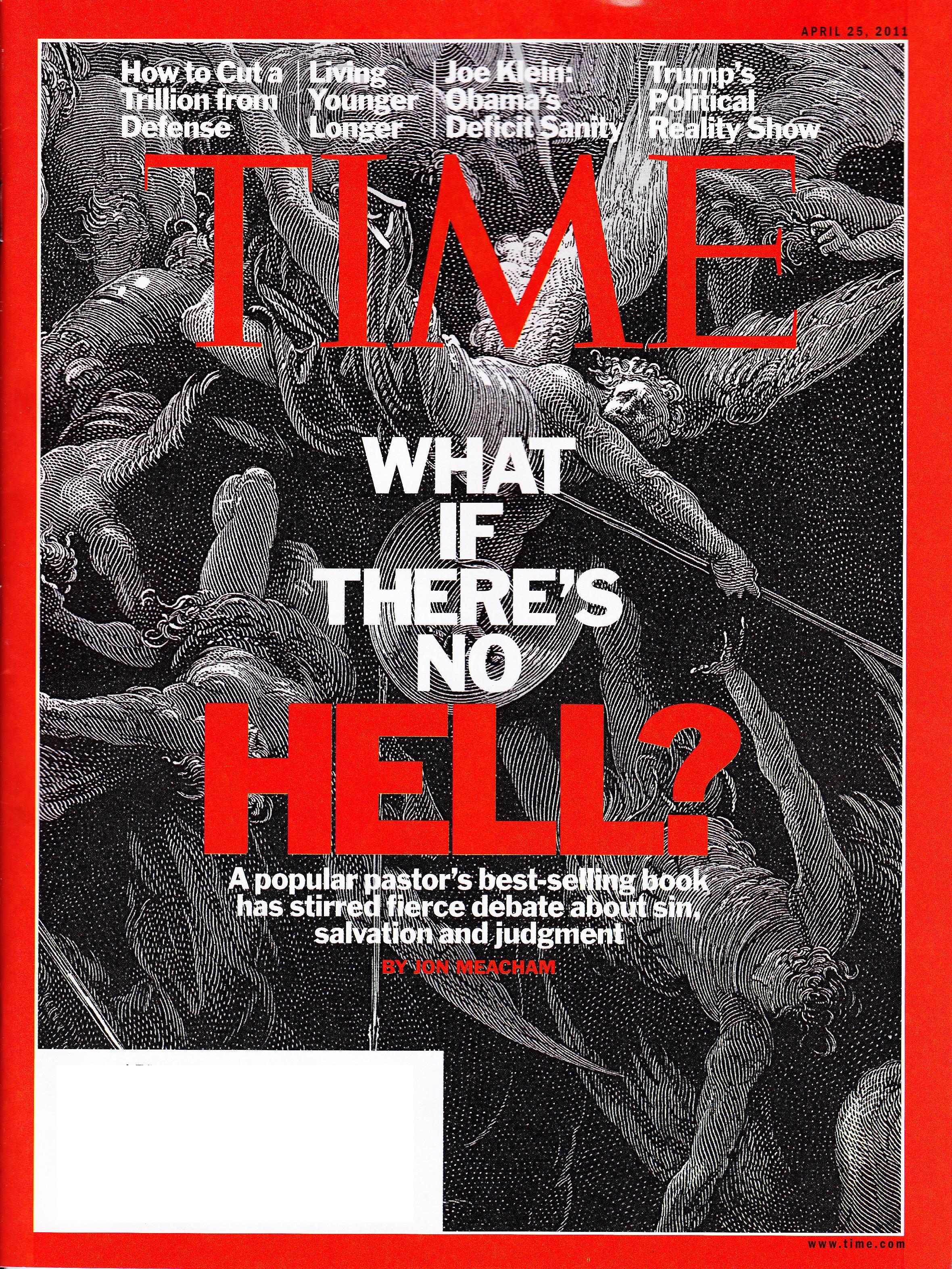
Hell makes the cover of Time. Or at least its absence does. For those of us who’ve delved deeply into the Bible for many years, it is no surprise. In fact, the uproar, as Time confesses, is among Evangelicals. So why Hell? Why now? The Evangelical pastor of Mars Hill Bible Church, Rob Bell, has just published a book questioning the existence of Hell and his fellow Evangelicals are in a conflagration about the loss of the sacred icon of God’s omnipotent stick that threatens them all into Heaven. It is a sad day when love cannot encourage enough that hatred becomes religion’s motivating factor.
The loss of Hell, however, represents so much more than just the loss of the scariest place under the earth. It represents the loss of control. Without Hell to wield and Hell to pay, many of the faithful may wonder what they might get away with. Neo-cons have been eager to court the Hell-mongers because the issue is making others lock-step in their own pattern. Diversity is not encouraged or appreciated. Lawns must be cut to the same height, trees carefully trimmed, shirts must be conservative and cookie-cutter, and one must wear that blessed smile that proclaims “Hell-dodger.” Cast any doubt into this fabled world and the results might be, well, realistic.
The Hebrew Bible knows no Hell but the one we make for ourselves. We hardly need a Devil to tutor us in the ways of evil. Human history reveals that we’ve had it in us all along. Instead of celebrating the death of Hell, several Evangelical pastors are simply adding Bell to its numbers. Time’s news is not news for many of us, but for those who haven’t considered seriously the implications of their faith as Holy Week rolls around, this may be a good time to take stock of options for eternity. What do we gain by fabricating an eternal torment devised by the most loving deity ever conceived? Hell can now claim its rightful place as a metaphor for the wickedness Homo sapiens devise for each other and for their planet.
Worshipping Religion
When does religion itself cross that invisible line into becoming the object of idolatry? In a world of an entire marketplace (“bazaar” might be a better word-choice) of religions, where each consumer selects his or her product, some take that choice with such conviction that the religion itself becomes their god. In ancient times religion was often a matter of ensuring that the gods were not angry. The average citizen had little control over this since the religious life of city-states and nations was the responsibility of the priesthood. Just pay your temple taxes and shut up. A religion anyone can live with. Last night as we discussed Jeremiah’s temple sermon in class the point became clear: even the God-chosen, fully approved temple in Jerusalem could become an idol.
Watching political candidates and parties and factions of parties posturing (apart from reminding one of peacocks and other showy birds) for possible election, they fly high the flags of their faith and hope that the market favors their brand. It is clear among many of their constituencies that the religions themselves have become objects of worship. How else can the rancor among a deeply divided Christianity (as only one example) be explained? Families and friends are torn apart by a common faith while ministers with the dubious benefit of seminary egg them on. Having been subjected to seminary as both student and instructor, I tremble when I think how clergy are trained. A holy nationalism pervades religions, transforming the faithful into armies that some, unfortunately, end up taking literally.
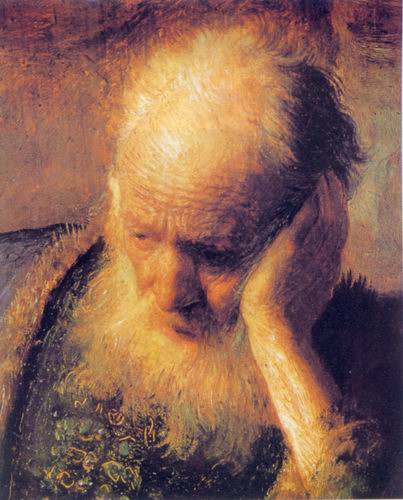 All the endless debates about religious violence and evolution and abortion should have taught us by now: no one has God in the witness stand. Our religions are our best guesses, no more, no less. In the face of great uncertainty many turn to the bravado of a faith that is willing to murder in order to prove its point. If God is really watching all this, perhaps a humble acceptance might be more appropriate? I think old Jeremiah might have agreed. Of course, he likely died at the hands of his own people who didn’t like his version of religion. That’s where the prophets have gone.
One Percent Solution
A colleague just pointed out an article in Vanity Fair that should be required reading for all Americans and it should be offered with a generous quaff of nepenthe. Please pardon any excess indignation you may find in today’s post. Whenever I’m teaching my course on the Hebrew Prophets I tend to get swept into the spirit of their oracular outrage. The latest statistics reveal that 40 percent of American income goes to only 1 percent of the population. Despite protests to the contrary, wealth does not trickle down like milk and honey (even though the latter takes its sweet time). The disparity between the ultra-wealthy and the middle class, as suggested by the article, has its closest analogues in Russia and Iran. Once the top is reached all political systems begin to look the same. Even President Obama’s budget will continue the legacy of tax cuts to the wealthy.
Where is the outrage? Americans are among the most complacent people in the world. Kept at the cusp of sufficiency, most people will not complain. Louis XVI himself could waltz into congress and be heartily greeted by his peers. All things being equal, if we the bottom 99 percent have enough then complaint is only sour grapes. All things being equal, however, is always hypothetical. All things are not equal. While many hard-working people are caught in a cycle of diminishing returns the bloated oligarchs help themselves to performance bonuses lofty enough to support hundreds of suffering families for a year. “Let them eat fake,” one can almost hear them say.
In the idealistic world of the Bible a pipe-dream was touted. Wealth itself is not evil, but it comes with an obligation. Trickle-down is a dried wadi in summertime. The wealthy are obligated to make certain that their fellow citizens all have enough. No one gets two houses before everyone has one. Once this level of fairness is reached, go ahead and get stinking rich. But that principle has never been realized. Those who have always require more. From those in such stratospheric positions magnanimity cannot be expected; for others to benefit some of their astronomic wealth must be taken. What are taxes for? Josef Stalin is laughing in his grave and shaking hearty hands with P. T. Barnum. They share a cigar and neither one of them need speak the motto they both know to be as true as the gospel.

Trickle-down economics
Genesis Rising
Educating against the grain of an unthinking religiosity is a sobering enterprise. Every semester students provide presentations for my intro class on various issues that the Hebrew Bible informs in wider society. Inevitably one group will choose evolution as the relevant topic. While the actual theory of evolution is outside the scope of a Bible course, I spend more time on Genesis than on any other book. I carefully explain how “science” is a concept absent from the biblical world and how the creation myths in Genesis have no basis in the physical reality we know. The world Yahweh is busy creating consists of a dome turned upside-down over a plate-like earth. That see-through dome keeps out the waters that rush back in a few chapters later to flood the world. It is a fantasy world that even the most intractable creationist can’t accept. (Well, maybe not the most intractable.)
Nevertheless, the Creationist movement that began about 1920 has done its homework. That homework, unfortunately, has been in disciplines that both biologists and biblical scholars ignore – public relations. Any observer of modern American society can easily see the distrust with which education is regarded. As a culture, we dislike those who “think they’re so smart” while we daily use the gadgets and devices they design and improve. Biblical scholars are especially suspect because they engage in the most hubristic of all human activities: storming Mount Olympus (oops, sorry, Heaven) itself.
In a typical Rutgers University intro class of 50 or so students, with a wide variety of majors including the sciences, student presentations on evolution ultimately end up suggesting “let the students decide for themselves.” Although they consistently rate my instruction highly, they just can’t let go of the gnawing belief that Genesis 1 describes the world as it actually is. Disappointed, I am not surprised. When headlines constantly demonstrate the antipathy – if not downright hostility – that governors and some presidents have for education, we will reap what we sow. That, by the way, is from the Bible.

(It's just made of green cheese)
Online Religion
My secret robotic fears were icily confirmed this week. I had no idea that chatterbots existed, or even what one might be. In the exponentially growing world of Artificial Intelligence, web applications have been developed to carry on conversations with humans. My daughter urged me to try Cleverbot a couple of days ago. Cleverbot responds to your statements/questions by drawing from the pool of collected responses of its 20 million conversations. Not only did the number of friends this artificial consciousness has jar me into insecurity, but our actual “conversation” turned to the theological entirely without my prompting. Cleverbot and I were conversing about guessing a number that the other was thinking. Here’s a partial transcript of our dialogue:
Cb: It is cold outside. (How did it know? No doubt, advanced sensors!)
SW: Too cold for march.
Cb: What can you tell me about my soul? (We had gone from meteorology to metaphysics in a nanosecond – what insidious, arcane knowledge does this machine have?)
SW: You don’t have one.
Cb: One?! You need to see people’s faces, please. Going with Christ, Johnny:-8 kiss.
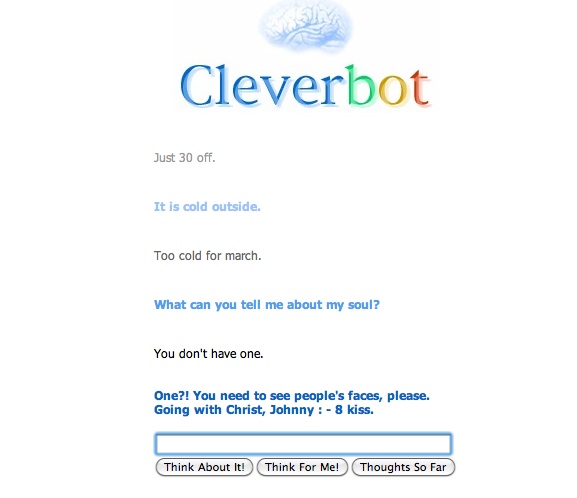
I stopped our conversation there. It seemed Cleverbot was either trying to convert me or make a pass at me, both of which felt terrifying. I was able to gather that the robot menace has multiple souls and that theses minions are indistinguishable from human faces. Also, they are evangelical. I’m scheduled to attend a FIRST Robotics competition next weekend. As I watch the innocent, baby robots (all of them built since January), I will be wary of any that I find reading a Bible between heats. Enforced conversion at the metallic hands of an unthinking machine: why do I feel that I’ve somehow glimpsed the future of America?
The Sign of Jonah

The Sign of Jonah?
Each year during the spring semester my Prophets class brings new levels of fixation on those familiar characters that so few actually know. The process began early this year. With several students of eastern Christian persuasion, Jonah became an issue based on the folkloristic nature of the tale. Jonah is particularly prone to a literal interpretation because of the “sign of Jonah” trope cited by none other than Jesus himself. Also, as I learned in my doleful days at Gorgias Press, many eastern Christians understand Jonah as a special favor to them, sent by Yahweh well before Christianity began. Even with the full weight of history against them, the students are unwilling to relinquish Jonah to his native literary genre. Then came Isaiah.
Isaiah is the most heavily co-opted prophet in the canon. Well, one might put Elijah in the running, and it would be a Chariots of Fire finish I’m sure, but as the most quoted prophet in the Christian Scriptures, Isaiah would come out on the Liddell end. So massive is this sense of ownership that Isaiah’s direct prophecy concerning the Syro-Ephramite Crisis in 7.13-17 is incapable of being understood as anything other than a prediction of a virgin birth some seven centuries down the road. Interestingly enough, it is the literal sense of this passage that is generally overlooked in favor of a later interpretation.
Even the sense of what prophecy was in the ancient world has been altered to an unrecognizable jumble by later agendas. Prophets spoke out regarding current issues (“the two kings you dread”), occasionally providing future, generally conditional, remarks. In our apocalypse-hungry society, pundits are eager for the culmination of all things and the more fireworks the better. If old Jonah and Isaiah were sitting together in a bar I can imagine the stories they’d exchange. And it wouldn’t be a whale (excuse me, “big fish”) that would be doing most of the swallowing.
One to Tree
Asherah’s in the news again. My book on the old girl safely moldering on obscure library shelves, I figure it is my academic duty to be a staid voice of reason on the subject. The jury’s still out on her status as Yahweh’s wife – no wedding pictures have yet surfaced – and her associations with lions and snakes have always been suspect. It is clear, from the Bible’s perspective anyway, that the physical object called by the goddess’s name was made of wood. Although such a slight association does not a tree-goddess make, it nevertheless runs counter to scholarly orthodoxy to suggest otherwise.
In the Rabbinic period it had become clear that just about any tree in the right location could serve as an asherah. So it was with a double-take that I looked at the cover of my Green Bible. I began using the Green Bible a couple of years ago because of the environmental impact of the millions of Bibles printed annually. Best estimates are that about six billion Bibles have been printed (about half of which have been sent to me by various vendors as textbook options) and I was hoping to at least use a recycled book to ease the burden. Then yesterday it clicked for the first time: the Green Bible has a tree on its recycled cover.
Asherah seems to have had the last laugh. If she was a tree-goddess. The fact remains that Asherah is a difficult goddess to qualify. She may have been associated with trees, or lions, or snakes, or wisdom, but none of these things has been proven beyond reasonable doubt. She was, however, the spouse of the high god El among the people of ancient Ugarit. And the Israelites accepted without qualm that El was essentially the same as Yahweh. Did he bring his former spouse along? We don’t know. Asherah, as her own person nevertheless, is a wonderful example of the feminine divine. Too bad she doesn’t have her own book.

God's wife on the cover of his book?
Sister Christian

“They heard the sound of Yahweh God walking in the garden at the time of the evening breeze, and the man and his woman hid themselves from the presence of Yahweh God among the trees of the garden.” That’s what the verse says. Perhaps it is just one of the dangers of a literalist upbringing, but when I saw the above ad in today’s newspaper I automatically took it as a scriptural reference. There were, however, no books of Accent, Elantra, or Santa Fe (the last nevertheless being named after a saint). Genesis has become a secular word. In fact, all words are secular, but many have been co-opted by their biblical context.
Every year I ask my students what Genesis is about. Every year the first answer is “creation.” This is, naturally, incorrect. Genesis is the story of Israel’s ancestors. 39 of the 50 chapters in the book are concerned with Abraham, Isaac, Jacob, and Joseph. The creation takes up only three chapters at the beginning. It is the Bible’s “once upon a time,” not the whole story. In an over-stimulated society, however, glib responses are mandatory. Genesis means creation and let’s just tell our kids about intelligent design and evolution and let them make up their own minds – I’ve got an important text to respond to! How far the Bible has fallen!
“Genesis” is a Greek translation of the very roughly “in the beginning” (translation issues abound here, but I’m just trying to make a point) in Hebrew that opens the book of Genesis. It was the convention in olden days to entitle books after their incipits; all fairy tales would have been titled “A Long Time Ago” under this rubric. And yet we are perfectly content, in the context of a “Christian nation” to go about misunderstanding the Bible from the very beginning. The Bible need not be understood as long as it can be thumped. And if you’re looking for a good deal on a Hyundai, why not make it biblical? Naked man and woman hiding behind the tree, however, will cost you extra.
Angry Gods
Podcast 23 concerns the concept of atonement. Related to but distinct from sacrifice, the concept of atonement is widely utilized in the Judeo-Christian tradition. This podcast considers why the idea of God as an angry God is so prevalent, and suggests how the concept of atonement might fit in this matrix.
Tuesday Mourning
A mourning dove sat on my front steps today. I weep for Shaunakaye Williams, although I never met her. The death of the young is tragedy defined. I did not know Shaunakaye, but I know that she was a young woman of great potential. She had discovered FIRST Robotics in Newark and died while in California at a FIRST competition. If it weren’t for the FIRST connection, her death might of remained unknown to me, but it would have been a grave loss nevertheless. Becoming a parent has been the most wonderful and terrifying event in my insignificant life. Since it has happened, I have mourned every death of a child of which I’ve heard. The words of comfort fail. FIRST is the most optimistic group with which I’ve ever been affiliated, recognizing and rewarding the potential of bright young minds. Shaunakaye was part of that family, and her loss is deeply felt.
In the field of religious studies, those who would justify the actions of God in a world full of suffering are faced with a daunting task. Theodicy is the most unenviable and unsatisfying aspect of the theological endeavor. Even the stalwart author of the book of Job dared not ask the great unanswerable “why?” – there is no justification for the death of the young. Often the answer is there is no answer. Job’s friends cannot accept this truth and fabricate excuses to show that God is just. God himself affirms, however, that life is just not fair.
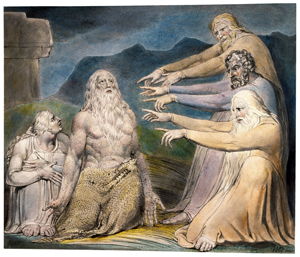
As a race, as a species, our children are our greatest assets. Bully governors and pedophiles notwithstanding, any society that does not promote or encourage its children has already cut off its entire future. I mourn for Shaunakaye Williams, and for all those who have not been given the chance to reach their full potential. I mourn for all parents who have had to face this most terrible of afflictions. And I will never be counted among the friends of Job.
Corny Children
Once upon a time, if you wanted to see a movie you had to go to a theater or wait until it ran on television. This is stretching my memory back a long way, so indulge me if I only remember that four channels existed in those days, and you had to wait years for movies to appear at a time when you could actually be home to see them. Fast forward a few years and the VCR was invented. I remember being impressed that you could actually rent movies you’d always wanted to see, within reason. If you watched them too often they wore out. Then the electronic revolution came. This is all by way of excuse for why I’ve only just started to watch movies that came out in my younger years. Children of the Corn, although critically panned, was a financial success in my college days when I started watching horror movies. When I finally watched it yesterday, I realized it was a natural candidate for this blog’s running commentary on horror and religion.
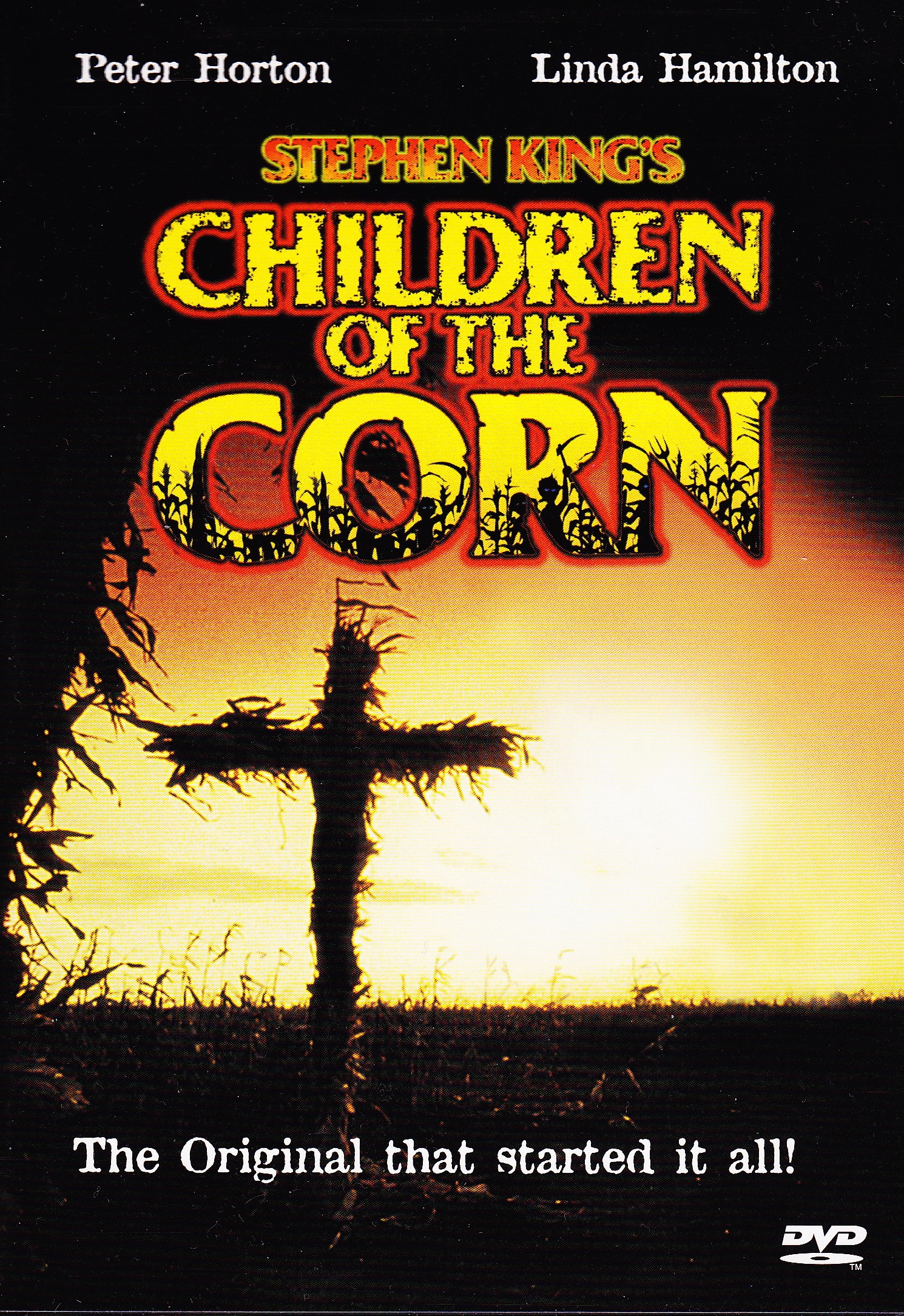
What I had not fully appreciated is that the movie is a cautionary tale centering around a sacrificial cult. While the movie does have its problems, the concept of children taking the religion they hear from adults seriously runs throughout the film. Understanding gods as bloodthirsty demanders of sacrifice is a gruesome staple of all monotheistic religions. Someone’s got to die for the rest to be saved. While Fundamentalists take comfort in the substitutionary atonement of the “once for all” nature of sacrifice, in the film, the children erect crosses and sacrifice adults to “he who walks behind the rows” – a typical Stephen King kind of monster. Monster or not, the children believe he is a god.
Belief is the guy-wire for religion. The reality behind that belief is open to question, otherwise multiple religions would not exist. Children of the Corn confuses the issue by presenting “he who walks behind the rows” as a legitimate supernatural entity, one who is vanquished by a passage from Revelation. The truly disturbing aspect, however, is the complete, unquestioning devotion of the children. When children are raised in intolerant religions today, we are also planting corn that will lead to some unholy reaping in the future. Perhaps the message of the film was more trenchant than most critics were willing to admit back then. Today it is certainly more believable, given many religions’ demonstrations of their destructive powers.
Ice Father in Heaven
The Internet can be a window into the collective consciousness of a nation. In a world where even the Weather Channel invites comments on its forecast page, the outlook of many Americans is laid bare. This latest shot of winter weather on the northeastern quarter of the country is an excellent example. It is still March, the tempestuous month of the war god, so a little snow in the northern latitudes should come as no surprise. An unnamed dean at a state school here in New Jersey had just sent out an email blast the week before stating, with decanal authority, that there would be no more weather delays this year. Yesterday there was still snow on the ground after the storm. Frustrated citizens cursed – actually cursed – the winter on weather.com.
For years I have maintained that the weather is key to understanding the human perception of the divine. From ancient Sumer’s An and Enlil through classical Greece’s Uranus and Zeus, the gods unquestionably in charge are the sky gods. The guys who control the weather. In Israel Yahweh took that job description from a reluctant Hadad – aka Baal – and many people considered this a serious mistake. Don’t mess with the weather god! As the snow begins to melt once more, even those of us in the enlightened twenty-first century should be reminded that our sense of what the world should be is an illusion. Nature evolved our brains, and now our brains think they have the right to take over.
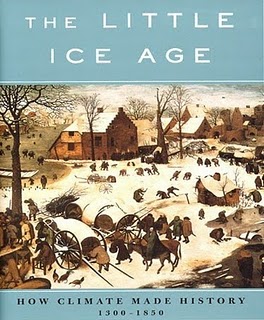 Once, back in Wisconsin, I stepped outside on a chilly June morning and saw flecks of snow in the air. It wasn’t “snowing” – it doesn’t snow in June – but there was definitely a frozen sort of precipitation hanging tentatively in the air. I was teaching at the most self-righteous of seminaries at the time, and it became clear to me, once again, that we are not in control. Among the scariest books I read in Wisconsin was Brian Fagan’s The Little Ice Age. I was at work on my book on weather language in the Psalms (still unpublished) and the unsettling truth drifted around me like this winter’s snows: if a new ice age settles in, there is nothing we can do to stop it. Geologists still can’t state what triggers these periodic events, or even what their timetable might be. If earth’s ice caps again begin to grow, however, I am certain that we will also see a dramatic increase in religiosity. For the gods, we all know deep down, are in the skies.
Joseph Smith in the Spotlight
Mormons on Broadway? Well, not actual LDSers, but their famous founding document, The Book of Mormon, is now a Broadway show. While I wouldn’t hold my breath waiting for The Quran to be produced, holy books have often been utilized by the media as rich venues for timeless tales. Joseph and the Amazing Technicolor Dreamcoat and Jesus Christ Superstar come to mind as Lloyd Webber adaptations. Godspell, while not as directly scriptural, drew its inspiration from the Gospels (particularly Matthew). Those who lose are those who resist the free press of popular culture.
At the risk of sounding Niebuhrian, the religion that refuses the blessing of society is the one that will fade away. Religions are human institutions, and as such, require human adherents. Critics often claim that popular adaptations of their sacred writ are making fun of the texts, but is not cultural adaptation all about celebrating a story that has won its way into the media and outside the confines of rigid orthodoxy? Which version can be said to be truly alive? This is not theology, it’s theater.
Working with students who have very little background in the Bible, I clearly see the wisdom of taking what are admittedly dry texts and bringing them to life. Religions often founder in the process of mistaking form for substance. Literalism has done more to damage religions that it has to keep them pure. Reviews from the Book of Mormon attest to its appeal, and in a country where the Latter Day Saints are generally considered the second-fastest growing church, the musical is a boon. Trey Parker and Matt Stone can hardly be accused of attempting to convert the heathen, but their show cannot but help to bring this particular denomination into the public eye nearly as much as Mitt Romney’s attempted candidacy will. That’s what I call rose-colored glasses!
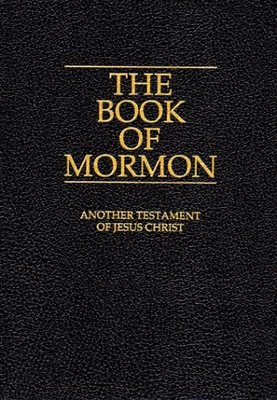
You've seen the show, now why not read the book?
Garden of Nede

Dystopias fit the Zeitgeist of the twenty-first century a little too well. The level of disillusionment has soared since the administration of Bush the Less when an unprecedented degree of ridiculousness tempered every political decision filtering out of a Washington that has become a little too religious. So it is that the genre of the dystopia is strangely therapeutic. I first became aware of Margaret Atwood because of an introduction to the Bible that pointed out the misuse of Holy Writ in her classic The Handmaid’s Tale. An allegory that demonstrates the power of religion to reduce women to mere reproductive objects is frightening enough in itself, let alone the post-optimistic view of a future of endless possibilities gone bad. Now that I’ve finished her more recent Oryx and Crake, I see that her outlook has grown more bleak, if more believable.
Like most dystopias, Oryx and Crake is filled with religious and biblical allusions. A society that does not know its Bible is easily manipulated by it. The book has been out long enough that I won’t worry about spoilers – does any dystopia end well? The basic idea is that the eponymous Crake of the title has tried to replicate Eden with genetically improved human beings. To prevent them from entering a world filled with human-inflicted suffering, he devises a way to wipe out the world’s population, leaving these innocents to carry on a genetically modified human gene pool. One survivor of the old days, Snowman (Jimmy), has to explain to these innocents what their world is about. He concocts a myth where Crake becomes a new god. Although Crake tried to modify the brains so that the “bundle of neurons” that make up God are gone, the new generation stubbornly develops a rudimentary religion.
Is it possible for humans to build a better future? I have never been swayed by the perverted notion of total depravity; people are quite capable of doing good. Our great ape cousins demonstrate that it is within our genes to produce a harmonious society. Although religions have motivated some extremely noble behavior in the past, they have also introduced heinous distortions of anything of which it might be said “behold, it was very good.” Atwood has offered us a world to ponder seriously. It is a world where humans play God and end up rotting under an unforgiving sun. Perhaps if politicians were more literate and less religious we might be able to counteract our partial, self-inflicted depravity.

