Ask Your Local Agnostic

A study released by the Pew Foundation reveals something many may find surprising: the best informed citizens on religion tend to be those who do not believe. There are obviously exceptions to this trend, but for those of us who teach religion it certainly rings true. Over nearly the past two decades, I have repeatedly encountered students brimming with religious zeal, but who know very little about what they’re so excited about. The emotional charge is real enough, but few Americans know in any detail what their religion actually teaches. Some of us didn’t need the Pew report to tell us this – we have known this all along.

One of the flip assumptions that must fall by the wayside here is that non-believers don’t know what they’re missing. In fact, it seems, many of them consciously reject what they are brought up believing. This also fails to surprise those who spend much time with religious studies. Religions are developed in defined culturally and chronologically bound circumstances. The longer it takes the parousia to occur, the more human knowledge mitigates against it. In a pre-scientific first century many ideas held a currency that no longer bears weight in theological commerce. Those who study it closely realize this.

As political parties gear up for midterm elections and various contenders are sending out their feelers for the highest office (secular, in this country), they know something the electorate does not. Religion, poorly understood, is perhaps the greatest motivator known to the politically ambitious. People believe – and feel it strongly – but what exactly it is they believe, they are not sure. Anyone who has read the Bible soberly, on its own terms, without ecclesiastical lenses firmly in place, walks away with more questions than answers. Religious belief relies on answers, often at the expense of knowledge. So it is that the Pew Forum on Religion and Public Life has discovered something that those of us who daily live with religion had already surmised from the evidence right before our eyes.


The Very Blustery Day

What is it with car service and religion? After a long drive to and from Montclair yesterday to teach my mythology classes, I realized the poor car was due for an oil change. I try to be religious about auto service since the gods of mechanics seem to have bypassed me when handing out their gifts. I am pretty good at taking things apart, but when it comes to reconstructing them, well, they seem to work in new and interesting ways when I’m done. I don’t trust too much auto repair to myself. At the same time, Jiffy Lube is not my favorite hangout. I always take a book along, but the waiting area always has a television going and stale coffee perking, and other people chatting. It is sometimes hard to concentrate. A Friday afternoon seemed like a good time to go since weekend warriors would not be spending their first free hours at the Lube.

I had a choice of seats. I sat behind a Plexiglass divider from the television, figuring it might muffle the sound a bit, and began trying to focus on my work. The TV was on ABC, an early news show was running. I hadn’t been reading ten minutes when I heard the Bible mentioned on the news. I scrunched forward to peer around the windshield wipers suspended from the rack on the other side of the Plexiglass. An official looking authority named Carl Druze of the National Center for Atmospheric Research was explaining to an unseen journalist how he’d discovered the miracle of the Exodus! The government scientist explained, with a fancy graphic illustration, how if the wind blew all night the Red Sea would part into a marshy bit of mostly dry land for up to four hours, giving the Israelites an opportunity to walk right out of Egypt. The woman tending the register was so curious about my bent-over posture that she came around to see what the story was about. When she saw, she gave me a doubtful smile. The story concluded by mentioning that Carl Druze is a devout Christian, but that had nothing to do with his research.

Scientists have long tried to explain mythological episodes. Over the years I have read many implausible conjectures of “perfect storm” conditions that could lead to a dried sea bed, a series of horrific plagues, a world-wide flood, or even the earth itself holding still on its axis for 24 hours. While clever, these scientific fictions miss the point. The Bible is presenting miracles as unaccountable acts of God. No formulas or figures can explain them. I was bemused since four hours would hardly be time enough for the (at least) three million Israelites cited by Exodus to have made it across marshy swampland with their considerable material goods. The fact remains that no archaeological evidence for the exodus exists, claims of chariot-wheel shaped coral in the Red Sea notwithstanding. If the Bible had been intending to be literal here, it would have been the end of Egypt since the army was completely wiped out. And this was on the eve of the invasion of the Sea Peoples. There is a reason I let automotive experts work on my car. It is always interesting when scientists tinker with the Bible, but I’m glad that such tinkering doesn’t involve a half-ton of metal that is capable of racing down the highway at speeds the fleeing Israelites would have been overjoyed to have achieved on the road out of Egypt.

Dive low, sweet chariot


Bleached Angels

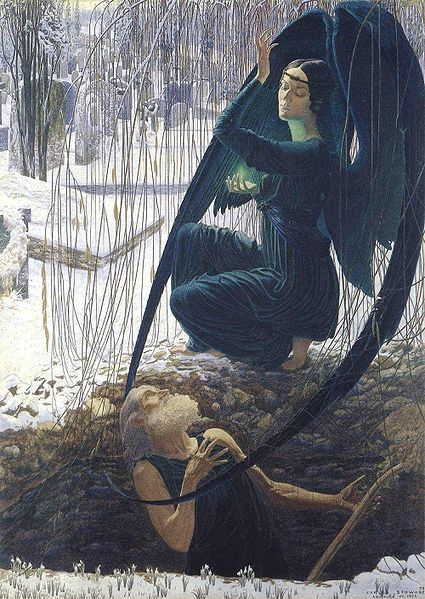
A friend recently asked why, in the canons of western art, angels suddenly made the shift from colorful to predominately white. What was behind this loss of color? The history of angel imagery is complex and a great deal of the complication derives from a generally iconoclastic sensibility in late Israelite religion. Images were frowned upon, so we do not get “Hebrew angels” recorded for us. The current-day perception of angels seems to go back to Mesopotamian Apkallu figures and Egyptian deities. In both ancient cultures various deities and demi-gods were portrayed as winged humans. The Egyptian figures, at least, were colorful. In the world of the Hebrew Bible angels are nowhere cited as having wings and they were likely imagined as being pretty much the same as humans in form. Many biblical characters mistake angels for people.

In Greek portrayals, Nike, goddess of victory, is a winged character. Eros, the god of love, also bears wings (and unlike Nike, he is generally bare all over.) In some vase paintings the Harpies are winged women. Since Greek pottery painting was generally monochromatic, we don’t have much color to go on. The earliest Christian angel portrayal comes from the Priscilla Catacomb in Rome. This angel is monochrome and wingless. The more familiar, and lavishly colored angels are Byzantine creations. Since my opinions on art history are not to be trusted, it is advisable not to make too much of this, but Byzantine art made flamboyant use of saturated hues to bring glory to God. This is part of the tradition behind Orthodox icon writing, and angels were simply following suit.

In the Middle Ages in Europe, angels were widely used to represent good and evil. It would stand to reason (if not to art-historical standards) that “good angels” would show their goodness by donning white apparel while “evil angels” would take on darker garb. This also fits with the growing tendency to represent Satan as dark red or black in color during this time period. As angels symbolized goodness, they became bleached of their former, Byzantine color. Symbolic value outweighed aesthetic sensibilities. Today angels retain their ancient legacy of Mesopotamia, Egypt, and Greece. Wings fit the view of angels as messengers, although ancient ideas of their colors depended more on the artistic conventions of the culture than any attempt to be true-to-life.

The earliest Christian angel (left)


Roman Women

This week’s Life section of Time magazine features an issue that yet again raises the questions of definitions and who decides on correct religion. The feature by Tim Padgett entitled “Robes for Women” demonstrates the conflicted nature of religious authority. With the Vatican claiming women have never been priests, but historians questioning the assertion, the salient point is who has the right to decide. And what is lost, if such a change were to take place. Tradition is not threatened by change – it always stands sentinel over the past, but no religion remains unchanged for any length of time. It is not biblical authority that is lost either. Any religious body whose scriptures state, “call no man on earth your father,” yet which addresses its clergy by the title “Father” clearly possesses the casuistry to get around other biblical injunctions. What is lost is male power.

No matter how vociferous theologians may be concerning the genderlessness of God, the default male image seems deeply embedded in the human psyche. One of the most ancient and pervasive of mythological themes is the search for the father. The loving mother is the one who stays near and raises the child while the father leaves to make provision, or for reasons less wholesome. At some level we know that the deity portrayed by Scripture and tradition is male, a father who is difficult to find at times, particularly times of need. This archetypal image is not an excuse not to re-envision a genderless deity, but it underscores what generations of human experience has taught us. Referring to God as father and mother only complicates the matter by throwing into the mix all aspects of gender complications. Can humans even truly worship a god without gender?

If the Womenpriests movement succeeds, as no doubt it should, there will always remain a group who will not accept their authority. My experience at Nashotah House taught me that some prejudices are so deeply rooted that they are no longer even recognized by those who hold them. Wild examples of theological gymnastics were paraded before me as to why women should not hold priestly office. And like Nashotah House reveals, if women are finally accepted by Rome, others will split away and both sides will lay claim to the true faith. There will be no convincing either that the other is correct. The history of Christianity has taught us this sad truth. Current estimates suggest there are some 38,000 different Christian denominations. This is the common fate of all religions who claim to have exclusive access to the single, unambiguous truth.

The secret of the catacombs


Ends and Beginnings

The Ninth Gate, a Roman Polanski film from a bygone decade, portrays a world the director doesn’t believe in. Typical of “devil movies,” the story involves a personified evil that not only seeks world domination, but who also writes books. I’ve been working on a book review for Relegere, the new online journal of Studies in Religion and Reception. In part the book addresses how the devil is portrayed in movies, although this particular film is not cited. Perhaps it is difficult to take seriously a film where the screenwriter is not a believer.

As a young teen I listened with horror as friends described The Omen, a movie that I never saw until just last year. The premise of the movie, that the Antichrist has already been born and is now walking the earth, ready to usher in Hal Lindsey-esque last days, is frightening to those who find a biblical basis for the idea. When finally watching the film the scariest part was viewing the extras. David Seltzer, author of both the book and screenplay, eerily tells the interviewer that he believes the Antichrist to be here now. His acceptance of mythology is admirable, but it is the problematic acquiescence to a modern reconstruction of disparate ancient views that is troubling. Like many late-twentieth century westerners, Seltzer has been influenced by attempts to construct a coherent account of the apocalypse from tattered bits of ancient traditions that never belonged together.

If education included a serious, critical look at how religious ideas developed, the world might be spared this sad predilection for seeking its own end. Apocalyptic ideas thrive in cultures of persecution, such as those very real torments of Jews under Antiochus and Christians under Nero. Their hopes for a brave new world of righteous rule, borrowing freely from Zoroastrian traditions of a new age, offered scraps of expectation of a better tomorrow to those dying today. When nineteenth-century evangelists saw the advances of industrialization and Darwin’s rational explanations of human origins, they felt the need to reconstruct the biblical demise of the world. Modern day apocalypticism, so evident in the Y2K, 9/11, and 2012 scares, is often ready to accept uncritically a supposed future already scripted by a sadly misunderstood Bible. If the world ends it will be our own doing, and maybe Roman Polanski will have to rethink whether or not a devil can actually write a book.


Noah in Time

When the silence was first broken at Gorgias Press, one of my colleagues suggested that I read The Time Traveler’s Wife by Audrey Niffenegger. The title suggested to me some kind of point-of-view rewriting of H. G. Wells’ classic The Time Machine, a novel that had a large influence on my young, science-fiction inclined mind. For some reason I wanted to keep this place sacred to the memory of Wells and I dismissed the suggestion with polite demurral. Since that time Niffenegger has been constructing quite a reputation as a novelist, and because I enjoy the implications of time-travel and I like to keep current – fashionably late, of course – I finally took the time to read the book.

I wasn’t sure what to expect; it is a sensitive love story, wrenching in parts, but the mysteries of time travel are left to a genetic defect and not some technological invention. In the course of wending in and out of past and present lives, the main characters, Clare and Henry, carry on a dialogue that includes the dynamic of a protagonist raised Catholic. Once, while discussing the bizarre nature of time traveling, Henry suggests that Noah is a fairy tale to which Clare replies, “Noah is in the Bible. He’s not a fairy tale.” This statement reaffirms that, for many people, Noah is the obvious touchstone of the Bible and modern society. A versatile figure, enigmatic and only sketchily drawn in the Bible, Noah reappears regularly in the popular media. Just this summer I noted how Justin Cronin’s The Passage also cites Noah as a schematic for much of the plot that bears the story. A few weeks ago I mentioned how the remake of The Day the Earth Stood Still viewed Klaatu’s ship as an ark. Noah from outer space.

Noah is a foundational figure for our society. This should not be surprising since the flood myth is among the most ancient of stories that humanity has relegated to religious literature. The Sumerians and Babylonians told the story long before Genesis was composed. In its own way, the Noah story is an example of time-travel. A tale whose origins are lost in the pre-literate stages of humanity, it becomes history with the uncritical acceptance of the Bible, only to become a defining myth of twenty-first century literature. The world of the twenty-first century often feels like a fragile environment ripe for a catastrophic flood. Consciously or not, we are still looking for our Noah.

Another kind of Noah


I’ll Take Coffee, Thank You

Yesterday’s victory of Christine O’Donnell in Delaware’s senate primaries seems to have shocked a lot of people. Have these people not been paying attention? Did they sleep through Beckpalooza? Have they failed to see that Sarah Palin’s lackluster life story has become a best-seller? Are Americans in denial that we are facing a major Religious Right comeback? The problem, yes, problem, is that Americans are not taught to think about religion for themselves. Raised with the idea that their political and religious leaders have some special channel open to the divine, they are sheep led to the, well, you know…

Society pays for its sins. One of the most fatal of the deadly sins is the refusal to take ownership of religious education. Unreflective religion in the hands of politicians is a fully armed atomic warhead. Many Americans like to think this is only a problem in nations with Islamic infrastructures, nations unduly influenced by shahs, ayatollahs and imams. Nations influenced by Tea Parties, Neo-Cons and biblical amateurs are much safer, much more friendly.

Problem is, the Bible’s a mixed bag. Some of the loftiest spiritual sentiments nestle down uncritically next to calls for genocide and harsh repression. As long as it is the magic finger from above that’s written it, that’s good enough for tea-tipplers. There are few opportunities to call Americans together for a religious town meeting. We’re all too busy off doing it our own individual way. In such a climate, isn’t it best to let those without any formal religious training tell us what the Bible says we should do? Do you want one lump with that, or two?

O'Donnell takes Castle to school


Bibles and Freedom

Visiting the Red Mill in Clinton, New Jersey is always a worthwhile experience. Yesterday, a gloomy, gray September postcard, was perfect for such a visit. In addition to the many buildings on the museum grounds that retain an atmospheric feel year-round, the Mill is supposedly haunted and is frequented by a number of ghost hunting teams. With its long (for America) history and its picturesque beauty, the museum is a popular spot with tourists as well as ghost hunters.

One of the buildings on the grounds is an old one-room schoolhouse. As a family we have visited a number of these, although none of us qualify as having been actual pupils at one. A frequent blandishment at such institutions is the rules by which school teachers had to live in the nineteenth century, usually posted on the wall. Yesterday as we read the obligatory list, one “commandment” stuck out from the 1872 code of conduct: “After ten hours in school, the teachers may spend the remaining time reading the Bible or any other good books.” While many of the rules were condescending in their moralizations, this one carried a perfect example of how a nation, naively short-sighted, was already giving preferential treatment to one religion, Protestant Christianity.

As a nation founded as a haven for religious freedom, the colonists and settlers simply had narrow exposure to religions of the world. Freedom seemed an ideal worth dying for, but usually it meant freedom to be whatever (Protestant) denomination you wished to be. Catholicism was associated with the old powers of Europe, and the religions of the east were barely known. The Protestants were the ones who promoted Bible reading in those days, and while the rules allowed for other good books, there is an unstated superiority given to the Good Book in its pride of place. Once the colonials became nationals, it was still fair to taunt Quakers, Unitarians, and others who didn’t seem to fit the mold. We didn’t see any ghosts at the Red Mill yesterday, but it did seem that a haunting memory of true religious liberty hung about the place.

Clinton's Red Mill sews freedom


Athtar in Wonderland

Last night I finally got around to seeing Alice in Wonderland, the Tim Burton version. As a child I don’t recall having seen the overly optimistic Disney original, and I only read Lewis Carroll’s two-part, disturbing original after I had finished my undergraduate degree. When I first discovered Wonderland I was in one of my periodic phases of questioning reality and Carroll’s provocative prose and ingenious lyric ability only made the inquiry more complex. Strangely, it felt as if I had rediscovered a missing piece of my own childhood.

Burton’s versions of childhood stories would likely have been my preferred fare had they been available when I was young. Eerie without the overt horror of an R rating, the vision is one of a world where uncertainty reigns supreme. Then came the hookah-smoking caterpillar. It has been a few years since I’ve read the book, but I don’t recall the larval character as having a name. Linda Woolverton, the screenwriter, presumably gave him the name Absalom. Supposing this to be nothing more than the reassignment of a fated biblical name associated with failed attempts at kingship, I simply let the reference pass. Until the chrysalis scene. There he was, Absalom hanging from a plant, just like David’s son swayed from a tree according to 2 Samuel. This mysterious scene in the battle of Ephraim Forest had captured my attention before when I wrote an article on Absalom, eventually published in the Journal of Northwest Semitic Languages.

Noticing the strange phrase that Absalom was suspended between heaven and earth, I suspected that this might be a reflex of the ancient morning star (Venus) myth. The story of Athtar, the god who would be king but who must decline the throne, is a brief tale preserved in the Ugaritic Baal Cycle. As I watched the sage caterpillar giving wise advice to a confused Alice, the name Absalom took on new significance for me. I have no way of knowing if the reference was intentional or not, but in a culture deeply suffused by the Bible it would appear to be a logical guess. And if I was correct in my article, I was seeing a cinematographic reference to Athtar as a blue caterpillar last night. Wonderland indeed.

Curiouser and curiouser


Bible, Bible, Who’s Got the Bible?

Rutgers University boasts a truly diverse population. In my fourth year as an adjunct in the Religion Department at the New Brunswick campus, I am continually reminded of the religious and cultural mix of the human race. As I began my twelfth section of Introduction to the Hebrew Bible last night, it occurred to me just how tight a grip Christian-based publishers have on the Bible. I generally spend my first class session on defining the Bible since many students enter such a course (and it is always full) with notions of what the Bible is. In fact, “the Bible” is a difficult document to define.

Binding a book together indicates that what is between the covers belongs together. This is almost a subconscious fact that we pretty much take for granted. If a publisher put all of this in the same place, it must belong together. For the general consumer market, that translates into Bibles that contain the Hebrew Scriptures and the Christian Scriptures. This mix of 66 books satisfies most customers in the United States and Canada, but the Catholic reader expects some 13 additional or expanded books in her or his Bible. Jewish customers expect somewhat less, with 27 books normally in “the Bible” being specifically placed there by a later, revisionist sect. Orthodox Christian Bibles may add or leave out a book or two, depending on the tradition.

The irony of this situation strikes me as we have Bible-thumpers constantly appearing in the news. Their well worn, black leather King James Versions are “the Bible.” For them. Their message to the American public: we must get our lives back in line according to (my interpretation of) this book. What of those in this country who have fewer or more books in their Bibles, or, Yahweh forbid, completely different scriptures? Is there no room in a nation of religious liberty for them? I have a modest proposal. For the politicians who want their Bible to drive our society, stop by my class at Rutgers sometime. I am always glad to see the diversity. And it shouldn’t be too hard to find a section to fit in your schedule – I teach four sections of the class throughout the year, including summer and winter terms.


Natufia to Say

The Natufian culture predated the Israelites by millennia. They were gone by at least 7000 years by the time Israel appeared. The Natufians seem to have been the first permanent residents of a hotly disputed piece of real estate: Israel/Palestine. On Monday MSNBC reported on the archaeological find of a feasting hall among the Natufians. The story reminded my wife of similar stone-age sites that we visited in the Orkney Islands several years ago. What the story reminded me of, however, was the marzeah. The Natufian site features two activities: feasting and burial. The article notes the coincidence of 28 human burials, including one shaman, and the unmistakable signs of feasting. Bring them together and its sounds like marzeah time to me!

Natufian burial, from Wikipedia Commons

The marzeah is an imperfectly understood social institution from the ancient Levant. It is mentioned in the Bible as well as in the Ugaritic texts. Although plausibly reconstructed by modern theorists, we simply do not have a complete record of what the marzeah entailed. Two of the key elements seem to have been feasting and a funerary nature. Monotheistic religions tend to downplay the role of the dead as influential entities since they interfere with a monistic view of the divine. The two Hebrew Bible references (Amos 6.7 and Jeremiah 16.5) do not speak highly of the practice. The Ugaritic material suggests drinking may have been involved as well, further problematizing the ritual.

Now here is where the ambiguity of archaeology is thrown into sharp relief. The fact is we do not know what the Natufians were doing when they buried or feasted at this site. The Hilazon Tachtit Cave does not seem to have been a regular occupation site, and we do not have any reason to connect the burials with the feasting. Beyond a hunch. The hunch is the incredible urge to bring like things together. People excel at pattern-recognition. When I read of funerals and feasting my mind leapt to the marzeah. There seems to be no organic connection between the Natufians and Israelites (or Ugaritians), but the continuity of cultural concepts seems to strong to dismiss. Were ancient people toasting their dead with feasts that were remembered down into the Late Bronze and Iron Ages?


Gort to Flood

There seems to be a society-wide fascination with the end of the world as we know it. Or maybe it is the just the perspective I bring to it. The past two decades with their breathless run up to Y2K and grappling to forge some sense out of 9/11 before 2012 rolls over us, have been awash in popular representations of how it might all come to an end. A society begging somebody to apply the brakes. We’ve got many senior citizens still around who’ve never used a computer attempting to coexist with a generation that has never been without one. From Kitty Hawk to the moon in just 66 years. I remember watching the latter on (black-and-white) television. Now I watch students walk into class with devices about whose function I can only ask Mr. Spock to speculate.

So it was that I finally got around to watching The Day the Earth Stood Still last night. The 2008 remake. Having long been a fan of the original, I can understand the insistent draw to bring it up-to-date. Even by the time Star Trek (original series) aired, it was hard to see what had terrified 1950s audiences about Gort or the idea of aliens. Thus I had great expectations when I first saw the trailers for the remake, but the reviews took the edge off my shine and I’ve only now experienced it. Naturally, I was looking for the religious angle.

Like Justin Cronin’s The Passage, the religious metaphor came in the guise of an ark. Klaatu is here to save all species except us, prompting Regina Jackson to state that after the ark is filled, the flood will come. The apocalyptic end of the world – being eaten by bugs (perhaps prescient of New York’s bed-bug infestation) – brings nanotech and the Bible together in an unhappy marriage. As soon as the authorities learn that Klaatu’s sphere is an ark they try to blow it to kingdom come. And yet Helen Benson is here to tell the tale.

We are vulnerable. For all our achievements, we fear the kids down the block that are bigger than us. Whether they be cold, emotionally flat aliens or ragingly wrathful gods, we are constantly watching the skies waiting for the next great flood.


Gnot What It Seems

Mythology has a funny way of dying. It just keeps resurrecting itself. It is the eternal return. One of the shocking truths about religions is that their cohesiveness is exaggerated for effect. The usual desired effect is power or influence over others, as in most human enterprises. Nowhere is this clearer than at the birth of religions. Since each human brain processes information in a unique way, the two people in a room with the religious founder will hear his/her teachings in their own way and neither will be identical with each other or the founder. This phenomenon has been long recognized by religionists. It is customary to speak of “Christianities” or “Judaisms” rather than suggest a fictional singularity.

Manuscript finds and serious study of early Christian texts make a strong case for two major brands of Christianity as early as the first century of the common era: “Orthodox” and “Gnostic.” The former likely arose in opposition to the latter. Gnosticism congealed out of a heady brew of Zoroastrian dualism, Judeo-Christian nascent apocalypticism, and good old “Canaanite” mythology. The teachings of Jesus could readily fit into a worldview that rejected materialism for a pure spiritual plane untainted by physical limitations and pollution. It is only a small step from here to the belief that the physical world is an illusion. Problem is, that would mean the physical resurrection was apparent only, and what does that mean for all future prospects of bliss? Better to bring down the hammer of Orthodoxy than to live with doubt.

Yet Gnosticism lives on. One of the few direct lines of descent can be found among the Mandaeans, an endangered monotheistic sect that has maintained a Gnostic dualism for centuries. Indeed, they trace their origins all the way to Adam. Gnosticism, whether recognized or not, has left its influence on concepts from The Matrix to Philip K. Dick’s novels to Rich Terrile’s theories of God. Certainly there is a draw to believing this world is an illusion and that reality lies elsewhere. Maybe in that real world there is no need for religion since everyone already knows the truth.

sursum codex


Two Roads Diverged

Back in my Gorgias Press days one of my co-laborers (BU) suggested that I might enjoy reading Cormac McCarthy’s The Road. Since then it has come out as a movie, and further apocalyptic events have occurred – the Deepwater Horizon disaster and the election of Chris Christie come to mind – so I finally got around to reading it. It is a harrowing book for any parent to read and I doubt I have the heart to see the movie. Already the book is spawning internet quotes and quips, but I was particularly interested in seeing how this post-apocalyptic novel handled God.

Since the Bible, via Zoroastrian influence, gave us the religious concept of the apocalypse, it is fitting to see how religion fares in its unhallowed progeny. Mostly God is absent. When the man and his son mention God, the language is spare and laced with betrayal. “There is no God and we are his prophets,” the old man declares after the man and his son leave the bunker. A few paragraphs later he states, “Where men cant live gods fare no better.” The value of the apocalyptic metaphor is that it forces us to face life as we find it: raw and uncompromising. In the fictional apocalypse it is permissible to utter aloud implications of life’s callous lessons.

My career has had its share of jagged edges. The lacerations I’ve personally received have been at the machinations of Christians eager for self-justification. Self-congratulatory individuals and collectives that suppose God has specially favored them. “There is no God and we are his prophets.” It is like reading Camus in slow motion. One of the lessons both Nashotah House and Gorgias Press taught me was that it can always get worse. Reading McCarthy’s sad yet true tale of the woe we bring upon ourselves, the lesson for those eager for the apocalypse is that they have only to open their eyes.


Woeful Wisdom

“There is a wisdom that is woe; but there is a woe that is madness. And there is a Catskill eagle in some souls that can alike dive down into the blackest gorges, and soar out of them again and become invisible in the sunny spaces. And even if he for ever flies within the gorge, that gorge is in the mountains; so that even in his lowest swoop the mountain eagle is still higher than other birds upon the plain, even though they soar.” Herman Melville takes the credit for this passage. It is one of the many pericopes that make Moby Dick the greatest book ever written. Those who know me only as a biblical scholar may be surprised to read that, but I invite anyone who has ever instantly fallen in love with 1 Chronicles 1-9 to reply and argue the point.

Although Moby Dick has fallen into the provenance of books that are kept alive only by required high school and undergraduate required reading lists, this novel still comes back to me at many points in my life and fractured career as both a solace and a warning. Melville was clearly a man tormented by his search for meaning. He drew heavily on the Bible for Moby Dick, likening Ishmael to Ecclesiastes at one point, and the whaling haunts of New Bedford to tophets. To appreciate Moby Dick deeply, one must be familiar with the Bible.

Is this the Bible, or what?

Considering the great changes that are taking place in society, I often wonder if we have reached a breaking point. In my university life, I see students absolutely frantic to achieve an A in an easy class, one that would not have broken a sweat in my undergraduate days. Their anxiety is real; grade inflation has forged the B into the new D, or F. Yet these same students know nothing of life apart from the internet. In times like these, I betake myself to the Catskills, and with Melville, turn my eyes upward, seeking madness.