Lost in Translations

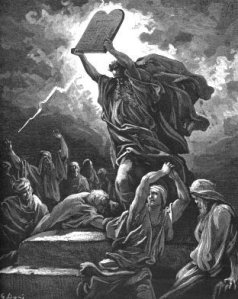
Furor is up like storm waves concerning a revision of the New International Version of the Bible according to the Associated Press. Evangelical groups, fearful lest the word of God be misrepresented (!), claim nothing is wrong with the Old New International Version. The story of biblical translation is long and colorful and peppered with more than a few deaths. People, originally especially Europeans and Americans, but spreading like swine flu around the world with the missionary movement, are very concerned about being certain they have they exact words from the Author himself.

Concern with having the correct answer is natural enough, but the goal of a perfect translation is unattainable. The basic reason is that translation, like Bible-writing, is a human endeavor. And people just don’t achieve perfection. Also, words often betray us. I used to ask students what the word “die” means. Some would say to cease living, while others would say it was the singular form of dice. Some even recognized it as the nominative, feminine singular definite article in German. The truth is, however, that words do not have meanings. Words are symbols that have usages, but the letters “d-i-e” in that order mean only what we intend for them to indicate in any given circumstance. Certainty is a mirage; it can never be reached.

A few years back Today’s New International Version was published and it has been called “an emblem of division in the evangelical Christian world,” by Moe Girkins, president of Zondervan (owned by Rupert Murdoch). Even among self-identified evangelicals unanimity is illusory. Each person’s religious beliefs start to differ from everyone else’s in the privacy of his or her own head. That is because everyone is unique. The Bible can be made to “mean” whatever an individual wants it to mean. Until we became merged into some Borg-esque entity new translations will be loved by some and hated by most.


Hell on Earth

October 8, 1871 is remembered by many as the night of the great Chicago Fire. Few Americans ever learn that it was also the night of what many consider to be the greatest natural disaster in United States history: the Peshtigo Fire. The autumn of 1871 was tumbleweed dry in the upper midwest. A wildfire that burned over a million acres of northern Wisconsin and Michigan completely incinerated the town of Peshtigo, Wisconsin on the same night Chicago burned. 1,200 people were killed in a single night. One of the most terrifying books I’ve read is Robert Wells’ Embers of October (also published as Fire at Peshtigo), a factual horror story filled with survivors’ accounts and early aid workers’ reports. Many described the scene as reminiscent of Hell.

Gehenna in Wisconsin

Hell is an interesting concept. Following on from my podcast on the origins of the Devil, the concept of Hell is an equally interesting development. The Hebrew Bible knows of no Hell. The dead, good and bad alike, go to Sheol, the gloomy world of the dead, after they die. There is no punishment or torment beyond the languor of being deceased. People seem to be described as having some recollection of life and its benefits, but they are weak and sleepy and attached to their drying bones. The concept of an afterlife comes pretty late to the Israelites, depending on how you define “afterlife.” The book of Daniel, the latest in the Hebrew Bible, provides our first glimpses of a kind of resurrection for the righteous who died before their time. The earliest biblical Hell is the Gehenna of the Gospels, the garbage heap perpetually burning outside Jerusalem.

To picture an eternity of constant burning and torment requires a kind of distinction between an afterlife and afterdeath to be made. Zoroastrian influence on emergent Judaism provided the dualism that made a Devil possible after a few centuries. It also provided the distinction between the glorious afterlife of the good and the doleful fate of the wicked. Concepts that eventually blossomed into the theological constructs now regarded as Heaven and Hell drew their inspiration from an ancient religion of Afghanistan and Iran. Given what human imaginations are, Hell has naturally grown more and more gruesome over the centuries, but if one requires a sense of an entirely natural version of what can happen to good and bad alike, the Peshtigo Fire may also deliver many sleepless nights.


Biblical Black Lagoon

During my summer-term courses I feel it is only fair to break the lecture time up a bit. Rutgers summer courses can run four hours at a stretch, and no matter how valiant the student, no one can pay attention to me for that long. I have long had an interest in the Bible in popular media, so for each class session I show a brief clip of a movie that features the Bible, often in a pivotal role. We then discuss how it is presented. As a personal pork barrel I give the students a multiple choice question on their exams as to which movies we have watched (it also gives them incentive to be in class, I hope). One summer, after sending the exam off to the print office, I realized I’d made a mistake. As usual, my interest in 1950s sci-fi flicks led to trouble. One film I hadn’t shown a clip from, and which I thought was Bible free (I hadn’t seen it in a long time) was The Creature from the Black Lagoon, a perennial favorite for both camp and kitsch.

Of course, The Creature from the Black Lagoon does have the Bible in it. The movie begins with a narrator reading Genesis 1.1. Well, I had to give all the students credit for that question, because there was no wrong answer. Nevertheless, the easy association between beginning the film with the Bible and its evolutionary plot-starter seemed worthy of comment. Back in the 1950s evolution was already a hot-button issue (so I’ve read). Forces lined up on the scientific and biblical fronts faced off like angry hockey players as they swung at that hard black puck of the truth. It does seem odd in a country so heavily reliant on science that the foundation of biology and its benefits (if scientists hadn’t recognized and reacted to the swift evolution among microbes I’d likely not be here typing this sentence) that one particular interpretation of a very small section of the Bible should have the power that it does. I’ve seen carnivorous, chrome-plated bumper Jesus fish eating the peacefully walking Darwin fish! Old metaphorical Moses would be scratching his head, I’m sure.

The Creature was, of course, also a metaphor (if I’m not shoveling out too much credit where it isn’t really due). The sequels to the original film grew progressively worse, but those who have the patience to sit through The Creature Walks Among Us discover that the gill-man is a man after all, under all that green rubber. The beast is us. Not too weighty of a revelation to be sure, but it isn’t too weighty a movie. Like any discriminating Bible reader I choose what to accept and what to explain away. When I watch The Creature from the Black Lagoon, it ruins the story for me to think ahead to the denouement of the gill-man being a real man. It is a passage I simply choose not to accept. (This is, of course, a metaphor.)

What might this be a metaphor for?

What might this be a metaphor for?


This Fair’s for the Goats

“County fair, county fair, Everybody in town’ll be there, So come on, hey we’re goin’ down there …” Thus begins the chorus of Bruce Springsteen’s little-known song “County Fair.” (It is one of the bonus tracks on The Essential Bruce Springsteen.) The haunting melody of what might otherwise be a carefree summer song is enhanced by the fact that my wife has been staffing a couple of 4-H County Fair booths over the past weeks and I don’t get to see much of her with the long hours. While at a recent fair she pointed something out to me that, not having much experience on a farm, I had never known. Abattoirs employ goats in a specialized animal herding role. The animals in a stockyard, usually sheep or cattle, get familiar with the goat and learn to follow it. The goat is trained to lead them to their deaths while it is spared. The industry term for this animal is a Judas Goat.

It's a goat's life

Slaughter House Rock

Although the origin of the name is obvious, the practice strikes me as insidious, if justifiably biblical. Training an ignorant animal to lead more gullible animals to their premature demise — it sounds a little too much like Pat Robertson to me! Is this sending in a goat to do a man’s job? Then to saddle the poor creature with the title of Judas, as if the poor thing planned it! Yet another reason to be glad I’m a vegetarian!

The Bible is pervasive in and paradigmatic for our culture. I might even term it endemic. As many children grow up without the biblical force-feeding that many of those in my generation had, these images and metaphors may eventually go extinct. Or perhaps there will always be a goat to lead them back to a Bibliophile culture. The county fair itself might be instructive. Originally instituted in Roman times as periods of relaxation from labor (rather pointless for those of us not gainfully employed), fairs evolved into opportunities for individuals and companies to display their wares and goods. From a practical point of view there is little you can see at the fair that you can’t find quicker or cleaner on the internet. But the internet lacks that human element. Perhaps we are really all just glad to go with the crowd sometimes without even asking where the goat is leading us.


The Divine Finger

As the thunderstorms break out overhead yet once again, I am naturally reminded of tornadoes. I grew up in a part of the country relatively free from natural disasters. In my little corner of western Pennsylvania we felt secure from the earthquakes, volcanoes, wildfires, mudslides, and hurricanes that seemed to plague other parts of the continent. Then one night a tornado came. I happened to be a few hundred miles from home working a summer job when the cheery newscaster announced that a tornado had swept through my hometown during the severe thunderstorms we’d had the night before. I had always believed our unrelenting hills made us somewhat resistant to the tornadoes that plagued our next-door neighbor Ohio. It was probably then that my fascination with severe weather, especially the tornado, began.

Pulling the divine plug?

Pulling the divine plug?

One of the reasons for the entirely understandable fear accompanying tornadoes is that they have all the hallmarks of an ideal divine weapon. In an article soon coming out in Maarav, I argue that an obscure Hebrew word should probably be associated with whirlwinds rather than tumbleweeds. Although violent tornadoes are rare in Israel, the story of Elijah seems to imply that a weighty prophet may be hefted skyward by a whirlwind, and that sounds tornadic to me! There are passages where whirling winds are referenced as harbingers of divine wrath, an association that clings to tornadoes even today. I ended up writing an entire book on weather terminology in the Bible that had been fueled on by this ambiguous fascination. Publishers, it seems, alas, do not share my enthusiasm for the topic.

Classic F-5

Classic F-5

The popular media, however, shows a glimmer of understanding. The second half of the 1990s (when I finished my draft of my book/doorstop) was a bonanza of American storm fascination; Sebastian Junger’s The Perfect Storm (1997) was shortly followed by Erik Larson’s Isaac’s Storm (1999) and both tailed the much-touted movie Twister (1996). Being somewhat of a connoisseur of tornadoes, I was disappointed by Twister, but one scene remained scoured into my memory. A layman asks one of our overly-folksy, lovable storm-chasers what an F-5 tornado (the F-, or Fujita-scale is the measure of a tornado’s intensity based on the level of damage it leaves behind — 5 is the highest number on the scale) would be like. One of our jocular heroes becomes suddenly serious and replies, “The finger of God!” Despite the cornball, this is an accurate explanation of the awe that surrounds a storm as random as a tornado. Adjacent houses can suffer entirely different fates in a tornado, or, in a poignant story I’ve never forgotten, a Wisconsin tornado killed one of a set of young twins in the same house during the storm. Finger of God, indeed. If Moses had lived in Iowa I’m sure he would have made liberal use of the tornado for precisely that image.


Thy Will Bee Done

Today I had to do battle against the bees. That’s the way I must steel myself for the task of mass specieocide. Watching those little tiny creatures struggling, kicking their six legs and antennae into the air, trying to get the poison off is heartrending to me. They are, after all, only trying to do whatever it is that yellow-jackets do. But it is a heat wave right now, and without central air we need to open windows as much as possible, and today they tried to invade people air space. I had to do something. So standing over the carnage of an Ezekielian valley of damp exoskeletons, I recalled the bees of the Bible. (May their entomological souls rest in peace.)

Bees are one of the more innovative weapons in the divine arsenal. They are used to chase people away, like God’s little army of armored stinger missiles. And as in any arms race, it is numbers that count. Hundreds of them to the one human being holding a putrid can of chemicals trying to defend home against their incursions. In the book of Judges, the one prominent female judge is Deborah. Her name translates to “bee.” She is the bane of the Canaanites. So much so that general Barak (“lightning”) refuses to go to war without her. Bees were a potent curse in ancient times as well, strong enough to drive a family from their home.

Bee careful around this one, because love hurts!

Bee careful around this one, because love hurts!

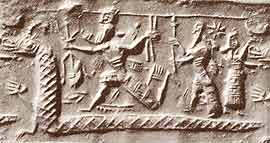
A Sumerian cylinder seal depicts what appears to be a divine scene with a killer bee goddess (not an Africanized killer bee, but a slang killer bee). One wonders what the worshippers must be thinking. Perhaps they too had watched Phase IV when they were kids! Bees could also be benevolent. Honeybees provided a rare treat before sugarcane had been discovered, and even Israel’s “promised land” flowed with milk and honey. So like most of life, bees were ambiguous. They bore all the markings of the divine: a wonderful sweet residue, nice trendy color scheme, but a painful sting that could even be fatal. Gifts of the gods are like that. So no matter how humane my temporary solution may be, I still feel like I’m taking on the gods.


Man and Womandrakes

With the recent release of Harry Potter and the Half-Blood Prince in theaters, young minds (or at least juvenile ones!) turn once again toward things magical. Anthropologists find difficulty in distinguishing between magic and religion, and many kids have been introduced to religious themes through this series of books and movies. I admit to having read the books and even having seen some of the films, and one of the memorable mythical sub-supporting characters that captured my attention was the mandrake. My first exposure to this herbological wonder was, naturally, the Bible. (Well, after Mandrake the Magician, of course.)

The tale of Reuben’s mandrakes in Genesis 30 shows a hint of that old white magic. Rachel bargains sex for mandrakes and the next time she is mentioned she becomes pregnant. Mandrake roots are often claimed to have anthropomorphic qualities – just how anthropomorphic depends on the imagination and how many the viewer has ingested. In the Middle Ages, the roots were classified as mandrake and womandrake!

Womandrake and Mandrake from a 12th-century manuscript

Womandrake and Mandrake from a 12th-century manuscript

Even in ancient times they were revered as aphrodisiacs. The Bible has plenty of these quasi-magical moments, often explained away as “folk beliefs” by literalists with a nervous laugh. To me they are part of the charm of a Bible unashamed of its roots.

The mandrake (mandragora officinarum) is a Mediterranean plant that had medicinal, and likely “religious” usages in the ancient world. A natural narcotic, the plant is poisonous in sufficient dosages, and it was used as an ancient kind of anesthetic, having been available long before whiskey. When a mandrake was uprooted, its humanesque tuber was thought to emit such a horrendous cry so as to drop the uprooter dead. Dogs were therefore tied to mandrake roots and prodded or urged to run, extracting the plant and dying in the process. Before calling the good folks at PETA, please note that no dogs were harmed in the writing of this post! Although this legend has a distinctly medieval bouquet, it is a method of mandrake hunting actually cited as long ago as Josephus. The mandrake has long arrested the human imagination. From Rachel to Pomona Sprout, the mandrake has not lost its potency for mystical mischief.
"Man"drake, 'nuff said (from Sibthorpe's Flora Graeca, 1808)


More Biblical Cats

In the Bible there are no cats. This silence is odd since cats have been associated with humans for over 9,000 years. Large felines, of course, appear in the Bible; lions and leopards prowl sacred writ, but nary a housecat. In a world of subsistence farmers, the concept of a “pet” is also absent — an animal as part of the household is yet another mouth to feed. The closest we get to biblical pets is in Nathan’s parable to David about Bathsheba. Here the “pet” is a lamb — a potential source of wool and almost certainly a funeral involving roasting and possibly mint sauce.

The Israelite view on animals is difficult to assess fully. Clean and unclean classifications seem to relate to predatory behavior and “fitness” for an environment. As a notorious but useful predator, cats could have been somewhat of a religious embarrassment. Having tamed feral cats, I know that the key is to make repeated offerings to a cat (by the way, this is the advice of Old Deuteronomy in Cats). Being quite self-sufficient, cats can find what they need without human, or divine intervention, thank you. Perhaps feline behavior resembles that of the gods a little too much for people inclined towards henotheism?

In the beginning was the cat

In the beginning was the cat


The problem with predators is no one knows what they’ve been eating. Predation involves bloodshed and blood pollutes. Look at what the cat dragged in! Biblical cats are victims of argumentum ex silentio — we can never know why they don’t merit a mention. As carnivores they are necessarily unclean. By the Middle Ages, for reasons still unclear, the church and superstition rendered cats as the familiars of witches. Ironically the associated killing of cats likely helped to spread the Black Death because of the removal of the flea-bearing rodents natural predators. In most ancient cultures cats are credited with supernatural powers. Since the Bible strictly guards this privilege, perhaps cats stepped just a little too close to divine prerogatives to merit a mention in the Good Book.


Not Lion

Being raised without much of a paternal presence, I frequently wondered at how church services were always presided over by men but populated by women. When I grew up (well, part-way at least) I became interested in feminist interpretations of the patriarchal Bible. The idea that just half of the human population seemed to have all the interpretive privileges simply struck me as unfair. Being a man myself, however, I wasn’t sure where to go with feminist interpretation, or even if I was qualified! This penchant no doubt vexed many an official in my Nashotah House days, but the conviction only grew stronger there.

While preparing class materials on the prophet Amos, I recalled how fond the prophet was of leonine imagery for Yahweh. Amos characterizes Yahweh as roaring, hunting for prey. Curious about lions in Israel, my research revealed that the great felines are extinct in that part of the world. The Barbary lion, extinct in the wild, was the biblical lion. As usual, we kill off what we don’t comprehend.

Further research revealed that lions like to sleep even more than most teenagers. It is not unusual for a lion to sleep 20 hours a day! When they have to wake up, however, they are hungry. And here was the interesting tidbit — when lions hunt it is usually the females that do the work! Once a kill is made, the male struts in and takes the proverbial lion’s share, but the lionesses are the hunters. In the ancient world, before television, ipods, or even mindless Ann Coulter drivel, people were keenly aware of their environment. Ancient writers often made astute observations of nature. Would Amos, the shepherd, have known that it is the lioness who makes the kill? Was Amos the first feminist in the Judeo-Christian tradition?

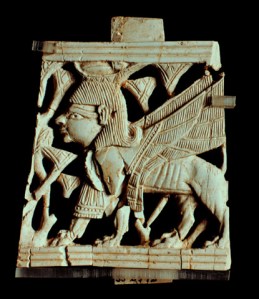
Compare the lions.

Compare the lions.


Which is scarier?

Which is scarier?


Bible Guy

Strange bedfellows?

Strange bedfellows?

In my Nashotah House teaching days, standing sentinel in my office was the 8″ action figure of Bibleman. I first discovered Bibleman while surreptitiously skulking through a Christian bookstore seeking Veggie Tales paraphernalia (don’t ask). I quickly rounded the corner in the kids’ section and there he was, encased in purple-and-yellow body armor, packing a Bible and laser sword and a packet sealed forever from the curious eyes of Biblegirl. I knew then and there that I had to have him. I sent my wife back to buy him later.

Naturally curious, I found a website and learned that an entire culture and money-making industry had grown around this ultimate good guy. He had a sidekick called Cypher (sold separately), and arch-enemies with such names as Primordious Drool and Wacky Protestor. I marveled at the missed opportunity here — they could have called them Text Critic and Doctor Mentary Hypothesis! Fascinated, I watched video clips of Bibleman’s deft swordplay in a scene that brought back the poignant death scene in Robocop. This was certainly not the old-fashioned fundamentalism I’d grown up with. But even with a Schwarzenegger build and phallic light sword, this guy was KJV and GOP all the way.

Shortly after taking another surreal job, this time at Gorgias Press, my wife showed me a related article in the newspaper. Wal-Mart announced that it was planning to carry Bible action figures, manufactured by One2believe. The line includes Noah, Moses, Daniel, Goliath, and of course, Jesus. I must admit that I was let down that David and Bathsheba figures did not seem to be available. Jesus does have a pull-string, however, for quoting his favorite Bible verses. Even as I throw the paper aside in vexation, I know that come fall, when I find my way back into a classroom at Rutgers, Bibleman will likely have a new companion on my office shelf, and it may be the son of the Big Guy himself.