Mothers’ Instinct

Maternity leave (not for me, but still) demonstrates just how sexist capitalism is.  This becomes very clear in publishing where schedules are reinforced by incentives (instead of paying properly) for meeting agreed-upon deadlines.  If an author gets pregnant while writing a book—not an unusual situation—it can throw shockwaves all through a book’s schedule from production all the way back up to editorial.  Why?  Because incentives are on the line.  It’s possible to counter with what if an author falls sick?  Or dies?  Yes, these happen too, but pregnancy isn’t an illness and isn’t infrequently a biologically constrained event—there is an age at which it ceases to become an issue.  So incentives, which are based on schedules drawn up before an author conceives, put the capitalist machine into a tizzy.

If employers didn’t rely on incentives, but paid better wages, this could make the issue less acute.  The entire system is devised from a male perspective.  Sickness and death do occur from time to time, but the invariability of a schedule (which ironically takes about nine months) is based on a view that doesn’t account for the somewhat likely event of a pregnancy.  I often think about this.  The corporate structure was made by men, for men.  We now give lip-service to equality while refusing to change the masculinist structure that underlies it.  By doing so the valuable contributions and improvements that women might make are kept under the standard business model.  No wonder it feels like we’re stuck in a rut.

Societal change is generally slow, and that conservative tendency preserves our property and our means of making a living.  If we gave women more prominence in leadership I would hope that this would start to change.  The male-oriented viewpoints of the capitalist entrepreneur, the stolid religious leader, and the halls of government, and even education, are reluctant to let people think differently.  We want to move forward, but we’re afraid of losing what we have.  This is why the conversation needs to widen.  Maternity leave reminds us that some things are more important than work.  Care for a helpless human being is something nearly all people would support.  It’s when they grow up that society feels it can safely ignore their needs.  We need a mother’s wisdom here.  Every time a pregnancy sets publication schedules in a frenzy I ask myself why we have to rely on incentives beyond just being the most human that we can be.


Learning Lingo

Languages are more than ways of communicating.  They are ways of thinking.  I figured that out with German, the first foreign language I studied.  It became even more evident with Greek and undeniable with Hebrew.  Beyond that, Ugaritic and other Semitic languages confirmed my suspicion.  To unlock a language is to open up a new way of thinking about things.  (This is one reason Trump’s isolationism was so dangerous.)  Babel: Around the World in Twenty Languages, by Gaston Dorren, is an overview of twenty different ways of thinking.  The book picks a prominent feature of the twenty most-spoken languages in the world.  Apart from the list of what they are (in order of appearance: Vietnamese, Korean, Tamil, Turkish, Javanese, Persian, Punjabi, Japanese, Swahili, German, French, Malay, Russian, Portuguese, Bengali, Arabic, Hindi-Urdu, Spanish, Mandarin, and English) there are many other surprises.

Many of these languages—perhaps all—are reflections of history.  The histories often include intentional divisions between people.  “They are not like us” thinking.  Usually on the part of elites and rulers.  The common person is quick to pick up the language of neighbors but those, like Trump, who hate differences, tend to rise to the top.  Quite apart from that, the features of these various languages show us the many ways people have learned to convey their thoughts.  Some tongues are super, even hyper-polite.  Some are reserved for women.  Some represent an entire continent, but notice the sheer number of Asian languages on this list.  Dorren notes at one point that having a unifying Scripture, such as the Bible, often codifies a language.  Religion is part of the human way of thinking.

Nowhere is this more obvious in the case of those languages that are considered divine.  Arabic, as many people know, is considered the only appropriate language in which to read the Qur’an.  Since languages are ways of thinking, that makes perfect sense.  What really struck me the most, however, was the case of Tamil.  A language of south India (many of these languages are spoken in India), Tamil is considered not only a divine language, but some adherents make it into an actual deity.  In a polytheistic culture there’s no problem with adding another god.  The idea that a language can be an actual divinity, however, shows once again how important it is that we try to understand one another rather than asserting one people is superior to another.  The book is appropriately titled Babel, and to properly understand that it is probably necessary to learn Hebrew.


Dirty Books

Dirty books annoy me.  Not that kind of dirty book, but books that arrive dirty.  If a book is expensive, particularly an academic book, I look for a used copy.  Since we’re in a pandemic, and also since the books I read tend to be outré, shall we say, getting them in the local second-hand place generally doesn’t work.  Sellers of used books online have to rate them.  Acceptable, poor, fair, good, very good—the scale is somewhat arbitrary.  I don’t like books with writing in them; I don’t want somebody else telling me what’s important.  I think I can find a topic sentence, thank you very much.  Lately I’ve gone down to the level of good with my online buying.  (Have you looked at the prices?!)  When you add that “very” to “good” sticker shock sets in.  Okay, so the books arrive well loved, I expect that.  But dirty?

I used to sell used books on Amazon.  I never sold many, but I always tried to be sure they were dusted off before putting them in the envelope.  I never put a cup of coffee on them.  Nor used them as a plate.  Some people apparently do, though.  I had one book arrive so filthy that I took the 409 to it.  Thing is, it cleaned up nicely.  Is it too much to expect that someone selling used books might go ahead and get some of the gunk off before sending it?  It’s not exactly Antiques Roadshow patina, after all.  It’s someone else’s slovenliness.  Who knows—might not a quick wipe-down improve the profitability by enhancing the condition of the book?

Library builders like yours truly want to afford the best editions that we can.  Books are more than mere objects gathering dust on the shelves—they’re individuals that we get to know.  Those that we meet but don’t really care for we pass along, hopefully to loving homes.  The way someone treats books reveals quite a bit about a person.  Accidents happen, of course.  A hazard of reading a lot may lead to the occasional spilled coffee or dropped bit of food, but treating books with respect not only increases their resale potential, it’s also an acknowledgement of the accomplishment.  Writing a book involves a considerable amount of work.  And although your property is yours to treat as you please, books are particularly vulnerable to damage by water, mice, or neglect.  Add fire, food, or extended exposure to sunlight and you get a sense of their fragility.  Acknowledging the effort a book takes to produce can go a long way towards making sure no book is dirty.  That, and a quick wipe-off before shoving it in the envelope.

Neat as a pin.


Savage Doc

Over the past several years I’ve written quite a lot about childhood books.  Despite my ambivalence toward the internet, it has made it easier to find books from years ago.  Since one of my Modern Mrs. Darcy reading challenge categories was a book from my childhood, my thoughts went to Doc Savage.  I haven’t written much about the Doc on this blog.  I think I can understand why now.  Doc Savage, I suspect, was one line of inspiration for Indiana Jones, although the latter was much more of a hapless sort of adventurer.  Kenneth Robeson was a pseudonym mostly for Lester Dent, the author of many of the pulp fiction stories about Doc.  As a forerunner of the superheroes that were shortly to appear, Savage was a “Mary Sue”—a literary character with no faults.  The stories were originally written in the 1930s and ‘40s.

As a child I read many of these novels, beginning in sixth or seventh grade.  I recently found a used copy of Brand of the Werewolf, which I read as part of my challenge this year and I was embarrassed by what I found.  Not that Doc’s perfection came as a surprise.  No, my embarrassment was at the racial stereotypes that were so blatantly on display.  This particular story caricatures African-Americans, American Indians, and Spaniards.  It does so unselfconsciously with an air of entitlement that made me ill.  Sure, all characters suffer by comparison to Doc Savage, but those who aren’t “white” (or bronze, in context), are throw-away characters.  Unless, of course, they are pretty girls.  If so we’re reminded every time that they are pretty.

No wonder our culture remains so intolerant of difference!  Here the default human being is the white male.  Even Doc’s female cousin (pretty, of course) doesn’t really help at all.  The entire scandal is uncovered and resolved by the white man.  I realize that I might be putting too much stress on a pulp that just can bear much weight, but I do wonder about how such stereotypical messages, repeated decade after decade, blend into the cultural stew in which we all soak.  I was by no means the only tween reading these books in the 1970s, some three or four decades after they’d been published.  A friend of mine got me started on reading them, and they were still popular books at the time.  We need, it seems, to be aware that our prejudices will live on in our words after we’re gone.  And after all that there wasn’t even a werewolf in the book.  Childhood memories are sometimes unclear.


Sea Romance

Sea shanties seem to be one of the early rages of 2021.  I’ll likely address this as a separate topic soon, but today I would note their appropriateness for discussing Melissa Broder’s The Pieces.  Despite my earlier concern about the Modern Mrs. Darcy’s reading challenge for this year, my family helped me put one together.  You see, January has become a bookish month for us.  Not only are books frequent holiday gifts, they are also a great way to anticipate a year of reading.  One of my categories was a book that makes you laugh out loud.  For help in selecting such a book I consulted some websites and found The Pieces so listed a few times.  The tie-in for sea shanties?  It’s the story of a woman’s love affair with a merman.

What defines a book as laugh-out-loud funny is largely the reader.  Yes, this is an amusing story with several parts that make the reader smile (or blush), but it seems to this reader a much more serious story than many reviewers suggest.  Yes, the idea of a merman makes it less reality based that much straightforward literary fiction, but the protagonist is portrayed as dealing with very real human relationship issues.  These made my reading of the book a pretty serious one.  When a person feels inadequately loved, it’s no laughing matter.  Sometimes such people (as the protagonist is portrayed as being) are driven to desperate measures, as the book suggests.  Perhaps some people find this funny, but others of us see a serious message dressed up in fiction.

Part of the draw here is clearly the romance of the sea.  Lucy (the narrator/protagonist) begins her relationship with Theo (the merman) because of the abusive kinds of relationships men have presented her with.  It’s a sign of Broder’s writing ability that she can make this kind of story lighthearted enough that some would call it hilarious or laugh-out-loud funny.  For me, however, when the issues raised are serious, even when couched in humor, there are underlying issues of sober import.  Relationships are complex.  Since the speculative element of a merman is thrown into the mix, it seems, many readers think the story is funny.  This despite the suicide attempts of one of Lucy’s friends and the death of the dog she’s watching for her sister.  For me laugh-out-loud books either have no serious consequences or dismiss such consequences as laughable in themselves.  The Pieces, however, made me think and, ironically, take a renewed interest in sea shanties.


In Praise of Brevity

I recently read an article in praise of short books.  Marina van Zuylen, whose response led to the article by Steven Weiland, praises not only brevity, but also print.  There is a difference between reading an actual book and reading something on a screen, even if an actual book of it exists somewhere.  I don’t buy the argument that books are clutter.  Books are my life, and if you start tossing them out you might as well start chopping bits off my body.  But it’s her thoughts on short books that really caught my attention.  Not that there’s anything wrong with long books.  Good ones are like getting lost in a pleasant mind-forest.  But I miss short books and the sense of accomplishment they engender.

Maybe like me you see a book online and get excited.  You really want to read it and then you click on its landing page and learn it’s over 300 pages long.  Or 400.  Or more.  You stop to think; do I really want to invest that much time on a single book?  As van Zuylen explains, some tenure committees don’t take short books seriously.  They want heft.  This blog should stand as proof that anyone can multiply words.  There are well over a million words on this blog alone.  As a book this blog would be about 3,650 pages.  Without footnotes.  But it’s not a book, and that’s the point.  Your time is valuable.  You’re choosing to spend a little of it with me (Thank you!).  I keep my posts around 400 words.  A five-minute read.  And I like books that I can finish in a week or two, along with my full-time job and other life responsibilities.

The electronic revolution—as good as it’s been—distorts things.  Even the very definition of “book” is up for grabs.  My mind always goes back to the scriptoria with weak-eyed monks rubbing aching backs as they laboriously copied books out by hand.  Today we don’t even wait for the paperback, but download it instantly.  How is this the same?  And yet we have less time than ever.  That’s why I enjoy short books.  Some of the most impactful (oh, that word!) books I’ve read have been brief.  As Pascal long ago noted, it’s more difficult to write a short piece than a long one.  So I join Dr. van Zuylen in her praise of the short book.  Long may they live!

At least it’s real…


Year Book

I have to confess that I’ve had trouble letting go of the holidays this year.  Actually, that’s kind of normal.  The let down from “sacred time” (however that may be understood) to “ordinary time” is often a rough transition.  Anthony Aveni discusses this, among other things, in his short study, The Book of the Year: A Brief History of Our Seasonal Holidays.  Not a deep history, but a thoughtful consideration of the seasons of our celebrations, the book informs and entertains.  There are surprisingly few books that cover the holidays, despite their centrality to modern life.  What person in business doesn’t look forward to the third quarter?  Who doesn’t anticipate a little time off work, punctuated throughout the year?  Aveni is one of the few general purpose books that you can go to for background on several seasonal holidays.

Aveni is somewhat of a polymath, being both an astronomer and an anthropologist.  He clearly has a special interest in first nations studies as well, as The Book of the Year occasionally dips into the rituals of Latin America.  A number of holiday traditions are explored here, leaving the reader wanting more.  I find the question of why we celebrate the way that we do a fascinating one.  Many of our customs have unexpected roots and many of them were transformed along the way by the church.  An unusually high number boast recent developments that we tend to think of as foundational to their essence.  The holidays as we grew up with them likely stay in our minds as the default way they should be.  Interestingly, bringing them into continuity with ancient customs reveals a steady evolution, mostly from sacred to commercial.

Since I wrote a book (unpublished) about the holidays several years ago (and have read a number of the same), I’ve always dug into books like this whenever I can find them.  Holidays are the heartbeat of the year.  Many of us look for something to help pace us in the reckless spinning vortex that we call capitalism.  Our lives are all interconnected, and the holidays also have subtle intricacies as well.  As they wind down, they tend to point both back to the previous red-letter day and forward to the next one.  Aveni doesn’t cover political holidays very much.  He does mention Martin Luther King Day, the next federally recognized day of rest.  As Aveni points out, the end of the Christmas season can stretch as far as Candlemas, so I guess we still have a few weeks to go before it’s all officially over, in sacred time.


Slow Jinn

You can sort of tell when an author has a background in religion.  Early on in my blog writing, I made note when novels had religious elements.  It’s so common that I seldom do that anymore.  Matt Ruff’s father was a minister.  His understanding of the religious landscape comes through in The Mirage.  It wasn’t on my reading list, but someone gave me a copy and the story drew me in.  In case, like me, you only know Ruff from Lovecraft Country, this tale’s quite different.  There may be some spoilers here, so if you’re thinking of reading it fresh, you’ve been warned!

Set in an alternate reality in which the superpower in the world is the United Arab States, the story follows three police agents of Homeland Security as they uncover a perhaps unwelcome truth: the world they know is a mirage.  It is, in fact, the work of a jinn.  Before commenting on that, I would say that you don’t learn about the jinn until a good way into the story.  Up to that point I’d call this simply literary fiction.  The jinn adds a speculative element to it, and also explains, mostly, how things ended up the way they did.  Jinns, by the way, are often considered demons in Arabic culture.  They are quite different from Christian demons, and that point makes itself clear as the story unfolds.  Our three protagonists begin to uncover hints that the twin towers didn’t actually stand in Baghdad, and that Christian terrorists didn’t fly planes into them on November 9 (11/9).  They have run-ins with Saddam Hussein and Osama bin Laden as warring factions vie for power in the UAS.

This is a great story for trying to understand the world from the point of view of a different religion (unless you’re Muslim).  This is a world where Christians are terrorists (you get to meet David Koresh as well) and the United States is a backward country divided over religion.  Reading this as events unfolded in Washington, DC last week was a little bit disconcerting.  Alternative realities are often just a heartbeat away.  The plot is a bit complex at points, but it’s a fairly quick, if profound read.  Religion is the heart and soul of this book.  That religion could be either Islam or Christianity.  Perhaps even something different.  The way it plays out is very much like real life, dividing people against each other until reality becomes difficult to bear.  For anyone interested in what a Muslim-run world might have looked like, this is a good starting place.


Bookselling 101

My wife and I have sometimes toyed with the idea of running a mom and pop bookstore.  Our combined lack of business sense (and capital) have always prevented us, but dreams can be comforting and persistent.  I met Andrew Laties at his bookstore Book & Puppet Company in Easton.  His neighbor, a professional colleague, introduced us just as things were gearing up for the first Easton Book Festival, back in pre-Covid 2019.  It was a big event, and Andrew surprised me by remembering my name when we ran into each other at one of the many presentations held that weekend.  It was there that I picked up a copy of his acclaimed Rebel Bookseller: Why Indie Businesses Represent Everything You Want to Fight for—From Free Speech to Buying Local to Building Communities.  Although the subtitle is lengthy, it encapsulates what the book is about.

A true liberal, Laties is also a savvy businessman.  Rebel Bookseller is the one book you want to be sure to have on hand if you ever dream of starting an indie.  Independent bookstores stand for so much of what liberals value—helping local communities, free expression of ideas, education.  Indeed, one of the draws of the Lehigh Valley is its ability to support several independent bookstores.  We lived for years in an affluent (yours truly excepted) community in New Jersey.  It had a small indie that closed after just a few years.  The nearby mall (which draws employees a nearly two-hour commute from New York City, I kid you not) was a better measure of the local mindset.  We had to drive to Bernardsville or Princeton to find indies, or perhaps all the way to New Hope or Montclair.  Communities that support bookstores are great places to live.

The acquisition of knowledge is, according to a most rudimentary understanding of human civilization, our most basic need.  The invention of writing is what set us on the track to true progress.  Anyone who has benefitted from modern medicine, technology, or the rule of law, has writing to thank.  Books represent the surest way to keep knowledge alive.  Rebel Bookseller moves beyond the sobriquet of knowledge into wisdom.  This is a very well-informed book.  Laties knows the realities of how publishing works and the real costs involved with big box corporations deciding what people will read.  For anyone who wants to think independently, a local bookstore is an essential business.  My wife and I will likely never be able to run our own little indie, but we both reaped the rewards of reading, and dreaming, about the possibilities.


2020 in Books

As has become traditional on this blog, I like to revisit my reading for the year before the next one begins.  No matter what else goes wrong, we have books.  As I noted yesterday, I’ll be devising my own reading challenge for the coming year and if nothing else, it’ll be diverse.  For 2020, according to Goodreads, I finished 78 books.  Since I was in the final stages of getting Nightmares with the Bible to the publisher, several books early on were about demons, and many of them were quite good.  The nonfiction that really stick out in my mind, however, includes D. W. Pasulka’s American Cosmic, Richard King’s Ahab’s Rolling Sea, Gary D. Rhodes’ The Birth of the American Horror Film, Jeffrey J. Kripal’s Secret Body, Barbara Ehrenreich’s Living with a Wild God, and Ernestine Hayes’ The Tao of Raven.  If anything ties these books together it is likely their honesty when it comes to the spiritual quest.  It can legitimately take many directions.

Fiction has, at least for much of the year, been driven by a few factors: books I have on hand during a pandemic, The Modern Mrs. Darcy’s reading challenge, and books on my reading wishlist.  That list is constantly growing and the books that stand out particularly are again diverse.  Especially memorable were Ralph Ellison’s Invisible Man, Hank Green’s An Absolutely Remarkable Thing, Han Kang’s The Vegetarian, Scott Shibuya Brown’s The Traders, Andrew Michael Hurley’s The Loney, and Silvia Moreno-Garcia’s Mexican Gothic.  Apart from their diversity these books have little in common.  I suppose that’s a testament to the importance of reading widely.  On that list there are only two “white” men but a lot of great books.

Another couple of categories might apply: big books and short story collections.  Big books intimidate me, but I read five of over 500 pages: Ellison’s Invisible Man again, Herman Melville’s Moby-Dick, Mark Twain’s The Innocents Abroad, George Eliot’s Middlemarch (my longest book for the year), and Ann Radcliffe’s The Mysteries of Udolpho.  These books are all in the “classics” category, I see.  Short story collections are more edible, and I read nine of them, including four “by” Rod Serling.  The first was an edited collection of his works, and the other three were his own Twilight Zone adaptations.  I read a few plague books because of the pandemic, but they weren’t really among my favorites.  Perhaps they were a little too close to reality.  Nevertheless 2020 was a good year of reading, overall.  I’m looking ahead to what gems 2021 might hold.


Reading Ahead

One of the highlights of the changing year, for the past five years of my life, has been the Modern Mrs. Darcy’s reading challenge.  My wife pointed this out to me at the start of 2016 and I’ve used it to guide some of my reading for each year since then.  The idea is fairly simple: many of us get set in our reading habits.  The reading challenge listed categories of books, with a total of twelve volumes, that often forced you to read things you normally wouldn’t.  In pre-pandemic Januaries we’d go to a local independent bookstore and pick out some of our chosen books to fit the various categories.  It became kind of an extended holiday ritual.

It must be tricky to come up with new categories all the time.  Therefore it’s understandable that the Modern Mrs. Darcy has decided to shake things up a bit for 2021 with a somewhat more complex scheme of determining what to read.  Unfortunately for me, I have about enough complexity in my life right now.  For a reading challenge what I crave is simple-minded direction: read a book in (blank) category.  So now I’ll be left to my own imagination for 2021.  Not that that’s ever a problem.  My reading wishlist is enormous and, like the universe, expanding rapidly.  Every year new books of great interest appear.  Every year I learn of books I should’ve read long before now.  I also do research, in my own way, and these books can be rather insistent regarding one’s time.

Goodreads also has a reading challenge (which I also started taking in 2016), but it’s based purely on the number of books you pledge.  There’s a sense of accomplishment when you can tick off that final pledged book (hopefully in September or October), and still have a few months of bonus reading left.  Each year becomes a year in books.  Like many people, I’ve survived the pandemic so far by spending lots of time with books.  For my last post of the year tomorrow I’ll do my traditional summary of the year’s reading.  I began the year thinking of Sea Lab 2020, a formative, optimistic Saturday morning cartoon from my childhood.  We were then hearing rumors of a new disease in China, not anticipating that 45 would decide to sacrifice over 300,000 Americans on the altar of his personal disinterest and pride.  Through it all, however, there have been books.  Reading improves intelligence.  Let’s all hope, then, for a much more intelligent 2021 ahead.


Yankee Doodle

Some books stay with you in a way that hits very close to the nerve.  Since I read Mark Twain’s A Connecticut Yankee in King Arthur’s Court many years ago, memories of how it left me feeling prevented me from re-reading it.  That’s pretty unusual for Twain, in my experience.  I’ve read some of his other novels and there’s not a similar feeling toward them.  The racist elements are disturbing, but overall the stories manage to overcome some of the darkness with either levity or sarcasm.  The scenes that scared me off from re-reading Connecticut Yankee were the two episodes in which young women were murdered.  I realize Twain was simply being honest here regarding the cheapness of life in medieval times, but I found both these instances so saddening that I had a difficult time coming back to it.

Now, some two or three decades later the book speaks to me in a new way.  Something else I recently read reminded me of it, and I was struck at just how much Twain’s Arthurian peasants resemble the unthinking crowds of Americans who simply accept what people like Trump say.  One of Hank Morgan’s banes is how the uneducated refuse to question what they’re told.  In many ways this is humorously narrated but a dark undercurrent remains behind.  Twain had clearly supposed that nineteenth-century America had overcome this brainless gullibility.  A century and a half after Twain’s Connecticut Yankee we’ve clearly been involved in retrograde motion.  Twain levels much of the blame on the church.  His choice comments in this regard also still apply.

“I was afraid of a united Church; it makes a mighty power, the mightiest conceivable, and then when it by and by gets into selfish hands, as it is always bound to do, it means death to human liberty and paralysis to human thought.”  So Morgan states in chapter 10, and indeed, in the novel it is the church that largely leads to the downfall of the civilization Morgan had built.  Or again, in chapter 17: “I will say this much for the nobility:  that, tyrannical, murderous, rapacious, and morally rotten as they were, they were deeply and enthusiastically religious.  Nothing could divert them from the regular and faithful performance of the pieties enjoined by the Church.”  Twain couldn’t admit in public,  even in his own nineteenth-century life, what he really thought about organized religion.  It’s pretty plain in his fiction, but disguising fact as fantasy is a tried and true method of getting at the truth.  If I weren’t so sensitive to the human plight, I might read it more often.


Udolpho’s Mysteries

The carousels on Google can provide a great deal of information.  Looking at them, along with trusted lists of gothic novels, it became clear that one of the few classics I’d not read was Ann Radcliffe’s The Mysteries of Udolpho.  It’s been on my shelf for many years, it’s shear bulk staring me down each time I turned in its direction.  Long books are, of course, fine if they keep you going.  Knowing this was published in 1794 (in four volumes) cast some doubt on the narrative earning the sobriquet of “page turner,” and thus it proved not to be.  I’m afraid my disposition meant that the gothicness of the novel (and it’s certainly there) didn’t speak to me as I hoped it might.  There are creepy castles and rumors of hauntings.  Lots of stormy nights and damsels in distress.  Still, it comes across as the problems of the wealthy and that has to be handled well in order to not turn off this poor reader.

Still, a novel of such fame being written by a woman in the eighteenth century is worthy of note.  More than that, Radcliffe was the most successful (in financial terms) professional writer in the decade that produced The Mysteries of Udolpho.  Her literary influence is undisputed.  The novel is, however, excessively long.  Descriptive prose style was common at the time and may seem excessive to modern readers.  This is, however, impressive for an author who never traveled to the regions about which she wrote.

About 600 pages in, in the edition I read, something caught my eye.  Much of the novel consists of descriptions of mountain ranges in France and Italy.  As one party is on its way up one of the inclines, one of the gentlemen mansplains some of the geological features.  Noting that sea shells are found at such elevations, and so far from any body of water, it is noted that this is evidence of the deluge.  What’s so astonishing about this is that even in the twenty-first century that explanation still has currency among biblical literalists.  The novel appeared before Charles Lyell, who would explain the ancient ages of rocks, was even born.  We have centuries of knowledge at our disposal that we still have a tendency to dismiss.  Interestingly, Radcliffe was famous for reviving gothic literature partially by explaining away any supernatural elements.  Of course, accepting standard religious teaching of the day would pretty much have been expected.  And yet the mysteries continue even over two centuries later.


Wooden Translation?

The summer got away from me, as it always seems to, leaving several boxes of things yet to be sorted.  Since these boxes are in the garage where there’s no heat, doing it during winter isn’t really feasible.  Still, I found myself in the garage storage area the other day and quickly tipped open a box or two to remind myself of what might be inside.  One of the treasures I found is actually from my wife’s family memorabilia.  Not exactly a family Bible, it’s a New Testament one of her grandfathers gave one of her grandmothers as a gift.  It’s a red-letter edition, but what makes it unusual is the binding.  It has olive wood covers from Jerusalem.  The front cover is embossed with a Jerusalem cross.

Bookbinding has long been an area of personal fascination.  Growing up when and how I did, most of my books are paperbacks.  The paperback was initially one of the responses to shortages introduced by wars.  Since they were cheaper to produce they could be priced down.  I have a few academic paperbacks from the twenties (I can’t make myself acknowledge that 1920 was a century ago) whose paper bindings are literally paper.  I fear to take them off the shelf, given the fragile nature of their bindings.  Prior to that books tended to be “hardbacks.”  A piece of cloth-covered cardboard was the preferred means of protecting the vulnerable leaves inside.  Before that leather was routinely used.  Those were the days when books were properly thought of as an investment.

I often think of how little I will leave behind, at least in terms of items of monetary value.  Books seldom maintain their cover price for long.  As someone who lurks on used book websites, however, I do know that the choice tome of either quirky fiction or nonfiction under-appreciated at the time can easily jump market values with predatory sellers.  Even for a paperback.  I am loath to confess how much I’ve paid for a book I really needed for research that mere public libraries simply can’t access.  (The university library is a place of wonder, and one of the resources I most often miss in having become secular.)  Just this past week I saw a sci-fi book from the sixties I wanted to read priced at over $500 on Amazon (used).  When I went to check on it this morning all copies were gone.  And to think the world considers books a poor investment.  The real key is to be obscure, no matter your binding material.


Religion Prof

Back in 2009, when Sects and Violence in the Ancient World started out, there was a fair bit of interest.  At one point I was listed among the top fifty “biblioblogs.”  Back in those days I got to know James McGrath, the curator of Religion Prof, a great blog now hosted on Patheos.  If you want a finger on the pulse of what’s happening in religious studies, you should read him.  With an energy I can’t conceive, he posts interesting stuff every day, even while being a professor.  And like me, he’s fascinated by religion and pop culture.  He also understands something—links and likes and shares are important.  People in my generation and beyond often don’t think that clicking that little thumbs up will do anything.  It does.  More so, that share button.

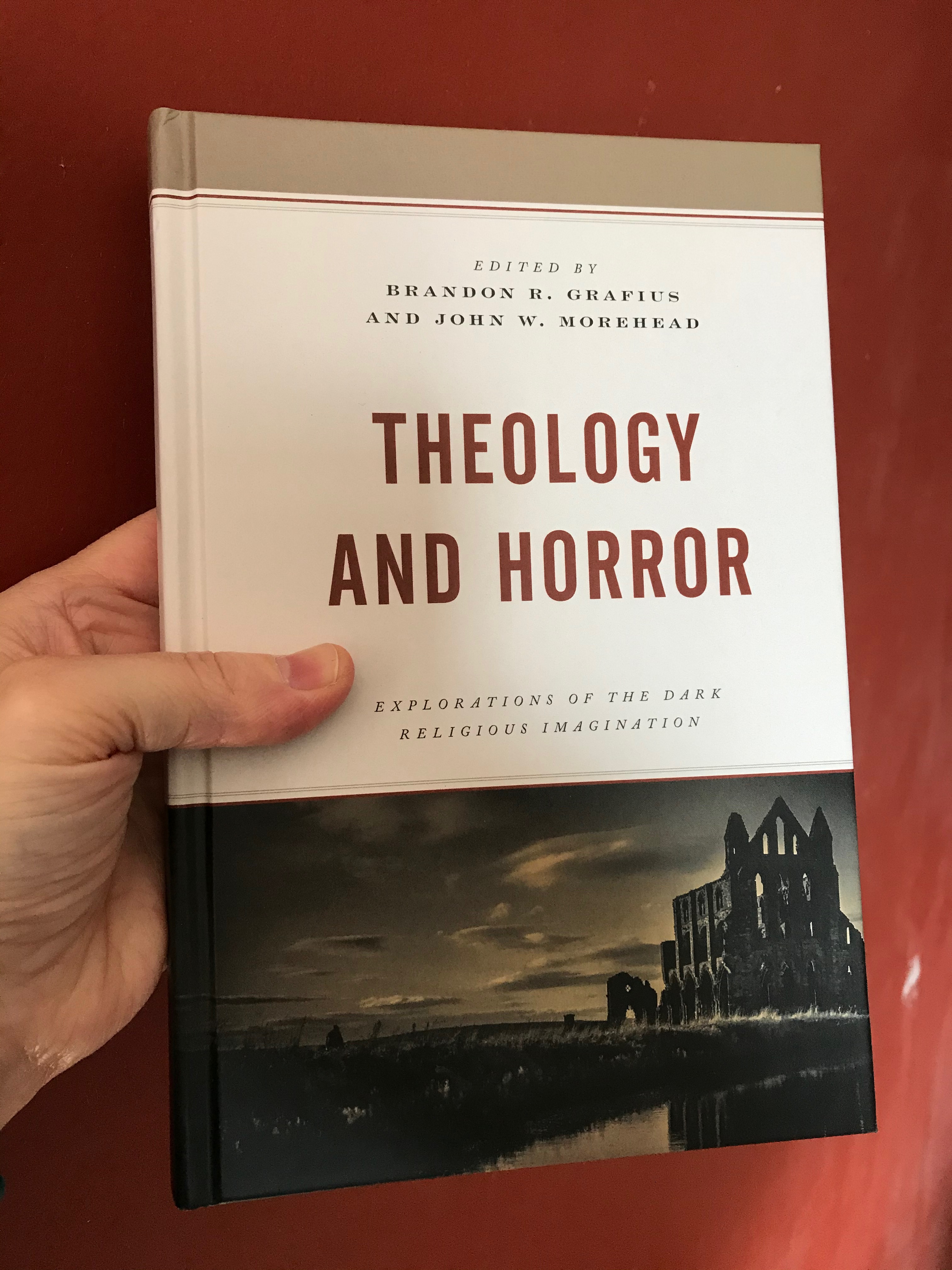
I was really pleased when James agreed to do a virtual interview with me about Holy Horror and Nightmares with the Bible.  You can find the interview here—and be sure to recommend and share it.  James has several interesting books of his own.  You should check them out.  The world of religious studies (and dare I claim it, biblical studies) is hardly moribund.  Underfunded, yes.  Socially devalued, certainly.  But alive nonetheless.  James’ blog is proof of that.  My regular readers will know my usual jeremiad about how higher education has been treating religious studies.  You see, I’m an historical thinker.  Where we come from is important.  Higher education began because of religion.  Its origins lie in monastic communities preserving learning—some of it secular—for the good of the world.  Now administrators looking for a department to cut know just where to turn. Shouldn’t we treat our ancestors with a little more respect?

I’m forcefully reminded of the many times analysts have declared that religion would fade away.  The claim has been made multiple times over the centuries.  At the same time scientists studying humankind conclude that religion is good for us, and that we’re naturally inclined to it.  Of course we should cease studying it!  Well, Sects and Violence in the Ancient World has also evolved over the years.  Not all of my posts are about religion anymore.  Most of them touch on it, however, because I’ve studied it my entire life.  Not only did religion make Homo sapiens what they are, it also formed some of us individually in ways so profound that we’ll never escape it.  Some of us even wear it proudly.  Great job with the blog, James, and thanks for the shout out!

Remember the early days?