Another Turn

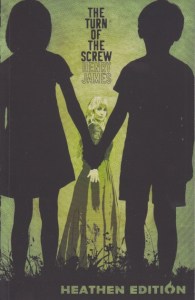
I have read The Turn of the Screw before.  Henry James’ most famous ghost story is a classic of ambiguity.  My previous reading, maybe a decade ago, was in an edition of James that insisted on stuffing other stories into the same binding, most of which I’ll probably never read.  I located a reasonably priced edition containing only the novella I wanted and it is published by Heathen Editions.  Obviously priding themselves on the unorthodox, Heathen Editions provides books with some little commentary, particularly pointing out unfamiliar words or explaining circumstances that many modern readers lack the training to spot.  The edition ends with James’ own afterword to the story, something my larger James volume lacks.  The story I remembered in part, but the notes also engaged me.

These notes aren’t numerous and they don’t distract.  In my case I understood the words defined, but I appreciated some of the historical or literary context supplied.  With so much literature available these days modern readers have to be drawn back into the classics.  James’ style tends toward the choice of more words than would be strictly necessary to tell the tale.  The fact that it was serialized helps to explain that.  Like Middlemarch and The Woman in White, both of which I’ve posted on in the past, being serialized encourages a kind of verbosity that modern publishers of fiction eschew.  At least in my limited experience.  For The Turn of the Screw the slow building to the climax requires spreading out.  The story itself could be summarized in a paragraph (which I won’t do, because you should read it yourself), but the feeling of dread has to grow as bits are slowly revealed.

One of the notes particularly caught my attention.  In an oblique reference to David and Saul, the editor expanded the footnote a bit.  The scene is when Saul is being tormented by an evil spirit sent by God and David is called in to help him with a kind of music therapy.  David plays his lyre and Saul’s demons temporarily leave him.  This is subtly referenced in chapter 18 of the Heathen Edition.  The note briefly explains Saul and David and then, for the only time in the book, goes on to provide a reception history of the reference by informing the reader that Leonard Cohen also refers to this episode in his song “Hallelujah.”  I’m sure the opening lines are familiar enough that I don’t need to risk violating copyright to quote them.  So it was that while reading a ghost story the Bible was introduced, which, of course has been my research agenda for a few years now.  A turn of the screw indeed.


Seeking Knowledge

So, I’m doing some research into a seventeenth-eighteenth century alchemist named Johann Konrad Dippel.  He lived in what would become Germany, and had a bit of a reputation.  The first stop for information these days is Wikipedia.  Now, as any academic knows, you can’t rely on what you find on the site.  I use Wikipedia to help start my bibliography.  The references here are rather slim.  I see there’s an Encyclopedia Britannica article (1911 edition) available for free.  I check their references.  They wouldn’t have passed my 100-level courses.  They contain the initials of the authors, no titles for their books, years and cities of publication but not the publishers.  Okay, so I’ll google/ecosia the authors with just their initials.  And the years.  And the cities.  Nothing comes up.

The next step is WorldCat.  It’s never let me down before.  Indeed, my first search brings up the bibliographic information on one of the mysterious, initialed authors.  (The WorldCat entry doesn’t even have a last name.)  The book is in German and the nearest copy is at Yale.  Looks like I’d better keep looking.  The next book doesn’t show up on WorldCat at all.  No combination of author (with only initials and surname), place, and date appears.  What was Encyclopedia Britannica 1911 thinking?  It’s at times like this that I miss paper research.  Although the privilege is no longer mine, roaming an academic library stack to stack, checking the card catalogue, breathing in the perfume of old books, acquiring new knowledge, these come back to me with the force of meeting an old friend after many years’ separation.

Less about the subject and more about the journey, seeking knowledge used to be an embodied thing.  I suspect somewhere in a bio-mechanical future with the internet coursing through our veins, it will seem quaint to think of oldsters like me tapping away at a keyboard and peering at a screen to find information about a nearly forgotten dead white man.  But even with all the knowledge of the web in intravenous electronic supply, will our future selves be able to put it all together?  Will they solve the problems of sexism, racism, capitalism, and dare we go any further than that?  Of will they elect leaders who care only for themselves and call on Christians to join them in deep corruption and fraud?  Or will, after some collapse, future Leibowitz stumble across a mysterious piece of melted plastic and wonder if there really was anything here before?


Looking to the Stars

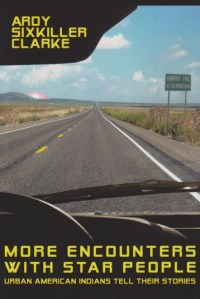
American Indian culture fascinates me.  As my usual readers know, so does the unusual.  A few years back I read Ardy Sixkiller Clarke’s Encounters with Star People.  Clarke is an American Indian who holds a Ph.D. and had several years of university teaching and administration to her credit.  She has degrees in psychology and education.  In other words, she’s credible.  Being American Indian she’s also aware of the cultural belief in star people.  Those of European descent, often expressing their self-supposed superiority, deny such things exist.  Interestingly the mainstream media seems to have taken an interest in the subject of UFOs lately, and that is also the phenomenon that Clarke investigates in her books.  Her follow-up More Encounters with Star People: Urban American Indians Tell Their Stories is another compelling glimpse into a different way of looking at the world.

The book consists of contextualized interviews with people of American Indian ancestry, and, as Clarke points out, with nothing to gain by telling their stories.  They don’t want their names or locations to be revealed.  They don’t want money.  Many of them don’t even want to be mentioned in a book.  These stories will take you into very strange places.  Places without the filters most of Anglo culture puts before anything that might hint at the paranormal.  I’m intrigued by the nearly universal (outside a narrow European outlook) belief that the world is not as it seems.  Because European-based cultures developed the most sophisticated weaponry and an economic system that takes no prisoners, its view, by default is considered the accurate one.  Time may tell on that.

I read quite frequently about indigenous cultures.  Often widely separated and not in any direct contact, such groups often drew very similar conclusions about the world.  These views are actually shared by those of European stock, but only when carefully labeled as fiction: fantasy, science fiction, speculative stories of any sort.  All of these are widely consumed.  They are also safely considered “not real.”  I’ve been rewatching The X-Files over the past several months.  Its success and its continuing fan base show that as long as we can agree that we’re watching something not true, we enjoy monsters and aliens.  And besides, Halloween wasn’t that long ago.  Still, I wonder if we’re missing out on things we might learn if we’d be willing to consider what the original inhabitants of this continent have believed.  It would take us to some strange places, but we might just emerge wiser.


Strange Reading

The internet has changed things.  Perhaps forever.  I’m thinking particularly of the way we read.  Not just ebooks, either.  I’m primarily a book reader.  That is to say, I prefer long-format, print writing.  Since we’re fairly isolated (this applied to me even before Covid-19), one of the ways we discuss books is via social media.  There are any number of sites where this takes place such as Book Riot or Goodreads.  I tend toward the latter because that’s what publishers tend to pay attention to.  Each year I participate in a couple of reading challenges.  On Goodreads my goal is a set number of books.  But this has a hidden aspect as well.  What counts as a book?

As a matter of course I don’t count the odd Dr. Seuss book I pick up and read in a matter of minutes.  Nor do I count the many, many books I read as part of my job.  The ideal method of tracking reading on Goodreads is to use the ISBN.  Older books, especially, come in multiple editions, often with differing content.  One way that publishers make money on public domain books is by adding a new introduction or preface to which they own the copyright even though the majority of the text is in the public domain.  The first commandment of capitalism includes the phrase “what the market will bear.”  You can price up until people stop buying.  In order to get value for money, short books are often bound together with other material.  This especially applies to novellas.   Who’s going to pay ten bucks for a book of under 100 pages?

The problem is counting them on Goodreads.  In order for the ISBN to count, you really need to read all the stories in a book.  In steps Amazon.  Making it simple to self-publish, many individuals have rushed in and have saturated the market with public domain material bound and distributed by their own print-on-demand editions.  If I want to read Joseph Conrad’s Heart of Darkness, the older dilemma was you couldn’t buy it alone.  It was almost always bound with some stories I didn’t want to read.  Now, however, some savvy book smith can download an electronic copy, word-process it, format it and sell it to you at a nice markup.  And you can enter the ISBN and get credit for only what you actually did read.  This is a strange new way of reading.  Before I had challenges to complete I’d read a short story or novella and not worry about the rest of the book.  For now, anyway, my reading patterns have changed just to keep up with the challenge.


Wild God

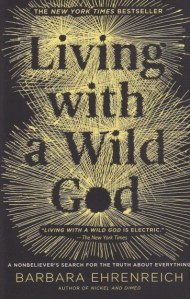
Living with a Wild God, by Barbara Ehrenreich, is one of those books I wanted to put down gently after reading it, for fear that it might explode.  Or maybe it was my head I feared might combust.  Describing it is difficult because it is so wide-ranging.  On the one hand it is an atheist’s view of religion.  On the other hand it is a spiritual biography.  On a third hand it is coming to terms with having had a profound mystical experience.  It is one of those books where, knowing my life has been so very different, yet I feel that Ehrenreich and I have had so much in common that we’d be friends if we ever met.  It is also the work of a woman who is scary smart and whose teenage thoughts were so intense that my own seem puerile by comparison.

But that mystical experience!  I’ve had many of them in my life, but I don’t know you well enough to share them here.  They’ve been recorded in an unfinished book that I may or may not try to publish some day.  (Ehrenreich was smart and took a job as a journalist, which means others assume you know how to write.  Even those of us in publishing have trouble convincing agents and others who hold the keys to non-academic pricing that we understand the craft.)  Mysticism quickly becomes a staid discipline, not at all like the life-directing experiences such encounters themselves actually are.  It’s difficult to explain without sitting down and talking to you.  It’s something academics tend to avoid like Covid-19.

The books that mean most to me are like conversations with an absent author.  Drawn in by an openness, or perhaps by the fact that we’ve lived in a few of the same places over the years, perhaps passed one another unknowingly on the street, you feel that they’ve invited you into their very head.  What you find there has a strange similarity to what is in your own head, while being completely different at the same time.  We should all strive for such honesty in our writing.  In the end Ehrenreich, with a doctorate in science, suggests we need to be open.  That kind of validation is important for those of us who’ve poured our lives into the study of religion.  She was drawn in from atheism, and I have been trying to escape from literalism all my adult life.  We have ended up in places not dissimilar from each other and I’m glad to have met her through this profound book.


The Abbey

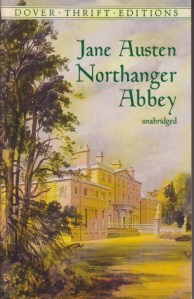
In my efforts to satisfy the Gothic longing of October—such a melancholy month—I’ve been reading Jane Austen’s classic, Northanger Abbey.  I avoided this particular title for many years because I knew that the Gothic frights were all rationally explained.  Austen was such an accomplished writer that she was able to poke fun at the Gothic genre while participating in it, at least somewhat.  I actually read this novel with no idea concerning the plot or characters.  Sometimes for works of the western canon these elements are so well known that you kind of know what to expect.  Northanger Abbey, although appreciated, isn’t often considered Austen’s finest work.  In fact, it was her first novel finished, but was only published posthumously.  As I writer I can understand that.

The story follows Catherine Morland in a satire of Gothic novels.  In fact, Catherine’s favorite book is Ann Radcliffe’s Mysteries of Udolpho, one of the Gothic standard-bearers.  The first half of the novel (pre-Gothic) sets the story up with two love triangles formed in the city of Bath.  Austen excels at making the reader uncomfortable with characters.  So much so that the second (Gothic) part of the novel ends up making one of the formerly noble Tilneys,  father of Catherine’s love interest Henry, look downright snobbish and petty.  O, the egos of the privileged!  The fact that she threw this in just about ten pages before the close (in my edition) made the ending all the more anxious.

There are no ghosts in Northanger Abbey.  No murders or poisonings took place there.  No secret manuscripts contained cryptic truths.  No secret passages led to hidden chambers.  Austen sets readers up for all of these, only to bring the conceit down in a showcase of her satirical ability.  The novel still frequently ends up on lists of Gothic classics.  I wonder if readers don’t get the satire.  I had put off reading it for many years because I knew it to be good-natured fun-poking at a genre I unaccountably enjoy.  At least I know I’m not alone in this.  I’m glad, in any case, to have finally read it.  Jane Austen was a most capable writer, a master of portraying human foibles particularly well.  The problems of the landed gentry, however, as I’ve noted before, aren’t really of interest unless there’s actually a ghost or monster lurking in the shadows somewhere.  Without monsters even an imposing abbey owned by a spoiled petty nobility is just an abbey devoid of purpose.


Dreams and Nightmares

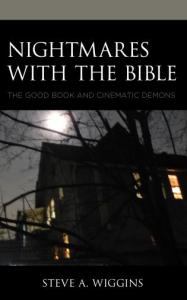
Since posting just a few days back about the cover of Nightmares with the Bible it has now been posted on the Rowman & Littlefield website (more on that in a moment).  I’m pleased with the cover because it includes a photo I took.  It’s a little blurry, but that adds to the effect.  In the days before my commuting began, I could easily stay awake until regular hours and one autumn weekend we arrived home to find the spooky house next door all lit up, under a full moon.  I appreciated the eerie look of the situation and snapped this photo, which I’ve used a few times on this blog.  I’m not sure the house next door was haunted, but it sure looked like it.  More to the point, it reminds me of the poster for The Exorcist.  It has always been a dream of mine to have one of my photos appear on a book cover.

I also received the happy news that the book is with the printers.  That means it will soon be available.  It will be expensive, but I should be receiving a discount code that I will be glad to share.  “Library pricing” is something publishers unfortunately have to do to make books pay themselves off.  In the past several years so many books have been appearing that the bottom has fallen out of the academic library market.  Too much supply, to put it in capitalist terms.  Many publishers, however, will give discounts to individuals who want to buy a copy.  All you have to do is ask the author.  (I don’t have the discount code yet, but I will be glad to share it once I’ve received it.)

Nightmares with the Bible is being published by Fortress Academic.  A few years ago Fortress Press partnered with Lexington Books to handle their library market books, including those in the series Horror and Scripture, in which Nightmares appears.  Lexington Books is an imprint of Rowman & Littlefield.  It’s sometimes difficult to keep track of publishing houses since there has been a lot of consolidation over the centuries, accelerating in recent years.  Publishers don’t sell as many individual books as they used to and with Amazon’s arrival a new shift in the market took place.  It tends to favor trade publishers over academic ones.  In any case, that means even books written for trade readerships, like Nightmares, are priced for libraries.  If you have access to an academic library please recommend they buy a copy.  If the book succeeds in that venue a case can be made for a paperback edition.  In the meantime, the book should be, barring an apocalypse, out on schedule.


War of Egos

As an author you have to believe in your book.  Experience has taught me that if you don’t, nobody will.  Still, there are ways of believing in your book while keeping your ego in check.  Given the ego we’ve seen along Pennsylvania Avenue these last few years it may come as little surprise that even some wannabe authors can nearly match it.  The line, as professionals draw it, is balancing between the importance of your work with the realism that few books sell well.  Your best approach, as author, is humility.  Many people don’t read the professionals.  You quickly learn this if you’re in an editorial role.  It is normal to receive emails from authors telling you how important their work is, some even claiming it as an even on a cosmic scale (I am not joking).

I often consider how much pain authors could spare themselves with just a tiny bit of research.  If a publisher has turned your book down twice already, don’t submit it a third time.  (You already crossed the line the second time you sent it.)  And don’t send your proposal with a list of demands.  What I’ve noted both on this blog and elsewhere is that editors value professionalism.  We don’t like turning down books.  We don’t want to ruin a prospective author’s day.  There are, however, safeguards you can use to prevent the worst kinds of disappointment.  Rule number one is check your ego at the door.  Do you know how many books have been published?  Do you know just how difficult it will be for your book to get noticed?  Take a reality check.

Also, scale your expectations.  How many bestsellers have come from university presses?  If you’re after bestseller status you need to aim for a trade publisher.  This is pretty basic stuff.  Those of us who publish in the academic world do believe our books are important, but many of us also know that they start only small conversations.  Biblical studies isn’t exactly a growth field.  We talk amongst each other, a collegial little group for the most part.  And to keep things on the collegial level it is helpful to remember that we’re not publishing for ego.  We’re publishing to try to move knowledge ahead, even if just by a micron or two.  Good writing, I was once told, is simply clear thinking.  Getting that writing published is part of a conversation and conversation only works if  we are willing to keep our egos on their leashes.


Keep It Covered

I’ve seen it at last.  The cover concept for my book.  I’ve been manicly checking the Rowman and Littlefield (parent company of Lexington/Fortress Academic—a roadmap would be useful) webpage to see what it might look like.  I’ve “seen a sighting” at last.  Nightmares with the Bible seems to be actually happening.  As a writer there’s always some doubt involved with your book.  You wonder, will it really come out?  Will someone pull the plug at the last minute?  Is any of this real at all?  Those kinds of things.  I’ve mentioned before that waiting is a very large part of the process.  Publishing is a slow business and the world changes so fast.  I sincerely hope it doesn’t ever leave books behind.

My waiting hasn’t been idle, of course.  My next nonfiction book is well underway but I’m focusing on fiction at the moment.  I had two short stories published within the last month and I’m inclined to follow where some success shows itself.  Besides, fiction and nonfiction aren’t as far apart as is often claimed.  Seeing the cover of the book, however, nudges me back towards nonfiction a bit.  Since I’m no longer an academic it’s a toss-up.  A few colleagues like what I’m doing, but my fiction work is secret.  So the process continues, waffling back and forth.  It’s all in service of learning how the publishing industry works.  That’s one of the many things they don’t teach you in graduate school.

It’s October and I should be thinking about monsters.  Although I’ve gone through my closet of DVDs, there are many that bear watching again.  If only I could fabricate time!  One of the things I’ve noticed about this pandemic—and I know it’s not just me—is that time seems to have been swallowed up.  A simple walk down the local biking trail now requires masking up before and washing hands after.  Less than a minute of time, for sure, but it adds up.  And if you go after work there’s not enough light left to paint the porch by when you get back.  Such are the contradictions of this wonderful season.  You really can’t pin anything down.  The colorful trees put you into rapture then they’re bare.  The bright blue sky looms under relentless clouds.  You throw off your jacket one day and it snows the next.  And there might just be monsters lurking out there.  One of them, it’s said, will be released in November.  Given the nature of this season we’ll just have to wait and see.


Ode to Bookstores

The pandemic has changed everything.  You knew that, of course.  Like many people in fields of regular job uncertainty, we’ve curtailed spending as much as we can.  Never very securely established after Nashotah House, we’ve managed to get by by not thinking too far ahead.  I can’t imagine retirement (if there’s still a job left to report to).  Even more, I can’t imagine a life without books.  The only way I get through each day is by trying not to think about it.  Still, I miss bookstores.  Pre-pandemic, when jobs at least felt somewhat secure, we’d often nip into one of the many local independents of a weekend.  Missing browsing shelves sorely, we stopped into Book and Puppet over in Easton, when on a trip to buy produce at the outdoor farmer’s market.

It felt strange, the thought of going into a store that wasn’t dedicated to groceries or hardware.  Masked, of course, but would there be lots of people there, crowding the air with germs?  No.  There was maybe one other customer in the place.  I have to admit that I was a bit disoriented, trying to read over spines on a shelf, not wanting to touch anything.  I’ve tried hard to curb any spending during these highly uncertain times, but could I imagine a world with no bookstores?  Would I even want to?  Books, you see, give me hope.  My vision of heaven is October and a never-ending stack of books (and, of course, friends).  Books allow for escape and exploration.  Life will continue after the pandemic in books.

The fear has gripped many of us, I suspect.  I’m old enough to retire, but not well-off enough to do so.  Our house requires a two-person income at our level (highly educated, under-employed), and the pandemic rolls on.  I think of the Black Death—I’ve read about that too—and how history changed because of it.  In this pandemic we’re dying (all but the wealthiest) piece by piece.  The most vulnerable first, of course, but the middle class may well be in the sights.  The owner of the bookstore said he wasn’t sure how long he could hold out.  Just last year at this time I was participating in the Easton Book Festival that he’d organized.  I had a book-signing at the nearby Moravian Bookshop.  I can’t remember a time I felt so hopeful, knowing I had another book coming out, and if we survive long enough, another after that.  I really shouldn’t, but I’m in a bookstore.  I’ll buy one in hope that the future may just offer a place to keep it.


No Way Out

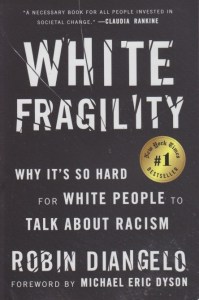
Racism is evil.  The grading of the shading of humans degrades us all.  Robin DiAngelo knows much about the subject and as we watch Trump rally the openly racist, she gives us all pause for thought.  Our entire culture is one of white supremacy.  Progressives, determined to combat it, are also part of it.  White Fragility is not an easy book to read.  It allows no escape for anyone “white” to use.  We must confront our racist culture and admit that we benefit from it.  When we try to explain that we’re misunderstood, she anticipates.  She has heard it all before.  The only thing we can do is confess, interrupt, and try to break down the system that continues to support the systemic evil we’ve embraced.

One thought occurred to me as I was reading.  No doubt DiAngelo would suggest I’m deflecting, and it may be that I am, but those of us who struggle with a perpetually low self-image, even if “white,” may not participate in feeling superior to anyone.  There are individuals whose natural assumption is the superiority of others.  I’ve experienced it time and again in my professional and personal life.  I assume the other is more adept and worthy than me.  In such circumstances a bit more carrot and less stick might’ve been helpful.  I know many both at work and more voluntary activities, for whom a word of encouragement is rare.  For those of us who assume the superiority of others, such encouragement goes far.

Even as I was thinking this I saw a post on Nextdoor.com.  The app, intended to help you find contractors or dentists or whatever, receives many posts on all kinds of topics from identifying animal droppings to alerts regarding crime.  The post to which I refer was from a security camera showing a “prowler.”  The young man seemed more to be walking than prowling to me.  His skin tone and the time of night led to a string of assumptions built on assumptions.  Since I’m often awake just an hour after the alleged “prowling” took place, I knew that were I caught on a security camera I’d merely be considered an insomniac.  Add some melanin and some racism and suddenly a walker is a prowler.  The words I was reading in White Fragility hit me with incredible force.  We have a massive amount of work to do.  “White” people have to own their history.  Own it and overcome it.


Gothic Tales

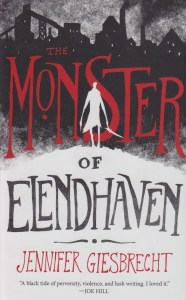
Each year when autumn worms its way into my consciousness, I begin looking for the ideal gothic book.  I can test this by looking at the Goodreads lists of best gothic novels and noting how many of them I’ve already read. The thing now, since I’ve already covered much of the canon, is to discover modern writers who can still evoke that feeling I seek.  This is all complicated by the subjective nature of what readers term “gothic.”  Many of the books on the lists don’t fit my own working connotation, so I keep looking.  One recommended title was Jennifer Giebrecht’s debut novel The Monster of Elendhaven.  I’m still trying to decide whether it is gothic or not.

It’s a little hard to classify, actually.  It certainly has some gothic elements, as well as some horror.  There are secrets and plagues and gruesome murders.  There is a monster from a polluted sea, but not quite your grandfather’s monster.  A human monster.  Or at least partially.  The tale is written with some tongue in some cheek.  There are funny elements and there are many serious moments.  There’s magic and mayhem.  If I were to try to characterize it the closest I might come would be a Tim Burton treatment of horror.  Like Burton, Giesbrecht creates a Halloween mood, but sometimes the humor undercuts it.  This makes it difficult to pin down the work as a whole and figure out if this is the gothic I’ve been seeking.

Set in a time difficult to define and in a fictional nation, it is the kind of novel that can be read without much consequence.  The references to the Allfather make comparison with Nordic regions natural, and there is perhaps a touch of Beowulf here.  In crafting the monster Giesbrecht has made a pretty unlikeable character.  He is a monster, after all.  But not a sympathetic one.  As in other modern treatments he is a stand-in for chaos.  There’s also an environmental sensitivity here.  The monster arises from a polluted sea that derives from, of all things, human greed.  So maybe there’s a parable here.  A short book, it doesn’t take too much of a time investment, but it may leave you wondering what exactly it is that you just read.  It is dark, and gritty, and fun.  A nice combination for an October night.  Is it gothic?  That one’s a little harder to answer.  It depends on how I’m defining it on any particular day.


Watery

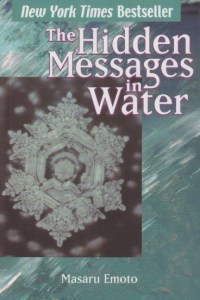
Having watched What the Bleep Do We Know? a few weeks ago, I became curious about Masaru Emoto’s The Hidden Messages in Water.  The book is highlighted in the film, and in a world where money decides truth, the fact that it was a New York Times bestseller must count for something, right?  I am of a skeptical bent, but I like to keep an open mind.  This itself is a delicate waltz at times since just about anybody can make truth claims and find a following.  Curiosity, as they say…  So instead of critiquing Emoto’s obviously slipshod methodology, I want to reflect on whether he really might have been onto something.  Many people around the world thought so, after all.

What it comes down to is water.  If you haven’t seen the movie or read the book, I owe you a brief explanation.  Emoto suggests that water crystals reflect the influences to which they’re subjected.  For example, water frozen as classical music plays forms beautiful crystals.  If heavy metal is played, it doesn’t.  Water frozen in beautiful surroundings forms beautiful crystals.  If that’s not controversial enough, Emoto suggested that emotionally freighted words typed on paper wrapped around the water bottle as it was frozen would reflect the emotions on the paper.  There are lots of problems here, but what I wonder is if water might not somehow be related to consciousness.  Emoto makes that claim, but since science can’t yet explain consciousness there’s no way to test it.  Could it be that water is a recording medium in some way?  Without raising the woo factor too far, some ghost hunters (it is October, after all) suggest moving water has something to do with “recording” spirits.

Like most critical readers, I left Emoto’s book not at all convinced.  I also left thinking that we shouldn’t throw the bath water out with the baby.  There are crazy ideas in the book, for sure.  But there may also be just a hint of insight as well.  That insight comes in the recognition of spirituality as an important aspect of human life.  The book was a bestseller.  Not all people are credulous.  We are, however, spiritual.  Many deny it.  Some violently rail against it but still have feelings along with their rationality.  Water can lift spirits.  The negative ions of breaking water tend to make people feel at ease.  We visit the coast where waves break against beach or rocks.  We visit waterfalls where cascades scatter water particles.  Even a fast-flowing stream will do.  Emoto clearly went too far with his ideas, but I think, deep down, he might’ve been onto something.


Keep Cool

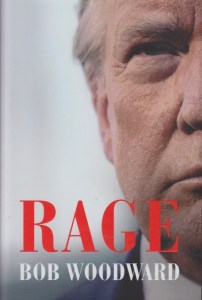
I know national secrets.  You can too!  Bob Woodward’s Rage contains them because Trump is willing to talk about anything that aggrandizes himself.  The real takeaway, and in many ways the point of Woodward’s book, is that Trump knew about and decided to downplay Covid-19.  And not because he didn’t think it was serious, but because he didn’t want to hurt his chances of reelection.  Although Woodward had no way of knowing in the middle of the summer, when the book went into production, that 45 would be infecting his senior staff mere months later, he would likely have been able to predict the results.  With the best medical attention in the world, Trump would recover and immediately downplay the virus that has now killed over 210,000 Americans.  Why?  He wants to win the election.

Many of us knew in November 2016 that this wasn’t just another Republican nominee with questionable intellect.  We knew that Trump had a long, long track record of caring for nobody but himself and that isn’t the kind of person who can lead a nation.  He had seventeen interviews with Woodward as he was writing Rage, and, as we might guess before opening the book, those interviews indicate that being president, for some, is all about bragging rights.  Knowing how serious the coronavirus is, he decided to ignore it for political expediency.  Now we see his own party’s leaders daily falling into the epidemiological pattern of the science they disbelieve.  Early on wearing masks was politicized and now we’re being told a deadly disease is a walk in the park (if you’ve got the best healthcare in the world).

I’m reluctant to write about politics.  I find it boring and intellectually stultifying.  But even under George W. Bush I believed that the president had what he believed to be the best interest of America at heart.  All that has changed in the last four years.  The Republican Party has sold its soul to the cult of Trump and those of us who’d rather just watch horror movies and write books and stories have had to become political activists simply to try to save democracy from the slide into a fascist narcissism that is intended to prop up one man’s ego.  Woodward’s book is more than a series of interviews with a dangerous man, it is a condemnation of political leaders who’ve failed their country repeatedly, without recrimination.  Of course, it is only intended for those who read, or maybe I’m just angry.


Ghosts, of a Sort

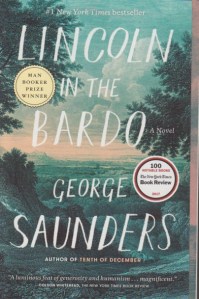
What happens when we die?  That question is perhaps THE question that drives just about everything we do.  Evangelicalism, masked behind love of Jesus, is really the desperate attempt to avoid Hell.  That idea is powerful and insidious.  The question of what happens, however, has also inspired a tremendous amount of literature.  Lincoln in the Bardo, by George Saunders, is a recent example of how diverse such views may be.  Written mostly epitaphicly, it is a conversation among the spirits in the cemetery the night Willie Lincoln arrives among them.  Fearing what is beyond, these ghosts don’t admit they’re dead, but rather think themselves sick, awaiting recovery.  When the profoundly bereft Abraham Lincoln arrives to mourn his son, things begin to change.  

All through my reading of this book I found myself wondering about the many ways we conscious creatures reassure ourselves about death.  Materialists say it’s like the turning off of a lightbulb.  All goes dark and there is no soul to remember anything.  Many of them claim science for proof, although science has no way to measure the non-physical.  Various religious sentiments of the eastern hemisphere posit reincarnation until one’s soul reaches the point of no longer having to cycle through all of this again.  Here in the western world, influenced by a Zoroastrian-inspired Christianity, we posit a Heaven and Hell.  Some include various shades of Purgatory, which, to the classic Greek, would’ve sounded familiar.  Those who’ve undergone Near Death Experiences often suggest a more dream-like reality of acceptance.

There are many more shades and nuances, of course.  We’ve entered the shadowy half of the year.  Those of us in temperate regions spend half of our lives with nights longer than the days.  Death, however, is generally a shunned topic.  We try to avoid talking about it since we really don’t know what comes after.  We have beliefs.  We have hopes.  We really just don’t know.  We often look to literature to help us explore these topics.  Lincoln in the Bardo does so with some humor, some sadness, and some soul-searching.  Those of us drawn to ghost stories naturally think about them as we wait later for the morning sky to lighten, and find it dark before we turn in for the night.  A great many options await us, some with a kind of historical anchor, and others that are completely made up for our edification.  The one thing they all have in common is they force us to think of that which we really don’t know.