Making Frankenstein

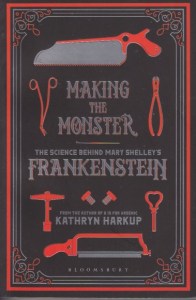
Some days ago I mentioned reading a book about Frankenstein.  This was Making the Monster: The Science behind Mary Shelley’s Frankenstein, by Kathryn Harkup.  I’ve read several books like this, many of them written about on this blog (search “Frankenstein”—there is a search box out there!), about the context of Frankenstein.  The base story is all the more compelling for having been written by a teenager who’d eloped with a married man who would eclipse her literarily.  Mary Shelley never got rich off Frankenstein, but it is one of the best known novels of the nineteenth century.  It had an impact during the author’s lifetime and has continued to have one these centuries later.  Harkup, however, is a scientist.  Her specific interest, apart from being a female writer herself, is in the science of the story.

Arranged thematically, Making the Monster covers several of the developments which would’ve been “in the air” at the time.  Mary and Percy Shelley both read science also, and knew many of these things.  There was the question of reanimating the dead that coincided with the early dissections of humans that made the modern study of anatomy possible.  There were medical breakthroughs—some of the more difficult parts of this book to read—and there were experiments with electricity.  There were cases of children raised in the wild that had been found and their subsequent stories documented.  There was evolution (in the form known to Charles Darwin’s grandfather Erasmus), there was revolution.  It was a time with so much happening that Frankenstein became a cathartic outpouring of the human soul amid the science that both Shelleys atheistically accepted.

Much of this book is fascinating, even after reading other similar accounts to the background of the novel.  What really brought it all together for me, however, was reading through the chronology at the end.  It takes me several days to read books.  What with the monster of daily work I often forget some of what I’ve read along the way from introduction to conclusion.  Having a chronology at the end reminded me of just how much information is packed in between these covers.  The narrative covers about a century (longer, if you include the alchemists), and shows how Mary was using fiction to address some very real science.  Harkup never loses track of Mary Shelley’s personal experience, however.  Estranged from her father, constantly on the move, widowed fairly young, losing several children, treated poorly by aristocratic in-laws, hers was a story of perseverance and ultimately influencing the western canon.  It shows that science and art can assist one another to make us all more human.  And the monsters left behind endure.

For Illustration Purposes

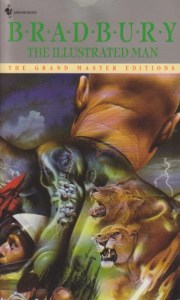
With the non-essential stores closed, my daughter asked me the other day “does that mean bookstores?”  Sadly, yes.  More weekends than not I spend some time in a bookstore.  Fortunately we are well stocked for an apocalypse, book wise.  Lately I’ve been on a kick of reading short stories.  I’ve certainly written enough of them to fill a book or two, and it’s nice to start something you can finish in one sitting.  I just finished reading, or perhaps re-reading Ray Bradbury’s The Illustrated Man.  I say “perhaps re-reading” because I know I read many of the stories in the edition of the book I bought as a tween.  Some of the tales I didn’t recall at all, making me think I was reading selectively in those days.  That’s the nice thing about story collections: you don’t have to worry about continuity.

That having been said, the conceit of the illustrated man himself is that of a framing device.  His tattooed body is the canvas on which all of these tales are painted.  A surprising number of them are religious in theme.  Many of them take place on Mars.  Rockets are ubiquitous.  As a child I hadn’t realized that many of Bradbury’s stories were published in the late forties and in the fifties.  They still felt futuristic to me, having grown up in a small town with very little exposure to technological developments.  Reading many of the tales as an adult, I was surprised at how much they influenced my own fiction writing style.  I must’ve read a lot more of them when I was younger than I recall.

My tweenage years were long enough ago now that memories slip into one another.  I can’t remember when this or that happened, especially as regards reading.  When did I first read about the incessant rain on Venus?  Or about the writers living on Mars dying out as their books are destroyed?  Looking back over my own fictional work I see Bradbury’s fingerprints everywhere.  Bradbury couldn’t afford to attend college, so he did what he knew—he wrote.  Of course, back in those days publishers and agents weren’t dealing with the volume they face these days.  The internet has made writers of us all.  And I have to admit that some of the stories in The Illustrated Man disappointed me.  They didn’t reach the level of either depth or insight that I had recalled.  Overall, however, the impression was good, if nostalgic.  As the days become a long series of interconnected hours of sitting in the house, it’s a real gift to have short stories to punctuate the days.


See Index Saw

Too much of my life is taken up with indexes.  If life with technology is a teeter-totter, then my generation stands just above the fulcrum.  There are guys with whom I attended college who maintain no internet presence at all.  I’ve repeatedly searched for college buddies and come up blank.  Those in the decade following mine, if they want to work, have pretty much resigned themselves to tech.  Those in the decade before, not so much.  What does this have to do with indices?  Plenty!  You see, in academic publishing, and its consequent research, you need to look stuff up.  If you read multiple books on the same topic you’re not likely to be able to pinpoint a page number without an index.  You remember you read it here (you think) and so you stick a finger in the back and begin checking out the pages referenced until you (hopefully) find it.  That’s the old school way.

I’ve typed my fingers down to the marrow trying to explain to guys my age and older that the average academic no longer uses a print index.  Just about everything has been digitized.  Although I’m no fan of ebooks (I very seldom read them) looking things up is sure much easier with a searchable PDF.  Type in your search term and voila—an easy list of references appears that can be quickly clicked through and checked.  And yes, my colleagues, that’s what people are doing these days.  I lament the decline in print books.  When I set out to write a book I have a physical object in mind.  It has pages and a cover.  A spine.  I am writing a book, not “content” to be “exploited” in “multiple formats.”  And yet, the index is really no longer necessary.

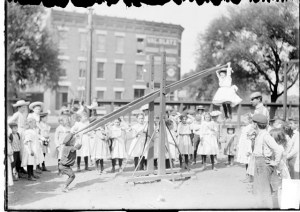
The typical academic author whose book is at the production stage fusses greatly over the index.  Calmly I explain that indexes are very rarely used.  They must have detailed indices, they insist.  The thing about teeter-totters is that they move.  I have an inner-ear problem.  As a child this prevented me from doing the usual playground things like swinging and seesawing and spinning, to different degrees.  I still can do none of those things well.  My wife and I bought a gliding rocker early in our marriage, that seats two.  We quickly learned that I couldn’t rock with her.  Indexes, you see, are on one side of that long board.  It’s the side on which the heavy weight of time rests.  So ponderous is it that the kids on the other side just can’t get it off the ground.  And I spend my days over the fulcrum trying to get the two sides to play nice together.  Without rocking the thing too much.

Photo credit: Chicago Daily News, via WikiMedia Commons


Classic Monsters

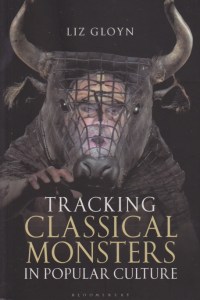
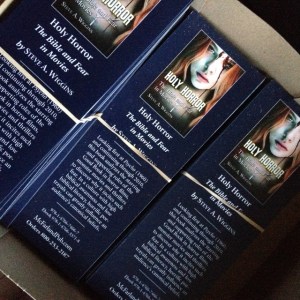
Convergent evolution is a term that’s used for when two unrelated species, separated by some gulf, develop a smilier trait independently.  I began studying monsters in biblical reception history before I really knew others were doing so.  After I’d written Holy Horror I discovered an article by another scholar who was doing similar things, even looking at some of the same movies.  Liz Gloyn, it turns out, was also doing something quite similar with classical monsters.  Her Tracking Classical Monsters in Popular Culture just came out a couple months ago.  Having taught classical mythology for a few semesters at Montclair State University, I have retained an interest in the subject and I was delighted to find a scholar who suggested that to get at the real substance you sometimes have to look beyond the heroes to the monsters they fight.  It’s the monsters who often prove more human.

Covering both cinema and television, Gloyn considers how classical monsters are represented in modern reception.  She looks at their appearance in literary forms as well.  Obviously not all of these reception avenues can be examined, but those she chooses are entertaining and informative.  In the case of biblical studies, I long ago came to the conclusion that biblical scholars pretty much just speak to each other.  The average person doesn’t read their books and the average pastor doesn’t either.  Laity, for the most part, get their interpretation of the Good Book from pop culture.  There’s a very good case to be made that, shy of sitting down and reading through a very big book, people would have little access to the Bible, or classics, if it weren’t for media representations.

Concurrent with my teaching classical mythology, the release of the reboot of Clash of the Titans transpired. (Gloyn covers both the original and the remake in her book.)  Students were really excited, anticipating the film.  It was one of the rare times (The Book of Eli was another) when I felt compelled to watch a movie as an adjunct professor, simply to share the experience with my pupils.  Clash of the Titans had made an impact on me in high school but the reboot failed to take me to the same place.  Still, here be monsters.  Those who’d never read Hesiod, Ovid, Pseudo-Apollodorus, or Homer, may have thought they were getting the straight dope from the silver screen.  That’s what reception history is all about.  Gloyn’s treatment kept me riveted, and I used to teach the subject.  Monsters have a way of doing that to you.


Remarkably Green

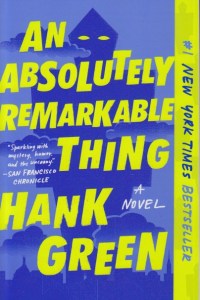
Fame is something most of us never experience.  In a world of billions we imagine what it would be like to have others pay attention to us.  Care what we think.  Admire us.  I can’t help but suppose that a large part of our political crisis is based on this concept.  It’s one of the reasons Hank Green’s An Absolutely Remarkable Thing is such a timely novel.  I’ve read a couple of Hank’s brother John’s novels, mostly in the Young Adult category, and I’ve been curious about this one for some time.  April May, the protagonist, isn’t seeking fame.  In an almost parable-like way it happens to her and she becomes addicted to it.  Safety and human relationships fall aside as she follows what seems to be the next logical step in order to secure more fans, more followers.  (There may be some spoilers below.)

There’s more than that, however, going on in the story.  Tales of “first contact” with alien intelligence often pose the question of humanity’s readiness for such an encounter.  The Defenders, a group that looks an awful lot like the right wing, are afraid.  They’re afraid of what humans might face once a superior power arrives.  Their response is to attack April, who, for some reason has been chosen as the first contactee.  Her fame isn’t accidental.  I’ve watched enough of Hank Green’s excellent YouTube videos to suspect he’s not exactly looking for a Christian parallel here, but April is a kind of messiah.  The book, in many ways, could be read as a recasting of Christianity’s foundation myth.  This isn’t a book with which most Sunday School teachers would be happy—there are adult situations and adult language.  They don’t cancel out the message of the book, however; I’ve known evangelists to use these techniques as well.  They help capture attention.

With all the books I read I have to admit that many are forgettable.  I sometimes read an old post on this blog, or a review on Goodreads, and find myself having forgotten a novel completely.  Something Hank shares with his novelist brother is the ability to make an impression.  It’s too soon to tell for sure right now, but this has all the marks of a story that’s going to be my mental companion from now on.  There’s wisdom and humor in it.  There’s a touch of Qohelet as well.  Whether intentional or not, An Absolutely Remarkable Thing follows the line of a classical story arc.  And the reason that stories have become classics is that they make us think.  I’ll be thinking about this for quite some time.  Fortunately, I don’t have to deal with fame—that would only be a distraction.


Without Peer

Peer review makes the world go round.  Well, at least the academic world.  It’s based on a simple enough premise: if your academic work is passable other scholars will be able to tell.  It’s a process fraught with peril, however.  Scholars, being human, are subject to fits of pique or of hypersensitivity, or just having gotten out of the wrong side of bed that morning.  Perfectly good projects can be shot down with a single, well-placed arrow.  Or even dart.  Problem is, there’s no better system for deciding if academic work is adequate, or even good.  There may be some objective measure out there in the universe, but if there is we don’t have access to it.  We have to rely on peer review.

During my teaching years, which numbered nearly twenty, I was never asked to peer review anything.  My first invitation came while I was working as an editor.  Of course I said “yes.”  A number of scholars, however, don’t share the basic reality that if nobody peer reviewed their work, they’d never get published.  Many scholars decline offers to review their colleagues’ work.  I even had a very senior scholar once blithely tell me that he had his own research to do, so why should he take time to review that of others.  Professional reserve prevented me from pointing out that if his colleagues felt the same way he’d be as unpublished as a fresh doctorate-holder.  Scholarship is a cooperative venture, no matter how many Lone Rangers ride the cuesta.  So why is it so difficult to find peer reviewers?

I’ll read your book if you’ll read mine!

Something I’ve noticed is that many scholars are coddled.  Constantly told that they’re brilliant and gifted, they come to believe it like miniature Trumps.  More to the point, perhaps, is the shrinking number of academic positions.  The few who hold actual jobs are bombarded with other tasks, including committee work, advisory duties, and sometimes even teaching (depending on the adjunct pool).  I know it’s tough.  Been there, done that.  Nevertheless, academia cannot survive without the basic peer reviewer.  Education is a cooperative venture.  We may imagine the academic alone in her or his study, but breakthroughs generally come through when people work together.  Of course, my job is one performed in isolation.  Increasingly, academics can be found not in their offices, but working remotely from home.  Is the sense of “peer” itself breaking down?  My own book, Nightmares with the Bible, was slowed down by peer review.  In a sense I’m glad it was.  Hi ho Silver, away!


CBD

They found me.  I used to call them CBD, but because of the popularity of a certain hemp-based product, Christian Book Distributors changed its name.  Now I knew about them long before they had me on their mailing list when I taught at Nashotah House.  When I was a seminary student in Boston I made occasional trips to CBD’s Peabody warehouse for sales—this was quite a boon to students who never have enough money (little did I know!).  Books you’d heard about in class were there, for a fraction of the price.  At Nashotah I always looked over their bargain page, because, well, professors like books.  I recognized their catalogue in my mailbox instantly.  The name is now Christianbooks.com.  Grab some munchies and sit down.

Not only the name has changed.  Back in my student days I could find academic resources here.  As religion in America has become more and more polarized, what used to be CBD (if I use their current incarnation my computer insists on putting links in) has become radically conservative.  Page after page of study Bibles reveal no hint of the mainstream bestsellers in the genre.  It’s as if they don’t exist.  More than that, if you leave them out maybe people will come to believe they don’t exist.  Even the bargain books are nothing an erstwhile professor would buy.  Instead of academic titles there are all kinds of Barnes & Noble-type gimmicks to get shoppers to spend their money.  Like junk food for the soul.  I look at the books on my shelf.  Some of them were purchased, cash in hand on the ground in Peabody.  Not any more.

There will be those who claim (fake news is the only news now) that what has changed is me, not them.  The fact is places like CBD used to be more open minded.  They admitted the possibility of doubt.  Now your choices are Scofield or Ryrie.  That should be enough for any appetite.  Not only that, but many of the titles now sound militaristic.  Battlefields and all.  Thumbing through, I wonder where Jesus has gone.  The evangelicalism of my youth was clearly Prince of Peace centered.  Now it’s politicized to the point that I’m not sure what it represents beyond GOP values of greed, opportunism, and power.  Anyone who thinks differently need not apply.  How CBD found me after all these years, I do not know.  I wish they’d consider saving the environment rather than printing catalogues to send me.  The climate, despite what they would claim, has changed.


Hearts are Dark

For the most part, reading introductions to literary works is tedious.  Since this edition of Heart of Darkness was brief enough, and the introduction wasn’t as long as the novel, I decided to follow through.  I’m glad I did.  I’ve read Joseph Conrad’s classic before, but it was helpful to have pointed out before this reading just how much darkness is in the story.  Drawn in by Kurtz’s famous last words, I suspect, many readers make the heart of the darkness the life lived by this contradiction of a man.  An individual who’d set himself up as a deity, and who pillaged the region for his own gain.  A man who wasn’t above using terror to acquire his ends.  An enigma.

But in actual fact, the story is about as full of darkness as an early Bruce Springsteen album.  The story begins at sunset and ends at night.  There is darkness to the Europeans’ dealing with the Africans throughout.  Even Marlow participates in that interior darkness that seems present in all people.  Delivering the deceased Kurtz’s letters to his still grieving fiancée, he meets her as darkness is setting.  He lies about her beloved’s last words, preferring to preserve her feelings than to reveal the truth uttered upon the deathbed.  There are layers of interlaced darkness here and Conrad never gives a definitive statement about what it really is.

We live in dark times.  I suspect that, for someone somewhere, that will always be the case.  The corruption of our government is so blatant and obvious that we seem to have fallen under the shadow that must’ve driven Conrad to pen his novel.  When living in darkness it helps to have a guide who’s been there before.  No matter what evil Kurtz has perpetrated, he’s treated as a god by those he oppresses.  He knows their suggestibility and preys upon it.  Although slavery was no longer (officially) a reality when Conrad wrote, the attitudes—embarrassing in the extreme today—lingered.  Even more embarrassing is the reality that they linger even today.  Not just linger, but assert themselves and then deny that they exist.  This is the heart of darkness, I believe.  We cannot allow others to live in systems that don’t kick money back into our own.  Trade on our terms, with our worldview being the only legitimate one.  Like so many writers, Conrad has been made a prophet by history.  And we all know the horror.


Frankenstein, Frankly

The classics.  No matter how much I read more contemporary fiction, the classics keep me coming back.  Mary Shelley’s Frankenstein is a classic in more than a single sense.  It was a novel that had tremendous influence in the nineteenth century and has continued its impact to the present.  Chris Baldick’s In Frankenstein’s Shadow can be considered a classic in its own right.  Although it only dates from the 1980s, it contains exhilarating analysis of Frankenstein in a number of authors and genres of the nineteenth century.  And I’m a fan of literary scholars who write accessibly.  I’ve read modern literary studies that I simply don’t understand and they leave me feeling alienated and cold, as if they were written for a private audience.  One that didn’t include me.  Baldick’s treatment is wide-ranging and full of moments of blinding insight and is open to all.

Often I put the book down thinking that I’d had my world changed.  Baldick’s no hero-worshipper.  He notes the weaknesses in Shelley’s writing (and they are admittedly there), but he does so respectfully.  The astonishing part of this study is the sheer breadth of the influence Baldick finds for Frankenstein.  A word or phrase, a theme here or there, and yet he makes an excellent case that these can be traced back to their monstrous forebear.  His section on Melville made me want to stand up and cheer.  (I have to admit to being more of a hero-worshipper than the author.)  This is literary criticism done right.  It makes you want to read the books you haven’t.

Since the book deals with literature, it doesn’t really address how the creature morphed into something completely different in the twentieth century.  I know I grew up thinking Frankenstein’s monster was part robot.  I suppose it was the bolts in his neck, according to the Universal script, that convinced me.  That, and his stiff-jointed lumbering about.  Shelley’s story is, however, very much a human one.  In many respects the monster is more humane than his creator.  Various aspects of this tale, including that one, are taken up in other classics and turned over, examined, and reapplied.  Suddenly quite a bit of what I’d read elsewhere made immediate sense.  Interestingly, although I grew up not so much a fan of this particular monster, books on him have become among my favorites as an adult, if I am such.  I think Baldick may have had his fingers on that revivified wrist when he wrote this book.  It certainly did for me what literary criticism always should.  At least for the classics.


A Stiff Salute

From the way he writes, Charles F. French was a Marine.  I don’t know that for certain, but those of us who venture into fiction put ourselves into our stories.  Those who blithely reject something into which you’ve poured yourself are either boorish or unfeeling.  Yes, even literary types can be so.  This year’s reading challenge includes a book from a local author.  Since I live within a (long) commuting distance of the city, I suppose I could count New York as local.  That felt like cheating, though.  To find local authors you have to haunt independent bookstores.  I do that anyway, and a few weeks ago I found a copy of French’s Maledicus.  It fit the bill.

Although the story is about the titular demon, the ensemble protagonists are mostly military men.  There’s a strong sense of combat-readiness among them, and a good deal about military honor.  I have to admit this made me a little sad.  Don’t get me wrong, I have respect for those who are willing to fight to protect their country.  I’m sad because we need military forces at all.  I’m also a born pacifist.  My father was a veteran of the Korean War.  The military was present at his otherwise sparsely attended funeral.  I grew up reading the Bible and committed to the peaceful resolution of disagreements.  In my idealized world, we really wouldn’t need weaponry at all.  There are bad people, yes.  But like Eli Lapp, I wonder how humans can judge such things.  There are good people too.  More of them than there are bad.  More often than not, they are the victims of weaponry.

Given my work on demons, I’m always interested in their origin stories.  Maledicus gives us an evil Roman lieutenant to emperor Caligula (ahem), who is a climber and a sadist.  After his nasty and brutish life, he’s approached by a demon in the next world and joins it.  This even worse Maledicus is then taken on by the Investigative Paranormal Society, which consists of three old men, two of them retired Marines.  So you see how the military comes into it.  I won’t give any spoilers, although to my knowledge I have no local followers here in eastern Pennsylvania.  It’s a nice area for peace, actually.  The same could be said for the rest of the world.  If we put our fears aside and pooled our resources to help the vast majority of good and innocent a good number of our demons would be banished naturally.


Voice of Experience

Trust your publisher.  Well, if you have one, that is.  I’m not the only erstwhile academic to have ended up in publishing, but what constantly surprises me is that academics care little about those who give voice to their ideas.  Now this blog is self-publishing.  It contains my ideas, but they are free for the taking, and here’s a bit of useful advice: trust your publisher.  These days with easy online publication and formatting that makes your posts look like a pro (not here, mind you), it’s sometimes difficult to realize that publishers actually provide more than just an imprint.  They offer services to make your book look serious, scholarly, and also to be useful to others.  Those of us who write books are often far too emotionally involved to see this.

I regularly run across academics who tell publishers how the text should look on the page.  I’m not talking about those weird and wonderful sections of ancient texts with <lacunae>… ellipses… [brackets] and whatnot.  No, there are those who want to control kerning, leading, and all sorts of things.  There are those who want practically every single word indexed, although research shows that most researchers access searchable PDFs rather than wasting their time thumbing through pages to find a reference.  And that traditional chestnut, “written for general readers.”  Publishers have access to book sales figures (at least of their own books).  There’s no need to bluff; if your book is only for scholars (does it have words like “reify” or “heuristic” in it?  Be honest now!), publishers know how to handle that.

We’re all nervous when our book gets through the acceptance process.  Peer review always breaks me into a cold sweat.  Believe me, we understand!  Take a soothing sip of tea.  Go for a walk.  Better yet, jog.  Scholars tend to be precise thinkers.  We get that.  When, however, is the last time someone used a map from a Bible for navigation?  Most of those cities don’t even exist any more!  This strange mix of online savvy and adherence to the old ways of print (which I love and of which I shall never let go) clash in ways that cause publishers great stress.  You can find a YouTube video on how to make your own book.  Those of us in the biz can tell at a glance if a book’s self-published or not.  And believe me, we’re rooting for you.  We want your book to succeed.  Why not trust those who know what they’re doing?


VFD

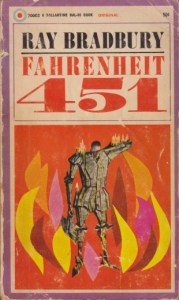
It’s been a few years since I read Fahrenheit 451, the classic novel by Ray Bradbury.  Like so many dystopias, it’s seen a resurgence of interest since 45 was elected.  (I can’t help but notice the shared digits.)  Bradbury was a writer of his time.  So much, I suppose, could be said of all of us who write—how can we be anything else?  Still, it’s difficult not to see that his fear was of television decimating reading.  And intelligence.  We’ve got the internet now, so the effect has been magnified a bit.  The tale, despited being dated, is poignant.  The more electronic we become the more of what used to be termed “real life” we miss.  At this reading it was clear that The Book of Eli was largely based on the last pages.

When Montag confesses to his wife that he’s been secreting books away, and she finds him insane for doing so, he takes the book in his hand to a former acquaintance, Faber.  It turns out that the book is the Bible, perhaps the last in existence (see what I mean?).  On the subway ride he tries to memorize the Good Book.  Now, I’ve been on the New York City subway, and I know the delays can be long, but there’s an error of scale here.  The Bible’s a big book.  Still, he gets pieces of it down.  Now, in the 1950s, when Fahrenheit 451 was published, the Bible was known for its liberating qualities rather than its darker side.  Also the atomic end of World War II was clearly still a painful living memory.  The two may not be unrelated.

Given the age of the story, I won’t worry about spoilers.  In case, however, it’s on your list proceed with caution.  The war that’s been building the entire story takes place the night of Montag’s escape.  Along with the intellectuals forced out of the cities, he becomes part of a human library.  Each person is, through a memory recovery technique, capable of recalling the books they’ve read.  Montag becomes, appropriately enough, Ecclesiastes.  Perhaps the least evangelical book in the Bible, along with Job (with which most evangelicals find themselves cheering on Job’s friends), Qohelet has long been one of my favorites.  It’s an honest book.  The same can be said for Bradbury’s novel.  Primarily a short story writer, Bradbury didn’t sustain the narrative to novel length very often.  But when he did he fashioned a book that, particularly now, needs to be read.


Shifting Perspectives

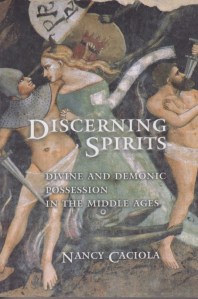
Perspective.  The ability to change it is vital to understanding.  I’ve been working with the idea of demons for a few years now.  My perspective, however, has been aided by Nancy Caciola’s Discerning Spirits: Divine and Demonic Possession in the Middle Ages.  Noting something that has long been a puzzle—behaviors attributed to saints were also recognized among the demonically possessed—Caciola suggests a solution.  In the Middle Ages very few female saints were canonized.  Delving into records from the period Caciola noticed that when saintly behaviors exhibited by men were experienced by women those behaviors were deemed demonic.  In other words, from a perspective that saw masculine experience as normative, when supernatural events were encountered in women they were seen as diabolical.  Using Hildegard of Bingen’s frame of an “effeminate age,” Discerning Spirits explores the idea of how the Medievals told good from evil.

 My own experience of “discerning spirits” came about through a United Methodist curricular study on spiritual gifts.  I was in either junior or senior high school, and deeply involved in the church.  An adult study (I was close enough) on spiritual gifts explained the laundry list compiled by Paul in 1 Corinthians 12.  The apostle from Tarsus notes that discerning spirits is a divine gift.  I trembled as a teen, wondering if I might possibly have it (that was the point of the study).  It seemed like an immense responsibility.  The issue, it turns out, was nothing new.  Since codified in the Bible it had to be true, but what was it all about?  Smarter people than me were struggling with it.

There’s plenty of provocative and explanatory information in Discerning Spirits.  From ancient times it was understood that gods could possess people.  By the New Testament demons clearly could too.  We hear less and less about divine possession as time goes on.  In fact, it becomes a kind of heresy in itself.  Demonic possession was never really in doubt.  It fell out of favor with the Enlightenment, but it didn’t really disappear.  This book shows a clear trajectory from women’s possession as being demonic straight toward the witch craze that erupted in Europe toward the end of the Middle Ages.  It was no coincidence that the majority of accused witches were female.  The perspective had shifted with the fortunes of the church during the Medieval period.  Fear of schism and fear of unsupervised spirituality in a world where only men could be priests led to results that, in hindsight, look inevitable.  Caciola’s book is an important source for not only ages past, but also a mindset all too prevalent in our present world.


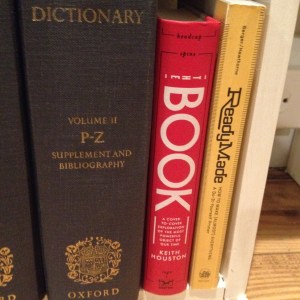
Bookkeeping

I can’t express just how happy I was when I first read the word “bookkeeping,” and it wasn’t because it had three repeated letters in a row.  I was strangely joyful at learning there was such a profession.  That joy quickly plummeted when I found out what bookkeeping actually is.  This memory came back to me this tax season.  I realize the word “book” has a storied history and multiple meanings.  I’m one of those people who likes to read books about books.  In “keeping” books, of course, we mean ledgers that show assets, profits and losses, accounting.  These are among the most boring things on the planet for some of us.  My imagination dances around all over the place, but it seldom sways to the realm of business.  As a young person faced with what bookkeeping is, I was crestfallen.

The idea that you could keep books—not necessarily as a librarian or bookseller—and have that as your job, seemed like an almost Platonic utopia.  A world where it was recognized that reading books is a virtue.  Even being around them can make me happy.  I still live in the world suggested by that form of the word bookkeeping.  When I’m sad a trip to a bookstore can usually bring me out of it.  Although I have difficulty finding publishers interested in my own books, writing them is a form of therapy.  Even this little blog is a way of participating in the keeping of books.  At least in an ideal world.  Tax season looms when many of us will find out how much we owe to a government we no longer trust.  If only more people would read.

Books began, in their earliest forms, as receipts.  Marks on clay to prove what you owned.  Shortly, however, those mud tablets began to house myths and stories.  That’s when the mud became clay.  Stories are what conscious minds crave.  Even the word “Bible” means “book” (via the circuitous route of naming books after the papyrus reed, which along the northeastern Mediterranean coast was called “Byblos”).  These stories, books, came to represent what we hold sacred.  Writing is a divine act.  Many centuries later books became commodities that could be sold.  Ah, and when money enters the equation, bookkeeping soon follows.  Perhaps in some distant future utopia we’ll come to a place where words like bookkeeping mean something more than just numbers.  Maybe someday bookkeeping will be recognized as far more valuable than mere money.


Patina

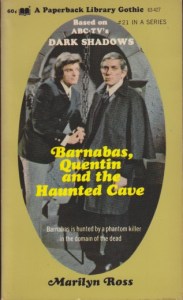
When reading three books by the same author, most of the time, it seems, it’s good to spread them out.  For the past few years my wife and I would visit an independent bookstore in January to pick up a few books for the year’s looming reading challenges.  We slipped behind this year and I happen to have three unread Marilyn Ross books at home.  Barnabas, Quentin and the Haunted Cave was the second of them.  Since, unbelievably, I didn’t have books to fit into the other categories, I read my second Dark Shadows book of the season shortly after the first.  It is a revealing experience to come back to a childhood influence as an adult.  I’m pretty sure I hadn’t read this one as a child, and as much as I like Barnabas Collins, this particular story was somewhat tedious.  And that’s saying something, considering how formulaic the series is.

One of the reasons I found it slow going—especially for a book of less than 200 pages—was that Ross relied too much on dreams to move the plot along.  I read quite a bit of fiction and I always find writing about dreams tricky.  Even within the diegesis of the story you don’t know whether to believe what’s going on in dreams or not.  Just as in real life, dreams are a break from the tedium of consciousness and they permit the mind to wander.  The dreamer can go anywhere, do anything.  Generally without consequence.  You awake back in the more continuous narrative of your life and the dream is forgotten.  In fiction, which is largely made up, dreams often act as filler.  Given the number of times Ross repeated himself in this particular book, it seems that he had to pad the story out quite a bit.  It would’ve worked just fine without the dreams.  Might’ve fallen short of contracted length, though.

It also continues the conceit of Quentin as a Satanist.  I have to confess that the original series was so long ago I don’t remember much about it.  The theremin music of the opening, with the waves crashing against the cliffs of Maine, yes.  Barnabas, tortured but not evil vampire, yes.  Much beyond  that, no.  I’ve had friends discover Dark Shadows as adults.  I watched it on commercial television during its first run and I haven’t seen it since.  I certainly don’t have time for soap operas in days crowded with other demands.  Still, these little books can take me back to a dusty corner of childhood that has a pleasant patina over it.  But it is best to keep such experiences separated a bit in time.