In the Inn

One of those things that really bothers me is the concept of being forced out of a home.  It’s never happened to me personally, but that doesn’t mean I can’t fear it.  That idea works its way into more theoretical applications as well.  Lately both my phone and my laptop computer have sent me messages saying there’s no more room in the inn.  Now, dear reader, you may understand technology better than I (you almost certainly do), but I wonder just how much these weightless thoughts I store here can possibly tip the scale.  I back up my hard disc weekly—there’s no telling who’s going to get kicked out when all the room is finally gone!—but when I open my space manager I find all kinds of things I can’t identify.  Software that I’m not sure it’s safe to remove.  I have no idea what the function of many apps might be.  So I just start deleting.
No room for your data here!

And I keep deleting.  I won’t touch my writing, however.  It’s backed up on a high-capacity drive, but such drives fail.  I want to keep a copy here on my laptop where I can reach it.  The real problem is that this massive sorting exercise keeps me from doing the things that I’d rather spend my time on—writing blog posts, for example.  How can I relax to do that, though, knowing that there’s no room to store them when I’m done?  Why does iTunes take up so much space anyway?  I feel guilty deleting anything from it because of all those warning dialogue boxes with their dire notes that this action can’t be undone.  Occam’s erasure has its consequences, I guess.

I suppose this is related to my recent observations on how tech demands time.  I’ve got some big projects going.  One is to sort out and file all my browser bookmarks.  They are embarrassingly plentiful.  Then there’s the sorting of thousands and thousands of electronic photos into files.  When I first starting using devices there weren’t enough pictures or bookmarks to worry about.  Now each of these projects has been ongoing for months and neither is nearing the end.  I’m old enough to recall when office supply stores sent catalogues (print catalogues, no less!) to my employers stating things like, “We’re in the  midst of an information explosion.  You should buy folders in bulk.”  They meant manilla folders.  Were we ever so naive?  Now what about these ebooks that I also have in hard copy?  Which should I get rid of?  That choice, at least, is easy.  Even my manger has room for books.

Croce’s Lament

So how much time is there?  I mean all together.  I suppose there’s no way to know that because we have no idea what came before the Big Bang.  Those who invent technology, however, seem not to have received the memo.  New tech requires more time and most of us don’t have enough seconds as it is.  Perhaps in the height of folly (for if you read me you know I admit to that possibility) I’ve begun uploading material to my YouTube channel  (I hope I got that link right!). These are cut-rate productions; when you’re a single-person operation you can’t fire the help.  I figured if those who don’t like reading prefer watching perhaps I could generate a little interest in Holy Horror visually.  (I like my other books too, but I know they’re not likely to sell.)

The question, as always, is where to find the time for this.  My nights are generally less than eight hours, but work is generally more.  What else is necessary in life, since there are still, averaged out, eight more left?  Writing has its reserved slot daily.  And reading.  Then there are the things you must do: pay taxes, get physical exercise, perhaps prepare a meal or two.  Soon, mow the lawn.  It may be foolishness to enter into yet another form of social media when I can’t keep up with those I already have.  What you have to do to drive interest in books these days!  I think of it as taking one for the tribe.  Readers trying to get the attention of watchers.

There’s an old academic trick I tried a time or two: double-dipping.  It works like this: you write an article, and another one, and another one.  Then you make them into a book.  I did pre-publish one chapter of a book once, but getting permission to republish convinced me that all my work should be original.  That applies to reviews on Goodreads—they’re never the same as my reviews on this blog—as well as to my YouTube videos.  There’ll be some overlap, sure.  But the content is new each time around.  So you can see why I’m wondering about time.  Who has some to spare?  Brother, can you spare some time?  I’ve been shooting footage (which really involves only electrons instead of actual linear imperial measures) for some time now.  I’ve got three pieces posted and more are planned to follow.  If only I can find the time.


Bookmark This

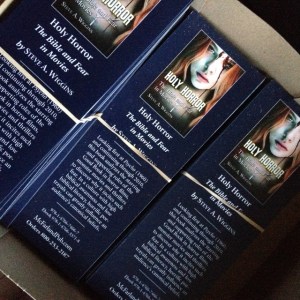
I haven’t forgotten about horror.  In fact, this past late winter my list of must see movies has continued to grow.  I don’t subject you, my kind readers, to endless barrages about Holy Horror since I believe the idea behind the book is novel in its own right and can stand on its own.  The other day I even ordered bookmarks to be made, for free distribution.  Thing is, days are getting longer, and warmer, and people are thinking the opposite of horror just as spring is the equinoctial opposite of fall.  Like a good monster I’m biding my time.  And doing so on an editor’s budget.  (The pay scale’s not the same as that of a professor; believe me, I know.)  Horror’s funny that way—it is seasonal, at least in most people’s minds.

I make the point in the book that fear serves a useful function.  It occurs in other genres quite frequently, although they bear the outcast label less overtly than horror.  Perhaps this gets to the root of my fascination.  Having grown up as part of the pariah social class of the poor, my sympathies are with the genre that often fails to find respectability.  Many of those who criticize horror do not watch it.  Some of these films are quite sophisticated, and the genre blends into other “speculative” categories such as science-fiction and some action, as well as into the more naturalistic thriller.  And thrillers are merely dramas with an elevated pulse rate.  This difficulty of distinguishing genres sharply is one reason Holy Horror addresses some films that aren’t strictly horror.

Work continues apace on Nightmares with the Bible.  Again, the ex-professorate never receives sabbaticals during which concentrated work might be done on books.  In the pre-dawn hours, however, I steadily make progress.  Very shortly an article I wrote for Horizons in Biblical Theology on the topic will appear.  Safely during the spring.  As the days grow longer more of my weekend time is demanded by the outdoors aspect of home ownership, cleaning up after the freezing and thawing of a long winter when infelicities were safely covered under snow.  Sometimes I fear for the progress made on my next book—it is the first advance contract I have ever had—but then I remind myself that fear does serve useful functions.  It’s not called a deadline for nothing.  So even as the darkness fades I prepare for the next round to begin.


Winter Travels

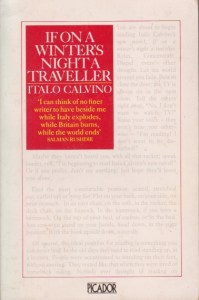
Every now and again you read a book that drops you into a world of wonder.  That’s how I’d describe Italo Calvino’s If on a Winter’s Night a Traveller.  What’s it about?  It’s difficult to say.  It’s a novel about reading, and more specifically, interrupted reading.  You might call it Post-Modern, but in a good way.  I came across the book in a manner that, like the story itself, emerged from different narrative structures.  First of all a colleague sent around a quote from the book that grabbed my attention.  I decided that if I ever found a copy in a bookstore I’d buy it, based on that quote alone.  A second stream was the Modern Mrs. Darcy’s reading challenge.  One of this year’s categories was a book in translation, which this is.  And yet a third factor was that I found the book on the shelf of a used book vendor in Ithaca.  And so I read.

Like David Mitchell’s Cloud Atlas—and having nothing to do with the fact that it was the most recent novel I’d read—If on a Winter’s Night a Traveller is a nested story, a story within a story.  Breaking the “fourth wall” Calvino addresses his readers in the second person and makes them characters in the plot.  The reader buys a defectively printed book and when he tries to return it to the seller, a fantastical world opens up.  I’m not sure that there’s a particular genre here—literary fiction constitutes a genre of its own—but there are a few speculative elements that keep the story pulling you along without really giving any conclusions (that the po-mo aspect to which I referred).

Apart from being merely fun, the story is thought-provoking.  What goes on when we read?  Do we not get absorbed into the mind of the writer?  And not only of the author but also of others who’ve read the book with whom we might discuss it?  Writing is an endlessly addictive activity.  One of my observations about careers without sabbaticals is that those who wish to practice the art must carve time out from days interrupted by work to be writers.  For me that means awaking early, for this blog is only one of many writing projects I have going.  To write well, however, means reading much.  And if you’re casting about for a story that’s hard to classify and difficult to put down, I would gladly recommend If on a Winter’s Night a Traveller.


Chilly Fluids

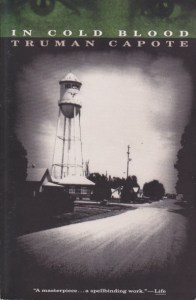
I’m not sure why I did it.  Read In Cold Blood.  I’d known of Truman Capote’s main claim to fame for years, but an accidental recent mention, a cheap copy in a used bookstore, and a week of grabbing time to read did it.  I’m not a fan of true crime, and despite my fixation on horror movies, I try to steer away from anything that doesn’t have a hint of the speculative about it.  There’s a difference between horror and terror.  I’d happily lived a half-century without ever hearing about the Clutter murders and kind of wish that were still the case.  Yes, there are doubts about the veracity of Capote’s account at points and novelists are often convincing liars, but still, at the heart of the matter more than just four people are senselessly murdered in the course of the tale.

A few elements stood out in the reading of the book.  One was that given the naiveté of the 1950s I wonder how anyone could ever really want to go back to that decade.  We’re run by a government full of doddering old men who seem to idealize the falsity and utter conformity of an age that was really a pressure cooker in which cases such as this would explode.  I was born in the much idealized 1960s but I don’t think we should go back to them.  We learn, we change, we grow.  Knowing what we now do, it was kind of painful reading how blissfully ignorant so many people were.  We may be more afraid these days, but at least we’re more realistic.

Another factor, very much at home in this world older but no wiser, is how the Bible is cited at the trial in support of capital punishment.  Although it may not have been intentional on Capote’s part, he demonstrates a deep truth about Scripture.  It can be read in more than one way.  In conservative Kansas in 1960 it could sway jurors to seek the death of other human beings.  The murders were indeed savage and pointless.  Capote’s account of them is difficult to read.  Perhaps more difficult is the way the Bible is used to unleash the basest instincts of people against other human beings.  Yes, parts of the Good Book require the bad thing, but if we’re over fifty years beyond Holcomb we’re over fifty score beyond a time when just one interpretation stands for all.  If it ever did.  There’s a difference between horror and terror, but the Bible can participate in both.  I prefer to stick to the former.


Chapter and Verse

Maybe like me you’ve read some arguments based on chapter and verse.  I should mention that I mean chapter and verse in the Bible.  The typical scenario will go like this: Genesis (say) uses this word three times in chapter 38.  The case then often slips to making a point on the number of instances a word or phrase occurs within a circumscribed set of verses.  (The actual word doesn’t matter—this is a thought experiment.)  When I ran into an example of this a few days ago a thought occurred to me: chapters and verses are later additions to the biblical text.  They were never part of the original and were only added because Bible readers got tired of saying “That part in Genesis where…”  In other words, chapter and verse are artificial means of interpreting the Bible.  They’re very useful for taking quotes out of context.

I used to tell my students that you have to think carefully about what is the Bible and what isn’t.  As a culture where the book has instant recognition, we tend to think of that discrete unit of pages and cover as coming from one person—the author.  In reality most books (I can’t speak for the self-published) are the work of several people.  Just like it takes a community to raise a child, it also takes one to assemble a book.  That includes the Good Book.  Not everything between the covers is sacred text.  I’m pretty sure about that since as I was glancing through the latest edition of the New Oxford Annotated Bible I found my own name in the Preface.  As much as I’d like to claim otherwise I’m not exactly biblical. 

Modern ways of looking at ancient texts require a degree of facility in understanding how God’s scribes of yesteryear went about their work.  While early experiments in binding books may go back close to the time when the latter parts of the Bible were being written, the scroll—without chapter and verse—contained only the words of the text.  Most ancient manuscripts in Greek, anyway, didn’t even bother to put spaces between the words.  That leaves some room for ambiguity in among all those letters.  The Bible is a complex book with a complex history.  We do it a disservice as modern readers treating it as a modern book.  If you read Scripture online, or via electronic media, an even further layer of interpretation has been added.  That’s why we still need Bible scholars tangled somewhere in this world-wide web.


Devil or Con?

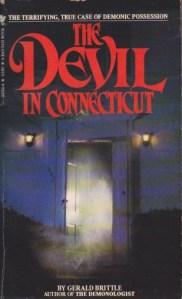
You can’t believe everything you read.  That’s one of the first tenets of critical thinking.  This whole process is about how to get to the truth, and in a materialistic world that truth can’t involve anything supernatural.  These were my thoughts upon finishing Gerald Brittle’s The Devil in Connecticut.  Controversy accompanied Ed and Lorraine Warren’s investigations and some of the people involved in these cases have later claimed the extraordinary events didn’t happen.  Others claim that the Warrens offered them to make lots of money by selling their stories.  The effect of reading a book like this is a blend of skepticism and wonder.  Among their fans the Warrens are held in the highest regard.  Anyone who begins to look into their work critically ends up frustrated.

So when I put this potboiler down—it is a compelling read—I went to the internet to find out more.  Then I realized what I was doing.  Using the internet?  To find the truth?  It’s a vast storehouse of opinion, to be sure, but what with fake news and alternative facts who knows what to believe anymore?  I found websites debunking the whole case as a hoax.  Others, naturally, claim the events really happened.  Both kinds of web pages have the backing of someone in the family involved.  It’s a pattern that follows the Warrens’ work.  In one of the many books I’ve read about them they claim to have ten books.  If my math is right this was number ten.  Even that remains open to doubt.

The word “hoax” seems a bit overblown.  Dysfunctional, maybe, but hoax?  Reading Brittle’s account it’s clear there were some issues in this family.  Having grown up in a working class setting, I’m aware such scenarios are extremely common.  Accusations were made that this was an attempt to spin gold from straw.  The nearly constant stress of blue collar families makes that seem less far-fetched than a stereotypical devil showing up in a modern house because a satanic rock band placed a curse on the family.  Lawsuits—the most avaricious of means for determining facts—apparently prevented a movie deal and have even made this book a collector’s item.  Somebody, it seems, is making money off the story.  As after reading the other nine books, the truly curious are left wondering.  My skepticism kicked in early on, but then again, I’ve always liked a good story. 


Not Your Parents’ Bible

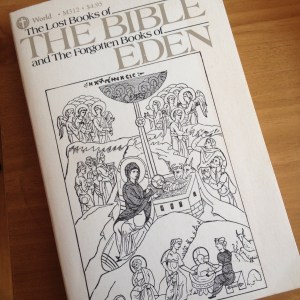
As someone always interested in origins, I reflect on how I’ve ended up the way I have.  I mean, who plans to end up a Bibles editor?  In the grand scheme of a universe with a sense of humor, it’s an odd job.  I grew up reading the Bible, but lots of people do.  Most of them end up with ordinary people jobs.  Obviously, working on a doctorate in the field is admittedly strange, but then, my interests have always been to get to the truth.  The other day I spotted a book on my shelf—the book that arguably started it all.  The Lost Books of the Bible and The Forgotten Books of Eden.  These days I would recognize this for what it is, a cheap reprint of a book published quite some time ago (1926 and 1927).  No “value added content.”  Just a reprint.  But why did this book have such influence?

It was the first time I’d realized—and growing up in poverty with parents lacking college educations you have to teach yourself a lot—that there were other books about as old as the Bible.  The idea fascinated me.  Somehow my fundamentalist upbringing had convinced me the Bible was the first book ever written—after all, its author was God and how much more primordial can you get?  Now this particular book (Lost Books of the Bible etc.) contains some apocryphal Gospels.  Not having a strong grasp on the concept of canon, I wondered why these books had been excluded, or, to use the title conceit, “lost” and “forgotten.”  In college I would learn about the canonical process.  I’d hear more about it in seminary.  There I would learn that even older sources existed.  In the pre-internet days, in a rural town without so much as a public library, how would you find out about such things?

Helmer Ringgren’s Israelite Religion captured my imagination in seminary.  Even there, however, nobody on the faculty seemed to know much about what had come before the Bible.  Harrell Beck told us of ancient Egypt in our classes, but clearly there were further depths to plumb.  I learned about James Pritchard’s Ancient Near Eastern Texts, which I bought at the Harvard Divinity School bookstore.  Other texts went back beyond Holy Writ.  Just how far would have to wait until the University of Edinburgh.  I sometimes wonder if I might’ve taken a different turn here or there had anyone been able to answer my young, unformulated questions about the origins of the Bible and other ancient books.  Now we just have to ask the internet.


If It Itches

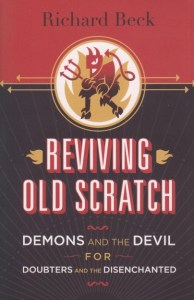
The problem, or rather a problem, of growing up Fundamentalist is taking things literally.  I suppose we’re all born naive realists, learning only later that things aren’t what they seem.  One of the dynamics of finding something new to say about demons involves an unconventional method of research.  Richard Beck’s Reviving Old Scratch: Demons and the Devil for Doubters and the Disenchanted is a case in point.  Being part of a series called “Theology for the People,” this book is not an exploration of literal demons or the Devil.  Well, it kinda is and kinda isn’t.  It is an engaging and often insightful treatment of the question of evil and what to do about it.  Evil is a question, but most of us, at least pre-Trump, could recognize it when we saw it.

Beck is a professor of psychology.  This meant that at several points I found myself pausing to consider some of the points he was making.  Some parts didn’t work for me—welcome to the world of reading—but others were eye-opening.  One thing that all books about the Devil seem to have in common is the observation that evil is clearly present in our world.  Governments, and Beck uses Rome as an example, easily become oppressive and harmful to the weak and powerless.  As a volunteer in a prison ministry, Beck knows whereof he speaks.  When governments are run by the unstable (think of the one with a toothbrush mustache or any other who declare themselves geniuses) oppression follows.  Evil not only bobs in the wake of oppression, it is oppression.  Beck has a Christian anchoring—call it theology—behind this, but it clearly works even without that.

Getting over my literalism, I know that academic books about demons or the Devil come with more serious titles and more hefty price-tags.  The value of a book, however, has to do with more than the cash you shell out for it.  Beck does a service by offering a theology that isn’t too theological.  I’ve known many candidates for the ministry who lost their compassion by getting tangled in the weeds of theology.  Even to the point of making sarcastic remarks to someone who wanted to help them when they fell on the ice.  I know myself, and I have to learn to trust those who practice theology in ways that I do not.  This may not be conventional research, but it is important reading.  Old Scratch, after all, is not just in the details.


Learn and Let Learn

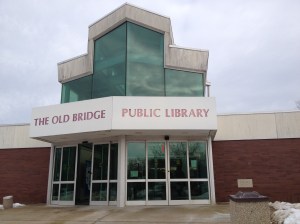
My wife often works weekends.  Generally this involves trips to New Jersey, and since my unconventional schedule means we see each other awake only a brief time during the week, I often tag along.  The colder months of the year, and general economic caution, mean things to be done around the house can wait.  Most of the locations where she works have nearby bookstores, but even a guy with proclivities like mine finds it hard to spend more three or four hours in one place, even in such a welcome environment.  It finally occurred to me that one need not be a resident to find shelter, and free wifi, in the public library.  I’ll pack my laptop, and if it’s going to be a full day, a sack lunch, and head to the library for a change of scenery.  It has led to a kind of renaissance for my spirits.

Public libraries generally do not house the books I read.  The source of my jouissance has rather been discovering how well used the libraries are.  In both affluent and more modest neighborhoods, people willingly spend part of their Saturdays in buildings dedicated to learning.  Not all are there for the books, but they seem comfortable surrounded by them.  We gather in a temple to the human mind.  And everyone’s generally quiet.  Mentors coach young people who want to learn.  Some even dress well, as if the library might be a place to be seen.  In a nation where education is under attack, I always leave refreshed without spending a penny.

Such opportunities are a rarity.  Before the library opens, if we happen to be at her venue early, I may need to find a Starbucks.  They more or less assume you’ll consume to utilize their free wifi, but beyond that a day at the library comes without cost and considerable gain.  A variety of ethnicities are always present, and nobody’s right to be here is questioned.  It’s a microcosm of what we could be as a nation, had we the will, the desire to learn and let learn.  People generally have a difficult time with silence—just ask any introvert.  I suspect this is one reason not everyone shares my enthusiasm for a cloistered experience of a Saturday.  Libraries are where we’re forced to be relatively quiet to respect the needs of those actually there to read.  Hoi polloi prefer to be loud, as any bar on a weekend afternoon will reveal.  But the libraries remain, and even in their own way, are buzzing hives of the life of the mind.


Mostly Clear

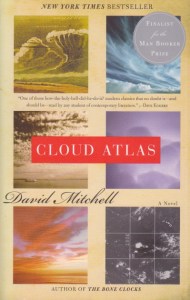
“Chiasm” is a literary technique based on the name of the Greek letter chi, shaped like a latinate X.  The idea is fairly simple and generally resembles a sideways V more often than an actual X.  It goes like this: a poem, or story, begin at a large, or wide premise, narrows down in steps to a center, and then, by corresponding steps, again out toward a larger, or wider resolution.  Another way to think of it is a set of Matryoshka dolls; first you take them apart, and then you put them back together.  David Mitchell’s Cloud Atlas is a chiastic story.  Starting on a cross-ocean voyage at an indeterminate time in the recent past centuries, it moves on to a Briton on the continent in about the turn of the last century, then a mid-twentieth-century American investigative journalist, a late twentieth-century or present-day rogue publisher in Britain, a clone in future Korea, and finally, to a planet of the apes-like Hawaii of the distant future.  Not really finally, though, since after the center of the X, it moves back outward through the nesting stories to bring us back to the beginning.

I’m not going to attempt to retell the story here, so don’t worry—it doesn’t get any more complicated.  There are, however, a couple of remarkable things about the tale.  In the brutish, nasty, post-collapse future that marks the center of the narrative, religion is central.  Some of the Hawaiians have come to believe the protagonist of the nesting story, the clone mentioned above, was a god.  To find her story, however, you’ll need to read the book.  Suffice it to say, that origin myth is part of the overall complex structure.  The second of the remarkable features, and one that makes this book very salient, is that in all the ages the issue of accepting those who are different is central.

In the outside framing story, the initial and terminal points of the chi, one of the characters is a missionary.  He’s trying to “improve” he life of Polynesians by making them into slaves, whereby they benefit from the largess of Christianity.  Quite a bit of the narrative draws its energy from the eventually faltering sense of superiority of the AngloSaxon “race.”  In that sense it’s definitely a parable for our time.  A story that deserves to be read.  Defying easy genre identification, Cloud Atlas is a thought-provoking novel that doesn’t fear religion and its larger implications.  A couple of the nesting stories have exquisite twist endings worthy of the Twilight Zone.  This book will make some demands on your time, but its message makes it a sound investment in a world rapidly heading toward a future that reveals just how troubled our species is.


Long Journey

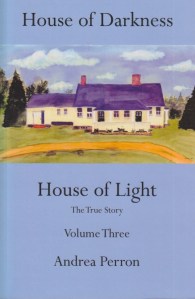
Although it may be only a venial sin, overwriting is nevertheless an offense.  As a professor I read many papers from students who had great difficulty clarifying what they were thinking only to disguise it with too many words.  I have finally finished Andrea Perron’s House of Darkness, House of Light.  Because academics too often dismiss personal testimony, I feel compelled to consider it.  Now over 1,300 pages later, I have discharged my duty.  Ed and Lorraine Warren, despite being famous, are difficult to assess in book form.  Yes, they (ghost-)wrote ten books, but they never had permission to include the Perron story that stands behind The Conjuring.  The eldest daughter took on the task herself and even seems to be aware of (in the acknowledgements) a dubious talent for overwriting.  What the Warrens saw as demons, she sees as ghosts.  Who has the right to decide?

I wish the author well in her writing career—those of us who write tend to be natural boosters of others—but it would’ve been nice to have had a more condensed version focusing on the events in the Harrisville house.  One interesting thing caught my attention here: according to Perron the Warrens called by phone after the Perrons moved from the offending house and tried to talk Carolyn, the mother, into a book deal.  Offering a healthy income from the proposition, they gave a hint of what other writers have claimed—they had the business angle firmly in mind.  I’ve read enough from people who actually knew the Warrens to believe they sincerely believed they were helping people.  They also had to make a living, and ghost stories tend to sell well.  Some use that as evidence that they were only trying to make money.  I’d remove the only, without dismissing the financial incentive.

It’s nearly impossible to read a very long book and feel that you haven’t come to know the author.  Also, it’s difficult to dismiss material written, even if overwritten, so sincerely.  We live in a world that we don’t understand nearly as well as we think we do.  Call it old school on my part, but I believe in extending the benefit of the doubt to eyewitnesses, particularly when there are several of them and they have a decade to observe closely what many others never get a chance to see.  This set of three books is a window into a realm over which the drapes are usually drawn.  For those willing to do some hard mining, there’s something of value here.


The Price Is Wrong

The costs for academic books can seem criminal.  Don’t get me wrong; I work in academic publishing and I know the reasons—or at least the reasons publishers seem to believe—for such pricing.  Still, when I see a book that my little public library will never be able to convince its network that it should be able to borrow, I look at the prices and blanche.  At least the pallor looks good with my skin type, or so at least I’m led to believe.  Why are books so very expensive when so few of them retain any resale value?  Publishing—the information business—is unlike any other.  In fact, it could be argued that the printing press was the earliest internet.  Ideas could be spread more quickly, among those who were able to read, than they could have previously.

These days books are the handmaidens to the internet.  The problem, of course, is that the web contains ideas that haven’t been vetted.  Publishers offer that service, but you have to pay for it.  Books don’t sell like they used to—physical books, I mean.  Inflation, however, ensures that the cost of paying employees is constantly going up.  This is the hidden factor of “overhead”—the cost of doing business.  You need to sell a lot of books to pay a staff.  Not only that, but unlike most “commodities”—I shuddered as I typed that word—books can be returned to a publisher if they don’t sell.  It’s like an entire business model run on consignment.  And the honest truth is—academic authors may want to cover their eyes for this part—very few books sell more that a couple hundred copies.  That means that the per unit cost has to go up.  Next thing you know you’re selling a kidney to continue your research.

I keep a running list of books I’d like.  Some are for research and some are for other pleasures.  The list grows quite lengthy when more and more interesting books get published.  I look at academic books and I wonder if maybe there’s another way.  If they were priced down in the range of mere mortals, would they sell enough copies to meet their costs?  I’m well aware that Holy Horror is priced at $45.  Believe it or not, that’s on the lower end of academic extortion pricing.  Many books on my “must read” list cost three times as much.  Are we paying the price for keeping knowledge solvent?  Or is all of this just criminal?


Strange Ending

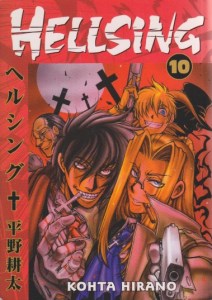
Perhaps it’s from growing up as a biblical literalist, but I’ll probably always have problems with post-modernism.  You see, when you’re taught as a kid that there is one absolute right and you already know it (it’s Genesis to Revelation, no Apocrypha, please), you kind of get the idea that things are just what they seem.  Po-mo teaches, among other things, that there’s no true objectivity—reality is subjective and there is no neutral ground upon which to stand.  I’m down with that, but the old ways of looking at things remain.  This is a long-winded way of saying I finished Kohta Hirano’s ten-volume manga, Hellsing.  Over the past year I’ve been reading for a friend of mine, but manga has never really been my thing.  I read The Watchmen as a graphic novel, but looking at pictures somehow feels like cheating.  It’s that literalist thing again.

I might be dropping some spoilers here, so if you’re even slower than me be warned.  There’s quite a bit of shape-shifting here and it’s not always easy to tell who’s who.  In a kind of homage to my childhood monsters there’s vampires, werewolves, and even a Frankenstein’s monster in the series.  All of them are engaged in a constant state of combat against which the Protestant Hellsing organization stands for a stable civilization.  The Catholics are associated with Nazis along the way.  It’s a fascinating look at how an eastern culture might view the religious wars of those in the west who all go by the name “Christian.”  I think this is the genius of the series.  The friend who lent me the volumes has no declared faith, but he finds the dynamic fascinating.  Real religious fighting has made it easy for him.

The story, however, falls clearly into the generation of those without absolutes.  For someone my age a plot clearly laid out is a thing of beauty.  In college we used to argue about how absolutes might exist.  Where did they come from, and which is the strongest?  Did God make them or does God have to conform to them?  Even without the answers, the fact that absolutes existed was assumed.  Argument-driven science tells us that a theory is never proven.  Science is the best explanation we have at the moment, based on the evidence amassed.  In its own way, it has become post-modern.  Hellsing is a kind of mind-blowing work.  It will likely be a long time before I attempt another manga series.  Although I accept the po-mo premise, I still find old-fashioned fiction my favorite.


How Many, Now?

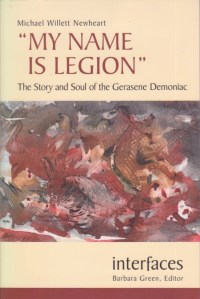
One thing you can say for the Bible—it’s been interpreted six ways to Sunday.  This point was brought home to me in reading Michael Willett Newheart’s “My Name Is Legion”: The Story and Soul of the Gerasene Demoniac.  Part of the Interfaces series, now apparently defunct, it takes an unusual biblical character and explores it.  Them, in this case.  The story of the Gerasene or Gadarene demoniac is one of the more famous episodes in the Synoptic Gospels.  Jesus and the disciples cross the Sea of Galilee and the possessed man runs out at them.  He has superhuman strength, and he lives among the tombs.  Jesus asks the man, or the demon, its name only to receive the reply “Legion.”  He then casts the demons into a herd of swine that drown themselves in the lake.

Newheart approaches the story creatively, first by considering the Gospel of Mark as a book, and then treating his version of the story via narrative criticism.  This was pretty good, and I learned quite a bit from his analysis.  The book then moves on to psychological criticism.  I have to admit that this approach is one I haven’t ever used and, like many reader-response methods, it can seem somewhat arbitrary.  That’s not to suggest it shouldn’t be utilized, but rather to note that results could be uneven.  Your psyche’s not my psyche, savvy?  Subjective approaches may be all that we really have when considering an ancient text, but I always tend to look at things historically.

This book caught my attention because I’m researching demons.  You can’t really ignore a book with this title if you’re trying to figure out how the New Testament looks at them.  In any case, the historical method seems to me the only way we can really engage the question of what the ancients thought demons were.  I don’t want to say too much or you won’t have any reason to buy my next book.  (That’s a joke, by the way, before anyone suggests I’m exploiting my readers.)  Newheart doesn’t really raise the question of what demons are.  He does briefly mention The Exorcist, but it isn’t his main interest.  The character of Legion, however, is difficult to place if we can’t really say what demons are.  I did find the allusion to the Roman occupancy to be worthy of consideration.  The demoniac, however, may have begged to differ.  It couldn’t have been easy being an unnamed character in the Good Book.  And demons are often not what they seem.