Local Hauntings

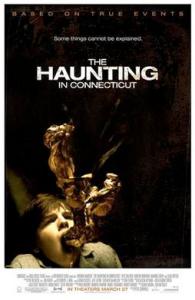
In my on-going research (as I think of it), I watched The Haunting in Connecticut.  I recently wrote about A Haunting in Connecticut, distinguished from the theatrical version by an indefinite article.  Both claim to be based on a true story and the story itself is disputed because it doesn’t fit into a materialist paradigm.  Ah, but that’s another can of worms.  Regarding the movie, it abandons the base story to add an entirely fictional subplot that drives the horror.  Or so the writers and director think.  The tale ends up jumbled and the confusion it generates is not the kind borne of intelligent planning.  The Campbell family, struggling to pay the bills against a case of childhood cancer is real horror.  In our healthcare system that is a true story.

According to the diegesis of the movie, Matt Campbell can see the dead because he’s close to death.  In case you don’t know the story—the family has to move to be closer to the hospital where Matt is receiving his treatment.  Once ensconced in their new house they learn it used to be a funeral home and hauntings ensue.  The writer of the original book claims to have made much of it up, while interviews with witnesses make the claim that much of it actually happened.  Matt ends up in a mental hospital.  In the movie a subplot of necromancy and a young boy medium are added.  Souls whose bodies have been bound are trapped in the house until Matt figures out how to break the spell with the help of the medium’s ghost.  Instead of Ed and Lorraine Warren investigating, a local minister is added.  Also suffering from cancer, he figures it out too, but too late to help the Campbell family.

In Holy Horror and Nightmares with the Bible I do not treat made-for-television movies.  A large part of the reason is that they often lack the cultural impact of a theatrical release.  (Although Game of Thrones and The Walking Dead may have reached a point of familiarity with numbers to rival big screen efforts.)  In the case of the cinematic treatment of the Snedeker (“Campbell”) family, however, the television treatment might well have been scarier than the big-budget studio effort.  Whether fictionalized or not, the Discovery Channel show stays closer to the book (In a Dark Place, by Ray Garton).  Using the Usher-like ending of destroying the house doesn’t seem to offer any release in the big-screen version.  Sometimes reality is scarier than the tales we tell after dark.


Fly Away

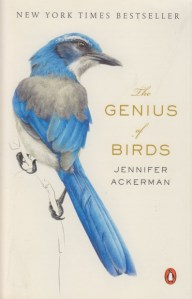
Humans can be quite likable, but we have some nasty traits.  One is that we tend to think of ourselves as the only intelligent beings on the planet.  The funny thing about evolution is that it gave us both big brains and opposable thumbs—a winning combination to destroy the planet.  (Just look at Washington, DC and try to disagree.)  Jennifer Ackerman’s The Genius of Birds is poignant in this context.  Page after page of nearly unbelievable displays of intelligence among birds demonstrates that we are hardly alone on the smarts scale.  Birds make and use tools, have better memories than most of us do, and can solve problems that I even have trouble following.  We tend to take birds for granted because they seem to flit everywhere, but the book ends soberly by noting how global warming is driving many species to extinction.

Homo sapiens (I’ll leave out the questionable and redundant second sapiens) like to think we’ve got it all figured out.  We tend to forget that we too evolved for our environment—we adapt well, which has allowed us to change our environment and adapt to it (again, opposable thumbs).  Many scientists therefore conclude that we are the most intelligent beings in existence.  Ironically they make such assertions when it’s clear that other species can perceive things we can’t.  Ackerman’s chapter on migration states what we well know—migrating birds can sense the earth’s magnetic field, something beyond the ability of humans.  We lack the correct organ or bulb or lobe to pick up that signal.  And yet we think we can rule out other forms of intelligence when we don’t even know all the forms of possible sensory input.  We could learn a lot from looking at birds, including a little humility.

The Genius of Birds explores several different kinds of intelligence.  What becomes clear is that birds, like people, have minds.  Like human beings they come on a scale of intellectual ability that doesn’t suggest only one kind is necessary.  For our large brains we can’t seem to get it through our thick skulls that we need biodiversity.  We need other species to fill other niches and our own remarkable ability to thrive has only been because we are part of a tremendous, interconnected net encompassing all of life.  Other species have contributed to our evolution as we clearly do to theirs.  When we end up thinking that we alone are smart and our own prosperity alone matters we are sawing away at the branch on which we sit.  Further up the birds look at us and wonder if we really know what we’re doing.


Dayglow

Yellow and orange leaves on a damp pavement.  A sky claustrophobically occluded with gray clouds.  A decided chill in the air.  All you have to do is add a few pumpkins and the feeling of October is complete.  I don’t know why this particular image of the change of seasons grips me the way it does.  As a homeowner I don’t want to turn the heat on too soon because the gas bills will jet up and will stay that way for seven or eight months.  I get depressed when skys are cloudy for days at a time.  Around here the leaves have only just begun to change.  In other words, there’s a decided difference between the way I imagine October and the way that it feels on the ground.  In my imagination there are Ray Bradbury titles, The October Country, The Autumn People, but here in the physical world I shiver and add another layer.

Over the past several weeks I’ve been struggling to figure out why horror appeals to me.  It seems to be the Poe-esque mood rather than any startles or gore.  The sense of mystery that hangs in the air when you simply don’t know what to expect.  Will it be a warm, summer-like day or will it be rainy and raw, a day when you wouldn’t venture outside without the necessity to do so?  October is like that.  It is changeable.  Beginning in late September it is dark longer than it is light and for much of the rest of the year I will go to bed when it’s dark outside.  It’s always still dark when I awake.  Is it any wonder that October has its hooks in me?

Short stories, of which I’ve had about twenty published, seem to be the best way to capture this mood.  You see, it isn’t a sustained feeling.  It’s piecemeal like that extra quilt you throw on your bed at night.  The urge to hibernate creeps in, but capitalism doesn’t allow for that.  October is an artist, and I’m just the guy wandering the galley, pausing before each painting.  This feeling only comes after summer, and it is fleeting.  In November the leaves will be down and the cold will settle in quite earnestly.  The candles we lit for Halloween will be our guide-lights to those we hold out to Christmas when the dayglow will begin to return at an hour that reminds us change is the only thing that’s permanent.  And in this there’s a profound hope.


Spiritual Fear

There’s an old adage that if a headline asks a question the implied answer is “No.”  I’ve found that to be true, largely.  I hoped differently when I saw the article titled “Are Horror Films Secretly Spiritual?” by S. Rufus in Psychology Today.  Rufus, admittedly not a fan of horror, ponders whether it might not meet a spiritual need for some.  She would not count herself among that number, should the assertion prove to be the case.  Indeed, her post has more sentences ending in question marks regarding this assertion than it has straightforward declarative ones.  Rufus notes that ancient religions involved a kind of fear-based response appropriate to the lifestyle of those open to constant threat by the natural world.  She seems to believe that civilization has saved us from that.

Now one of the questions with which I constantly struggle is why I watch horror.  I do not like being afraid, and when people find out about my fascination with horror they tend to treat me as if there’s something wrong with me.  I guess maybe I think that civilization has not so much eliminated the sources of threat so much as changed them.  Those who grow up poor know fear.  Fear of want is extremely prevalent in our capitalist society.  I see the “street people” when I go into New York City.  They are not few.  Once you start to get away from affluent suburbs just about anywhere you start to see the run-down houses of those who can’t cope with the demands of a consumerist society.  Even those of us with an education are liable to joblessness and the very real terror that attends it.

Civilization, in other words, comes with its own costs.  Religions originally began—some of them at least—largely from the fear response.  Yes, people were afraid.  The gods, properly propitiated, stay the hand of disaster.  For now.  Some religions, such as those in the monotheistic family tree, tend to suggest higher principles like love can be the motivation.  These religions, however, quickly begin to make threats against those who are heterodox, and reintroduce fear into the formulation.  I suspect, from my own experience of all of this, that the answer to the question may actually be “yes”—horror films do offer something spiritual.  There is a catharsis, if I may borrow a term from psychology, in them.  The spiritual element may, however, run much deeper than that.  Until human society truly takes love and justice as its operating principles, we will have horror films to help us learn to cope.


This Is a Test

For the next sixty seconds…  (If you were born after Civil Defense aired these commercials, it’s your loss.)  I’ve been reading about animal intelligence—there will be more on this anon.  Today’s lesson is on artificial intelligence.  For now let this be an illustration of how difficult it is to come down from an inspired weekend to the daily technology-enhanced drudgery we call day-to-day life.  One of the real joys of seeing art in person is that no tech intervenes in the experience.  It is naked exposure to another human being’s expression of her or himself.  Over the weekend we wandered through five venues of intense creativity and then, back home, it was once more into the web.  The ever-entangling internet of things.

I write, for better or for worse, on my laptop.  My writing’s actually better on paper, but you need everything in electronic form for publication, so who has the time to write and retype, especially when work is ten hours of your day?  Then a system update alert flashes in the upper right corner of my screen.  “Okay,” I say setting the laptop aside, “go ahead and update.”  But then the message that states I have to clear enough gigs for an update.  I have been a little too creative and I’ve used my disc space for stuff I’ve made rather than Apple.  This is a test.  Okay, so I plug in my trusty terabyte drive to back things up before deleting them.  But the laptop doesn’t recognize the drive.  Oh, so it needs a reboot!  (Don’t we all?)  I give the command to restart.  It can’t because some app refuses to quit beach-balling, as if it is the computer that’s doing the actual thinking.  Force quit.  “Are you sure?” the Mac cheekily asks.  “You might lose unsaved changes.”  I need a technological evangelist, I guess.

All of this takes time away from my precious few minutes of daily creativity.  Restart, login, start copying files.  Time for work!  Just a mere sixty hours ago or less I was wandering through showcases of genuine human creation.  Art pieces that make you stop and ponder, and not have to upgrade the software.  Artists can talk to you and shake your hand.  Explain what they’ve tried to express in human terms.  Meanwhile my phone had died and was pouting while I charged it.  I know Apple wants me to upgrade my hardware—their technological extortion is well known.  Anyone who uses a computer experiences it.  Buy a new one or I’ll waste your time.  The choice is yours.  This is a test.  For the next sixty years…


Trailing Art

One of the many trails that wend their way through Ithaca is the Art Trail.  (The town finds waypoints on the wine and beer trails of the southern tier as well, but we were looking for visual art.)  In early October several artists open their studios—these are personal places—to the tourists passing through.  Those of us on the trail are seeking inspiration in human expression.  I’ve neglected my own art for many years.  While other guys my age are retiring and expressing their boredom, I struggle to find enough time to write, dreaming of the day when I can again take up my pencils and brushes.  Being in so many studios over the weekend jump-started something in me.  Humans are at their most god-like when they create.

Seeing artists in context is revealing.  They don’t worry too much about convention.  I found myself hanging toward the back of our little group.  There was so much of others’ souls on display here.  While some were young, a fair number were older than me.  Perhaps retired from a novocaine job that dulled many days until enough years had passed and the need to let the art out escaped.  If felt like visiting a small farm where the true independent, liberal spirit of this country once resided.  These were farmers with paint brushes rather than shotguns and Trump bumperstickers.  Free thinkers, not Fox thinkers.  Under a sky October blue after two days of rain and gray, this was a mosaic of autumn.  Art is a muse.  I think of my neglected brushes and dried out paints, tucked away in the attic.

Modern art sometimes feels like someone slapped a frame around something random, but in talking with the creator something different emerges.  Something that doesn’t feel like plastic.  Something that defies words.  Like poems sometimes break conventional lines, art refuses to be confined.  Some of these studios used to be living rooms.  Houses converted and dedicated to creativity.  Why is this so difficult to accomplish in my own life?  How has the time come to be consumed with work, even when the commute has been effaced?  I suppose I’ve been using words to express myself—this blog is certainly an example of that.  It is, however, a mere fraction of visual ideas awaiting release.  I don’t know if I could ever open my studio to strangers.  Art trails are labyrinths, and once you’ve entered that maze, it will take some time to reemerge.  And when I do I know I will have been transformed.


Sun Out

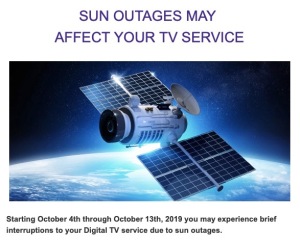
Okay, so this gave me a scare.  I mean, I know our government keeps secrets, but sun outages seemed pretty major to me.  Like maybe we ought to make a run on bottled water and other supplies.  I guess you can leave sun screen off the list, though.  How long would we even last with the sun gone out?   Then I read on.  “Sun outage” in this case means that the sun will be directly behind the satellite providing your service and it may cause outages, not go out itself.  Such is the world in which we live.  Just the other day I was having a conversation with a fellow thinker who indicated that I should be writing on clay tablets (since I know how) because they survive longer than any other form of media.  I have to admit the idea has appeal.

In these days of fake news and alternative facts, though, I wonder if there’s something about the sun they’re not telling us.  A few months back, before I ever saw this dire warning, I was worried about the earth’s rotation slowing down.  You see, I had tops as a kid.  No matter how hard you pulled that string, the top would always eventually stop.  Now, it may have been a very big bang that started all of this, but it was still a finite bang.  It stands to reason that eventually our spin will run out of steam.  Then I read that yes, indeed the earth is slowing at a measurable rate.  Infinitesimal, but still measurable.  I often bemoan how short the days are, but knowing capitalists like I do, when the days grow longer so will work hours.  So what other secrets are they keeping from us?

Compared to all this, the fact that only television service might be disrupted seems strangely inconsequential.  The sun is directly responsible for life on this planet.  At least in its physical aspect.  We need it for warmth, light, and food.  And it helps with lift one’s mood too.  How you say something matters.  Not only is precision in language important, but, being social creatures, how you say it counts.  Perhaps it’s news to those used to texting, but curt emails are often read as angry emails.  I know people who claim to be too busy to respond with social niceties.  I secretly wonder if such people should be held up as the shining examples they often are.  Perhaps if we said “please” or “thank you” we won’t face any sun outages at all.


Flipping

The mind-blowing book I mentioned last week is here unveiled.  I discovered Jeffrey Kripal’s work years ago, and have subsequently had a few conversations with him.  The Flip: Epiphanies of Mind and the Future of Knowledge is a challenging and necessary book.  In a way that only full-time academics can, Kripal examines the large picture.  When I say “large” I mean cosmic in scale.  He does so through the lens of the humanities and, especially, religious studies.  If anybody’s going to make religious studies cool, it is he.  The world is full of weird things.  If we’re honest most of us will admit to having had strange things happen to us.  Often we’ll filter them out or explain them away, but at other times we will stop, scratch our heads, and wonder what just went on.

The Flip is not a book of such anecdotes (and I, along with the author, am willing to take anecdotes seriously).  There is some strange stuff in here, but there is also a lot of science.  Historically the humanities, as understood by ancient Romans, included what we would call sciences.  Humanities, in other words, were attempts at understanding the world.  Today religious studies is among the humanities while science is separated out into STEM.  Kripal takes science seriously.  In fact, much of what he discusses here is the application of quantum physics to the macroscopic.  (I’m probably not explaining this well, but then, I guess you’ll have to read the book!)  In other words, science and the humanities need to come together again.  It’s not either/or, but both/and.

Holding out a hand across the aisle is uncomfortable.  Religion has done a great deal to disgrace itself of late, and it’s no wonder respectable folk want to keep their distance.  To understand what we are, however, requires a willingness to admit that humans are both deeply intellectually curious and deeply religiously inclined.  We can be both.  In fact, it is unlikely we can be any other way.  Anomalous occurrences aren’t generally welcome in religious studies any more than they are in the sciences.  That doesn’t stop strange stuff from happening.  This little book of big ideas uses that disjunction to lead the reader into spaces where the future might faintly be discerned.  Wide-ranging and provocative, this book needs to be read.  It is a strange world where two different approaches to knowledge so often decline to speak to one another.  Here they do, and their conversation is mind-blowing.


Grasses and Bans

It’s been so busy that I didn’t realize it was Banned Books Week until yesterday, when there was but one day left (today).  I usually make a point of reading a banned book during this week, but I suppose I read so many of them normally that the observance might lose its edge.  But that’s just an excuse—in this world of uber-corrupt governments, preventing censorship is a sacrament.  We’ve seen just this week how dictators try to silence those who expose them.  Banned books, whether we like what they say or not, should be available for reading.  This is an amazingly bipartisan holiday.  Some places have banned the Bible, to which true believers in the principles of Banned Books Week would respond “Even books we might disagree with should be made available.”  Censorship seeks to cut off discussion.

Although I won’t finish in time, after work yesterday I quickly grabbed my unread copy of Walt Whitman’s Leaves of Grass to begin to make up for my oversight.  Leaves of Grass has been called America’s homegrown Bible and it has an almost religious following, as it has for decades now.  Poetry has a way of moving people that frightens autocrats.  It taps into something that skirts around our conscious mind at times, opening up possibilities that censors would rather keep closed.  Over the past couple of years books of poetry have again begun to appear on the New York Times Bestseller list.  People read to be moved.

One element banned books tend to have in common is that they’re honest, even when they’re fiction.  Honesty is a source of great anxiety for many.  We don’t like to let our true selves be seen because, truth be told, we feel vulnerable.  Banned books take us into uncomfortable places.  And sublime places.  Not all books are great literature, of course.  Even I have been known to part with a book after reading it because it simply didn’t speak to me in the way I like to be spoken to.  Still, I’m loath to give such a book a negative review.  It didn’t speak to me, but it spoke to the author and the publisher, obviously.  It is a voice that deserves to be heard.  That’s what Banned Books Week is all about—defending the right of human expression.  I may not finish my banned book by the end of today since weekends tend to be busier than many work days.  Still, I’m looking forward to my encounter with America’s other Bible.


Book Magic

Something happens to you on a long bus ride, reading a mind-blowing book.  Part of the transport—literally—is that you’re captive for an hour or two and your book is your boon companion among snoring strangers.  Another aspect is the earliness of the hour.  Days like yesterday, when I have to commute to New York, involve awaking at 2:30 a.m.  The day is cast very differently when your timing shifts back by a few hours.  It’s almost mystical.  The largest portion of the transformative experience, however, is the book itself.  I’ve begun commutes with a book that I quickly realize is a mistake, but since I’m not a quitter, I soldier through it to the end anyway.  On yesterday’s commute the book was one of those that caught my imagination and flew it like a kite from the rear of the bus.  Arriving in Manhattan before six a.m. added to the feeling.  The city’s a very different place that time of day.

Not everyone enjoys reading, I realize.  My late stepfather once had a job as an elevator man.  Not the kind dressed in livery at a big-city hotel, but as an operator in an antiquated building in Oil City, Pennsylvania, where you had to pull the metal gateway  physically across the door and wait until the floor leveled before opening it again.  I didn’t get along with my stepfather, but one day I went to visit him in the elevator.  It wasn’t a busy building.  He sat on a stool, staring straight ahead.  For hours at a time.  Not a man prone to meditation, I knew he had to be bored.  I asked if I could bring him something to read, at least.  He declined for fear of missing someone’s call signal.  It was one of the most frightening scenarios I could imagine.

The clock in the Port Authority read 5:49 when we pulled in.  The day seemed full of possibilities.  I caught the 4:30 home, but the magic was gone.  The book had moved on to more technical things.  Traffic was bad, and there’s a world of difference between reading while the bus moves and trying to do so when it’s caught in traffic.  The commute out of New York City is normally a nightmare, and yesterday traffic didn’t flow freely until we were nearly through New Jersey.  My book was still my companion, but rather more like when a conversation ebbs after an intense discussion.  There was the worry of getting home, taking out the garbage, and trying to stay awake until a reasonable hour.  The book would still be there tomorrow, but I wouldn’t be the same.


Mouse Trap

The other day a friend asked me about theodicy.  Not in so many words, of course, but the question was distinctly familiar: why would an all-good, all-powerful deity let good people suffer?  My response, hurried as it had to be, coming as it did on a work day, was that this was the classic question that had led to the dismissal of much belief among those raised in the Christian tradition.  It is, if you will, the Achilles heel of the non-biblical unofficial trinity of omnipotence, omniscience, and omnipresence.  The answer typically given is that people have only a limited view and, given that we can’t see the whole picture we’re in no position to judge a being who can.  That got me thinking about the whole picture itself, and whether there is such a thing already in place.

As a young person learning to think theologically, I had to spend hours discussing with peers and teachers what this might mean.  Time, they would assure us, does not affect God.  The Almighty stands (metaphorically) outside of time and therefore understands how all of this will come out.  And the final result will be good.  The orthodox would then chime in that an eternal Hell was necessary to punish sins that, in comparison, lasted only a short time, comparatively.  This would raise the question of justice again, and whether or not we were all marionettes in a puppet-show that really excluded free will.  You see, the other answer to the question of theodicy is that if humans have free will a deity can’t force us to do good.  Humans, they reason are responsible for making the good suffer.

With the weather turning cooler, we caught a mouse the other day.  Decades ago I opted for a humane trap since it seems unspeakably arrogant of me to kill another sentient being who’s simply trying to find food and stay warm.  From the perspective of that mouse, I must seem terrifying.  I’ve caught it in a metal trap.  I’m a hundred times its size.  It has no idea what I’m thinking.  When I catch mice I try to talk to them reassuringly.  It’s got to be disorienting to find yourself going from “o wow, peanut butter!” to “I can’t get out.”  If that mouse is thinking of a higher power I know that I can’t see much of the larger picture.  My view is local, compared to that of larger intellects than mine.  Still, I don’t want that mouse to suffer for being what it is.  I didn’t create it, but I do want to set it free to let it find its place in both space and time.


Early Light

There are times when the Internet’s asleep.  Okay, well, so maybe that’s overstated, but if you have my hours you’ll quickly find the things you can’t do online well before 9 a.m.  For example, just the other day I wanted to check out one of my accounts that I only vaguely understand.  It’s with a company my employer contracts with, and it has an innocuous name that tells you nothing about what it really does.  Still, I had to check in.  After looking up the password, and going through the usual 18-step confirmation of my identity (it didn’t recognize my laptop), I landed on a page stating that it was the routine maintenance period for the website, and would I be so kind as to check back in later.  This is not an isolated incident.  In fact, I often awake around 3 a.m. to find that my laptop’s also doing routine maintenance, although I’m using it nearly every day at that time.  Smart tech, indeed.

You see, the ultra-early riser has a different view of time than the rest of the world.  After about 4 p.m. I don’t have the sharpness that was evident twelve hours before.  Oh, I can still function, but it’s on auxiliary power.  No warp drive that late in the day.  I realize I’m the weird one here.  After visiting friends and family and staying up to the obscenely late hour of 10 p.m., I’ll take an entire week to get back on track with days passing in a fuzzy haze of timely confusion.  I’ve been trying to break the habit for over a year now, but I still occasionally have to go into New York City, and those days require ultra-early awakening.  Knowing such a day is coming up, my body doesn’t want to be vulnerable to that shift.  So I wake up naturally when many others are just getting to bed.

This is mid-day for some of us.

The problem with this is that if you have to get some business done before work hours, many websites are undergoing their maintenance.  They don’t want to be interrupted when I’m actually alert.  There’s a lot of talk about diversity these days, but the person trapped in the early rising net is not a protected category.  It is frustrating to have people say “why don’t you just go back to sleep?” when you can’t.  I’ve gotten used to all that.  The early bird, they say, gets the worm.  That depends, however, whether the worm is on the Internet or not because, believe it or not, the Internet slumbers in the middle of the night.


Fearing Hubris

I’m afraid of hubris.  You see, my academic career was not exactly distinguished, and as an editor you’re encouraged to keep to the background.  Still, when you write a book you need to promote it a little, which is one of the things I learned as an editor.  I was equally parts embarrassed and pleased to see the bookstore display for my upcoming book signing in Bethlehem.  I mean, although I wrote Holy Horror for a general readership, the publisher tends more toward academic books and their pricing, so this is not an inexpensive purchase.  Those who write are nothing, however, without readers.  Those chosen for interviews are writers who’ve made a sales impact or who have a university behind them.  When it’s just me, it feels like maybe I’m trying to ascend Olympus on my own initiative.

I was in the Moravian Book Shop to purchase Neal Stephenson’s Fall; or, Dodge in Hell.  I’ve fallen a bit behind on Neal’s work, largely because Goodreads challenges are measured in numbers of tomes read.  I was pondering this, book in hand, when I noticed—there I was with my own display.  You see, Holy Horror was meant as a guilty pleasure read for those of us who like the scary time of year.  The book price is the scariest part about it, however.  I feel a profound gratitude when anyone actually buys it.  Since there are now copies available on sites such as eBay, I’m guessing some who’ve read it want to recoup a little of the cash outlaid.  While all of this is happening, however, I know that I have to learn the art of book promoting.  Still, it feels like that self-promoting I was warned against as a kid, an unseemly thing.

Writing is a form of conversation.  When I’m in a room with a bunch of other people unless I’m the teacher I have trouble making myself heard.  I’m soft-spoken by nature.  I suppose it’s obvious, then, why a book signing feels hubristic.  Perhaps it’s appropriate for a book about fear to engender this sense of discomfort.  Entering the conversation has always been difficult for me.  At the same time, as the beneficiary of so many books, I feel compelled to give something back.  My insights, if such there be, won’t rock the world.  As I think of myself signing books, I wonder what I could possibly say to someone who’s willing to pay that price for something I produced.  If you’re going to try to climb that mountain, you’d better think about what you’ll say when you meet the gods at the summit.


Paradoxical Psychology

In college I took enough psychology courses that I could have minored in it, had I simply declared it.  Focused on ministry at the time, this declaration never happened.  My own psychological issues (who doesn’t have them?) show up, I suspect, to those skilled at spotting such things, and friends sometimes suggest books I might enjoy reading.  As a result I recently finished Paradox and Counter-Paradox by Mara Selvini Palazzoli, Luigi Boscolo, Gianfrancro Cecchin, and Guiliana Prata.  Attempting to summarize the study would necessarily over-simplify what is clearly a very complex topic—what used to be called schizophrenia—but the basic idea can be explained.  These psychoanalysts worked as a team to help patients with (since it was the 1970s) schizophrenia.  Realizing that the basic mental processes are developed within a family, their practice used group therapy to treat families rather than singling out the “sick individual.”  This book is an account of the methods they used.

Seeing schizophrenia as a family issue rather than an individual one, the therapists saw the identified patient as often a child trying to keep family expectations in order.  The psychoanalyst team called this a “game” played by families seeking homeostasis—the perceived state of balance between members to assure that things stay the same.  The psychotic member enables this to happen and families, as recounted in some of the cases, clearly try to manipulate the situation to keep this strange and awkward balance.  The doctors used paradoxical (thus the title) scenarios to treat such families and reported a good rate of success.  The focal point of their work was often not on the “sick” member, but on the group dynamics which led to the sickness.

The idea is a fascinating one.  We are all members of families (with some exceptions), and the way our group functions is, for the most part, acceptable.  Dysfunction, however, sometimes leads to psychosis, which, according to these authors, is a state of affairs best treated on a family scale.  While it may be easy for me (having grown up in a clearly dysfunctional family) to see this, I sometimes wonder at how widespread mental issues really are.  Our species lives a highly unnatural existence for evolved beings.  Our work together in family units often leads to conflicts, overt and subtle.  Children—often the identified patients here—can see such things much more clearly than we frequently suppose.  Afraid of the consequences, they learn to play the game to keep the situation stable, if untenable.  There’s great insight here, even if the book is a touch outdated; our learning about the human mind is never-ending and it makes perfect sense to pay attention to the context when wondering about the results. 


Unwished Inheritance

When I mentioned my book Holy Horror to someone recently, she asked “Have you seen Hereditary?”  I had to allow as I hadn’t.  I have to struggle to find time to watch movies, and I’m generally a couple of years behind.  Surprisingly, Hereditary was available for free on Amazon Prime, and I finally had the chance to terrify myself with it.  Perhaps it didn’t help that I’d been reading a book on schizophrenia at the time (as will be explained in due course).  Hereditary is one of those movies that is impossibly scary, up until the final moments when it suddenly seems unlikely.  In this respect it reminded me of Lovely Molly and Insidious.  All three also feature demons.  Using a child to accommodate the coming of a demon king brought in Rosemary’s Baby and the Paranormal Activity franchise.  (The genre is notoriously intertextual.)

While demons can make movies scary, what really worked in Hereditary was the sense of mental instability and the lack of a reliable character to believe.  The Graham family is deeply dysfunctional.  Mix in elements of the occult and dream sequences and you’re never certain what, or whom, to believe.  As with many of the films I examine in Holy Horror, the realms of religion and fear are interbred.   While the Bible plays no part in Hereditary, the matriarch’s “rituals” pervade the family following her death.  In a family of females, where a male demon seeks expression through possession, an obviously challenging dynamic is set up.  It works out through a series of disturbing images and manipulations.

Watching the family disintegrate becomes the basis of the horror.  Then possession comes into play.  As in most films concerning possession, deception and misdirection are used.  A demon named Paimon is seeking to take over the one male heir.  This ties the movie to The Last Exorcism, where the same demon under a different name seeks to propagate through Nell Sweetzer.  Unlike many possession movies, the suggestion that possession is actually involved comes late in the script.  This revelation underscores the the misdirection of attention that focuses on Annie Graham’s struggle to cope with reality.  Her sleepwalking and threats to her own children as well as the suggestion that they are but miniatures being manipulated by a larger, more powerful entity, keep the viewer off balance throughout the story.  Intelligent and provocative, Hereditary assures me that tying to analyze such films, while perhaps a fool’s errand, is an enterprise unlikely to be soon exhausted.