Addicted to Heaven

I once wrote a scene—please don’t look for it; it’s never been published—in which a character awakes after attending a concert the night before. In my own life this kind of thing is very, very rare. Even when I had a full-time job in the relatively inexpensive Midwest, shows in Milwaukee were a bit out of our range for regular consumption. Here on the East Coast you have to scrimp and save to pull it off once in an every great while. In the scene I wrote, the character awoke wondering why the world looked so different the morning after. I’ve been pondering that because of my own recent Broadway experience, and a realization came to me. Such events involve an altered state of consciousness.

For all of science’s dowdy physicalism, there are very few practitioners who’d deny that altered states of consciousness exist. Nearly everyone experiences them. Perhaps the most common form is the dream. We know it’s not real, but most of us have had one or two that we just can’t shake. Upon awaking, going to work, dealing with the drudgery of everyday, we come home still feeling as if the preceding daylight hours were somehow less than real. Shows, some movies, and meaningful music can all induce alternate states of consciousness. Perhaps rare these days, but so can religious services. Such states continue after the event ends, and cushion our harsh reentry to “reality” with pleasant reminders that there’s something better somewhere else. Historically these moments have been highly valued. More so than even money. They’re addictive.

Attempts to induce such alternate brain chemistry through drugs are now a national crisis. One draw of opioids is their ability to bring on such altered states of consciousness. Our experience informs us that such things must exist, and they are likely behind the very idea of Heaven itself. The cost for altered states of consciousness is, of course, daily life. As physical beings we could not and cannot survive in a perpetual state of bliss. What is truly sad is that physicalism has convinced many that such alternative states are “not real.” Materialism leads, so often, to misery. The tendrils of altered states, however, interweave themselves among the synapses of our gray matter, sparking just often enough to make us realize that yes, those transcendent moments were just as real—if not more real—than this illusory world we daily inhabit. My character, awaking the morning after, was learning something she already knew to be true. Even if it was only fiction.

Investment Advice

One of the more obvious transitions to adulthood involves Christmas becoming less of a holiday for receiving gifts. As we get older we learn that very few things in life are actually free, and that gifts often have some kinds of obligations involved. My favorite gifts have always been books and movies. Each comes with a required investment of time. That doesn’t mean I’m not grateful, or that I don’t want these things—quite the opposite! It simply means that time is required to enjoy them. Or benefit from them. In the workaday world, time is the rarest gift of all. The gifts I received fell mostly into these genres, so I’ll be sharing a number of these books and movies with you over the next few months.

A knowing relative gave me a refrigerator magnet. Our fridge is covered in these, mostly from places we’ve visited. We do have one of the more colorful iceboxes around. This magnet is red and reads “Make America Read Again.” If anything can combat the evil spewing from our nation’s capital, reading can. Those who’ve decided that rhetoric from documented lying lips is more Christian than compassion for the poor need to learn to read again. The election of Trump has ushered in an era of attempted murder of the truth. The tactic of calling any news you don’t like “fake news” so that your own distorted version of reality rules is among the most dangerous in the toolbox of autocracy. Sacrificing truth on the altar of expediency seems like a very strange means of promoting the evangelical message, at least in my opinion. If people would read, they’d know when they were being lied to.

Reading forces you to confront the mind of another. This exercise is unique among human beings, as far as we know. It’s a kind of telepathy, involving the considered contents of another person’s thoughts coming directly to you. Lying is a possibility, of course. Even liars write books. The more widely you read, however, the greater likelihood of discovering the truth. Reading requires investment. It takes time and mental energy. Other activities must be laid aside. The potential benefits, however, are beyond measure. If we could make America read again, the results would be the greatest gift anyone could hope to find under any tree. It’s time to begin reading through the books that made their way to me this holiday season. This is a gift whose costs I gladly accept. It’s an investment in the future. Even Christmas trees require daily watering.


Remembering Catherine

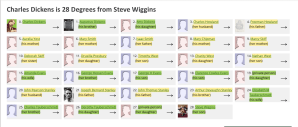
Literature has been on my mind lately. Although I’ve not read all of Charles Dickens’ oeuvre, he’s been in my consciousness what with the new movie and somewhat older book, The Man Who Invented Christmas. Those who analyze literature sometimes claim Dickens invented the modern novel. In my unprofessional opinion, however, the roots go back a bit further than Boz. Still, it’s an enviable position to hold, even if it’s just in the minds of admirers. Dickens came back to me yesterday in one of those apparently random emails from WikiTree. WikiTree is a genealogy website to which I’ve contributed from time to time. I have no famous ancestors, so WikiTree sometimes helps me borrow them. Turns out I’m 28-degrees separated from Charles Dickens.

Perhaps their algorithms are getting better, or perhaps one of their robots is reading my blog (goodness knows few actual people do!) but the connections are getting closer. I posted earlier that I’m 37-degrees separated from Bob Dylan and 43-degrees from J. R. R. Tolkien. I’m closer to Dickens than to either of these famous individuals. This is the beguiling aspect of genealogy—it shows how unexpected connections can be part of our unknown background. The maze back to Dickens is through my grandmother on the Tauberschmidt line. This is the one of the four grandparental lines for which I have the least information. Nobody in my family even knows my great-grandmother’s name. She died young and, as with women in that era, was known in census records only by her husband’s surname. I may never learn who she was.

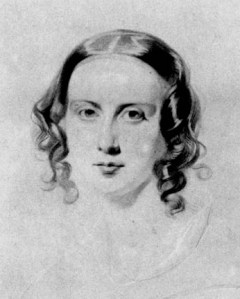
Although the reason for women changing surnames makes sense in its historical context, it is one of the great injustices of both gender equality and history. Signs are indicating that society is finally waking up on this point: women are half of the human story. As a dabbler in fiction writing, knowing that half the story is untold is a troubling phenomenon. Reading about Dickens I learned that he left the wife of his youth for a younger woman. Although such things are common, my reaction was to wonder who Catherine Thomson Hogarth might’ve become, had women had the opportunities they’re starting to have today. She was, after all, from Edinburgh. She has biographies, but not nearly as many as her feted husband. And if my math’s correct, I’m only 29-degrees separated from her. And this may well be the more important connection; the story untold.


Endings

It’s hard not to feel sorry for survivors. In a hostile world, the ability to resist the entropy lapping at your toes is a feat that inspires admiration. Although independent bookstores are making a comeback, there aren’t many around. An evening spent at Barnes and Noble, if allocated well, can evoke some sympathy even for a dying giant. While my wife had an appointment next door, I spent a good while in the fiction section—really the only part of our local B&N that is well stocked. My time among books, excessive to some, is my solace. It’s not a bad vice to have. Seeing others out shopping for books also delivers a message of hope to a world disinclined to read.

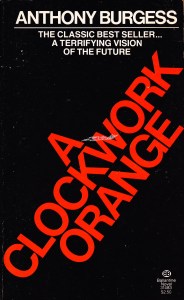
In the B section I saw an edition of A Clockwork Orange. If you read my post on Anthony Burgess’s book in the last few weeks, you’ll know that the American edition has always lacked the last chapter. I wondered if maybe, just perhaps, if this edition might contain the missing ending. It has been several decades since the original embargo. I picked it up and, indeed, the last chapter was intact. I stood in the aisle and read it. Say what you will about Barnes and Noble, but nobody thinks this kind of behavior odd. Once again I was transferred back to Alex and the world of his droogs, only to discover that the ending was something like I had anticipated. If you’ve read the standard American edition you know that it ends abruptly. Writers know how to draw a story to a close. Herewith I offer a spoiler alert.

Alex, now 18, has a new band of droogs. They sound quite a bit like his previous gang. Then he notices he doesn’t feel like the old ultra-violence one night. He goes to a coffee shop where he finds Pete, his old gang-mate, now married and holding a respectable job. He realizes with a kind of horror that having a child and wife appeals to him. He’s growing up. Critics often said Burgess was a moralist with Christian sensibilities. The original ending to A Clockwork Orange might suggest that’s true. Alex may be converted, but he’s unrepentant. Indeed, as he thinks of being a father he envisions his son being just like he was, and the cycle of violence and reform spinning on and on into the future. Shortly after I closed the cover, my wife met me in the store. I was amazed at how 15 or 20 minutes immersed in reading had shifted the mental world I inhabited. New information had changed me. This is the power of books, even when they’re found in Barnes and Noble.


Time Killer

The internet, while it’s no longer free, still at least offers many opportunities to connect. No matter what your obscure passion, you’ll find others who share it online. In my own little shadowy corner of the web, I’m keenly aware of the time requested of others. When you stick a piece of writing in front of someone’s face, you’re demanding a real commodity of them—their time. I keep the vast majority of my posts here under 500 words. Google will now tell you how long it’ll take to read my musings, so I won’t even ask 15 minutes of your time. Others, however, don’t always get the message.

The internet has also granted those who write copiously the ability to send long messages to complete strangers. People I don’t know find my name and send me lengthy emails, perhaps supposing an editor simply chooses material at random to publish. I even get requests on LinkedIn that begin with “Seeking representation.” I’m not an agent, and I’ve had a great deal of trouble finding one to represent my own fiction. Those who know me sometimes ask why I don’t write something longer (I do—my third book is on its way), but the fact is I respect your time far too much. My thoughts about religion in modern life ask only a few moments of your time to think, I hope, about matters profound and important. Then click off to another site. Besides, this blog contains well over a million words by now, and that is plenty long.

I try to read every email from an actual human. I also read about 100 books a year, not including those I read all day long at work. My world is made of words. I do not, however, have unlimited time. Sadly, when I walk into a bookstore I often look at how thick a book is. How much of my time is an author demanding? Don’t get me wrong, there are plenty of books with a weight problem on my shelves, many of them read from cover to cover. Still, they’re asking for my trust. Trust that the time spent won’t have been wasted. The web is a great place to kill time. It’s also a place, occasionally, to pause and reflect. This blog is no super-site with myriad hits every day, but it’s a place that makes little demand of your time. And it is my sincerest hope, dear reader, that time spent here is never simply killed.


Why Horror?

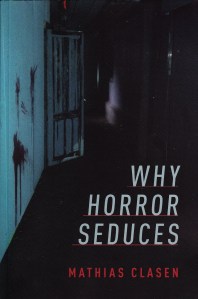
Some people wonder why I like horror. Well, “like” is hardly the proper verb here, I’d rather go the passive route—why I’m compelled by horror. That fits better. But isn’t compel a transitive verb? What’s the object? It really depends on the circumstance—compelled to read, watch, or look at. Quite apart from grammatical imponderables, I keep finding myself coming back to horror and I frequently wonder why. Mathias Clasen may have answered that question for me. Why Horror Seduces is a fascinating study that considers biological and psychological explanations for why we’re compelled to watch or read or play horror, even when we find it distasteful. And it’s not just excusing bad behavior!

As fairly weak creatures that are prey as well as predators, human beings have always placed a high value on security. We’ve driven most of our predators to extinction, but we still have other people to worry about. And microbes. And things that come from space. And, after all that, we still die. These are, realistic or not, things we must face. Horror allows us to confront them and assists us in considering “what would I do if…?” Clasen delves into an evolutionary theory of horror—we’ve evolved to need it. Negative emotions are some of the most ancient, leading us to self-preservation in a hostile environment (something our own government is teaching us anew even now). Watching or reading how people cope in such settings provides us with valuable information. In other words, horror is a learning opportunity.

From that perspective, it doesn’t feel so bad to have written a book about horror movies. I’m participating in the long struggle of humankind against forces that are out to get us. As with most things evolutionary, we need not know why we do them for the whole thing to make sense. Our brains reward us for behavior that is conducive to survival—we like to eat, sleep, and reproduce. Reward centers in our heads go crazy. Then we go to the theater to see the latest, greatest horror film. What may seem counterintuitive here is that we are engaging in a similar kind of activity to other atavistic survival techniques. Watching these movies, reading these books, (and for those who do so, playing these games,) has a basic biological utility. Who knew? And once I get brave enough to crawl back out from under the bed, I may feel better about myself for admitting I like horror.


The Art of Commuting

You can tell when the holiday season settles on the city. The commute home takes longer because developers simply can’t ignore a highway and the potential it has for shipping in the lucre. Highway 22 is built up in several spots—it’s kind of like a 20-mile long roadside mall between where the bus enters it and my exit. Holiday shoppers right after work clog this artery faster than fried eggs for breakfast every day. We crawl, penitent, wanting only to reach home. You get to know the regulars on the bus. You may not know their names, but their faces and personalities become clear enough. The man sitting across the row from me was someone I couldn’t recall having seen before. Lots of people, of course, go into New York occasionally. A stranger on the bus isn’t exactly rare.

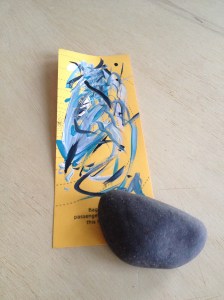
Near my stop I slip into the empty seat next to the aisle to get ready to disembark. He looks over at me and asks if he can give me a bookmark he’s made. Worse than talking to strangers is taking candy from one. He encourages me by telling me he does it to promote his work, since he writes haikus and does paintings. I accept one and learn of the website unfoldingmind.com. He then asks what I’ve been reading. If you read my posts in order, you can see my last book was The Exorcism of Anneliese Michel. There’s a reason I don’t tell my fellow passengers about my literary choices. I say it is a book about an exorcism and he takes it in stride, asking if it was an actual case.

I had my own unfolding moment then. Not only was it the case that I could mention exorcism in casual conversation, but a man considerably younger than me knew what it was. Stop and think about that: prior to the movie and novel, The Exorcist, very few modern people even knew about the rite. Strangers on a bus, both artists in their own way, I like to think, knew what this was. I look at my bookmark, some original art with a haiku on it, and think of the many interesting people that make this bus their temporary domicile. Occasionally, amid the snoring phone-movie watchers, is another passenger using the long ride home to open his or her mind. The bookmark is now amid the artifacts of my personal museum. And my words, hardly poetry, are a tribute to those who practice the arts that make us human.


Anneliese or Emily?

If it weren’t for the movie The Exorcism of Emily Rose, the name of Anneliese Michel would undoubtedly be less recognized than it is. Probably the first exorcism movie since The Exorcist to move the genre in a new direction, Emily Rose was based on the real life case of Anneliese Michel. There were significant differences between film and reality, however. Michel was from Bavaria, and she died at the age of 23 rather than being an American teenager like Emily. The story caught media attention because it was discovered that Michel had died after an extensive, months-long exorcism. Charges were made and the priests and Anneliese’s parents were found guilty of negligent homicide. The movie plays the whole thing out in the courtroom with flashbacks of the possession.

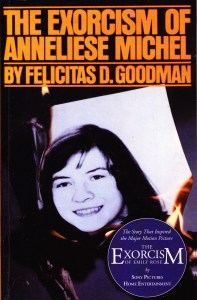
The book which led to the film was The Exorcism of Anneliese Michel, by Felicitas D. Goodman. Goodman, who died in 2005, was a rare academic who wasn’t afraid to address the supernatural. Trained as a linguist, she had years of anthropological fieldwork experience and a medical background. She was also not dismissive of religious experiences. Naturally, this makes her suspect among academics, but her treatment of Michel’s case is both sympathetic and masterful. After narrating events pieced together from court records, diaries, tapes of the exorcism, and information supplied by some of those involved, she offers her own hypothesis of what actually happened. Anneliese Michel was a religious girl caught up in a religious altered state of consciousness that was treated scientifically by drugs. The result was fatal.

Throughout history, and even today, shamanistic persons exist. Whereas in tribal cultures they tend to become prominent, in the “developed world” they are often quite hidden. They experience what Goodman calls religious states of altered consciousness, and are sometimes misdiagnosed as requiring chemical healing. There have been many thoroughly documented cases where such individuals do “impossible” things. The rationalistic world has no place for them, however, for like capitalism, materialism takes no prisoners. Religion is part of who we are. Human beings do have spiritual needs. Such needs can be placated by other means at times, and we can continue to believe that everything in this universe is made of atoms, or super-strings, or quarks. Or we can perhaps admit that theres’s much we do not know. Goodman admits that her solution is an educated guess, but it does put all the pieces together rather nicely. And she doesn’t declare unilaterally whether demons are physical or not. In the case of Anneliese Michel, however, they were undeniably real.


Inventing Breaks

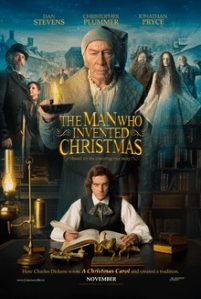
Breaks are good for many things. Time with family and friends. Hours of non-bus time for reading. Watching movies. So it was that we went to see The Man Who Invented Christmas. It really is a bit early for my taste, to think about Christmas, but the movie was quite welcome. Being a writer—I wouldn’t dare to call myself an author—one of my favorite things to do is talk about writing. Watching a movie about it, I learned, works well also. The conceit of the characters following Dickens around, and refusing to do what he wants them to should be familiar to anyone who’s tried their hand at fiction. My experience of writing is often that of being a receiver of signals. It is a transcendent exercise.

Not only that, but in this era of government hatred of all things creative and intellectual, it is wonderful to see a film about writing and books. The reminder about the importance of literacy and thought is one we constantly have to push. If we let it slip, as we’ve discovered, it may well take considerable time to recover. Getting lost in my fiction is one of my favorite avocations. Solutions to intractable problems come at most improbable times. Although publishers tend to disagree with me, I find the stories compelling. In the end, I suppose, that’s what really matters.

On an unrelated note, this is the second movie I’ve seen recently that attributes non-human actors their real names in the cast listing. What a welcome break from the blatant speciesism that pervades life! Animals have personalities and identities. Humans have often considered the privilege of being named to be theirs alone. True, animals can’t read and wouldn’t comprehend a human art form such as cinema. But when they communicate with each other, they may well have names for us. The beauty of a story such as A Christmas Carol is that it reminds of the importance of generosity. We should be generous to those who take advantage of our kindness. Our time. Our energy. We should also be generous to those who aren’t human but are nevertheless important parts of our lives. The movie may have come too early for my liking, but the holiday spirit should never be out of season. If we’ve made a world that only appreciates kindness because much of the rest of the year is misery, it means we’ve gone too far. Films can be learning experiences too, no matter the time of year.


Predestined?

This particular doctrine struck me as evil. It violated every experience and thought I’d ever had, even raised as an unquestioning Christian as I was. Then, at Grove City College I was faced with it for the first time—predestination. If free will is an illusion, what crueler God can be conceived? I couldn’t avoid such thoughts upon re-reading Anthony Burgess’ A Clockwork Orange. A non-conforming non-conformist at the college assigned it in a science fiction class, so it has been decades since I’d read it. Now I found it perhaps more profound than before. Much has happened since my initial reading of the book, o my brothers. (And sisters.)

The framework of the story is well known. Alex and his friends are teenage punks who love ultra-violence. Alex is betrayed and imprisoned. Considered incorrigible, he’s reprogrammed to the point that he can’t even defend himself in a society that’s grown even worse during his time in jail. In the hospital after a suicide attempt, he awakes to find his old self restored, whether this is a good thing or not. The main point that’s behind this, it seems, is that without free will, repentance means nothing. In fact, in my edition of the book, an afterword by Stanley Edgar Hyman makes the point that some interpret A Clockwork Orange as a fictional defense of Christianity. Certainly the comparisons are there, from Judas through Jesus, healing, sin, and suffering. How much it actually meets that idyllic vision of God in Heaven directing the lives of individuals is, of course, an open question.

The idea that human beings are born as Hell-fodder posits a cruel and sadistic deity. Not only are the majority of human beings going to face eternal punishment for matters beyond their control, there is a divinity who planned it that way. We are all, literally, puppets in a universal morality play written by a being whose moral compass is horribly skewed. Indeed, even at Grove City some of the faculty would state that philosophically there could be no contest—free will was right. But, they would add, tapping the Bible, it’s not true because the Word of God says so. When I protested, it was declared, without irony, that even my protest had been predestined. In other words, in this clockwork universe I was clearly an Alex. Upon closer inspection, however, the truer analogy would be that we are all the victims of Alex and his droogs. But only if we have the freedom to make such an observation.


De-programming

I’m no foodie. That’s not a trendy thing to admit, I know. I’ve never been a good consumer. I think it’s because I don’t like being programmed. One area of life where we are most open to programming is in what we eat. Raised to masticate animal flesh, we’re told that it’s healthy for us, and besides, where on earth are you going to get protein if you don’t eat animals? Without thinking too much about it, we step in line. I remember asking my mother, as a child, what part of the animal “the meat” is. I was kind of hoping, I guess, that it was some part that might be kind of painless to lop off, because I didn’t like to think of the implications otherwise. Even when the answer wasn’t satisfactory, I didn’t change my diet.

Once, when eating with a friend, my host commented that you shouldn’t be allowed to eat meat unless you were willing to kill the animal yourself. He wasn’t advocating vegetarianism—he was serving meat—but he was thinking through the process logically. I became a vegetarian, because of that logical thought process, about 18 years ago. I continued to be programmed, however. Yesterday I attended a vegan lunch. I always thought of vegans as spare, acsetical types, emaciated and gaunt. I learned that they are often people who think through the consequences of our love affair with meat. And other animal “products.” The problem is industrial farming. In a word, the commodification of animal suffering. Those who don’t work in the agri-business—to which most looming environmental disasters can be directly traced—are prevented from seeing the conditions in which their “food” is being kept. Animal cruelty on a scale that is, well, industrial. Decisions are made based on one metric—profits.

I don’t think about food a lot. It has become clear to me that my friend’s logic works. One of the things our vegan presenter pointed out is that pigs are considered the fourth most intelligent animal species. Our love of bacon has them kept in conditions where they literally lose their minds. We don’t see it, so we continue to be programmed. Go to the grocery store. The healthy foods are more expensive—“consumers” are punished for refusing to play the “no thinking” game. I don’t know much, but I do know that it’s often the things I do without thinking that ultimately lead to trouble. Capitalism rewards the greedy only. The rest of us, including our animals, pay the price. Think it through and consider the conclusions. I don’t like being programmed.


Spirits and Souls

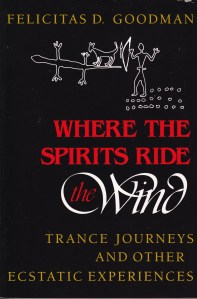
I first became aware of the work of Felicitas D. Goodman because of her classic text on spirit possession. Published by the reputable Indiana University Press, that book has become a standard for anthropological understanding of a strange phenomenon, which includes demonic possession. I found Where the Spirits Ride the Wind: Trance Journeys and Other Ecstatic Experiences in a used bookstore. Recognizing Goodman’s name, and always eager to learn about spirituality, I picked it up, It’s one of those books that makes you wonder. In an effort to experience trance states, Goodman began to experiment with various posture represented in the archaeological record. When she taught classes where students had no foreknowledge on the postures, she found they they reported similar visions during their trances while using the same posture. Matter, it seems, can effect mind.

I couldn’t help but wonder, as I read her account, what Indiana University Press must have thought about what they were publishing. This could be some serious woo, depending on how far you’re willing to go with Goodman. She was a doctorate-holding professor, so academic convention suggests she should be taken seriously. The BISAC classifications (those categories that often appear on the back cover of a book) tell the reader that this is Anthropology and Psychology of Religion. Neither field tends to give a whole lot of credence to the supernatural. At least not necessarily. And yet, there it is. Neither field really captures what Goodman describes in this book. Nobody really doubts that trances can happen; alternate states of consciousness are acknowledged phenomena. What we don’t have, however, is an explanation of what’s really going on.

A good deal of the this book consists of her students’ accounts of their visions. Although a native of Hungary, Goodman, through fieldwork and experience, became quite adept at Native American and other indigenous religious practices. The images that suggested the postures to her come from archaeological contexts around the world. This suggests that, according to Goodman’s worldview, these are some universal experiences. Attaining trance states, like meditation, takes practice. They can shift perceptions of reality. We tend not to hear too much about religion faculty who explore such things too openly. It’s a dangerous move in academia. Ironically, the institutions we build to understand our world tend to restrict themselves to the physical world or those fields that make ample lucre. I’m impressed that, even if by labeling it anthropology or psychology of religion, at least one university press took a chance at offering an exploration that might have some real world consequences.


Trained Witnesses

The problem with lying is that it generally doesn’t hold up. Eventually people will figure out that a falsehood is exactly that and the liar will be scorned. In other words, truth is determined by witnesses. This is tested and confirmed every day in our legal system. The witness is invaluable (except in the hands of lawyers). Since no one person can see everything, we rely on others to help us fill in the blanks. Think of it; when you see something unusual don’t you ask whoever’s with you “did you see that?” We witness the world around us, and unless we’re untruthful that observation becomes part of the collective narrative of what the world is like.

A story from IFL Science! sent by a friend describes “Ancient Legends And Myths That Were Later Proven True By Science.” Apparently this is part of an annual series. What the article lays out are recorded myths later confirmed by science. Scientists are trained witnesses. Taught to silo information, they separate belief (so they say) and eschew non-natural causation. They peer into the mirror each morning with Occam’s razor firmly in hand. Then everybody seems to be surprised when non-scientists have actually observed something correctly. This is the ancient bickering between religion and science—you can’t have it both ways, the reasoning goes. This is a zero-sum game. The winner takes it all. Reality, we observe, is seldom so simple. Articles like this one express surprise that non-scientists can get it right once in a while. The fact is, we’re all witnesses to what happens on this planet. Some of us are just taken more seriously than others.

Don’t get me wrong—I’m not equating religion and science. Nor am I suggesting that all people are equally good observers. It’s just that sometimes things happen when there’s no scientist in the room. Or if there is there’s no time to wire everything up appropriately. The events in the IFL Science! piece are all like this. Observed by people before science was invented—some of them before civilization was invented—events were called myths until scientists came round with their notebooks and validated the long-departed witnesses. The problem with occasional phenomena is that they don’t come on cue. The universe isn’t here to please us or satisfy our curiosity. It’s just that sometimes we see things that don’t match up with the textbook. Whether you call an exorcist or a scientist depends entirely on your point of view.


The Deity Electric

The title set me back. “Deus ex machina: former Google engineer is developing an AI god.” The article in The Guardian is surprising in several ways. Firstly, technocrats tend to suggest that since there is no deity, worship of said non-entity is a waste of precious time. Is this, then, an acknowledgement that those of us who’ve spent our lives on religion may have had at least an inkling of the truth after all? Scientific studies have repeatedly shown that religion is an inherent, and perhaps unavoidable, aspect of being human. Whether you call it inspiration or superstition, we think in religious terms. It’s entirely natural. Perhaps it’s evolved behavior. It’s anything but absent.

Another aspect of the article that generates wonder is the idea that we can create God. Yes, analysts have long claimed that we humans made God in our own image. Traditionally, however, the very concept of God was based on the idea that there was something non-human about the deity. Artificial Intelligence, however, makes the hubristic assertion that human intelligence knows enough to create a god. We don’t even know enough to elect a sane person as president. Looking at the wider world—let alone the universe—there is so much we don’t know. Our five senses are limited. There are realities which we have no way to measure. Is is perhaps not dangerous to make a divinity when our own way of looking at the universe is so terribly limited? What if I don’t like the god you build? At least with the old fashioned one we can shrug our shoulders and sigh, “that’s just the God there is.”

Any fulfilled future humanist will need to find an outlet for this need to worship. Can we truly respect a deity whose transistors we’ve manufactured? This Godhead will be, at the end of the day, only 0s and 1s. And what’s more, we will know that. Traditional religions have given us gods from the outside. Some of them are flawed, some are perfect, but they all have this in common—we didn’t make them. The universe imposed them upon us. Throughout history people have attempted, in various ways, to build their own gods. It generally doesn’t end well. It’d be like designing your own parents. They made you what you are and what would you be if you could somehow reverse engineer them into more perfect versions of themselves? Can we invent gods? Oh yes. We do it all the time. But when we set about making one that our disembodied, downloaded consciousness can worship we might want to consider the history of such attempts.


Scared Space

Ghosts appear whether they exist or not. People have seen them, we know, since as early as written records permit us to know. I first ran into Colin Dickey’s name in a review of the new Ghostbusters movie. The bio made mention of his book, Ghostland: An American History in Haunted Places. Then it was a matter of waiting until autumn to read it. It’s a book that will long stay with me. Dickey’s not out to prove or disprove ghosts—they are simply there (and sometimes not). Ghosts, however, teach us quite a lot about the living. What we value. What we fear. What we disdain. Some of the ghost stories in this book are famous and familiar, others obscure and pedestrian. What they all have in common is a sense of place.

This book is primarily about place. Ghosts seem to be generated by the fact that people have lived here before us. Focusing on the United States, Dickey points out that land stolen from others has inhabitants already. On top of Native American sites, we now have a few hundred years of European and African and Asian building. Lives lived on top of other lives. And although we can’t say for sure what ghosts are, they do seem to be associated with buildings, or at least places. Organized in a kind of concentric structure, the book describes ghosts of haunted houses, then haunted businesses and public buildings, including haunted outdoor spaces. And finally haunted cities. These hauntings are residue of our own making. We build, we inhabit, we die. Whether ghosts are just memories or uncanny feelings, they are ghosts nevertheless.

Combining a couple of my favorite ideas—ghosts and the sense of space—Ghostland is a rare blend of history and folklore. The architecture of our constructions functions like tombs for our imagination. We are spiritual beings, whether religious or not. Even if we’re in denial of that spirituality, we sense that somehow life doesn’t simply end. We’ve left a mark, a scratch, a dent. As long as those who’ve known us live, we continue on in their minds and lives. And some, it seems, remain beyond even that to be seen by strangers centuries later, maintaining the sacredness of space once familiar while living. Ghost stories are human stories, and Dickey is a sure guide along the way. He doesn’t tell you what to believe, but he tells you something you already may know but not realize. No matter whether they’re ever proven, or whether they even really exist, as long as there are human beings there will also be ghosts.