Winter Waiting

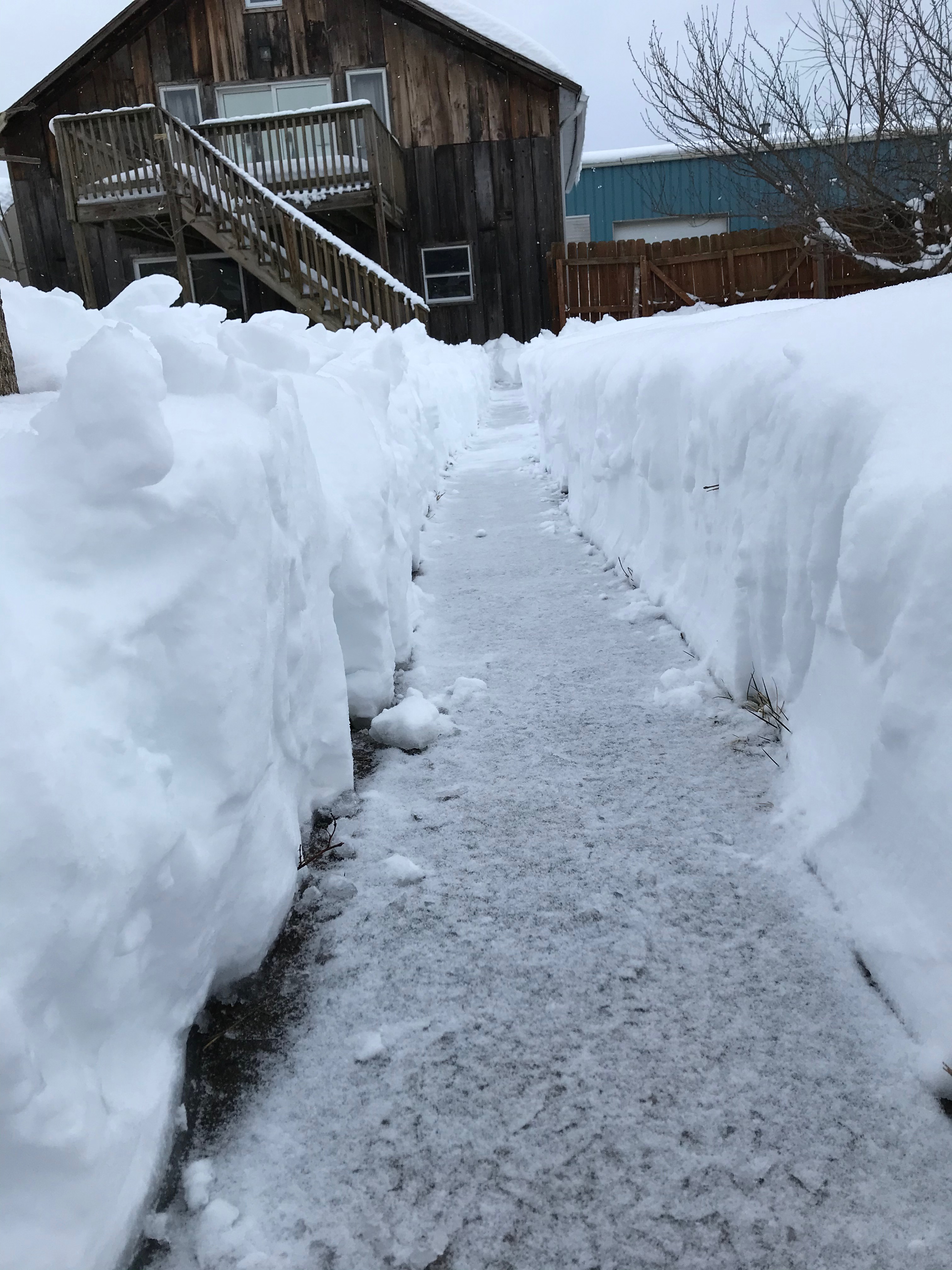
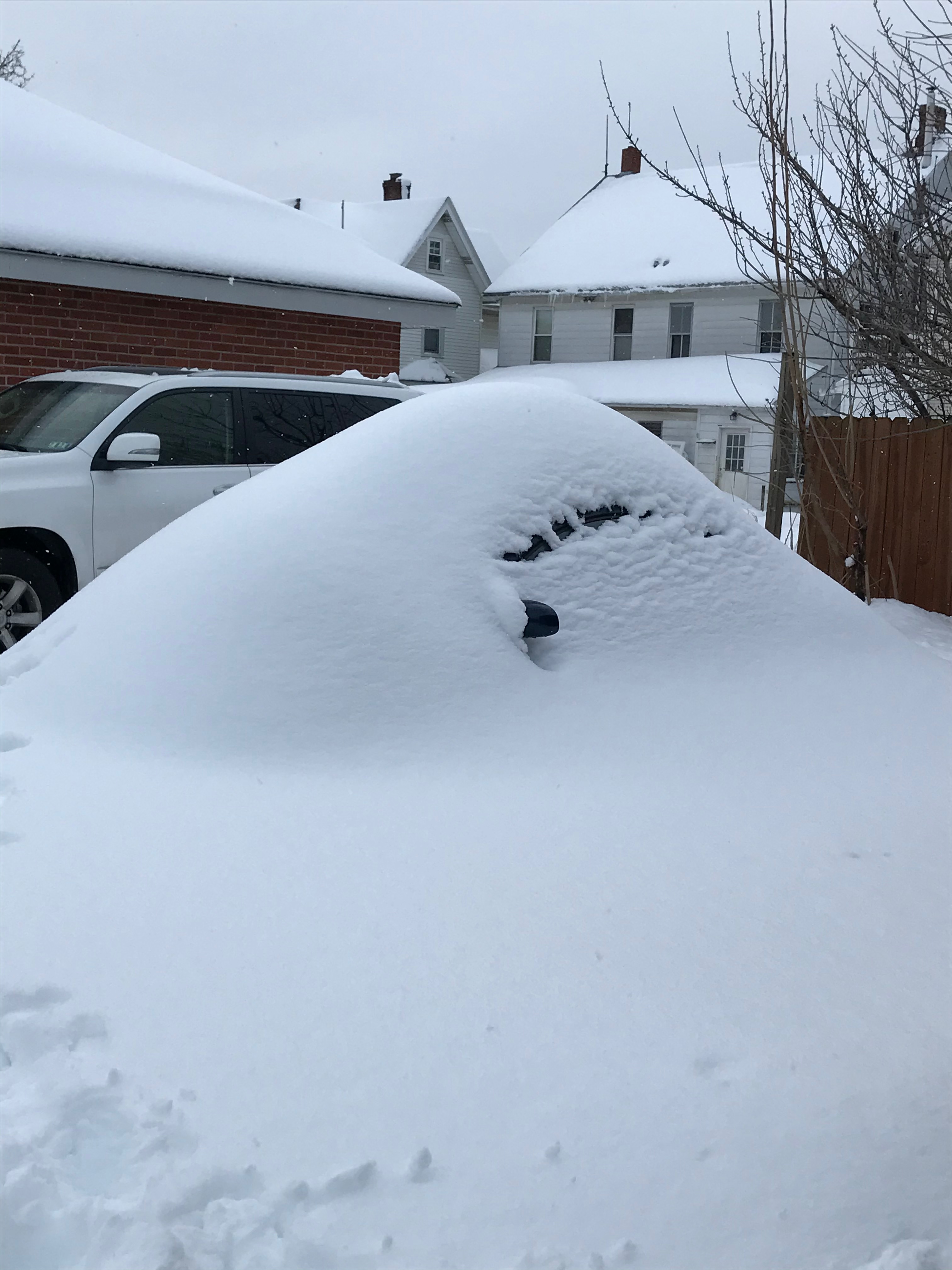
The waiting, as Tom Petty knew, is the hardest part.  Along the slow turning of the wheel of the year it’s now light enough to go jogging before work.  That won’t last, however, because Daylight Saving Time is imminent and will set us back a month in the illumination department.  Also I haven’t been able to jog because the massive snowstorm we had a couple weeks back dumped over two feet of snow on the jogging trail and it hasn’t melted yet.  I miss it.  The jogging, I mean.  I’ve become one of those people who never the leave the house and I see how difficult it is just waiting.  Waiting for the snow to melt.  Waiting for the vaccine.  Waiting for the light.

I’m no psychologist, but I have to wonder if that isn’t one of the greatest stresses faced by the many stir-crazy people who’ve been shut-ins for pretty much a year now.  For us this snowstorm took away the little mobility we had.  Getting out daily for a constitutional put me in touch with nature, at least.  Now nature is under a thick, crusty white blanket, slumbering away.  But the birds have begun to return.  With their avian wisdom they’ve seen the end of winter.  Suddenly this past Wednesday they were here, bringing hope in their wings.  Birds have long been symbols of freedom—we’ve got a couple bald eagles in the neighborhood, reminding me of that.  A far more ancient association was that between the bird and the human soul.  The ability to soar.

We may still be mired in winter, but time is inexorable.  Relentless.  As the globe wobbles recklessly back toward the warmer seasons we need to take responsibility for our part in global warming.  Ironically these freak storms are the result of an overall warming trend.  The weakening of the jet stream that allows cold northern air to drop snow in Texas and storms to cover much of the rest of us all at the same time.  The pandemic has helped clear the air a bit.  At least we’ve rejoined the Paris Climate Accord, and we’ll try to begin undoing the damage to our planet that the last four years introduced.  It will take some time, of course.  By now we should be experts in biding our time.  The snow will melt.  The light will continue to grow.  I will get back out on that jogging path again.  But for now we wait.


Still Standing

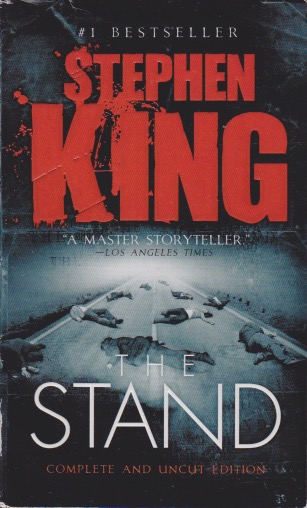
Investment.  Time is an investment, and I recently invested in Stephen King’s The Stand.  You have to realize that I made this decision sight-unseen.  More than one person whose opinions I value told me I should read it.  I had no idea it would be 1,400 pages and would dominate my life for a solid month.  Still, I’m glad I read it.  In case you haven’t, and intend to, there may be some spoilers below.  This is one of the King books I read without knowing the plot or the ending, so if you’re in that boat, skip a paragraph or two.

I hadn’t intended The Stand to be plague reading.  It just turned out that way.  The book is about a variety of flu that kills nearly the entire population of the world.  It’s only at the very end that you learn it’s a parable.  The ending also explains some of the apparently unrelated filler that makes the book so terribly long.  In any case, after wiping out much of the world, the story narrows down to several of the survivors and how they end up dividing into two camps: those who want to cause misery (think Republicans), and those who want to reestablish civilization.  Of course there are several unpleasant instances along the way.  The camp of violent ne’er-do-wells settles in Las Vegas under the demonic leadership of Randall Flagg—his identity only becomes clear at the end—while the good guys, under Mother Abagail, choose Boulder.  A confrontation is inevitable and when the smoke clears we learn that Randall Flagg is, essentially, civilization itself.  Perhaps Christianity.

Of all of the Stephen King novels I’ve read, this one has the most overt Christian imagery.  In fact, in his introduction to the expanded edition he refers to it as a “long tale of dark Christianity.”  There’s quite a lot of theological dialogue along with gruesome deaths.  The pacing often makes the story seem quite long.  Well, it actually is.  I suspect it was this Christian imagery that had friends recommending it to me.  The idea that evil is essentially our culture that comes around and kills us is both profound and paradoxical.  As well as “Christian.”  All along the good guys want to reestablish the cooperation and comforts of civilized life.  It was “civilization” that unleashed the killer virus, however, and herein hangs the tale.  I’m glad to have read it, and I have to confess that I miss the bleak world King created, after living with it for so long.  And it turns out to have been plague reading both literally and symbolically.


Politically Incorrect

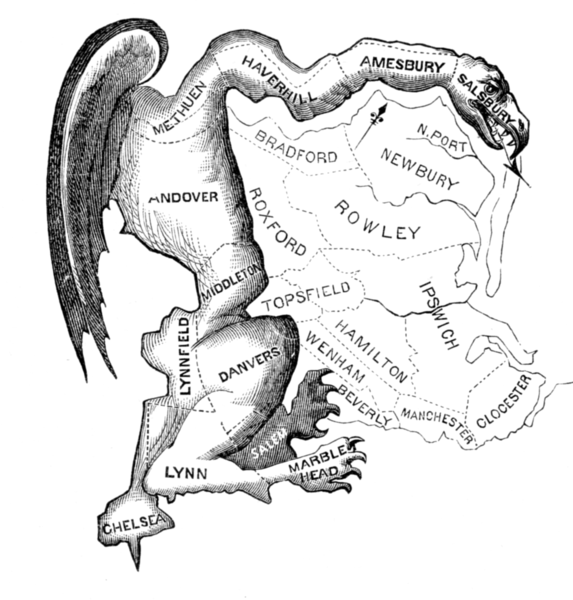
We’ve been dwelling so long in the materialist worldview that we’ve come to doubt evil.  Oh, we still use the word, but we don’t really believe it manifests itself in any real way.  I wonder, however, about it’s association with power.  Lord Acton’s adage is appropriately apt, but when the word “corrupt” enters in one has to wonder about whether evil is lurking.  I’m thinking about these things because some friends were recently telling me about “political” machinations of the Republican Party right here in Pennsylvania.  Initiatives that rank and file Republicans object to as being unfair, but are trying to be ramrodded through because they will keep one party in power forever.  Trump, a man with a staggering number of lawsuits against him before he even received the “grand old” party’s nomination, made it acceptable to bring blatant cheating into the political arena.

Credit: Elkanah Tisdale (1771-1835), via Wikimedia Commons

A recent story in the New York Times discussed how the Republican Party has been focusing on winning despite what the people want.  Its own people.  In other words, a planned destruction of democracy.  A hostile takeover bid for the nation.  Here in Pennsylvania, those who understand the legislation say, a variety of bills and propositions are being put forward—particularly gerrymandering—to ensure that the losers of the popular vote will nevertheless win.  We’ve seen this on the national level when the electoral college has elected a couple of Republican presidents who’ve clearly lost the popular vote.  It never elects Democrats that way—they win both popular and electoral votes when they win.  The fact that Republicans are actively trying to make it harder to vote so they can maintain minority(!) rule would be ironic if it weren’t so, well, evil.

I remember my first civics course (which most Republicans, it seems, never took) in middle school.  I remember my teacher—who was a smart man—saying that voters never elect someone who will hurt their financial interests.  This was before Reagan was elected and every Republican president since has favored the rich over their own poor and working class supporters.  I’m not a political scientist.  I find politics boring and I resent having to try to have to learn an entire new discipline just to keep living in the country where I was born.  We would find, I expect, widespread agreement that taking a country by force of arms is evil.  Taking it by shady lawmaking that is the very definition of corruption, apparently, is not.  The Trump administration took corruption to new heights, right in the eye of the public.  Could a Democrat make such a showing in an election after stating outright on television that Republicans can only win by cheating?   And when he lost fairly and squarely to try to overturn that result and still be the favored candidate for a party that’s lost its moral bearings?  We put the word “evil” to bed a little too soon, I fear.


What Have Faces To Do with Books?

I don’t write much about it because I don’t understand it.  Facebook, that is.  I’ve had an account there for many years now and with the rapid changes they make it seems you might want to major in it if you want to pursue it even as an avocation.  One of the bits of wisdom I’ve picked up from various marketers and publicists in the publishing biz is that you need to be visible on social media.  (I’ve encountered agents who actually won’t consider your project unless you already have thousands of followers, preferably on Twitter.)  The aforementioned marketers and publicists insist that you shouldn’t do all social media—who possibly can?  Just stick with the big ones, especially Twitter.  Especially Facebook.  If you’re a working stiff, like yours truly, you’re not allowed on these sites during the day, which means building a following is difficult.

The publisher of my third book, Holy Horror, hasn’t done much promotion for it.  (They also priced it higher than most of their books, forever dooming it to the dreaded library market.)  One thing I found in my few pre-dawn minutes on Facebook is a group of other authors who’ve published with this particular press.  We share ideas and ask questions.  We try to promote our work in ways that most publishers wish authors would.  In any case, we are hosting and event on Saturday, March 6, where we’ll be on Zoom talking about our books.  The event will be free and lots of interesting things will be on offer.  If you’d like to attend, you’ll need to see the link in my Facebook feed.  It’s free.  There will be a limited-time sale price on Holy Horror.

Working in the academic publishing world but not being in the academy I’ve learned that you “fall between two stools.”  Nobody quite knows what to make of you.  Editors aren’t supposed to write books, are they?  The funny thing about that way of thinking is that many editors (yours truly excepted) are among the smartest people I know.  Those who don’t have doctorates read more than most of the people who do.  It would seem that if you wanted to get some really interesting books you’d ask editors to write.  Of course, they may not be permitted to use social media during the day.  Falling between stools is a place familiar to me.  Facebook, however, seems more like an impenetrable forest.  It’s a good thing I write about horror movies, I guess.  If you’re interested in hearing more take a look at Facebook and join us on March 6.


Critical Snow

No two snowflakes, I’ve always been told, are the same.  Far be it from me to question the collective wisdom of our species, but I wonder how this fact is ever confirmed.  I suppose I’ve personally swallowed a good deal of the evidence over time.  Snowflakes melt and we can’t get them all under the microscope, can we?  This year has been a winter of more than usual snow around here.  During our most recent storm I stared out the window and tried to count.  Billions of snowflakes collected in my yard alone, and no microscope-bearing statistician was anywhere to be seen.  I like the idea of each flake being unique, but I know it’s a theory impossible to falsify, and I wonder if it’s accurate.

I’ve been thinking a lot about critical thinking.  At its base, critical thinking is about asking questions and learning reputable places to find answers.  Not “fake news” or “alternative facts”—these are tools in the Devil’s workbox—but evidence-based information.  Primary education, it seems, is about learning to read, and write, and handle numbers.  It is about learning who we are  and who we’ve been.  About the way that science helps us understand this old world.  Higher education, as it’s generally conceived, used to be about learning critical thinking.  That was before colleges became mere trade schools, catering mainly to careers with high earning potential so that alumni would give more money back to the college.  Where will we learn critical thinking?  No two are the same, right?

Instead, knowledge and hearsay become very similar things.  I used to tell my students not to take my word for it.  Just because I can legitimately put the word “doctor” in front of my name doesn’t mean I know everything.  Yes, I am an expert but even experts aren’t exempt from the test.  So, as more snow starts to fall, I think about all the many, many places I’ve heard that no two flakes are the same.  I think of the astronomical number of snowflakes that have fallen this year alone.  The number of years before we ever evolved on this planet.  In ice ages and even during human-initiated global warming.  And I realize nobody’s done the actual work of comparing every single snowflake to every other one.  Tradition is like that accumulating snow, building on past layers until great glaciers form.  And who, I wonder, would argue with a glacier?


Plants Will Lead

The world just keeps getting weirder.  Although I very much appreciate—“believe in,” if you will—science, sometimes the technology aspect of STEM leaves me scratching my primate cranium.  What’s got the fingers going this morning is spinach.  Not just any spinach.  According to a story on Euronews, “Scientists Have Taught Spinach to Send Emails.”  There are not a few Homo sapiens, it seems, who might learn something from our leafy greens.  The tech comes, not surprisingly, from MIT.   When spinach roots detect certain compounds left by landmines in the soil, it triggers sensors that send an email alert to a human being who’s probably eaten some of their (the spinach’s) very family members.  I’m not denying that this is very impressive, but it raises once again that troubling question of consciousness and our botanical cousins.

Some people live to eat.  I’m one of those who falls into the other category—those who eat to live.  In my life I’ve gone from being a picky omnivore to being a somewhat adventurous omnivore to vegetarian to vegan.  I’m not sure how much more restricted I can make my diet if I leave out plants.  I’ve watched those time-lapse videos of trees moving.  They move even more slowly than I do when my back’s acting up, but they really do move.  If they had legs and speeded up a bit we’d call it walking.  Studies into plant consciousness are finding new evidence that our brainless greens are remarkably intelligent.  Perhaps some could have made a better president than 45.  I wonder if spinach can tweet?

People can be endlessly inventive.  Our thirst for information is never quenched.  Universities are among those rare places where ideas can be pursued and it can be considered work.  While I don’t think everyone necessarily needs to go on to higher education, I can see the benefits it would have for a culture.  Indeed, would we have armed mobs trying to take over because of a fact-based election loss?  I wonder if the spinach would take place in “stopping the steal.”  Hopefully it would fact-check more than those who simply follow the leader.  Consciousness and education can work together for a powerful good.  I’m not sure why Popeye’s favorite was chosen for this experiment, but it does seem to show that we can all get along if we really want to.  Maybe then we could meet in the salad aisle rather than out in the field looking for explosives.


Keep at It

Photo credit: ESA & MPS for OSIRIS Team MPS/UPD/LAM/IAA/RSSD/INTA/UPM/DASP/IDA, CC BY-SA 3.0 IGO, via Wikimedia Commons

Perhaps it’s an indication of just how sick the United States has been for four years—waking up each day wondering what new crisis Trump would have put us into—that I heard nothing about our next Mars visit.  I’m normally quite interested in space exploration.  I seriously considered astronomy for a career, until I found out it’s mostly math.  In any case, I’ve watched our planetary explorations quite closely.  Yesterday, until just about five minutes before the landing of Perseverance on the surface of the Red Planet (earth is supposedly the Blue Planet), I knew nothing of the mission.  When my family alerted me to NASA’s live feed of the event I tuned in for those five minutes to watch as we safely landed our fifth such probe on our neighboring world.

It’s funny how a self-absorbed person can take a whole nation down with himself.  It was a relief to look outside for a while, and to wonder.  I remember when the rovers Curiosity and Spirit landed.  The advance of technology was evident in yesterday’s deployment.  No more bubble-wrap was necessary.  The landing system was incredibly elegant, and if there are any Martians I’m sure there were several UFO reports yesterday afternoon.  As the NASA interpretive explainer told what was going on, I wondered just how life might be on the Blue Planet if we were able to put all our tech to work for peace and the betterment of all.  Instead I find a Congress only too willing to acquit a traitor so we can continue the hate.

Emotion is a funny and unpredictable thing.  Although I knew nothing of Perseverance until five minutes before touchdown, I was immediately drawn into the feeling of the moment.  My eyes weren’t exactly dry as I watched the cheers of jubilation from those masked engineers in the control room.  This had been the culmination of years of hard work, and yes, math.  They were able to calculate fall rates and counter-forces, landing spots and trajectories.  And all of this from about 140 million miles away.  Perseverance was launched back in June—you can’t get there overnight—when we were still reeling down here from the overt evil of white supremacists.  Stoked by a man who would be king.  Leader of the Red States.  Would-be ruler of the Red Planet.  How I wish our technology could help us on our own planet.  Any probes landed here from elsewhere must, I suspect, not believe their mechanical eyes.


Leadership

After four years it finally feels safe again.  We can celebrate Presidents’ Day, although now and forever with some trepidation.  Even as Republicans still protect the insurrectionist Trump, democracy has survived his tenure of horror.  Many Americans don’t realize just how close to Nazi Germany we came.  There are many who hold party above the good of the nation, something our founders, one of whom we celebrate today, feared.  The outdated safeguards of democracy, such as the electoral college, have been used more than once to “elect” presidents the American people did not want.  One guess as to which party this has only favored.  Democracy, we’re now being told, is fragile.  It shouldn’t be.  Only the designs of a party scheming for personal enrichment makes it so.

Today we can at least take a breather and be glad that we no longer have a bigoted, sexist, classist, racist incumbent.  We have a female Vice President of color.  We are on the long, slow road to recovery.  The senate, clearly recognizing Trump’s danger to the nation, voted to acquit him because Republicans fear not being reelected if they stand up to him.  Our democracy’s not out of the woods, even this Presidents’ Day.  Until the GOP learns to grow a backbone we’ll be in constant danger of collapsing.  Anyone with back trouble knows how it can stop you in your tracks.  Of course, once you’ve made a deal with the Devil, there’s no getting out of it.  Most Republicans could benefit from just a touch of folk wisdom.

When one party sides with armed thugs who’d have happily killed them if they’d been found just a little over a month ago, our grounds for celebrating today remain on thin ice.  The GOP, which has no moral compass left, has decided that bullies and armed bandits are the way of the future they’d like to see.  Although Trump lost both popular elections they’d still vote for him a third time and support him again if he incited another insurrection.  It’s Presidents’ Day but we’re still on the edge of a precipice.  When a political party refuses to learn from its mistakes, and indeed, tries to build upon them, our celebration of democracy must, by definition, be subdued.  We do have grounds for hope.  Efforts to get the coronavirus under control are starting to take effect.  We have a sane human being in the Oval Office.  Until the GOP disavows evil, however, we’ll continue to live in fear.


Meanness

There’s often a meanness to literalist religions.  A sense that if they can keep their particular interpretation of God’s will, then anybody can.  No compassion.  No forgiveness.  Considering the base messages of nearly all those religions that harbor fundamentalists, that attitude is quite surprising.  Indeed, it ceases to be religion at all and becomes merely a facade of one.  The recovery of the body of Khaled al-Asaad is what brought this to mind.  Back in 2015 al-Asaad, an 82-year old archaeologist, was beheaded by the extremist Islamic State group in Syria.  Al-Asaad had spent his life excavating and attempting to understand the site of Palmyra.  The Islamic State was determined to destroy what they considered “idols” or offensive images.  When the octogenarian refused to tell them where they could find further antiquities to destroy, they beheaded him.

This isn’t finger-pointing at Islam.  Islam is a highly moral religion that values peace.  What it has in common with Christianity, apart from some shared history and theology, is that it fosters extremists.  Extremism may be fueled by religion but it’s not religious.  The adherents are often mean, hard-line individuals who have trouble distinguishing the shades of gray that make up so much of life.  As a result of the Islamic State movement, many antiquities that had survived for thousands of years were destroyed forever.  There were heroes like Khaled al-Asaad (we might even call them saints) who tried to protect these irreplaceable artifacts.  Religion has no feud with the past.  In fact, religions consciously build on their pasts.  Continuity is important to them.

Extremism of this kind is a fairly new blending of religion and politics.  As recently as the sixties it was felt that religion and politics should be compartmentalized.  Kept separate.  When the Republican Party realized in the seventies that evangelicals could be made into a voting bloc, religion became politicized.  This happened elsewhere around the world.  “True believers”—the very term suggests the rest of us believers aren’t true—tasting political power, realized they could use their meanness to make the rest of the world in their own unforgiving image.  We’ve been living with the consequences ever since.  Even now Republican lawmakers fear reprisals of Trump supporters if they dare accept the truth.  In other words, extremist religion has pitched its battle against the truth itself.  That would be ironic if it weren’t so terrifying.  No religion that I know has meanness among its central tenets.  It takes literalism to make it one.


How Clean Is Your Brain?

First it was in.  Then it was out.  Now nobody seems to be sure.  “Brainwashing” isn’t really a scientific term, but human suggestibility is very well in evidence.  Advertisers count on it.  Did I really need that phone case when I never go out?  And so on.  The real question is can people be compelled to do what they normally wouldn’t want to.  Think Jonestown.  Heaven’s Gate.  Waco.  Do people really want to die en masse?  Are we but higher lemmings?  I’ve seen hypnotists do their shows.  The human mind is manipulable.  We can be shut off from reason.  A recent article from The Middletown Press my wife shared with me raises the question whether conspiracy theories, such as those sported by QAnon, are something like brainwashing.  Clearly they are.  As are many Fundamentalist forms of religion.

You can recognize this when a conversation becomes such that the true believer simply won’t listen to evidence.  They’ll say they want to discuss an issue when all they really want to do is have someone state their side so they can tell them they’re wrong.  Reason has nothing to do with it.  When that part of their gray matter that handles things rationally feels backed against a wall they resort to ad hominem attacks.  I’ve been observing this since I was a child raised in such a paranoid religious tradition.  It works for politics, too.  For many QAnon sorts, Trump’s word was God’s word.  Once uttered it could not be refuted, not with all the evidence in the world.  It’s very much like Fundamentalist views of the Bible which can’t take context, translation, and reason into account.  When contradictions are blatantly pointed out they respond with “there are no contradictions.”  Is there brainwashing?

Conspiracy theories can seem real because there are actually some conspiracies.  There are government secrets.  Only the naive deny that.  Still, once you start throwing in the ridiculous—that a devil-worshipping cabal of pedophiles is running a secret government—you’re in water over your head.  Not only that, this sounds incredibly like the satanic panic that spread through much of the world in the late 1980s into the 1990s.  When the evidence was examined, it was found lacking.  Some of the key bestselling accounts were admitted to have been forgeries.  The believing mind, however, has trouble letting go.  We used to call fringe groups cults.  We used to suggest that people could be held against their will.  People leaving QAnon are reporting similar experiences, according to the article.  Brainwashing by any other name would be so real.


Christian Nationalisms

Ongoing analysis of the Capitol Riots continues as footage of the event is scrutinized.  Although the press is puzzled, those who study religion—underfunded and ignored in the academy—aren’t really surprised.  A recent story from the Associated Press explores how Christian Nationalism, one of the most dangerous forces in the United States, played a large role in the event.  Christian Nationalism is one example of what I call weaponized religion.  As someone who’s spent over four decades studying religion minutely, it’s pretty clear when religion begins to slip its moorings and is becoming radicalized.  Generally it begins when adherents refuse to hear any views but their own.  They believe their version of their religion is the only “one, true faith” and this gives them the mandate to attack any who believe differently.  In the case of Christianity it’s very difficult to see what any of this has to do with a carpenter from Nazareth.

Indeed, evangelical Christians themselves are exploring what is now being called “Republican Jesus.”  This Jesus isn’t the one from the Good Book.  Far from it.  No humble shepherd saying “turn the other cheek” fits this image.  Long ago I read Stephen Prothero’s American Jesus.  In it he analyzed how the American appropriation of the Jewish rabbi became a muscular, masculine fighter.  Not the kind of guy who’d let Roman authorities nail him to a cross.  And certainly not a softie who would favor outcasts, women, and children over the rich and powerful.  This image of Jesus, who draws a hard line on certain trigger issues, is as patently false as any reconstruction can be.  And yet it drives unruly mobs into the halls of power.  Universities, meanwhile, cut religion departments.

Photo credit: David Shankbone, via Wikimedia Commons

I don’t pretend to be a prophet, but this issue isn’t going away.  Our culture has long harbored the myth of America as the “new Israel.”  The leaders of Christian Nationalism are organized and they have a clear agenda to take over the country.  Like other serious issues that don’t have to do with making money, it’s simply overlooked as irrelevant.  When the mainstream media gets a glimpse at what’s been going on in such groups, it always seems surprised.  The kind of elitism that divorces itself from the everyday simply can’t be informed of what’s actually happening.  Religion is a very powerful driving force.  It motivates many far more than money does.  We see it plainly when it becomes weaponized.  By then, however, it could be too late.


Gothic Celts?

Two separate projects lately set me on the trail of preliterate Europe.  While this isn’t the best time to celebrate white cultures (timing has never been an especial strength of mine), I have been researching the Celts as part of a longterm project.  Not only are these people part of my ancestral mix, they are also mysterious.  Having arisen in central Europe, they were pushed to the margins of the continent by invading Huns from the east.  It’s from those fringes that I came to identify my heritage.  Not only do I have Irish ancestors, but Wiggins, it seems, is a Breton name.  The Bretons were a Celtic people on the northwest coast of France.  Since the ancient Celts didn’t leave a huge written archive, we rely on what others (such as the Romans) wrote, or what archaeology reveals.  Mysterious.  At the same time another project had me reading about the Goths.

The Goths are tricky to define, and again, didn’t leave literary archives.  Also politically incorrect, they were a Germanic people—another significant piece of my ancestry—and they must’ve lived quite close by the early Celts.  Although my parents wouldn’t be born for many centuries yet, their ancestral “tribes” may have known one another.  It’s fun to think about.  There’s quite a lot of interest in the movements of peoples in ancient times.  One thing that influenced both the Celts and the Goths were large, organized forces.  The Roman Empire, with what would come to be understood as Classical style, was one source of pressure.  Another was the aforementioned Huns.  The Romans considered all of them barbarians.  One of the results of these large pressures was the eventual establishment of nations in Europe, often with contested borders.

All of this splitting eventually led to nationalism, a dangerous force.  We’ve seen some of the end results in recent years.  A single nation thinking it is the best.  I’ve always felt that travel—difficult during a pandemic—is a great form of education.  Encountering the “other” on their own territory makes it hard to stereotype and boast.  Nationalism tends to lead to excessive pride, especially when a country is as isolated as the United States is.  And then it even tries to build a wall between one of only two neighboring nations because they speak a different language.  How different this is from the situation when Celts and Goths were moving somewhat freely across the European continent where, at the time, borders were fluid.  I realize I’m idealizing what was certainly not a perfect situation, but I also think Rome may not have been the best model to emulate either.


Ode to Snow Days

Once upon a time there were special gifts called “snow days.”  On these special days no one was required to report to school or work.  It was a caesura to late capitalism, albeit a brief one, in which the forces of nature triumphed over making everyone “go out” to work or school.  The pandemic has, of course, eliminated snow days.  Never again will there be the excuse of “I left my laptop at the office,” or “the roads are unsafe.”  The evil monster that enslaved all mortals of a certain class had won.  No brave knight, wearing mittens or not, dared face this great beast, and so nobody lived happily ever after.

There is a moral to this story.  Well, not so much a moral as an addendum.  During snow days we had time for our civic duty of clearing sidewalks of snow.  I begin work before the sun comes up, and consequently I don’t stay awake very late.  Over the past few days we’ve had several inches of snow.  It began falling Sunday morning, and it fell through Tuesday morning.  I had to take time out of my usual work schedule to shovel in the morning.  By that point it was already six inches at least of the kind of snow that’s so heavy that it starts to turn blue beneath the surface.  I hurried back to work since I had a couple morning meetings.  The snow continued to fall.  I normally don’t take a lunch break, but I had to on Monday, just to stay ahead of the snow.  After work, just before dark, I was out in it again.

The snow day, in other words, isn’t just about time off from work.  It’s also about taking care of things that need to be done in a weather emergency.  The idea of remote work being work without ceasing has really caught on during the pandemic.  Without office walls to constrain it, capitalism is free to take over our private spaces—and our civic duties—as well.  The dearly departed snow day was more than just a lark.  For younger couples it meant being home to take care of the kids when school was cancelled.  In other words, it was a day to acknowledge that weather is still in control.  We do need that reminder once in a while.  The snow out there is pretty.  It’s also deep.  More than that, it is even a symbol.


Contains Cookies

In the early days of this blog I used to get regular reactions from other bloggers.  This was back before I started the long commute to New York City and when I actually had a little spare time on my hands.  I always enjoyed the interactions, but followers eventually dropped away and I now often get no responses to my posts at all.  That’s why I was thrilled when two recent posts came together with a response one of my faithful readers sent.  I’d written about keeping books neat, along with a piece related to ancient food, when a friend pointed me to the story of a cookie found in a 1529 Cambridge copy of Augustine.  According to the piece on Delish, the cookie was left in the book about half a century ago and had only now just been discovered.

Photo by Mae Mu on Unsplash

Now, like most readers of religious studies, I have opinions about Augustine that aren’t pristine.  Still, I respect books.  I suspect all the bakery jokes necessary have been made about this particular bookmark, but what strikes me as odd is that nobody discovered a cookie placed in a book when I was less than ten years old, until now.  Let that say what you will—Augustine still sells wildly in translation, of course.  Not too many individuals go back to the source, however, at least not reading as far as the cookie.  I don’t know about Cambridge, but Edinburgh used to have books from the seventeenth century on the open stacks in the New College library.  I’m sure the older volumes weren’t frequently consulted.  And I’m not the one to point a finger; I have no catalogue of my own books so I have to remember what I already have.

Books aren’t a great investment, financially.  I remember back when Antiques Roadshow was all the rage.  Every episode I saw where someone brought a really old book led to certain disappointment.  No matter how rare, the value was measured in hundreds of dollars rather than thousands.  Those of us who invest in books do so for different reasons.  Our money is being exchanged for knowledge, learning, and thinking.  Back when Amazon used to give out bookmarks with each purchase one had a quote from Erasmus, “When I have a little money, I buy books; and if I have any left, I buy food and clothes.”  We are kindred spirits it seems.  Buy books and you’ll grow in wisdom, but you may go hungry.  That’s the way the cookie crumbles.


Down to the Sea in Ships

One of the first great trends of 2021 has turned out to be sea shanties.  Micro-current historians have traced the craze, at least in part, to a TikTok video released by Nathan Evans, a Scottish postal worker.  His version of “Soon May the Wellerman Come” has spawned an international cooperition of other singers and musicians who’ve added to a song that has created a sense of community among many who’ve never been to sea.  It even got the attention of the New York Times.  In the long, waning days of 45’s term in office (what a foul taste that leaves in my mouth) people were feeling isolated and largely directionless.  It isn’t so different than, I imagine, being out to sea.  I grew up away from the ocean, longing to be there.  Nevertheless, I didn’t discover Moby-Dick until seminary.

Melville’s classic is essential reading for those who want to exegete “Soon May the Wellerman Come.”  While I’m a vegan for a reason, understanding the lyrics of this particular shanty require some knowledge of whaling.  The wellerman was a supply ship that met whalers on their often multi-year voyages, to bring them provisions.  They’re not mentioned in Moby-Dick because the Weller brothers ran their operations out of Oceania.  The idea of relief being brought by others is nevertheless something we can all appreciate as we’ve been isolated from each other while being given the cold shoulder by the Republican Party.  The fact that a nineteenth-century sea shanty has the pandemic-ridden world by storm is really no surprise.  There’s a romance to the sea and those of us lubbers who spend our days on dry ground sometimes dream of the freedom the oceans represent.

Although not a shanty, a sea song that’s always spoken to me is “Sloop John B.”  A folk song from the Bahamas, it tells the tale of a homesick passenger wanting to go home.  It shares an element with sea shanties like “Wellerman.”  Both seek rescue.  Many world religions suggest humans need “salvation” of some kind—from sin in Christianity or samsara in Hinduism or Buddhism.  Songs of the sea also frequently share that hope of help.  Whether it’s the supply ship or a return home, a longing for salvation runs through the romance of the sea.  I can’t help but think that during this pandemic that need has surfaced in a viral song about the wellerman expected, but not yet arrived.  Or the trip to normalcy delayed.  However we might interpret them, songs of the sea give us some hope that the journey home will eventually come.