Love Thy Enemy

The line for the train snakes through Union Station before 6:00 a.m. Many of us, maybe all of us, were at the Women’s March on Washington. Listening to strangers speak to one another, it’s clear that this was the largest “love in” in history. Trump supporters say it was about hate—we know they rely on “alternative facts” now. Nearly every speaker at the rally emphasized love. The government gives us Orwellian doublespeak. 1984 must become required reading once again. We can’t let the fascists control the narrative. Those who control the narrative sway the crowds. The Women’s March on Washington was not hateful. This was a peaceful gathering in the name of love. I write fiction as well as non. (My fiction has even fewer readers than this blog.) The point is, I know about controlling narratives. If you let a government with a documented history of distorting the truth (at just one day old) control the narrative, friends, we are lost.

dscn6825

The March was the beginning. I saw children just old enough to march. Children so young they had to march in strollers. I saw grandmothers in wheelchairs. I saw mothers and daughters. Sons, brothers, fathers. Not one unkind word among people standing shoulder-to-shoulder for over four hours. No room to sit down. Bathrooms inaccessible. We were united. We are united. This government has already shown that it will offer post-truth rather than facts whenever possible. Do not let them control the narrative! They will be trying to silence our voices. They will, like all fascists, try to make lies our national narrative. George Washington, they will tell us, voted for Donald Trump. And those who find blindly will believe it. Those who don’t read history will have no way to assess this. They will follow any narrative with a combed-over talking head. Question everything. Question what I write. Check it out. I believe in facts.

We are embarking on a dangerous journey. These waters, however, are not uncharted. The Bismarck steamed this way. Marches have been documented around the world. Millions of eyes are watching. They are part of the narrative. Write the story. Talk to others about this. Incessantly. The truth is not arbitrary. There are groups near you that you can join. Resist. Peacefully protest. Write the narrative. Share the narrative. If we need to March every weekend, we will. If we need to take turns, so be it. This is our story. Unlike the blatant post-truth we’re already being fed, our story is non-fiction. Read it and tell everyone else to read it too. This is what democracy looks like.


Alternative Reality

devilsdominionIt is a caution that may become increasingly necessary as Trump’s supporters of “alternate facts” begin to sink their insidious hooks into feeble American minds that magical belief is part of our culture. While most would deny it in any kind of direct way, from the earliest days we have been a credulous lot. Richard Godbeer explores this historical affinity in The Devil’s Dominion: Magic and Religion in Early New England. Mostly concentrating on the events that led up to the Salem Witch Trials, and some analysis of the trials themselves, he traces the origins to such belief back to the theology of Calvinistic Congregationalists who held undisputed sway in the earliest days. Without benefit of clergy who might urge them to look at the world as a good creation, people instead saw evil and the Devil lurking everywhere. Magic was a regular component of their intellectual diet.

Now, some three centuries later, it’s looking as if things haven’t changed much. Those closest to the highest office in the land—and more frightening still, the most powerful single office on earth—are claiming that facts can have alternatives (what used to be called “lies”) and that if a rich man feels offended reality must be rewritten to make him feel better about himself again. The rewriting of history and science and law is really a mere trifle if you can claim “alternative facts” whenever you please. I wonder what you might find in Alternative Facts on File? I had a chance to thumb through recently and here’s what I found:

Alternative fact 1: Donald Trump didn’t win the election after all! We got the wrong guy in the White House. It’s a fact. Alternative fact 2: the Electoral College was abolished on November 8, 2016. That means that the popular vote wins the White House and Hilary Clinton is, in fact, President of the United States. Go ahead and challenge me on any of this Sean and KellyAnn—for any of your facts I can offer alternatives and they are, by definition, equally valid. Who’s with me? As long as alternative facts are now official discourse supported by the White House, let’s use them to the advantage of the entire nation. Is there a lawyer in the house? Even a Jesuit would do. The one I feel sorry for, however, is Richard Godbeer. His fine book has had to play Devil’s second fiddle to the new reality of post-truth Washington. Maybe the White House really does believe you can shake the Devil’s hand and say you’re only kidding. Wake up, America—you’re being laughed at and mocked by your own government.


Reading Lesson

“The President” responded to the Women’s March on Washington by tweeting that he was “under the impression that we just had an election!” Perhaps if “the president” read more he would understand that instead of looking in a mirror you need to look out the window once in a while. The Electoral College is even more outdated than the Republican Party and has only stood in place so long because our elected officials lack the energy to dismantle it. Like Daylight Saving Time. A loss by nearly 3 million votes is not a win in anybody’s book. I would suggest that Mr. Trump and his party learn to read. In strings of more than just 140 characters. Those who read know that Russia hacked our election. Voters can speak with their feet as well as with their fingers. We can see the Republican Party for what it’s truly become. Those accustomed to a lifestyle of theft sometimes don’t realize that others have seen their fingers in the cookie jar.

dscn6861

As one of the many marchers I would say if you want a mandate, look out your window. George Washington, if I recall my history correctly, did not try to put his will over on an unwilling country. Indeed, most of us believe he had too much integrity than to try to hide behind something like an Electoral College to reinforce his tenuous grasp on the reins of power. It’s our constitutional right, Grand Old Party. We can protest. Legally. We will protest. Continually. We will not let you suffer under the delusion that you won anything. Your party gamed the system and any “president” who reads would say “I can see now that I misunderstood.” Backing down is not cowardice. Listening to others is not weakness. Being “president” means having to ignore your cronies once in a while. Vox populi, for those who know how to read, means “the voice of the people.” Democracy is upheld by the consent of the governed, not electoral casuistry.

Those who rely on crooked systems to claim a mandate need to learn to read. Reading requires thought. Concentration. And the will to repair rather than to dismantle. Try ignoring the handlers once in a while. Was the “president” not at the inauguration? Did post-truth press secretaries hide the photos? Please look away from the mirror. Governing with the consent of the governed is hard work. It’s not about brokering deals and looking for one’s own best angle. It’s not about “me first.” As long as any disabled child, any woman who’s been sexually assaulted or discriminated against, and any African American can be told that his or her life doesn’t matter the job will be never ending. The accountability just started this weekend. Read and learn. We are the people.


On the Ground 2

dscn6785

Don’t believe the lies. Your government is lying to you already on day 1. I watched in disbelief as Trump’s press secretary for the White House, Sean Spicer, told bald-face lies the very first day of Trump’s reign of terror. I was in Washington, DC. My niece attended the inauguration. My extended family attended the Women’s March on Washington the next day. Spicer, clearly comfortable with untruth, lied through his teeth mere minutes after I myself stood outside the White House, saying that Trump’s inauguration was the best attended in history, far outstripping the paltry women’s march. Pure, unadulterated lies from the White House. My niece, and many others, noted how poorly attended the inauguration was. The evidence was in the white plastic matting, unbesmirched by mud on Saturday morning. The federal government disallowed the use of the Mall for the Women’s March. The unused matting was very clearly white the next morning. Around 8:30 on Saturday morning I saw for myself.

img_3152

The Women’s March may have been the most significant event of my life. I was part of something much bigger than myself. Along with thousands of others, I stood for three hours while celebrities including Scarlett Johansson, Michael Moore, and Madonna, appeared on stage to cheering crowds. There was barely room to stand. We marched past the Washington Monument to the White House. A US Security guard told us there were an estimated 1.2 million people there, making this one of the largest marches on Washington in history. Just inside that white-washed tomb Spicer was lying his face off. He castigated the press for telling lies. Wake up, my fellow Americans. On day one our new government has shown that it intends to lie and smirk its way through every attempt at honesty. My eyes did not deceive me. I was there, on the ground.

dscn6816

I work in Manhattan. New York City is a community of some 8 million people. I’ve never in my life been in a crowd as large as yesterday’s in Washington. The Women’s March was peaceful and perhaps the largest protest in our nation’s history. Protests in over 600 cities around the world joined it. An administration of the people, by the people, and for the people would acknowledge that. The smug, implacable—and I use this word sparingly—evil administration that insists on lying to its citizens is already spinning a false narrative. I was there, on the ground. This March may have been the best use of time in my life. Beware, Americans, your government will regularly be lying to you until future notice.

dscn6842


On the Ground

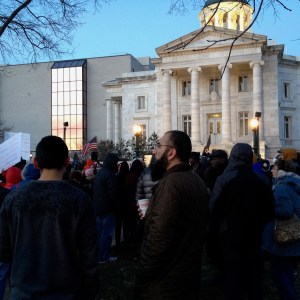
Washington, DC has always struck me as an artificial city. The neoclassical architecture is just a bit pompous and rolling into town on a train is kind of like stepping onto a movie set. Or, I’m told, into Los Vegas. Regulations about the heights of buildings make it unlike other large communities, and the Washington Monument has taken on a new phallic significance as of this weekend. I don’t come here seeking salvation. Indeed, I only came to register my dissatisfaction. I’m not alone. “Pussy hats” outnumber red caps by a long shot. It’s time to stand up and be counted. Stepping out of Union Station the first thing we saw was a Black Lives Matter protest. It’s peaceful, but forceful. Those selling Trump merchandise look like it’s a slow day. The inauguration is less than three hours from now.

Washington has some personal resonance with me. My grandmother—herself a second generation American—was born here. She wouldn’t have shared my political views, I’m pretty sure, but I believe in fair treatment for all. Even those who haven’t asked for it. The last time I was here it was for a conference. The atmosphere was more congenial then, but I’m liking the number of protesters I’m seeing here today. Woman carrying signs, wearing pink hats, talking to people they don’t even know. We’re all in this together and it sure feels better to know you’re not alone. We come upon a protest march. Police are herding the crowd away with an impressive array of black. A small crowd gathers to watch. I hear what sound like explosions. Welcome to the land of the need, the home of the rave. I’m not here to make trouble. The electoral college started it.

dscn6747

What you saw on the news last night isn’t what was taking place here on the ground. The protests here in DC have been going on all day. Even as I was getting ready for bed protesters had blocked the street on the way to Trump’s oversized balls even as the television anchors were spreading a narrative of glitz and glam, ignoring the tempest just outside. Determined to normalize Trump as if the elections of incompetents were everyday business is these states, the smiling anchors didn’t comment on the completely empty stands of the inaugural parade that were so painfully obvious. I’ve never seen so much riot gear in my life. This, they tell me, is democracy. I’m here to march peacefully, in solidarity. Marches in 60 countries and seven continents—the first ever Presidential protest in Antarctica has been announced. To see you only have to open your eyes. I’m in DC and I’m glad to be in the company of others who haven’t yet given up on our country.


Elephants and Snakes

I try to be a good son. As good as you can when living a few hundred miles from home. I call my Mom every week and when the mood’s right, we reminisce. During a recent conversation I was recollecting my first trip to Washington, DC. My grandmother, who lived with us, had been born there and wanted to see it again before she died. I don’t remember much about the trip. I would have been maybe 5 or 6, possibly 7. The Washington Monument I remember because I was terrified of heights and didn’t want to go up. The sharpest memory, however, involves the motel.

We didn’t have much money and very, very rarely stayed at motels. In fact, this is the only time I remember it happening before I went to college. It was one of those cheap places where you park right outside the door to your room. In the morning, bright and sunny as only childhood mornings can be, I remember racing around the oval, gravel drive with my brothers. We had our favorite stuffed animals with us. Mine, ironically, was an elephant. I remember that elephant well. I remember running with him under my arm and laughing and having one of the most carefree moments of my entire life. Now I think of elephants in Washington, DC and the magic is gone. We never had much money when I was growing up, but my other favorite stuffed animal was a long, black snake. It was as long as I was tall and I loved the fact that snake and my name began with the same letter. I loved him so much that his eyes came off and my mother sewed large purple buttons in their place. At that time I had no concept of how apt the symbolism might be.

400px-march_on_washington_edit

The snake and the elephant are two of the most feared creatures on land. (There is a bit of symbolism here, so please don’t be too literal.) In the biblical world the serpent can stand for good but more often it represents temptation, danger, and treachery. I loved that snake as much as I feared its real-life counterparts. And now I find myself headed to DC again. I’ll shortly be on the train to join the Women’s March, my first official protest. I don’t know that I’ll have internet access the next couple of days (I hear Washington’s a swamp) so I may not post again until the work week starts. This time I’m not taking either elephant or snake. They exist already in abundance in our nation’s capital.


Illusions Incorporated

illusionsFiction and fact aren’t so different. Long before the Wachowski Brothers came up with The Matrix, Richard Bach wrote Illusions: The Adventures of a Reluctant Messiah. I was in seminary when I read it and it seemed, at that time, to change my life. Fiction, or fact, has a nasty habit of getting into the way of things and over the course of decades I forgot. The Matrix reminded me—reminded me multiple times—but Illusions sat on the shelf, gathering dust. I was reminded of this book that refuses to be categorized when playing a family game. Like many games these days it’s a set of pre-printed cards and what makes the fun is the context in which you put the words. In this particular game you have to find the suggested idea in the book you have at hand.

I have to confess that this is just a touch artificial at our house. We don’t have much in the way of things, but we have books. Lots and lots of books. When we play this game, we think ahead of time what books we might bring to the table. You never know what the cards will ask, so books with diverse ideas are a good choice. I saw Illusions on the shelf. As I thumbed through, it was as if the decades were wearing thin. I knew I had to read it again.

Stubbornly refusing to classify itself as fact or fiction, the narrative of what it’s like to meet a messiah is inspirational. I can’t claim to have come to the conclusion on my own—I’ve read Illusions before, and I have seen The Matrix many times—but I recollect the realization coming to me on the streets of Manhattan. This is not real. Standing in the shadow of the tallest buildings in this country, that’s not a comfortable realization. Nobody said reality was comfortable. We easily let ourselves accept what we can’t do and what’s impossible. It’s far more rare to consider what is truly possible. What we can do. These ideas will be a hopeful ebenezer over the coming months. We choose to elect reality. Despite what the loud and angry say, the mind is the arbiter of truth. I read the book before I knew much about the world. If I’d had the good sense to believe it, it might not have taken me decades before pulling it off the shelf to remind myself of what I already knew.


Looking for Light

The one problem with Halloween is that most people suppose that when it’s over we need to wait another year for the scary stuff to come around again. Since we tend to skip from holiday to commercialized holiday, we have a capitalism-induced mindset of Halloween—brief pause for Thanksgiving—Black Friday—Christmas, spending money all along the way. Halloween, however, is a marker that stands near the beginning of half the year. The half with short days and long nights. Traditionally the holiday associated with ghost stories was Christmas, which falls near the shortest day of the year. Once the light starts creeping back, however, we tend to find reason to be optimistic that the chill can’t last forever and light follows darkness just as surely as life ends in death. All of this is prologue to say that a friend recently sent me a story about Irish witches which got me to thinking about origins once again.

The story, a piece called “Witches of Ireland,” by James Slaven, tells a few tales of Hibernian lore involving witches. As I read the article I was thinking about the origin of witches. Some of the phenomena associated with witches parallels that associated with demon possession—contortion, spitting up needles and nails, even levitating. There is a complex of ideas here that revolves around unseen forces that are categorized as evil. We tend to think the Enlightenment opened the door and shed strong sunlight into the closet, but that’s only true for half the year. The other half we’re mostly in the dark.

Pondering origins, I wonder where these associations began. We have no “histories” to tell us whence these ideas arose. Witches and demons both had, in Christianity, associations with the Devil. That connection doesn’t apply in other religions which, I suspect, is where the origin of many tales of witchcraft lie. You see, the Christian god is a jealous fellow—it says so right there in the Good Book—and displays of power over nature that most good monotheists lack will always be suspect. Perhaps we need to pay more attention to our pagan forebears.

Source: www.imagesfrombulgaria.com; perspective- and color-adjusted by Martha Forsyth (Wikimedia Commons)

Source: http://www.imagesfrombulgaria.com; perspective- and color-adjusted by Martha Forsyth (Wikimedia Commons)

These are merely nighttime thoughts, written in the dark. Already I begin to see the sun rise as I reluctantly trudge eastward across the island of Manhattan. I welcome the longer days, but somehow I strangely miss the comfort of the longer nights of yesteryear.


Women and Men

I’m going to the Women’s March in Washington, DC next weekend. At an organizing meeting yesterday it occurred to me that someone might ask me why. Why would a white, male, straight, employed-with-health-insurance person bother to go through the disruption, effort, and hassle of getting to the capital to protest when I personally stand to lose little? That question has stayed with me and although I haven’t articulated an answer, I’ve never questioned the decision either. So why am I going to a women’s event?

I am a son, a husband, and a father. The son of a mother, the husband of a wife, and the father of a daughter. Having been largely raised by a woman on her own, I came to realize early on that all the good I experienced in life was because of the effort of one woman fiercely determined to help her boys get ahead in life. Without the help of a man.

I am married to a woman who has had to face prolonged periods of my unemployment because an institution run by men dismissed me for standing up for minorities. As I have struggled with my career since then, often she has earned the lioness’s share of our household income. When I couldn’t find full-time work we relied on her steadiness to provide our healthcare.

I am the father of a daughter. She is part of the future and I can’t sleep at night if I don’t do everything within my power to ensure that her world is better than mine. A world where women share completely equal rights with men. Get paid the same as men for the same work. Aren’t forced to be biological slaves because men often act without thought of consequences.

IMG_0969

Today is Martin Luther King Day. I’m not an African American, but I believe the same truth applies. All human beings deserve equal rights. If those of us who personally stand to loose nothing do nothing one thing is certain—everyone loses. A friend implied, back in November, that this election was simply a matter of fiscal conservatism. That wasn’t the ticket on which the rails to electoral success were greased. It was a ticket of racial and gender superiority. A message of entitlement. Pulled by a locomotive of caucasian testosterone. Why am I going to Washington next weekend? Because I believe that the only way to be truly human is to recognize, respect, and resist any efforts to relinquish the rights of any person who calls this nation home.


Alas, Binghamton

“Store Closing” the signs veritably shout. “Everything Must Go.” It’s something I hate to see in an economically depressed town. The tragedy is redoubled when it’s an independent bookstore. While undergoing the ritual of returning our daughter to college after the holiday break, we were driving through Binghamton, appropriately enough, at twilight. In that first, lonely freshman year we’d discovered River Read books in downtown. Like many indies, it was small. Intimate even. I never walked out, however, without some treasure that I wouldn’t have found in a larger store. River Read eventually became an irregular habit based on parents’ weekends and academic breaks, and I’ve come to depend on it after a long drive across three state lines. Once again, however, the lack of concern regarding reading takes another victim.

img_2947

In the ancient world there was a poetic genre scholars now call the lament for a fallen city. I’m that way about bookstores. Amazon has proven wonderfully capable of getting things to me quickly. Obscure tomes, sometimes. Since our nearest independent is a 25-minute drive, this is often a necessity—I can spare 25 minutes only on a weekend, and then, only select ones. Ironically, just on the way to Binghamton we stopped at the Bookworm in Bernardsville, New Jersey. We try to help them survive. My mind goes back to fond occasions outside the home and how often they involve bookstores. Finding a new one. Returning to one already well loved. Even, back in the day, Borders. In a pique of nostalgia I starting searching the web pages of past favorites. Books & Company in Oconomowoc, Wisconsin. Farley’s in New Hope, Pennsylvania. Pages for All Ages in Savoy, Illinois. Ah, alas, the latter has also closed its doors forever. The store I’d visit after a long commute to Nashotah House and back, looking for something I really want to read.

The neon after dark is like an alien invader in my car. River Read is closing. The liquor stores and “gentlemen’s clubs” seem to be fine. The cars up here sure weave around on the road a lot after 9 p.m. on a Saturday. It’s not just here, I’m sure. I’m seldom out this late any more. Perhaps, even likely, this has been a long time coming. Civilization unable to support its foundation. Literacy, after all, spread the common ideals we used to share. Presidents united us and we were eager to read and every town wore its own bookstore like a badge of honor. I’ve seen the signs and I lament the fall of yet another fondly recalled city.


Hopeful Horror

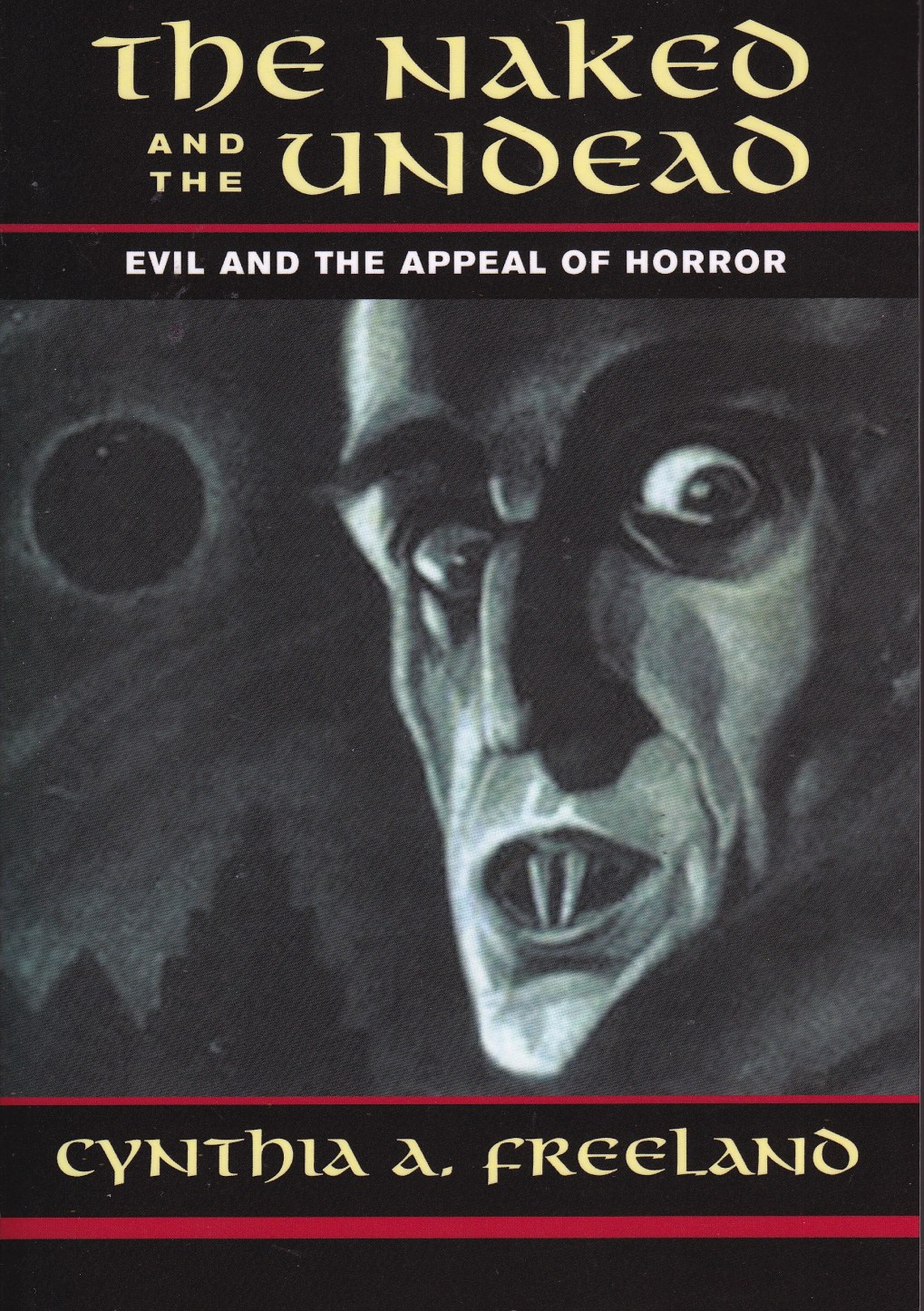
joneshorrorI don’t make New Year’s resolutions. To my way of thinking, if I’m aware I’m doing something wrong, I try to change it at that point, rather than waiting. Needless to say, then, I’m up to my old habits of reading about horror movies. Actually, Darryl Jones’ Horror: A Thematic History in Fiction and Film goes a bit broader than just the cinema. As the subtitle indicates, this charming book also addresses narrative fiction as well and the result is quite engaging. Divided thematically, Jones considers the various types of horror without delving into pretentious theorists to give him academic credibility. Here is a true fan who’s capable to sharing the excitement of the genre. Along the way, accompanying the usual observation that horror and religion share considerable conceptual space, he makes the point that in movies horror is one genre that makes use of academics as characters of authority. Sure, there are others, but in this realm to be educated is a benefit, whether the plan is to take over the world or to stop some evil force from doing the same.

I’ve been watching movies that can be broadly classified as horror since I was young. And I had admired—emulated to some extent—the professors and scientists I saw in those presentations. When a monster was on the loose, you went to find an expert to learn what to do. At the risk of contradicting myself, theorists have been suggesting that one of the problems with post-truth is the death of expertise. Anyone can be an expert these days. The question, “Why should I listen to you?” is on every self-appointed smarty’s lips. Earning a doctorate, the horror world tells us, gives you access to some kinds of knowledge that others don’t have. Problem is, zombies don’t respect such learning. They only want brains to consume.

It never seemed to me that watching horror was a means of learning. As a kid escapism is part of everyday life—taking things seriously is for adults. Growing up, however, I kept my love of scary movies in reserve. Little did I realize that it was a form of training. Now university-affiliated academics are finally able to begin admitting that they find monsters compelling. More than that, they actually learn something from them. Although not a resolution, I see myself reading further books about horror movies this year. It may be a naive hope, but it would be wonderful if they were all as insightful as this one has been.


Saint Charles

Honestly, I’m not sure where the idea of votive candles started. An educated guess—which will have to do in my state of limited research time—is that candles, like oil lamps, began as a practical necessity in places of worship. Temples, churches, synagogues, mosques—these tended to be large rooms and sometimes featured stained glass in their windows. Even if they didn’t, sometimes people want to pray after dark. Especially after dark. In the days before electricity, a lamp or candle was an obvious choice. Over time the practice of lighting votive candles developed. Lighting a candle for someone, living or dead, symbolized saying a prayer for them. The idea is much more common in liturgical branches of Christianity than it is in strongly reformed ones. Still, it’s a comforting idea. The few times that I’ve lit a candle for someone I’ve always felt better for having done so.

img_3125

Whenever a practice becomes sacred, parody is shortly to follow. As human beings we seem to be inherently aware that we take ourselves far too seriously far too much of the time. When I go to the grocery store—usually in the aisle with the more “Catholic” ethnic foods—I glance at the large, painted votives for sale. Secretly I’m hoping I might spot one for Santa Muerte, but this far north and east of the border that’s unlikely. Our own version of Saint Death is about to take office anyway. I was pleasantly surprised, therefore, to find a Charles Darwin votive candle in my stocking this past month. Intended, of course, as a novelty, there’s nevertheless something a bit profound here. What we’re praying for is the continuity of life. Evolution itself is under threat of post-truth science which is soon to receive official sponsorship. Time to light a candle and hope for the best.

I plan to keep my Darwin candle for emergencies. The idea isn’t that the figure on the candle is a deity. Those painted on the candle are the saints who have some influence in the divine hierarchy of this cold universe. When you light a candle you ask that saint to witness your prayer. I sense that many among my own political party have recently rediscovered how to pray. The beauty of a Darwin votive is that it’s non-denominational. We all evolve, whether we admit it or not. So if you can’t get yourself to a church, synagogue, or mosque on the traditional day of worship, Darwin can shed light at any time. And maybe even support a prayer for light in the coming darkness.


Wild Things

islanddrmoreauLast year my wife suggested we each do a reading challenge for the year. The one we selected was Modern Mrs. Darcy’s, which, with only a dozen books, seemed doable. What makes it a challenge is that to meet Mrs. Darcy’s expectations, you have to read certain types of books, not just go through the stack beside your favorite chair than never seems to get any smaller. I finished the challenge in October or November and posted on most of the books on this blog. This year’s challenge includes a book you’ve read before. Since I’ve been reading about horror movies I decided to reach back to childhood and once again read H. G. Wells’ The Island of Dr. Moreau. It was a timely choice.

For anyone not familiar with it, the story concerns a mad scientist (Moreau) who experiments on animals, making them “men” on an isolated island in the Pacific. These creations aren’t fully human and most of them are blends of different animals as well as part human. They can talk, and they can reason, in a rudimentary way. To create them without anesthesia, Dr. Moreau subjects them to tremendous pain and to prevent them from attacking him, he establishes a basic religion where they obey his rules or he will subject them once again to the “House of Pain.” The narrator, victim of a shipwreck, ends up on the island and has to come to an uneasy peace amid these very strange circumstances. The heart of the book is the chapter where Moreau explains what he’s doing and to justify it he makes a secular theodicy. He is, after all, god to these poor creatures. The book has been made into a horror movie or two over the years, but I’ve never seen any of the cinematic treatments.

What struck me as particularly interesting, revisiting this book some forty years after I last read it, was how easily Wells slips into theological thinking. This is a book unafraid of implicating the Almighty in the troubles of an island that clearly stands in for the world. I wouldn’t have noticed that as a tween. I don’t think there even were tweens when I was one. In any case, the story ends in chaos, rather than creation. What makes it such a timely choice? I suppose the arrogance and entitlement of Dr. Moreau suggested themselves as analogues to our current situation here in the US. Only Moreau is clearly intelligent as well as deranged. This little book is a cautionary tale of what happens when a strong will has its way, unimpeded. It might be a good time for all of us to pick up a copy.


What Democrats Don’t Understand

Human evolution (while it still legally exists) tells us a considerable amount about belief. Brain science (while we still have it) has long indicated that our noggins evolved to help us survive, not “to figure out” the world. Along its long and torturous path to modernity, the human brain has developed the ability to believe what it knows not to be true. This doesn’t just apply to the study of religions, but, in reality, primarily to psychology. Patients with split brains have shown a mastery of rationalization that should make any Republican jealous. So far the Dems are with me. What Democrats don’t understand is that you can’t change beliefs with reason. I grew up a Fundamentalist. That past still continually haunts me. What brought me out of it wasn’t thinking. It was experiencing. Specifically, experiencing in the course of education.

Recent polls show that well over 50 percent of Republicans believe Trump won the popular vote as well as the electoral vote. You could show this 50 percent as many statistics as you like and you won’t be able to convince them. Belief doesn’t work that way. In my experience, higher education (typically characterized as liberal) doesn’t really care about understanding belief. They hire professors recommended by establishment friends, very much like cabinet posts are now being filled. They still believe if you talk at someone long enough with reason, they will change their minds. I can’t change that belief of theirs—I have an idea how belief functions. We’ve all seen how the system works. Not every 1930s German was a Nazi.

In other words, it is very easy to believe a lie is the truth. In the words of Jim Steinman, “everything’s a lie and that’s a fact.” Education may help you spot the contradiction there, but it won’t help you unbelieve it. The truth is power can’t be taken, it must be given. If people do not believe what the media tells them, it isn’t true. As someone who’s spend a half-century trying to figure this out, I’m always amazed that my own party can’t see what’s so obvious to a reformed Fundamentalist. Until the day comes when avowed rationalists admit that emotions matter just as much as orthodox reason we will all be at a loss to explain how otherwise intelligent people will insist that what they know to be lies are indeed the truth.

Source: Lbeaumont based on image by Mila / Brocken Inaglory, Wikimedia Commons

Source: Lbeaumont based on image by Mila / Brocken Inaglory, Wikimedia Commons


Whose Story?

nikolaos_gyzis_-_%ce%b7istoria

What really happened? I grew up thinking that reading history gave the answer to that question. In fact, it is a viewpoint that I still struggle against. You see, historians try to marshal as many facts as they can to support their reconstruction of events in the past. Somethings, clearly, “really happened.” What those things are, however, depends on your point of view. For example we know that the twentieth century was dominated by wars and economic crises. Apart from a few periods when things seemed largely okay, it was a century of leapfrogging crisis after crisis. Historians pick a set of circumstances in this mix—let’s say the Second World War—and try to explain what led to certain results. But what if we stop to think about such events from another point of view? What if we think about it from the perspective that “nations” are purely fictional inventions? Who wins such a conflict?

This is more than an idle thought-experiment. We, as people, base our self-perception on how we view our personal histories. It can be quite jarring to have someone contradict our own personal narrative of “what really happened.” I’ve run into that from time to time—my reconstruction of events is not the same as someone else’s reconstruction. Who’s right? There’s no objective history. There are only events viewed from multiple angles. Turn the clock back a few centuries—was Jesus of Nazareth a political criminal (the Roman point of view), or a great sage out to save the world (a Christian point of view)? And these are only two out of many possible views of a political execution.

As we enter an era of post-truth politics, we’re going to find more and more historical events questioned. Facts have lost the anchoring functions they used to have. Historians built narratives by stepping from fact to fact, like using a series of stones to cross a river. They can’t tell us what really happened, but they can make sense out of an otherwise confusing stream of chaotic events. The thing about history, however, is that you have to read it to understand. Certain things we’ve pretty much all come to agree upon are now being questioned by those who see everything through the lens of capitalism. Money changes history. It is a narrative of great power as long as everyone agrees it’s true. What really happened? I think we may have all been too quick to accept what economists have told us and we have fabricated a fictional story that we can all believe.