Pointing to the Moon

The failure of India’s  Chandrayaan 2 to maintain contact, intended to make India the fourth nation to successfully conduct a lunar landing, sent me reading about the moon.  I remember the first manned landing, which happened when I was six, so the idea that we could make it that far seemed less impressive than it really is, I suppose.  I was fascinated by early space travel, and part of this may have been because of the moment of silence announced in school the day Apollo 13 safely returned to earth after the oxygen tank explosion that made its landing impossible.  As I was reading about the many moon missions that took place before I was born, I was surprised to learn how many nations are still attempting to reach our nearest neighbor.  This year alone China, Israel, and India have all attempted to land up there.

Israel’s mission called its lunar lander Beresheet.  It was the first attempt to land the Bible on the moon.  Beresheet is the Hebrew title of Genesis.  The US missions were named Pioneer, Ranger, Surveyor, and Apollo.  Ironically for the persistently religious nation, our only supernatural title was the name of a Greek deity.  Israel was true to its roots with its naming convention, but there is kind of a paradox involved.  In the world of the Bible the earth is the center of the universe and the moon is a quasi-living being circling about our stationary fix in this fictional view of the cosmos.  That’s not to say our own views may not some day be regarded as fictional as well, but simply that we now know the view in Genesis is incorrect.

Of course, the word “genesis” can mean a purely secular beginning as well.  It is a compound word that is often translated as “in the beginning.”  As such, it is appropriate for the first attempt at a moon landing, or any other great venture.  Still, it is instantly recognizable as the first word in the Bible, indicating a kind of strange juxtaposition where the biblical moon—which is not the same as the astronomical moon—are brought together.  Unlike the book of Genesis, the moon has been reached many times by others before.  The old and the new meet in this attempt to reach into space.  Meanwhile our problems continue down here.  Maybe that’s why we continue to attempt to reach the heavens.  And in that sense, no better title applies than that of the book that somehow defies rational explanation.


Good Monster

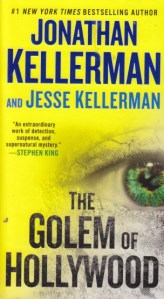
The little free library is a great idea.  Just after our move last year we contributed to our local many times as we discovered duplicates in the process of packing.  On one such venture, I discovered a book I wanted to read.  Not that I’d heard of it before, but any book with “golem” in the title catches my eye.  For the first (and so far only) time, I took a book.  Jonathan and Jesse Kellerman’s The Golem of Hollywood proved a fairly quick read for being over 600 pages.  I believe the industry term is “potboiler,” but it’s also a page-turner.  Nevertheless, it made me think.  The story follows a hard-bitten Jewish detective in Los Angeles.  Struggling with personal issues, he gets assigned to a bizarre homicide case that eventually takes him to Prague and Oxford, and then back to LA to clinch it.  And the killer is a golem.  (That’s not a spoiler, since it’s right there in the title.)

Parallel to the modern-day crime drama is the retelling of the biblical tale of the first days of humanity outside the Garden of Eden.  One of Adam and Eve’s daughters is headstrong and beautiful and when the tragedy between her brothers plays out she eventually takes her revenge on Cain.  Although not explicit about it, for violating the mark of Cain she witnesses the horrors that people will visit upon one another and her redemption is to become the soul that animates the golem of Prague.  Not your garden variety golem, she can transform into different shapes, and she stays loyal to the family of Rabbi Judah Loew ben Bezalel, the legendary first creator of the golem of Prague.

One of the frequent topics raised on this blog is how the Bible appears in everyday life, often unnoticed.  This novel is an example of that.  A further point, which is what stands behind my book Holy Horror, is that the Good Book is understood as mediated by popular culture.  Even those few biblical scholars who make it into the limelight can’t compete with the myriad representations of Scripture in the entertainment media.  Like The Golem of Hollywood, Holy Horror sees the Bible in the context of monsters.  Horror is an outsider genre.  Despite the many intelligent, thought-provoking exemplars extant, the default among the more refined is to see horror as something base and low.  It can also be a lot of fun.  Perhaps not great literature, The Golem of Hollywood is entertaining even as it underscores the continuing influence of the Good Book. 


Evolving Tales

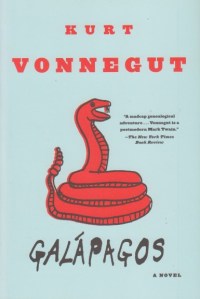
There’s nothing like a six-and-a-half hour flight to get some reading done.  I’d made good progress on Kurt Vonnegut’s Galápagos before leaving for England, but the plane ride gave me time to finish it.  While nobody, I think, can really claim to understand Vonnegut, there are clearly some trends in this novel that demonstrate his struggle with religion.  There may be some spoilers here, so if you’ve been saving this book for later you might want to wait before reading the rest of this.

As the title suggests, it’s a story about evolution.  Charles Darwin had his first divine epiphanies about evolution while visiting the Galapagos during his voyage on the Beagle.  Land creatures isolated from others of their species adapted to the environment in which they found themselves, and over eons passed on useful traits to their progeny.  If humans only had as much foresight!

With his trademark cast of quirky characters about to set out on a cruise from Equador to the Galapagos, Vonnegut has war break out.  Riots and pillaging take place.  Vonnegut takes broad aims at capitalism and business-oriented thinking, and how these represent the devolution of our species.  Of course, being Vonnegut, he does it with wit and verve.  Vonnegut was a writer not afraid to use the Bible in many ways, including what experts would call misuse.  As the surviving passengers make their way onto the stripped, but functional ship, he notes that they are like a new Noah’s ark.  They end up populating Galapagos with humans that evolve a million years into the future.

A thought that caught me along the way was a line where he wrote that in the long history of David and Goliath conflicts, Goliaths never win.  This kind of sentiment could do the world some real good right now.  In fact, although the book was written decades ago, one of the characters, Andrew MacIntosh, reads very much like a foreshadowing of 2016, down to the descriptions of how he regularly mistreats others.  In Galápagos MacIntosh gets killed during a rebellion, showing that grime doesn’t pay.  The cruise goes on without him.  Galápagos is a book that points out the evils that our system encourages, or even necessitates.  There can be another way.  The survivors land on the barren islands and set about adapting because they have no other choice.  A more egalitarian scenario evolves largely because females are in mostly charge.  While not intended as an actual solution to social ills, Galápagos is nevertheless not a bad guide, especially when shipwreck seems inevitable.


Built To Last

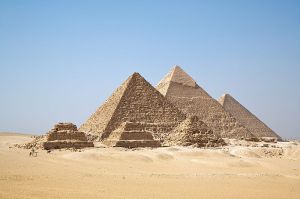
Those pyramids sure are sturdy.  The other day I was reading something from a biblical literalist that was discussing the pyramids.  The great pyramid of Khufu and its companions in Giza were built between about 2590 and 2505 BCE.  They’ve been around a long time.  Somewhat later this author casually mentioned Noah’s flood.  It had never occurred to me before, but since Archbishop Ussher dated the creation of the world at 4004 (and so it appears in the Scofield Reference Bible), the flood took place in 2348 BCE.  Now this flood was so catastrophic that it carved out the Grand Canyon and buried all those dinosaur bones that would eventually become fossils.  It was more than a little inconvenient, and terribly disruptive.  Except the pyramids had been around for well over a hundred years by that point.  It’s a wonder they weren’t harmed.

Such inconsistencies populate much of literalist literature.  When the Bible is the full measure of science and history and all human knowledge, there’s bound to be some issues, given that it was written at a specific time and place.  You see, the pyramids aren’t even held together with mortar.  These are loose stones we’re talking about, under great pressure.  The “Bent Pyramid,” at Dahshur, changed its angle at half-way up.  A physicist calculated that if they’d continued at the original angle, the weight of all that stone would’ve caused it to act like liquid, flowing like water.  Best repent and rethink your plan.  But these monuments were built to withstand world-wide floods!  And the mummies weren’t even mildewed.  If only Jericho’s walls had been so well built.

From WikiCommons

Maybe that’s why so many modern myths about the pyramids developed.  This sacred shape somewhere between a square and a triangle is said to have unusual properties.  I’ve read that if you put a dull razor (whatever that is) underneath a pyramid shape when you go to bed at night you’ll awaken to find it sharpened.  Made of wire, that shape on your head will not only prevent aliens from reading your thoughts, but will boost the power of your psyche as well.  The funny thing about the Bible is that it never mentions the pyramids at all.  Joseph spent a bit of time there and his descendants stayed for centuries.  Nobody bothered to note those wonders of the ancient world.  Since we’re literalists, though, that gives us a way out.  If the Bible doesn’t mention the pyramids they might not exist at all.  Problem solved.


Identified or Not

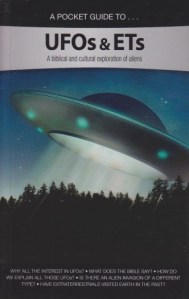
Okay, so this will require some explanation.  It came about like this: I was in a used bookstore.  (This in itself requires no explanation, of course.)  I noticed a slim book, cover out, called A Pocket Guide to UFO’s and ETs: A biblical and cultural exploration of aliens.  Biblical?  I picked it up only to discover it was from Answers in Genesis.  Please note: I do not buy books or paraphernalia of Fundamentalist groups unless I can get it used.  I don’t want to support this particular weirdness in any way.  Well, the money for this used book was going to support a used bookstore and not a religious aberration, so I figured it would be good to see what the Fundies have to say about a topic that seems to have started to engage public interest again.

The book begins by helpfully pointing out that if there’s life on other planets the Bible doesn’t mention it.  And since the only way it could’ve got there is by evolution—for surely the Almighty would’ve said something about it in his book, if he’d invented it—the whole idea is a non-starter.  Evolution, as everyone knows, is a satanic idea meant primarily to challenge the Bible and secondarily explain the diversity of life forms on earth.  And since earth is the only planet the Bible recognizes, it is the only one with life.  So, UFOs, it stands to reason don’t exist.  Well, that’s not quite fair.  They do exist but most can be explained away and those that can’t may well be demonic.  Since there can be no aliens, and since some sightings can’t be otherwise explained, then demons—which the Bible does mention—must be responsible.  They (demons) can also explain why other world religions exist.

There’s plenty in here to offend just about everyone apart from the Answers in Genesis crowd.  The screed spends quite a bit of time knocking down ancient astronaut ideas, and taking Erich von Däniken to task.  Science is useful in explaining how pyramids were built, but not in how the rock used to build them was formed (it takes far too long to make limestone the old fashioned way; God simply used a variety of different rock types to make the one inhabited planet more interesting geologically).  And those UFO religions?  Inspired by demons, no doubt.  In fact, even reading a little book like this could lead you to become interested in the subject, so be careful!  In fact, the safest thing of all (and I’ve only got your well-being in mind) is to leave it on the shelf.


Evil Origins

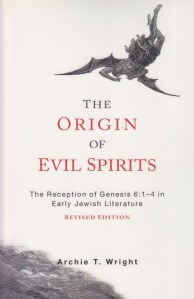
I remember well the eerie, uncanny feeling I had as a child reading Genesis 6.1-4.  This wasn’t a story we heard in Sunday School, and it wasn’t in any children’s Bible or Arch Books.  It was mysterious and strange, and not understanding what sex was made it even weirder.  The sons of God, or perhaps angels, came down from Heaven to mate with human women.  Although not stated directly, their offspring seem to have been giants.  Abruptly the story ends.  Archie T. Wright was clearly fascinated by this story as well.  His book, The Origin of Evil Spirits: The Reception of Genesis 6:1-4 in Early Jewish Literature, isn’t so much about demons as it is about the influence of this very brief, extremely odd story.

As a young person I knew about the book 1 Enoch.  Living in a rural town with no bookstore and no library (there was one in the town three miles away, but I didn’t drive and out-of-towners had to pay for a card), I had no way to read it.  Wright writes quite a bit about it here.  (In case you’re wondering, yes, in subsequent years I did read it.)  His history of transmission is a little suspect, but he explores the impact of these four brief verses on what can perhaps best be described as a diegesis.  This universe includes Watchers (the first part of 1 Enoch is called The Book of the Watchers), archangels, angels, evil spirits, giants, and demons.  Later Judaism moved away from this world, while early Christianity grew fascinated with it.  The mythology that emerged from it is sprawling and quite bizarre.  All encapsulated in a few verses before the flood.

Wright’s book is academic; it’s a revised dissertation.  Still, it’s a source more credible than a lot of what you find on the internet.  This particular biblical episode is an example of what happens when you don’t explain enough.  Granted, the writer likely had no idea that this brief account—shorter than a blog post—would eventually make it into a book that some people would consider from the anthropomorphic mouth of God himself, but because of this brevity questions, like angels, hung in the air.  As Wright shows, these verses were incorporated into ways of explaining the existence of evil in the world.  It was known by many names, and even took on personification in the form of Satan and his ilk.  This is a world of the unexpected, and it readily took me back to a childhood of wonder concerning the inexplicable passages in the Good Book.


Thunder Towers

It sounded like brontide.  The Martin Tower, the tallest in the Lehigh Valley and once corporate center for Bethlehem Steel came down yesterday morning.  Completed only in 1972, the following decade saw the collapse of the steel industry, and the building has sat vacant a dozen years.  Now it’s gone.  The reasons the building could no longer stand are many and I won’t try to explain them as if I understood.  The fall of the tower, however, put me in mind of human folly and the belief that corporate profits will only ever grow.  Capitalism is built on a set of myths that the wealthy truly believe—I suspect many others do too, otherwise the system couldn’t possibly last.  Adam Smith may have been right academically, but in reality humans are greedy, venal, and shortsighted.   At least those who “rise to the top” are.

We didn’t move to the Valley for the steel.  Having settled in New Jersey just about when the Martin Tower was abandoned, like many other displaced academics I was looking for a job.  There were cities in the Midwest—we weren’t far from Milwaukee or Madison—but there was no work.  If you’re “overeducated” your best bet is to settle near a huge metropolitan area, as closely as you can afford to.  Then hang out your shingle.  Capitalism, however, has made New Jersey affordable only for the excessively wealthy.  Besides, I was born within the imaginary lines that we call the Commonwealth of Pennsylvania.  In fact, when I got my license transferred last year the computer asked me if I still lived in Venango County, where I was born.

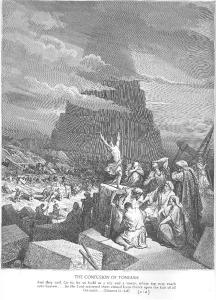
I didn’t see the tower come down.  It’s not visible from my house, but it was always right there when I drove to Lowes to pick up some necessary hardware to survive in this area.  (Weed-whacker and lawnmower—reel variety.)  My mythology of towers always takes me back to Babel.  In the biblical worldview towers were a sign of arrogance.  God seemed to think they were trying to invade divine turf, and so he made it so we could no longer understand one another.  There hasn’t been a moment’s peace since.  We build towers tall to show what we can do.  We don’t really need an angry deity to come down and confuse our language any more.  We’ve got capitalists and their excess money to lead the way.  The sound of thunder roared and I divined just where such leadership will guide us.


Terror Text

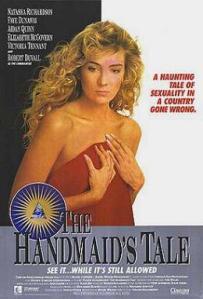
Dystopia reading and/or watching may be more practical than it seems.  History often reveals authors who may be accused of pessimism more as prophets than mere anxious antagonists.  Two books, according to the media, took off after November 2016.  One was George Orwell’s 1984,  and the other was Margaret Atwood’s The Handmaid’s Tale.  I’d read both long before I started this blog, but I recently asked my wife if she’d be interested in seeing the movie of the latter.  While teaching at Rutgers, I had a 4-hour intensive course and to give students a break from my lecturing I’d have us discuss Bible scenes from secular movies.  The Handmaid’s Tale was one of them.  Watching it again last night, I realized the problematic nature of Holy Writ.

The Handmaid’s Tale is a movie (and novel) that involves what I call “Bible abuse” in Holy Horror.  That is to say, the Bible can be used to oppress rather than to liberate.  To cause human suffering instead of eliminating it.  Sure, to make Atwood’s dystopia work a future catastrophe of fertility has to occur, but the military state, the assumed superiority, and the will to control on the part of men are all too real.  We’ve witnessed this in the United States government over the past two years.  A lot more has been revealed than personal greed—that side of human nature that quotes the Good Book while doing the bad thing.  In the movie it’s literally so, while our “leaders” are only a metaphoric step away from it.  Although it’s not horror, it’s a terrifying movie.  I still have trouble watching The Stepford Wives.  Why is equality so easy in the abstract, but so difficult when it comes to actual life?

Aggression is not a social value.  This is perhaps the most ironic aspect of using Scripture to enforce oppressive regimes.  The whole point of the New Testament is self-denial for the sake of others.  That may be why the only Bible reading in the movie comes from the Hebrew Bible, the story of Jacob and Rachel.  Although this isn’t one of the traditional “texts of terror,” to borrow Phyllis Trible’s phrase, it nevertheless illustrates the point well.  A culture that values women only for their reproductive capacities is dystopian to its very core.  When a book, no matter how holy, is divorced from its context it becomes a deadly weapon of blunt force.  Atwood moves beyond Orwell here—the government that sees itself as biblical can be far more insidious that one that only weighs evil on the secular scale.  Not only the Bible ends up being abused.


Evolving Intelligence

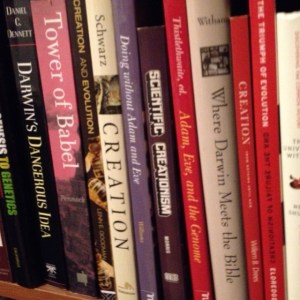
In the process of unpacking books, it became clear that evolution has been a large part of my life.  More sophisticated colleagues might wonder why anyone would be concerned about an issue that biblical scholars long ago dismissed as passé.  Genesis 1–11 is a set of myths, many of which have clear parallels in the world of ancient West Asia.  Why even bother asking whether creationism has any merit?  I pondered this as I unpacked the many books on Genesis I’d bought and read while teaching.  Why this intense interest in this particular story?  It goes back, no doubt, to the same roots that stop me in my tracks whenever I see a fossil.  The reason I pause to think whenever I see a dinosaur represented in a museum or movie.  When a “caveman” suggests a rather lowbrow version of Adam and Eve.  When I read about the Big Bang.

The fact is evolution was the first solid evidence that the Bible isn’t literally true.  That time comes in every intelligent life (at least among those raised reading the Good Book).  You realize, with a horrific shock, that what you’d been told all along was a back-filled fabrication that was meant to save the reputation of book written before the advent of science.  The Bible, as the study of said book clearly reveals, is not what the Fundamentalists say it is.  Although all of modern scientific medicine is based on the fact of evolution, many who benefit from said medicine deny the very truth behind it.  Evolution, since 1859, has been the ditch in which Fundies are willing to die.  For this reason, perhaps, I took a very early interest in Genesis.

Back in my teaching days it was my intention to write a book on this.  I’d read quite a lot on both Genesis and evolution.  I read science voraciously.  I taught courses on it.  I’d carefully preserved childhood books declaring the evils of evolution.  To this day Genesis can stop me cold and I will begin to think over the implications.  When we teach children that the Bible is a scientific record, we’re doing a disservice to both religion and society.  This false thinking can take a lifetime to overcome, and even then doubts will remain.  Such is the power of magical thinking.  I keep my books on Genesis, although the classroom is rare to me these days.  I do it because it is part of my life.  And I wonder if it is something I’ll ever be able to outgrow.


Pleasant Dreams

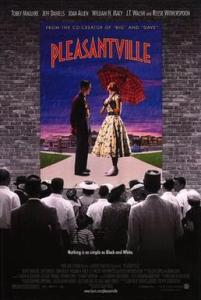
The last time I watched Pleasantville I didn’t have this blog running to discuss it.  It was also during the Obama administration where it felt more like nostalgia rather than a documentary.  In case you’re not familiar, Pleasantville is a movie about how a nerdy teen, David, and his cool sister Jennifer get sucked into a 1950’s sitcom, “Pleasantville.”  They find themselves in black-and-white and in a world as regimented as Stepford, but somewhat more humorously so.  As Jennifer is eager to get back home, she introduces this colorless world to sex, and as the two-dimensional characters begin to experience strong emotions colors start to appear.  The “picture perfect” Pleasantville begins to let the plastic facade of the 1950s slip to reveal a complex and messy world of true humanity beneath.

Watching the film in the age of Trump, as with most things, interjected a current of fear.  The townspeople feel threatened by those who are different, colorful.  They want everything just as it was—women serving their husbands, everyone the same hue, and pretending that sexuality doesn’t exist.  It may have been originally intended as an homage to the the 1960s, but what became clear in an age of MAGA is that crowds easily respond to suggestions of hatred.  Many of those in the group, individually, are “coloreds” themselves, but fear to let it show.  Conformity is much safer even if it means hating those who are different.  I wasn’t alive in the 1950s, but the superiority of the white man apparently was.  One of the characters is, tellingly, named Whitey.

Initially drawn to the film seeking biblical references (occupational hazard) I knew there was an Eden scene before I first watched it.  Margaret, on whom David has a crush, has discovered actual fruit at Lover’s Lane.  She brings him an apple which, the TV Repairman (if you’re lost, please watch the movie—it’s quite enjoyable) points out, is a form of sin in this world of simple answers and unspoken repression.  A mash-up of Jasper Fforde and American Graffiti, the film exposes the lie behind the idea that all were put on earth to serve the white man.  Jennifer discovers books and stays behind in colorized Pleasantville to go to college, something of a rarity in those days.  Although the movie bombed at the box office, it has a serious message to convey.  There was no perfect 1950s iconic America.  The process of becoming great is one of evolution, rather than that of a fabled Eden, available only in black-and-white.


Righteous City

I’m a stomach sleeper, if that’s not TMI.  This began many years ago when I realized that upon awaking from nightmares I was always on my back.  I started doing what I knew was dangerous to infants, safe since I haven’t been part of that demographic for decades.  Terrazzo isn’t one of my favorite sleeping surfaces, however, and on my back on the floor of Newark’s Liberty Airport I realized I couldn’t roll over, for many reasons.  My glasses, for one thing, were in the internal pocket of my Harris Tweed.  For another, on one’s stomach one’s wallet is exposed in a way that’s maybe too inviting.  Before suggesting I could’ve placed my wallet and glasses elsewhere, let me write in my own defense that rationality isn’t my strong suit after midnight.

The night before

I found a spot next to a set of escalators where the constant thrumming alternately kept me awake and soothed me to nod.  I heard many languages spoken as I drifted in and out of consciousness for the few hours I had to wait for dawn.  And nobody disturbed me.  This is rather remarkable—a person asleep is a vulnerable being.  Doing it out in public with no private walls was a new experience for me.  I don’t sleep on planes, buses, or trains.  Or, until two days ago, airports.  It brought to mind the biblical world.  A town was considered a righteous place if a stranger could sleep unmolested in a public place.  The traveller—please take note, United—was in need of special consideration.  My situation revealed something unexpected about Newark Airport.

The morning after

It was full of angry, frustrated people.  I opened my eyes at five a.m. to find a very long line snaking down the corridor behind me—a queue that had been there when I first drifted off.  These were people trying to reschedule flights since United couldn’t bump that day’s passengers because they’d decided not to fly out the night before.  Despite the weariness and intensity of emotions, there was very little bad behavior.  We were biblical strangers, mostly in the same circumstances.  No creature comforts, no privacy.  An east Asian woman said the next morning that in her country the airline would’ve brought food, and blankets at least.  In the United States fiscal concerns reign supreme, however; do you know how much it would cost to care for all these stranded people?  When I opened my eyes the situation was about the same as when I closed them.  I couldn’t help noticing I awoke on my back.


Whose Canon Is This?

Being a Bibles editor, I suppose, is a rare kind of job these days.  The book that defined our culture now rests in the back seat under discarded fast food bags and covenants of a more modern kind.  Often it surprises me how little we really know about the Good Book.  When I was a teenager I discovered that Catholic Bibles had more books than the Protestant versions with which I’d grown up.  Had I been more attuned to historical issues at that point this surely would’ve raised a crisis.  Had we left out some sacred books?  That would seem to be a grave mistake.  As I was making my way through all the translations of the Bible you could find in a rural area in pre-internet days, I began to read the Apocrypha.

The title “Apocrypha” translates to “hidden” or “obscure.”  Martin Luther’s argument was that these books were never in the Bible recognized by the Jews (therefore, by extension, Jesus), and therefore should be left out.  My question upon reading them, as it was regarding just about any book, was “did this really happen?”  That was the acid test for a Fundamentalist youth.  If something really happened it was, by definition, true.  The implications of this for the books of the Protestant Bible only became clear later.  Scripture is more subtle than that.  So it is that I’ve been thinking about how we in Bible-land privilege the western canon.  Not only are the Deuterocanonical books called “Apocrypha,” we leave out the books of the Ethiopian Orthodox Tewahedo Church, despite its 45 million members.

The books of 1 Enoch and Jubilees are included in the Ethiopian canon, but they can be tricky to find even now in the wide world webbed together.  Western biblical scholars have begun to take strong interest in these books, but the days are long passed when scholars could determine the content of the Bible.  The Good Book has taken on a life of its own that no amount of scholarship can challenge.  Minds have already been made up and tightly closed, even as we continue to gain information on ancient contexts and the massive collection of writings that never made it into anyone’s Bible.  Fundamentalism, so very certain of itself, has defined a circumscribed Bible to which nothing may be added or taken away.  Even as John of Patmos wrote that admonition, however, the Bible recognized by early Christians was growing.  And, ironically, some even left out his book.  Such matter remain hidden indeed.


Read, Mark and

One of the persistent questions of Christianity, given that there are four Gospels, is how to account for the differences between them.  The issue isn’t unique to Jesus-followers, however, as the composition history of the “books of Moses” shows.  Discrepancies in Genesis got the whole ball rolling, after all.  In fact, once I learned about historical criticism I decided that I’d better stick to the Hebrew Bible—there are some things you just don’t want to know about your own faith.  The way doctoral programs are set up these days, you can’t specialize in both testaments anyway, although that’s becoming a lot more common among scholars in these latter days.  In any case, I was reading about the Gospel of Mark lately and the question kept coming up of whether certain phrases went back to Jesus, were coined by Mark, or had their origin in the early church.

The picture that emerges from this kind of jigsaw gospel is of Mark sitting down, pulling his sources together like a graduate student in the days before computers.  Only Mark won’t get a doctorate when he’s done.  More recent scholarship asks the question of what if Mark wasn’t really a completed book after all—we read the gospels through lenses that were ground in the eighteenth century, at the earliest.  Nobody thought to question that Moses or Mark would sit down to write a book just like anyone did then.  (People writing books on their phones in electronic form only, as they do these days, will play havoc with future historical critics and their theories.)  Maybe these weren’t meant to be finished books.  Check out Gospels before the Book by Matthew Larsen and you’ll see what I mean.

The Bible, in other words, is a very complex book.  We know little of its authors beyond Paul of Tarsus.  We don’t even know that they were setting out to write Holy Writ.  Bible is a matter of interpretation.  As I thought about Mark—whoever he was—shuffling his papers about, mulling over what it would mean to become the first evangelist, I thought how like us we’ve made not only God, but also the writers of sacred texts.  True, they weren’t worried about tenure committees, or bad reviews, or being accepted by prestige presses.  It seems, however, that they were also not thinking of what readers down the millennia would do with their words.  When it’s all done we still don’t know who said what, but at least we have persistent questions that can’t be answered.  And job security ensures that Bible reading will continue as long as there are discrepancies to debate.


Getting Dirty

Composting is a very biblical activity.  Adam, according to the second creation account in Genesis, was formed from the divinely created dirt.  Some scholars try to capture the word-play in that story by suggesting “human” was made from “humus,” but since that sounds like chickpea dip it may not help so much after all.  Besides, we now know that soil has a complex and fascinating history.  Erosion grinds up rocks.  Organic matter dies and decays, forming the loosely packed substrate in which plants can survive, slowly breaking up the more dense pieces through the transformative power of water.  It is, imprecisely speaking, a miracle.  When Adam drops dead, he becomes once more part of the soil from which he was formed.  It’s poetic.  Elegant.  Economical.

Now that we have a house we’ve decided to try our hand at composting.  We’d considered it many times over the years since, what with recycling and hoarding, we’d managed to get our weekly garbage down to one fairly small bag.  Besides, since our government won’t be nice to the planet, somebody has to.  Institutional people that we are, my wife and I had to read up on composting before giving this very natural decomposition a try.  Things have to be just so for the process to work perfectly.  It was in the process of this reading that the biblical aspect became clear to me.  

The trick is to make sure the neighbors don’t complain about the smell.  That, in part, determines what can or can’t go into the compost bin.  Meat and dairy can’t go into the mix.  Since I’m primarily vegan such things aren’t generally here to be disposed of in any case.  Even the drier lint can go there, for the clothes that we wear become part of who we are, right Henry David?  And here’s where there’s a danger of TMI, although it’s good theology—cast-offs from our selves can also be composted.  Hair, for example.  The composting literature we have seems to take Adam himself out of the equation by specifying pet hair, but hey, mammals are mammals.  The longer I thought about this, the more obvious it was that burial, ideally, is a form of composting.  Giving back to the earth from which we’ve sprung.  That simple wire bin out by the garage is in the process of making the substrate for new life.  We may not be farmers, or gardeners like Adam, but composting feels like giving back somehow.  It’s an act of creation.


Financial Ethics

In a conversation with a professional colleague recently, I was discussing what might happen to ethics when sex with machines becomes common.  That statement might seem a little bizarre out of context, so let me widen the net a bit.  We were discussing the Bible and sexual ethics.  This led to the question of how those who apply the Bible straight from antiquity might apply their beliefs to a world vastly different than first century Palestine.  In biblical times, in other words, sexual options were limited and people didn’t understand the whole issue of human sperm and eggs, neither of which can be seen without a microscope.  Applying their outlook directly to today is problematic, and so how do we apply a book without outdated views to a world vastly more complicated?

Someone recently paid me a small debt via PayPal.  If sex is complicated, then let’s not even get started on Bitcoin or Apple Pay—for some of us money is money and even getting paid electronically is somewhat suspicious.  I sometimes buy things online with PayPal.  It goes straight onto one of my credit cards and then I write an old-fashioned check to pay for it.  So I had to approach the altar of PayPal itself to figure out what it meant to have money in my account.  What am I to do with it?  Then I found the FAQ—TFIA (The Future Is Acronyms).  One of the questions: “What is PayPal’s policy on transactions that involve sexually oriented goods and services?”  Now, here’s a question of biblical proportions.

Paying for sexual “goods and services” goes all the way back to the book of Genesis when none other than the ancestor of David and later progeny did so.  This is nothing new.  But the question of ethics now looms extra large.  For those who pay for such things, a new layer of complexity has apparently been added—can you pay with PayPal?  My transaction had to do with tickets purchased for a concert online, where we wanted seats together so someone had to do the buying for everyone.  What if the purchase had involved a somewhat more intimate setting?  Who needs paper or plastic when a string of 16-digits, or even a username and password, will do?  That’s to say nothing regarding the ethics of the transaction—this is, as it were, purely mechanical.  What would Moses say?  Surely this is a question of appropriate tips, for Tamar veiling herself by the side of the road had the moral high ground over her father-in-law who was simply looking for a good time.  A staff and seal, however, were no less complicated that paying for goods and services online.