Geeology

Some of my fondest memories of the Midwest, apart from living my teaching dream, involve rockhounding.  The other day I was out in the garage trying to locate my rock tumbler when I came across many carefully labeled boxes from our rockhounding trips.  Not all of these trips were local, nor were all of them solely rock-based.  For example, my family took a driving trip around Lake Superior.  This was back before a passport was required to cross the border.  Part of the trip involved driving up to Copper Harbor in Michigan’s Upper Peninsula to look for agates and, well, copper.  Then there was the time when we drove to Hannibal, Missouri to hunt for geodes.  The mine was closed because of excessive rain so a couple months later we drove down with some friends we knew from Michigan and tried again.  This time with success.

The great, unfortunately departed, bookstore manager at Nashotah House was a great conversation partner.  Once I was talking to her about rocks and I stopped and apologized, “I don’t know why I’m so interested in rocks.”  She said, “You’ve got curiosity.  If it wasn’t rocks it would be something else.”  I took that to be the compliment it was intended to be.  Not everyone at the seminary was curious and many were only interested in matters ecclesiastical.  One night a huge windstorm blew over a very large cedar tree that barely missed our house.  Before the week was out, I was outside standing in the hole left by its roots, poking around the glacial till for interesting rocks.  I continued doing this until the tree was removed and the hole filled in.  I’ve had other interests, bordering on obsessions, in my life, but the geological interest started early.

When I was a child my brothers and I would go down to French Creek in Franklin, under the 13th Street bridge and look for fossils.  I wondered how this could fit together with the story of the world being only 6,000 years old.  We knew from school that fossils were millions of years in the making.  One time my mother bought us, at a rummage sale, a small cardboard “rock collection.”  It had a few little pieces of non-gem quality gemstones glued to the bottom.  A couple of them had been previously pilfered.  I was fascinated that such colorful things just came out of the ground.  Planning on being a minister, I never studied geology in school.  To be fair, I don’t think Grove City even offered a geology major.  Years later, teaching in a seminary in the Midwest, my old fascination caught up with me again.  And it left many fond memories.


More Rocks

Another thing about rocks—I warned you!—is the matter of scale.  When I go out jogging, it’s on pea gravel.  Some of these tiny stones are interesting.  Or, if you’re the romantic type and gave or received an engagement ring, that diamond is likely not to be massive.  I’m always reminded of this when I go to a mall, say, which has a floor full of fossiliferous limestone.  I think of the hours I’ve spent poking around creek beds and cliff faces for fossils, and here, laid out for thousands of square feet, is polished flooring floating with fossils.  Or when I walk into a bank, say, and see a counter made of labradorite.  I carry a small labradorite piece in my pocket that my brother once gave me.  I love the way it catches the light and reflects a beautiful blue color back to me.  Here it is in massive form where I’m trying to make a modest withdrawal.

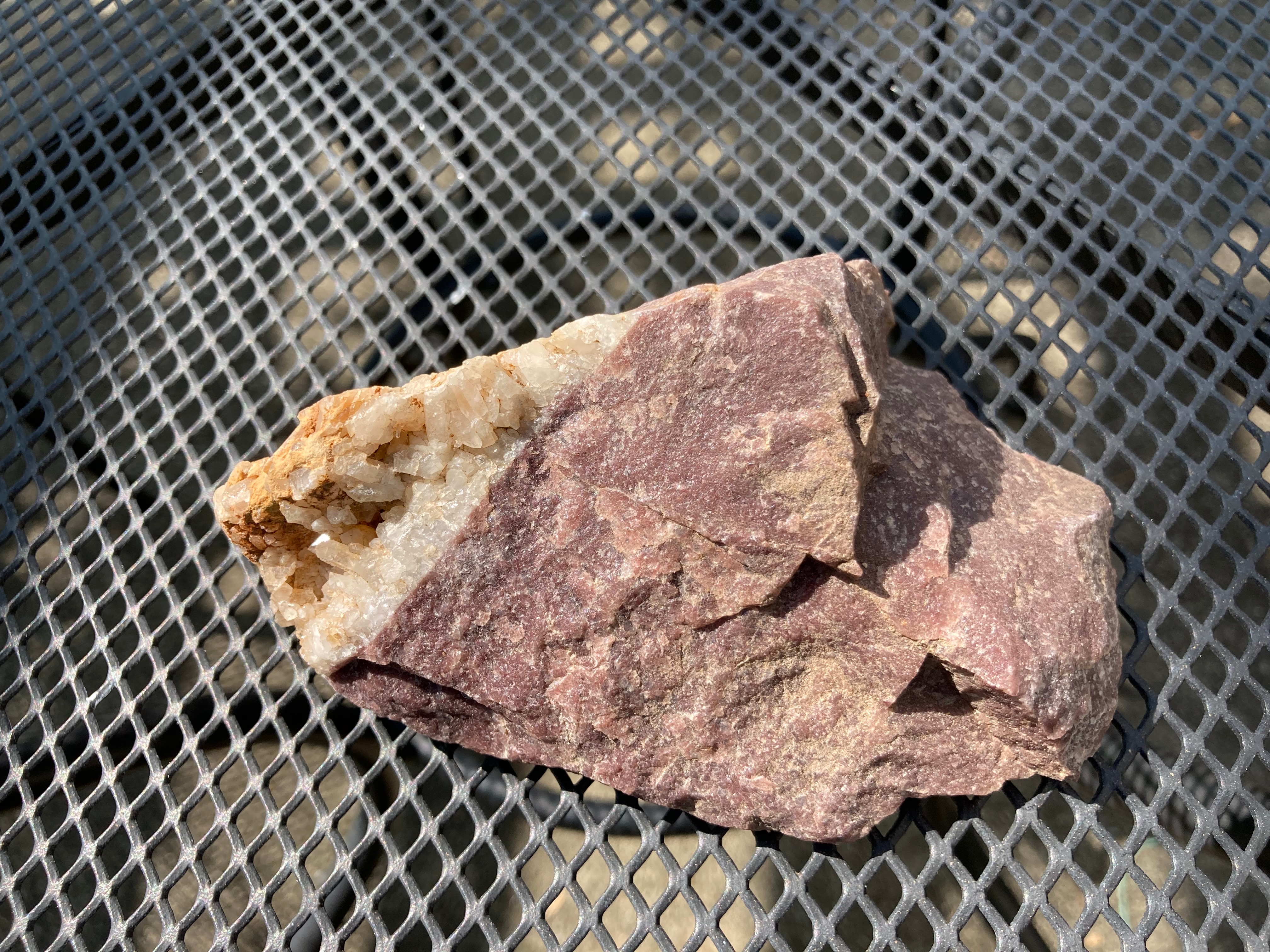
Once in Wisconsin we went to Devil’s Lake for the purple quartzite of the region.  If you look among the tumbles you can sometimes find clear quartz crystals.  I’ve noticed that on rockhound YouTube channels that collectors are chuffed to find nice, if small quartz crystals.  They’re collectable.  But they’re also small.  Size is one of the reasons for not letting rock collections grow too much.  I’ve tried my hand at making small sculptures out of significant rocks.  I can see some of them on the landing window ledge from where I’m sitting at the moment.  They’re small, but heavy, and if we ever move, will require careful wrapping.  I’m not even sure what kind of rock they’re made of.

Wisconsin quartzite with quartz crystals

Rock identification is hard work.  I have a Moh’s scale set.  A streak plate.  A hand loupe.  It’s hard to use the acid test (vinegar will do) because the pieces are so small.  Identification is often destructive.  This might not be an issue if I had a ton of similar rocks to dispose of.  No, but when you have just a handful, and these had to fit in your luggage along with your clothes, making TSA agents scratch their heads, you’re reluctant to damage them just to figure out what they are.  So identifying the small rocks I have is difficult.  Online forums tend to be unhelpful in this regard.  Not even the color can give you certain answers.  Once I collected some jasper in a creek.  I could identify it because a large boulder clearly had jasper intrusions and I could compare.  The piece I took home, of course, was quite small.  Small, however, does not mean insignificant.


Rocky Ground

When I begin to lose my sense of wonder, the natural world grounds me.  I’ve been an amateur rockhound for many years and I sometimes wonder if it’s because I grew up poor.  The idea that you can just pick up something valuable on the ground has a treasure-hunting aspect to it.  Movers, I’ve discovered, dislike rock collectors.  My collection is quite small, and most of it not on display.  The danger is that I’ll be wanting to pick up more interesting rocks.  Like much of nature, rocks are amazing if you look closely at them.  And when the mania hits, it takes all my attention.  We all know that gemstones tend to be small, but perhaps it’s the fact that they look very little like their finished state in the wild makes them intriguing.

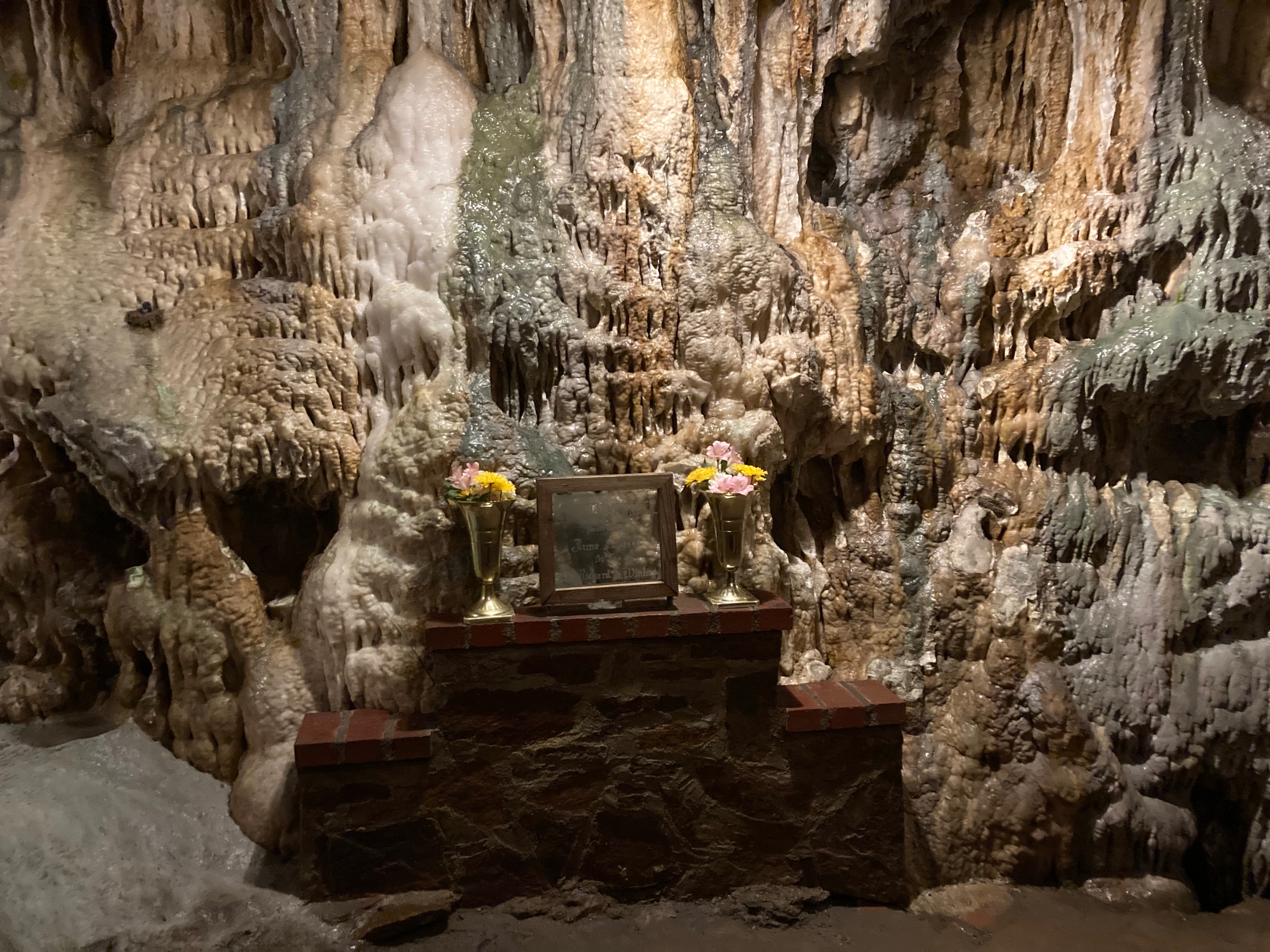
This interest was recently rekindled by a visit to the Lehigh Valley’s local cave, The Lost River Canyon.  As with most local attractions, it takes some time to get around to them.  We decided to go during the recent heat wave since caves maintain a constant temperature, generally in the fifties, and during the height of the wave the outside air temperature was double that of the cave thermometer.  Caves often have rock shops associated with them because being in a cave will trigger the rock-hounding gene.  And I suspect I’m not the only one to whom this happens.  Like many preserved caves, Lost River Canyon was an accidental discovery and was later purchased by a family that has been running it as a tourist attraction ever since.  I left inspired to find my rock tumbler and get it rolling again.

It’s difficult to say when or how such obsessions originate.  When my daughter was really into dinosaurs I started looking into geology.  The next thing I knew I was a member of the Wisconsin Geological Society and was going on field trips to collect.  When I lost my job at Nashotah House I seriously considered enrolling in a geology degree program, put off by the fact that calculus and chemistry were pre-requisites.  I was a hopeless humanities major and advanced math just doesn’t psit well in my psyche.  Part of me wonders if the fascination doesn’t go back to Genesis.  Geology was the science that tolled the death knell for any kind of literal six-day creation.  When this rock madness hits other interests can, if I’m not careful, be shunted aside.  It’s important to feel grounded.