
Another thing about rocks—I warned you!—is the matter of scale. When I go out jogging, it’s on pea gravel. Some of these tiny stones are interesting. Or, if you’re the romantic type and gave or received an engagement ring, that diamond is likely not to be massive. I’m always reminded of this when I go to a mall, say, which has a floor full of fossiliferous limestone. I think of the hours I’ve spent poking around creek beds and cliff faces for fossils, and here, laid out for thousands of square feet, is polished flooring floating with fossils. Or when I walk into a bank, say, and see a counter made of labradorite. I carry a small labradorite piece in my pocket that my brother once gave me. I love the way it catches the light and reflects a beautiful blue color back to me. Here it is in massive form where I’m trying to make a modest withdrawal.
Once in Wisconsin we went to Devil’s Lake for the purple quartzite of the region. If you look among the tumbles you can sometimes find clear quartz crystals. I’ve noticed that on rockhound YouTube channels that collectors are chuffed to find nice, if small quartz crystals. They’re collectable. But they’re also small. Size is one of the reasons for not letting rock collections grow too much. I’ve tried my hand at making small sculptures out of significant rocks. I can see some of them on the landing window ledge from where I’m sitting at the moment. They’re small, but heavy, and if we ever move, will require careful wrapping. I’m not even sure what kind of rock they’re made of.
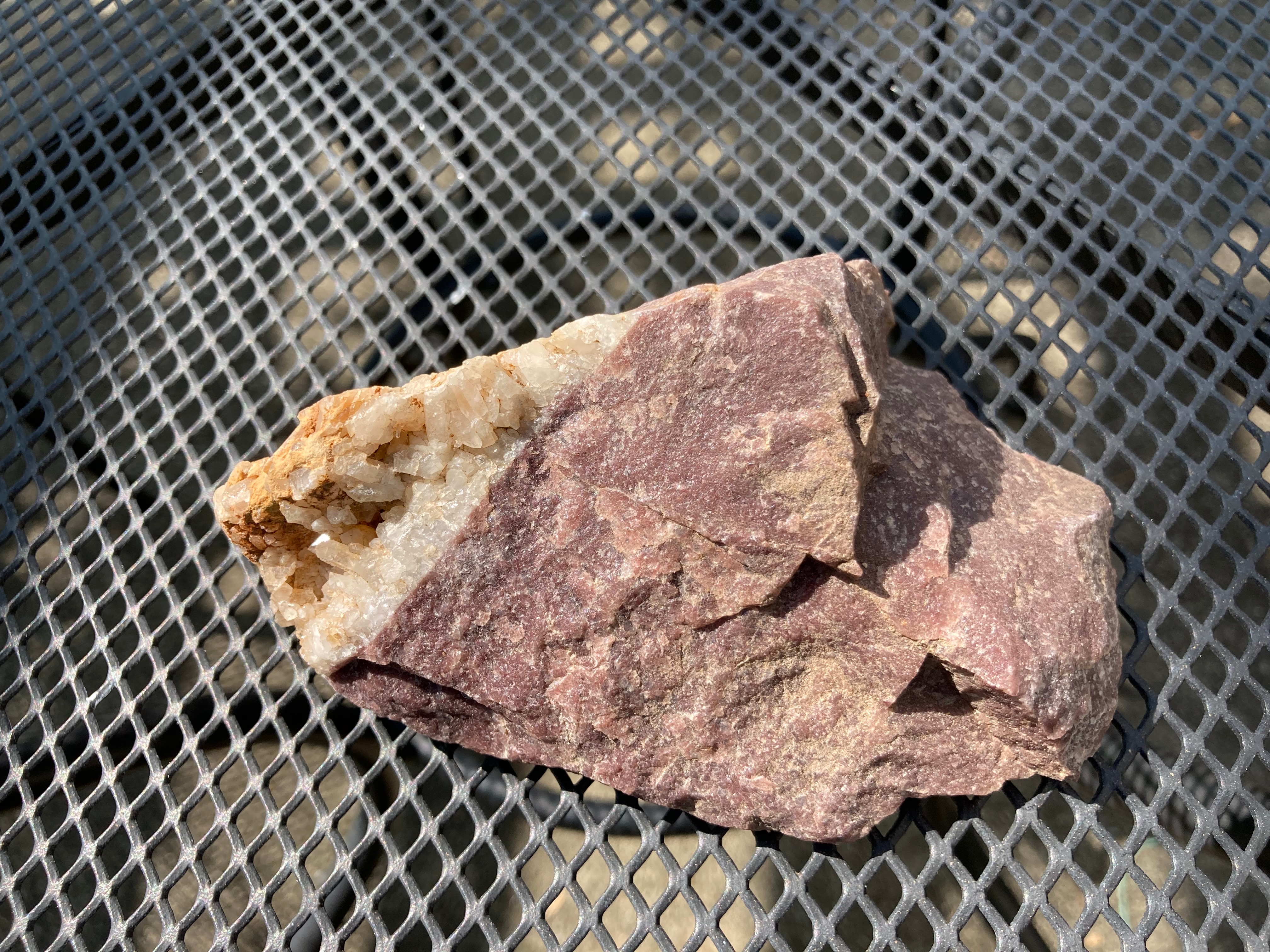
Rock identification is hard work. I have a Moh’s scale set. A streak plate. A hand loupe. It’s hard to use the acid test (vinegar will do) because the pieces are so small. Identification is often destructive. This might not be an issue if I had a ton of similar rocks to dispose of. No, but when you have just a handful, and these had to fit in your luggage along with your clothes, making TSA agents scratch their heads, you’re reluctant to damage them just to figure out what they are. So identifying the small rocks I have is difficult. Online forums tend to be unhelpful in this regard. Not even the color can give you certain answers. Once I collected some jasper in a creek. I could identify it because a large boulder clearly had jasper intrusions and I could compare. The piece I took home, of course, was quite small. Small, however, does not mean insignificant.

