Appily Ever After

While in the theater to see The Nun (which ended up being the biggest take) this weekend, I couldn’t help but notice that the pre-movie adds were all about apps.  I couldn’t help it because, much to my own chagrin, I’d left the house too quickly and I hadn’t brought a book to read while waiting.  This may not be news to some people, but different cinema chains have different “channels” of what passes for entertainment and ads to try to draw viewers in early.  The movie house we used to frequent in New Jersey had a variety of goods on show, most of the time.  The one we visited here in Pennsylvania presumed that everyone had their phones in hand, waiting for the show to begin.  On screen was the idolization of the app.

My phone is old enough that most modern apps don’t work on it.  Most of the time that doesn’t matter to me since I’m not addicted to the device.  Of course, when you’re trying to park your car in a town that offers only online options for such a convenience, I sometimes wish I could download the relevant necessary software.  Otherwise, I often wonder what we’ve lost in our lust for connectivity.  Coming out of New York on the longer distance bus recently, the driver called out, as leaving the Port Authority, “Lights on or off?”  The unanimous chorus, for I didn’t speak, answered “Off!”  I glanced around.  I was surrounded by devices.  I carry a book-light with me on the bus, for this has happened before.

“Drink the Kool-Aid” has become post-Jonestown slang for simply following the suggestion of someone without considering the consequences.  I sometimes wonder if our smartphones come in more than one flavor.  I’m not talking about features or physical colors.  As apps chip away at our money, a little bit at a time, they also take larger pieces of our time.  I’ve experienced it too, but mostly on my laptop (I don’t text—my thumbs aren’t that limber, and besides, the apocopated messages often lead to misunderstanding, emojis or not), the wonder of one link leading to another then realizing an hour has disappeared and I still feel hungry.  Perhaps that’s the draw to the modern commuter.  Or movie goer.  I’m sitting in the theater, taking a break from unpacking.  In my version of multitasking, I’m also doing research by watching a horror movie.  Around me eyes glow eerily in the dark.  I’m lost in the forest of unsleeping apps.
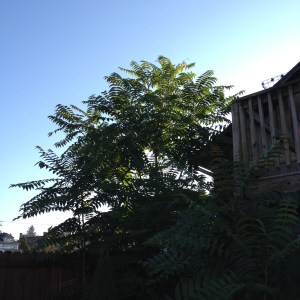

Somebody Else’s Heaven

Ailanthus is known as the “tree of heaven.”  It’s an introduced species in North America and, like many such species, it outcompetes its rivals.  The tree of heaven isn’t bad to look at—in fact its handsome appearance was one of the reasons it was brought to these shores.  Heaven isn’t all that it’s cracked up to be, however.  The tree is aggressive and resilient, and difficult to eradicate.  Among the many unexpected “gifts” the former owners of our house left us was a back yard full of ailanthus trees.  At first I thought they were pleasant but then I had to remove a small one.  The smell almost knocked me off my feet.  I then learned that the Chinese name for it translates to “foul smelling tree.”  Whose version of heaven is this?

Over the weekend I spent some time lopping off trees of heaven.  Mosquitoes, I found out, love its shade.  It keeps the kinds of friends you might expect.  Heaven is, after all, a construct.  The word can refer to either the great dome of the sky in which the ancients believed deities dwelled, or the realm of blessedness to which the righteous go after death.  In either case, it was assumed to be a pleasant place.  Any trees there (and there are some according to the Good Book) would likely have a pleasing fragrance.  The ironically named version we get down here didn’t get the memo, it seems.  As best as I can determine, the name of the tree refers to its rapid growth, as if it’s grasping for the sky.

A problem with our own species is that we seem to think we know more about this world than we do.  We introduce species from other parts of the planet without considering how they impact the local environment.  In the case of a property with lazy former owners, it can translate to a real problem with heaven trees.  We’re often taken in by the innocence of names.  The first time I saw a tree of heaven, in a public park in New Jersey, I thought I should write a blog post about it.  It took being invaded by heaven, however, to make it seem relevant.  Heaven is a foreign nation, it seems.  It should smell nice and be open to people of all nations and creeds.  According to Revelation the trees up there bear fruit every month of the year.  Presumably in heaven someone else has to take care of the yard work.


Galilean Blues

Call me nostalgic, but growing up Fundie, “Capernaum” tripped easily off my lips.  In fact, it was a word I heard very frequently at church, always pronounced “kap-er-NEE-um” (please pardon my amateur phonetics).  Even though no one I knew had ever been to Israel, we all knew it was in Galilee and that it figured large in the early life of Jesus of Nazareth (although we assumed he was surnamed “Christ”).  When I attended seminary I was surprised to hear the geonym pronounced “ka-per-NUM.”  It sounded so sophisticated—aristocratic, even.  Still, everyone at Boston University School of Theology knew what, and roughly where, it was.  It was a household name, no matter how you pronounced it.

Spellcheck disagrees.  It doesn’t recognize one of the most famous places in the New Testament.  Now, I’m aware that my view of things is idiosyncratic.  This blog should be proof of that.  Those who grow up from Fundamentalism often know this experience—something that everyone knew when you were young and informed is arcane knowledge to the rest of the world where Kardashians and Sedarises are household names.  The Bible, irrelevant at best, is a foreign country.  Then the religious right comes to power and everyone’s confused.  They don’t speak the same language as the rest of the world.  They say kap-er-NEE-um.  Others scratch their heads and glance at their knee caps.

When I visited ancient Capernaum it required some imagination to reconstruct what it had been, back in the day.  Since the ruins were relatively recent—only a millennium or two—some of the buildings were still above ground, including the famous synagogue.  Even among the unchurched archaeologists, everyone knew the connection of the city to Jesus of Nazareth.  That doesn’t mean, however, that the programmers responsible for spellcheck recognize the name.  Kardashian doesn’t get a red underline on my word processor.  Even in the first century, however, Galilee was a backwater (with real water!).  Important people came from big cities and had family connections.

Some things don’t change much over the millennia.  The famous often find their spotlight because of connections.  If the deity decided to incarnate today, s/he’d know to get a website put together first.  And it would help to have some product endorsements.  Even salvation at a click isn’t enough to draw most people in.  Of course, the matter of name—excuse me, “brand”—is important.  More than anything, you want something people can pronounce.  And just to be safe, anchor it to either New York or the city named The Angels.


A Kind of Happening

The roofers were here.  One of the things you learn only after laying down a ton of money is that those selling a house like to withhold information.  Moving during one of the rainiest summers in history, we naturally discovered leaks.  And so the roofers are here, like noisy angels banging above my head.  Given the orientation of our house, their access is outside the window of my work office.  I figured it was an opportunity to learn.  As the old shingles came raining down, however, I couldn’t help thinking of M. Night Shyamalan’s The Happening.  One of his more disappointing efforts, this horror film involved a memorable scene of mass suicide where people jumped off of a high building one after another.  Maybe other people would think of other comparisons, but the falling debris brought the film to mind in my case.

It’s a matter of framing, I suppose.  I’ve watched enough horror that it has become a framing device.  This is true although it has literally been months since I’ve seen a horror film.  (Moving proved to be its own kind of nightmare and one day I suspect we’ll be unpacked enough to watch movies again.)  Instead of losing the frame of reference, however, I find it intact.  If you spend long enough with Poe, he gets under your skin.  And changing states to M. Night Shyamalan’s eastern Pennsylvania might have something to do with it.  This is Bucks County territory, after all.  Another frame of reference, mediated by media.

As I watch the old shingles drop, I realize the window through which I’m witnessing this is another frame.  Like a camera lens, it limits my view.  At times it can be like Hitchcock’s Rear Window, seeing neighbors at their daily business.   Indulge me. For nearly the past five years I worked in a cubicle with no view of any windows whatsoever.  I was completely cut off from the outside.  (Which, for those of you who’ll admit to having seen The Happening, might not have been an entirely bad thing.)  Now that I have a window—my own framing device—I realize some of what I’d been missing.  At Routledge I had a window, but at such a level that the Manhattan outside seemed artificial.  You couldn’t see individuals down on the street.  The entire wall was a window—too much of a frame.  Gorgias Press involved working in a windowless room as well.  I’m professional enough not to let the falling material or the pounding distract me much.  There’s work to do because there are bills to pay.  And horror films prepared me for that as well.  It’s the ultimate framing device.


Financial Ethics

In a conversation with a professional colleague recently, I was discussing what might happen to ethics when sex with machines becomes common.  That statement might seem a little bizarre out of context, so let me widen the net a bit.  We were discussing the Bible and sexual ethics.  This led to the question of how those who apply the Bible straight from antiquity might apply their beliefs to a world vastly different than first century Palestine.  In biblical times, in other words, sexual options were limited and people didn’t understand the whole issue of human sperm and eggs, neither of which can be seen without a microscope.  Applying their outlook directly to today is problematic, and so how do we apply a book without outdated views to a world vastly more complicated?

Someone recently paid me a small debt via PayPal.  If sex is complicated, then let’s not even get started on Bitcoin or Apple Pay—for some of us money is money and even getting paid electronically is somewhat suspicious.  I sometimes buy things online with PayPal.  It goes straight onto one of my credit cards and then I write an old-fashioned check to pay for it.  So I had to approach the altar of PayPal itself to figure out what it meant to have money in my account.  What am I to do with it?  Then I found the FAQ—TFIA (The Future Is Acronyms).  One of the questions: “What is PayPal’s policy on transactions that involve sexually oriented goods and services?”  Now, here’s a question of biblical proportions.

Paying for sexual “goods and services” goes all the way back to the book of Genesis when none other than the ancestor of David and later progeny did so.  This is nothing new.  But the question of ethics now looms extra large.  For those who pay for such things, a new layer of complexity has apparently been added—can you pay with PayPal?  My transaction had to do with tickets purchased for a concert online, where we wanted seats together so someone had to do the buying for everyone.  What if the purchase had involved a somewhat more intimate setting?  Who needs paper or plastic when a string of 16-digits, or even a username and password, will do?  That’s to say nothing regarding the ethics of the transaction—this is, as it were, purely mechanical.  What would Moses say?  Surely this is a question of appropriate tips, for Tamar veiling herself by the side of the road had the moral high ground over her father-in-law who was simply looking for a good time.  A staff and seal, however, were no less complicated that paying for goods and services online.


Homework

I’m trying to organize a home office.  Gone are the days that this meant a stapler and mug full of pencils.  The office is essentially a laptop since work is essentially virtual.  Oh, there are days when I have to haul myself into New York City, but even making traditional print books is an exercise done largely online.  The office is a place conducive to work.  In the case of an editor, a room of books that can be used for reference.  In our apartment we had bookshelves (mostly homemade) around the inside perimeter, covering all wall space that wasn’t claimed by more necessary furniture.  We realized, as we were packing, that no free wall space reached to the floor.  We didn’t plan it that way, but a reading life can be a complicated one.  To write books you need to read books.

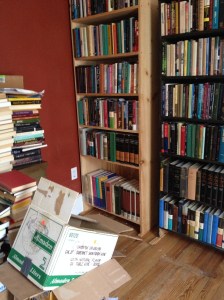
Our house has some built-in bookshelves.  Not enough to hold our surviving books, but it’s a start.  My office, however, is a spartan room.  Over the weekend I unpacked my “work books.”  That meant, for the most part, books about the Bible.  I filled three large bookshelves then ran out of room.  Not only was there that embarrassment, but there was the fact that a large number of “religion” books remained unshelved.  You see, I was a religion editor for a few years before being more narrowly slotted into the Good Book.  Some might say I should jettison these books since my career has moved on.  Those who suggest such heresy don’t understand the career of a displaced professor at all.  These books are still work books.  Job descriptions aren’t as stable as they used to be.

The complaint is an old one, at least to my wife’s ears.  In my mind I’m still a professor.  I still write—strictly on my own time—and I still research.  I do so without access to a university library so I have, over the past several years, made my own library.  This office, now out of bookshelves, is that amateur academic library.  My research has shifted from ancient Near Eastern studies (and that’s another whole discipline’s worth of books, some unfortunately washed away in the flood) to religion more broadly.  Not only is that reflected on this blog, but also in my publications.  The office isn’t done yet.  There’s a desk and a chair.  More importantly, there’s internet access.  There are some shelves, but in coming days there will need to be more.  Libraries are like minds; if they shrink they become less functional.  All books, no matter how dry, began in someone’s imagination.  That’s virtual reality.


A Few of My Favorite Monsters

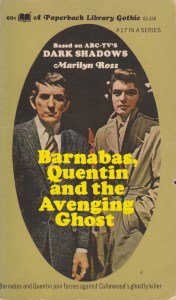
It was a guilty pleasure read.  We’d just moved and I needed a new novel for bed-time reading.  Most of our undamaged books were still boxed up and, well, enough excuses: I like Dark Shadows novels.  Hardly well written, these pulp potboilers are like extended, Gothic Scooby-Doo episodes.  I first started finding them used at Goodwill when I was a kid and I’ve re-collected a number of them as an adult.  Although they feature a vampire, and sometimes a werewolf and witch, the crisis of the story generally devolves to a hoax at Collinwood.  So it was with Barnabas, Quentin and the Avenging Ghost.  I hadn’t thought to write a blog post about it until I came across a passage mentioning Rocain.  In context, one of the characters explains how Rocain, the son of Seth, shows that sorcery goes all the way back to Genesis.

Genesis was one of my lines of research during my academic career, although I never published anything I was working on.  I didn’t, however, recall having read about Rocain.  The internet quickly pointed me to Legends of Old Testament Characters by Sabine Baring-Gould, chapter 8.  Clearly this was where Marilyn Ross, or his source, got his information.  Baring-Gould sits on my shelf as the author of The Book of Were-Wolves.  He also wrote the hymn “Onward, Christian Soldiers.”  There was an era, overlapping with Baring-Gould’s lifetime, when a minister could be an independent scholar of repute.  Although much that’s found in his many publications is now disputed, his was a lively and lifelong curiosity that led to several books.  

Upon reflection, Sabine Baring-Gould, who was a priest fascinated by occult topics, would have fit quite well into the Dark Shadows diegesis.  Although set in the late 1960s into the mod ‘70s when the television show aired, these were Victorian vignettes of a conflicted vampire and his strange, wealthy, and somewhat clueless family.  All kinds of guests, some of them quite Lovecraftian, drop into the Maine mansion and its grounds.  The writing of the novels is tepid at best, but the series was surprisingly literate.  Dark Shadows is nevertheless undergoing a kind of revival these days, and friends sometimes tell me they’ve just discovered this oddly compelling world.  I invite them in.  I’ve unpacked a few more boxes since selecting this pulp novel, and one of them, I note, holds books by Sabine Baring-Gould.  The guilty pleasure read?


Animal Rains

We may have been to the moon—if not personally, collectively—but we still don’t control the weather down here.  It’s probably not news that the eastern part of the country has been getting a lot of rain lately.  One of the factors that led me to write Weathering the Psalms was the overwhelming tendency for humans to attribute weather to the divine.  It used to be that we couldn’t reach the sky, so placing deities there seemed a safe bet.  Now that we’ve shot through the thin membrane of atmosphere that swaddles our planet, we’ve discovered beyond a cold, dark space liberally sprinkled with stars and planets but mostly full of dark matter.  The deity we thought lived beyond the sky somehow wasn’t anywhere our probes flew and recorded.

Still, down here on the surface, we live with the realities of weather and still think of it in terms of punishment and pleasure.  When we don’t get enough rain, God is destroying us with drought.  Too much rain, and the Almighty is washing us away with flood.  The true variable in all of this is, obviously, human perception.  Sure, animals experience the weather too, and they sometimes look to be as disgusted as humans when it snows too early or too late, or when the rain just won’t stop.  I have to wonder if somewhere in their animals brains there’s the seed of an idea that the bird, or squirrel, or woodchuck in the sky is angry at them for some unspecified faunal sin.

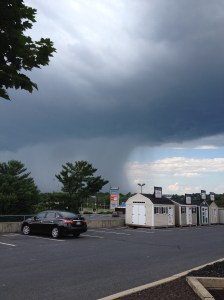
While heading to the store yesterday, after weather reports assured us the rain was finally over for the day, the skies told a different story.  The vistas around here are never what they were in the midwest—or what they are in Big Sky country—but the approaching storm was pretty obvious.  An opaque drapery of precipitation was coming our way and although a rainbow would cheekily show up afterward, knowing that we’d been caught away from home with our windows open felt like punishment for something.  Perhaps the hubris of buying a house when all I really require is a corner in which to write.  Somewhere in my reptilian brain I translated a natural event into a supernatural one.  When we got home to discover the storm had gone north of us, it felt like redemption.  I spied the birds sheltering in shadows from the sun’s heat.  Were they thinking it was some kind of divine avian displeasure, and hoping for some rain to cool things off for a bit?  If so, was our religion correct, or was theirs?


Starting Something

Starting your own religion, I’m told, just takes patience.  You may have to die before it gets off the ground,  but if it’s a religion you’re starting you get to make the rules.  Well, until somebody else starts interpreting what you wrote.  I grew up thinking a religion had to be ancient to be real.  There’s a certain comfort in untestablity—you can’t verify the facts, so you accept them.  It took many years before it dawned on me that new religions rely on the same premises as old: someone has received the truth (at last!) and is willing to share it with the world.  Followers emerge—true believers.  And then they begin to change things.  “The founder meant this,” they argue, and really they’re starting their own sub-branch of the religion.

Not everyone is convinced by this ancient religion paradigm.  Zarathustra, for example, set out to create his own religion, according to tradition.  Jesus, it seems, was trying to reform Judaism.  The process never stops.  A couple of weeks ago in New York City I saw an adherent of a New Religious Movement.  This one had started in the 1930s.  The man appeared a little older than me, so his life may well have overlapped with that of the founder, or they might’ve missed each other by a decade or two.  Already, however, the religion had grown into its own entity, and it doesn’t seem to worry adherents that the truth was being revealed, for the first time, maybe in their lifetime.  You have to start somewhere.

So, if I were to start a new religion, what would it be?  For a variety of reasons I think I’d call it Moby.  The connection with Melville is palpable, but that wouldn’t be the reason for the name.  (Religions must have a sense of mystery, otherwise they can be analyzed until they look illogical.)  Like Unitarian Universalists, I think the religion would be more about what you value than what you believe.  Belief can be shifting sands.  New information can lead to new results—this is one of the weaknesses of religions developed when the earth was still the center of the universe.  Heaven is now outer space and Hell is earth’s iron core.  Moby would avoid such a doctrinal morass by not having doctrine.  It would need rituals and ceremonies, of course—no matter what Mr. Spock wannabes say, we need emotional engagement and ritual has the goods.  All of this requires patience, because who has the time to develop a new religion when there are only two days in a weekend?


Awakening

Waking up for the first time in our new place, I felt a strange relief.   I hadn’t realized how much you feel owned when you have a landlord.  Slipping out of the bed while it’s still dark, vague shapes that eventually resolve into unpacked boxes lurk in the shadows.  They mean me no harm.  I go downstairs.  Downstairs!  Without revealing too much personal information here, I can say that I’ve always believed in sleeping upstairs.  In our several apartments my wife and I have lived on one floor.  Going to sleep meant walking down the hall into another room.  It lacked proper transition.  When we looked at houses it took some time before I could put my finger on it—we needed a two-story house.  You go “up to bed” for a reason.

The thing about writing is that it’s an activity of habit.  Not aware of the location of light switches yet, I shuffle slowly through my own personal towers of Babel.  Find the coffee maker.  Where do I go to write?  Not wanting to wake my wife, I decide it should be downstairs.  There’s the study, with its desk.  Seems pretty obvious.  Mug in hand, with no lights on, instinct drives me back to my usual chair in the living room.  Habits are seldom planned.  They happen.  I’ve become used to writing electronically, but as I wanted badly to explain to the movers, I grew up writing on paper.  Writers are readers and there are two things you don’t throw away—books and your old writings.  Carpenters don’t ditch saws and hammers just because they’re heavy and numerous.  There’s a kind of religious devotion here.

Don’t worry, I’ll soon be back to my more abstract topics on this blog.  Religion and all that.  Right now I’m in a transition and I’m wondering that if that means I’m now officially grown up.  If so, does that mean abandoning my childhood dream of being a writer and facing the fact that all these boxes were moved in vain?  Not having food in our new place, our first day we went to a Chinese restaurant for lunch.  The locals were talking.  Their concerns?  Lawn care and propane.  Everyday things.  Clean-cut and suntanned, they can tell at a glance that I’m a stranger with my unkempt hair and prophetic beard.  Is my writing fantasy just childhood gone to seed?  No.  Books and writings are my identity.  The movers may have mixed them in with saucepans and power tools, but I know at a glance which boxes contain books.  Soon they will be in every room of this house.  That will make anywhere feel like home, even if I can’t find the lights.  


Paranormal Pilgrimages

Although the Allegheny Mountains are hardly the Rockies—they’re much older and gentler on the eye—they harbor many tourist locations.  Even before my daughter attended Binghamton University, I’d been drawn to the natural beauty of upstate New York.  Prior to when college changed everything, we used to take two family car trips a year, predictably on Memorial and Labor day weekends, when the weather wasn’t extreme and you had a day off work to put on a few miles.  One year we decided to go to Sam’s Point Preserve (actually part of Minnewaska State Park) near Cragsmoor, New York.  It features panoramic views, a few ice caves, and, as we learned, huckleberries.  What my innocent family didn’t suspect is that I’d been inspired to this location suggestion by the proximity of Pine Bush.

A friend just pointed me to an article on Smithsonian.com by my colleague Joseph Laycock.  Titled “A Search for Mysteries and Monsters in Small Town America,” Laycock’s article discusses how monster pilgrimages share features with nascent religion.  People report strange encounters with all kinds of creatures and objects, and science routinely dismisses them.  Odd encounters, however, leave lasting impressions—you probably remember the weird things that have happened to you better than the ordinary—and many towns establish festivals or businesses associated with these paranormal events.  Laycock has a solid record of publishing academic books on such things and this article was a fun and thoughtful piece.  But what has it to do with Pine Bush?

Although it’s now been removed from the town’s Wikipedia page, in the mid 1980s through the ‘90s Pine Bush was one of the UFO hot spots of America.  Almost nightly sightings were recorded, and the paranormal pilgrims grew so intense that local police began enforcing parking violations on rural roads where people had come to see something extraordinary.  By the time we got to Pine Bush, however, the phenomena had faded.  There was still a UFO café, but no sign of the pilgrims.  I can’t stay up too late any more, so if something flew overhead that night, I wasn’t awake to see it.  Like Dr. Laycock, I travel to such places with a sense of wonder.  I may not see anything, but something strange passed this way and I want to be where it happened.  This is the dynamic of pilgrimage.  Nearly all religions recognize the validity of the practice.  It has long been my contention, frequently spelled out on this blog, that monsters are religious creatures.  They bring the supernatural back to a dull, capitalist, materialistic world.  And for that we should be grateful.   Even if it’s a little strange.


Blogday

Sects and Violence in the Ancient World is nine years old today.  Not that I’m keeping count.  Really, I’m not.  WordPress sent me a notice, and they ought to know, being the virtual womb whence my thoughts gestate.  The original plan for this blog was to take my abiding interest in the religions of antiquity and give them a more public face.  My brother-in-law, Neal Stephenson, thought I should do podcasts, because, at the time I spoke incessantly about ancient deities.  I can still hold forth about Asherah at great length, but ancient Near Eastern studies is, believe it or not, an evolving field.  You need access to a university library, or at least JSTOR, and a whole sabbatical’s worth of time to keep up with it.  Even though telecommuting, I’m a nine-to-five guy now, and my research involves mostly reading books.

So Sects and Violence began to evolve.  I realized after teaching biblical studies for over a decade-and-a-half that my real interest was in how the Bible was understood in culture.  Having a doctorate from a world-class university in the origins of the Good Book certainly should add credibility.  My own journey down that pathway began because of interpretations of Scripture that were strongly cultural in origin.  I first began reading with Dick and Jane but quickly moved on to Holy Writ.  It has shaped my life since before I was ten.  It’s only natural I should be curious.

Like most tweens, I discovered sects.  Why did so many people believe so many different things?  And many of them call themselves Christians.  And the Christians I knew said the others weren’t Christian at all.  And so the conversations went, excluding others left, right, and center.  As someone who wanted answers, this fascinated me.  The Bible was the basis for many belief systems of sects everywhere.  From Haiti to Ruby Ridge.  From New York City to Easter Island.  From Tierra del Fuego to Seoul.  And not just one Bible, but many scriptures.  And these beliefs led to behavior that could be called “strange” were it not so thoroughly pervasive.  Scientists and economists say we’ve outlived the need for religion.  By far the vast majority of people in the world disagree.  I couldn’t have articulated it that way nine years ago, but since losing my teaching platform, I’ve been giving away for free what over four decades of dedicated study—with bona fides, no less!—has revealed.  Happy blogday to Sects and Violence in the Ancient World.


The Moved Unmover

To say it was an easy move would be a lie.  I write this on a beautiful, cool, clear July morning.  Only I can’t even calculate the last time I slept.  Not new house syndrome, but that move!  Our personal account manager at International Van Lines was supposed to call us between 4 and 6 p.m. on Friday to confirm the time of the move.  She would also tell us how much money was needed, in cash, by the movers.  In cash?  She’d taken my deposit by credit card; why couldn’t the balance be paid that way?  She was supposed to call to clarify.  I suspect my tone makes it sufficiently clear that she didn’t.  I went to bed not knowing if we would be moved or not—I only reread her email after packing the last box (or so I thought) at 7 p.m.  The IVL offices were closed.

I awoke at 3:30 to an email saying they would be there between 9 and 11 a.m.  And they would be wanting an uncomfortably large amount of cash.  My wife went to get it, and three guys and a truck arrived at 9:15.  I could see their faces blanche at the walkthrough.  They’d been told it would be a ten-hour job.  It turned out to be seventeen.  Nothing makes you feel a cad quite like being thought a snake-oil salesman.  Our bill of lading was just a bit short of reality.  Packing the truck wasn’t finished until 9 p.m.  Unpacking until 2:30 a.m.  Our three guys were joined by two more for the unpacking.  Most everything went into the garage because, well, no stairs.

Twice during the day the amount of cash needed was upped by a significant amount.  This was one of those “we’re in it now” situations.  We paid what was requested.  The internet guy was arriving potentially by 8 a.m. this morning.  Who can sleep knowing the alarm is set for four hours from now?  And our labeling scheme was so arcane that, well, most everything ended up in the garage.  The movers themselves?  Absolutely fantastic!  I’m sure they’ll be talking about this move for months to come.  

Looking outside, the yard wants mowing.  The internet guy is coming.  Who needs sleep when my life of telecommuting begins tomorrow?  The good news is it took only half an hour and one trip to the garage to find the coffee filters.  I’m looking out at a beautiful, crisp morning.  Over an Everest of boxes.  But you won’t know any of this until the internet guy gets here.  Somehow I sense we just accomplished something quite extraordinary.


Moving Day

So, it’s moving day.  Amid all the packing and sorting—outside the regular 9 to 5—I realized that this was the first move I’ve made outside the constraints of academia.  Well, maybe not strictly so, but I left Nashotah House in the summer, and I was unemployed when I moved to New Jersey to start in the publishing world, so there was no office work involved.  The move without changing a job is a tricky thing.  And exhausting.

I didn’t write about the process early on, in case it didn’t happen.  Buying a house is an exercise fraught with peril and it can collapse at several junctures over the three-or-so months it takes to finalize things.  Then there’s the move itself.  Back in January I found myself setting books aside that I thought I might not need again in the next few months.  We started hauling boxes down from the attic to pack those books in February and March.  We finally made an offer on a house in May, and now, seven months after the process began, we’re ready to move.  Or so I tell myself.

Our last move didn’t go exactly as planned.  Like Bartleby and Loki, we were moving from Wisconsin to New Jersey, perhaps seeking our destiny.  Who knows—maybe undoing the universe?  We hired Two Men and a Truck to move us.  My brother in New Jersey said he’d meet the truck since it was going to take us a little longer to get there.  On arrival day, no truck.  We called the company to find that the said Two Men had actually abandoned said Truck in a parking lot in Chicago.  Although embarrassed, the big Two Men upstairs made no offer of a discount on the move, even if it cost my brother an extra day of work.  We’re hoping for better things this time around.

International Van Lines didn’t call the night before, like they said they would.  After a somewhat restless night (should I stay or should I go?) my usual 3 a.m. internal alarm kicked in.  An email, like a thief in the middle of the night, told us when to expect the big guys and their vehicle.  Moving is kind of like prophecy in that regard.  In any case, for those accustomed to early posts, there will be a delay tomorrow since the internet people are finishing the virtual move around 11 a.m.  Church time on Sunday.  If we pull this move off, I might have to admit there are miracles after all.


Extra Baggage

So, I’m packing.  Have been, on and off, since January.  One of the most dreaded moments of packing is the closets.  You know how in horror movies the villain often hides in closets?  We have no danger of that.  Any monster foolish enough to try it would be suffocated under tons of stuff.  Some houses may have walk-in closets, but I am inclined to call a mining company whenever I need to find anything in ours.  Our closets have led full lives.  It’s almost 100 degrees outside and I’m excavating.  We’re at that stage of “absolutely need to keep?” instead of “do we want this?”  Then I came upon it.  The layer of SBL tote bags.  Like a paleontologist of ancient academia.

If you’ve been a member of the Society of Biblical Literature you know what I mean.  Every year the Society wants you to realize value for your money, and they give you a tote-bag to help you haul home the books you’re going to buy.  Long-time attendees know to pack an empty suitcase inside their regular one just to accommodate the books.  (That could also account for about ninety percent of my packing—we have more books than a small town public library.)  But it’s not the books that are the problem today, it’s the bags.  I’ve been attending SBL since 1991.  Do the math.  I seem to recall that they didn’t do tote bags back in Kansas City, but soon after they became part of the agenda.  And I have an impressive pile of them in my closet.

Too small for groceries—especially in the early editions, back when we could meet in smaller venues—and too impractical for anything other than books, they multiply in our closets.  What professor doesn’t have his or her iconic briefcase already?  Reduce, reuse, recycle they say.  At least half of my totes have never been reused.  Zippers?  Who thought of that?  Pulling handfuls out of the closet, I marvel at their colors.  I can’t remember everyone walking around with a red bag—what year was that?  (San Francisco, 2011.)  The black leather edition—remember that one?  (SBL, n.d.)  The bags aren’t really useful for packing, on a movers’ scale.  You can imagine the burly guys outside their truck scratching their heads at this impractical conveyance.  Like so much else in life they’ve become mere souvenirs.  From the French word for something like “remembrance,” souvenirs are meant to take us back to the place in vivid detail.  I fear that many past meetings have run together into a blend of biblical arcana.  I’m sure that’s just me.  Still, I’m responsible for this new discovery.  I’d I’ll need shortly to decide whether these totes go into the museum or back into the landfill that moving inevitably creates in a throw-away world.