Gila’s Got the Whole World

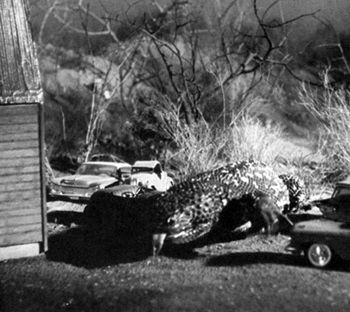
Singing pretty-boys and colossal lizards – it must be time for The Giant Gila Monster. A horror film that portrays all the innocence of the 1950s before the Beat Generation led us down the path to reality, the film has earned cult status in recent years. More accurately titled, “A Regular-Sized Gila Monster Filmed in Close-Up,” the sub-mediocrity of the movie has probably done more for preserving it in popular culture than any other aspect. The film stars the relatively unknown Don Sullivan as a great teen role model who writes and performs his own songs. The number that receives the most Internet attention, and the one that makes this movie of interest to this blog is “The Mushroom Song.” Chase Winstead (Sullivan’s character) has a young sister who is just learning to walk with leg braces. To cheer her, he picks up a ukulele and sings: “And the Lord he said I created for you/A world of joy from out of the blue/And all that is left to complete the joy–/Just the laugh of a girl and boy/And there was a garden, a beautiful garden/Held in the arms of a world without joy/Then there was laughter, wonderful laughter/For he created, a girl and a boy/And the Lord said, laugh, children, laugh/The Lord said, laugh, children, laugh” with the final line repeated numerous times.
Laugh, children, laugh

Perhaps intended to underscore the societal norms of a time when “the Lord” made frequent appearances as an unseen supporting actor in many movies, this song is oddly out of place. The disability of Missy Winstead is obviously a device to raise tension: how will a disabled girl run from a giant lizard? The song, however, provides the resolution – the Lord will take care of all good people. Their response should be to laugh. The reference to Adam and Eve, fitting for teen fantasies of all generations, also belies the evolution of this monster. The gila grows to its great size because of chemicals in the water that wash to the delta somewhere in Texas. This creature did not evolve. The Lord will take care of it. The Lord and nitroglycerin.

Respectful teenagers with predictable haircuts and a society that believes a missing teenage couple could be doing nothing but eloping fits the world of the Religious Right exceptionally well. Even though they may not be perfect, these kids know right from wrong for they live in a black-and-white world with no ambiguity or ambivalence. Children of subsequent generations have grown up with shades of gray or psychedelic colors. The older generation is frightened by new developments, claiming that the world they know is about to end. In fact, an evolution is occurring. Those who try to hold society to the norms of the 1950s would do well to move ahead a decade and at least listen to Bob Dylan. No matter how far we progress, however, it seems that Texas will always delight in producing Lord-loving, bloated threats to rational civilization.

Get Lent

Time to get Lent

Each year as spring struggles to overcome winter’s terminal chill, colorful flowers begin to burst from the earth to announce the rebirth of hope. So it is that bright purple signs have begun to spring up all over town announcing the joy that is Lent. Wait a moment – Lent and joy in the same sentence? The radiant signs read, “Lent: a good time to come home.” That’s not the Lent I remember. Having spent the longest decade of my life at a seminary that was frequently touted as “all Lent, all the time,” I suffered my share of the season. While I think I comprehend the tactic behind this attendance boosting campaign, I wonder if it isn’t leading with the chin.

Back when flowers were the first colorful signs of spring, when I was young, churches did not advertise. Stolid bastions of the truth, each and every one, they awaited sinners to come to their senses and select the correct avenue to the truth. If you missed, well, Hell never turned anyone away. Nowadays, however, we need advertising to convince us. In a consumerist heaven, we are deluged with choices. When the faithful dither, it must be time to advertise.

The first to admit personal bias, my experience of Lent has usually been dreary and unrelenting. A naturally quiet and self-critical individual, I don’t need a whole denomination on my back to force me to think about the faults I already castigate. The thought of the season makes me shudder – people who spend all the rest of the year looking out for number one are to emulate Jesus’ reflective 40 days in the wilderness to be like their savior, only to snap back to their old self-serving ways on Easter. Could be a recipe for collective schizophrenia. Temporary Christianity. Do we really need more occasions to be glum? My favorite part of Lent was always Mardi Gras; at least then we were working on something new to contemplate during the next 40 long, chilly days.


Not the Oscars

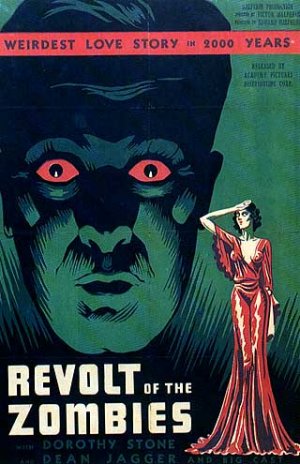
I could blame this week’s Time magazine for declaring that one thing we don’t need to worry about is an end to the zombie craze, but in truth I really have no one to blame but myself. Having watched White Zombie a few weeks back, I decided to see Revolt of the Zombies, its sequel, this weekend. With holes in the plot large enough for a small planet to pass through, it leaves a great deal of creativity – and imagined continuity – up to the viewer. It’s a movie bad enough to make you want to slap the television in frustration, but it did bring a number of my standard (read “tired”) themes on this blog together.

In this confused romp through sci-fi horror, excused only leniently for having been filmed in 1936, the terms robot, zombie, and automaton are used interchangeably. This is one of the technically redeeming features of the film. The term “robot” was coined to indicate a mindless servant, and in their religious origins zombies shared exactly that function of the automaton. Today’s robots are machines, and the future of the Singularity (posted on a couple weeks back) revolves around this very point: machines will complete the degenerating biological frame. Somehow the zombies will save us.

The zombies of 1936 were surrounded by swaggering, stereotyped caricatures of the helpless female who has very little mind of her own (perhaps less than the zombies who actually do something to better their state). Racist images including a wizened Scot called MacDonald and subservient Asians make the film uncomfortable for present day viewers. One glimmer of intelligence in the film, however, comes from an awareness of the classics. After a rat’s nest of a plot that is essentially one man wanting another man’s girl, old MacDonald gives a commentary on the assassinated master of the zombies. He takes his line from Euripides’ play Medea – an original strong female that the Greeks so feared. “He whom the gods destroy, first they make mad.” Second, I would add, they make watch Revolt of the Zombies.


Washington’s Birthday

Today’s post is an excerpt from an unpublished tween book I wrote on the origin of American holidays a few years back. Other excerpts are available on the Full Essays page of this blog.

Our founding father, a little worse for wear

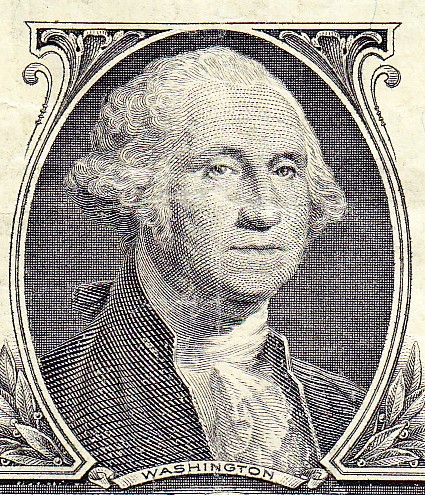
Today is the earliest of only three government holidays devoted to an individual, specifically George Washington. Also called President’s Day, this holiday comes on the third Monday in February. Washington was born February 11, 1731. In an interesting twist of fate, when the Gregorian calendar was finally accepted in the United States in 1752 Washington found his birthday shifted to February 22. Washington died in 1799, but the idea of national holidays for a single person had not yet been invented. It took almost a century for someone to do something about it. When Washington’s Birthday was first observed in 1880 only the government offices in the District of Columbia (named for Washington, of course) got the day off. Naturally, they celebrated it on February 22. Five years later, in 1885, all federal offices took the day off.

Now, the problem with government holidays is that Post Offices, which are run by the government, are also closed. That means no mail. For businesses that used to mean an interruption of work – believe it or not, before the Internet was invented nearly all business relied on snail mail! It is hard for a business to take a day off in the middle of a week, so in 1971 George Washington’s birthday was moved again so that it would always be on a Monday. Washington, being long dead, said nothing.

When I was a kid I always thought Abraham Lincoln’s birthday (February 12, 1809) was a holiday too. It came before Washington’s birthday, but still in February. Since junk mail hadn’t yet been invented, I didn’t notice whether the mail came or not. Lincoln’s birthday was printed on the calendar, but it has never been an official federal holiday. Now, here’s a funny thing: individual states have the right to set state holidays or even rename federal holidays. Lincoln’s Birthday, for example, is a state holiday in Illinois.

In the 1980s Washington’s Birthday underwent another transformation. Noticing that Lincoln’s Birthday was ten days before Washington’s (remember, on the Julian calendar Washington’s birthday was February 11) businesses could call it President’s Day and stores could offer sales. So, wait, what is this holiday called and when is it? Its official, federal name is Washington’s Birthday. Many people, and some states, call it President’s Day. It is always observed on the third Monday in February. And George Washington would have been just as confused as anybody, because he is the only president with three different birthdays!


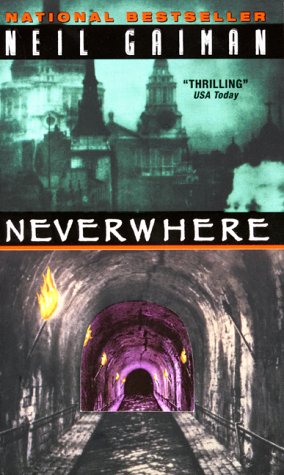
Neverwhere Angel

Neil Gaiman is popular among my students. At least among those that still read for fun. A couple of years back one of them lent me a copy of American Gods, and the story stayed with me. Having lived for many years in Wisconsin, and having visited the House on the Rock, the novel was like a kaleidoscope of some of my more pleasant memories of the state. Neverwhere is quite different and yet equally compelling. Gaiman peoples his worlds with characters just on the edge of believability thrown in with protagonists who tend to be completely confused by what they’re experiencing. Instead of gods, in Neverwhere there is an angel with the unlikely name of Islington and we have the myth of Lucifer’s fall retold in fantasy format, rolled together with Alice in Wonderland and the myth of Theseus. For starters.

A person is a composite of what s/he reads and learns and accepts. The books we digest, each in a unique recipe fitting our individual tastes, create new compounds and concepts that explore our personal realities. Neverwhere takes the reader down a rat-hole instead of a rabbit-hole, but nevertheless follows a young girl on a journey of maturity. The hero’s quest is undertaken to actualize both protagonist and idol, and along the way the beast in the labyrinth must be encountered and slain. Theseus, the flawed hero, dominates a world where even saviors have peccadilloes.

The protagonist of Neverwhere does not believe in angels, despite his encounter with one. As Gaiman puts it: “it was much easier not to believe in something when it was not actually looking directly at you and saying your name.” Belief generally involves not seeing. Once the object of belief is empirically confirmed, belief becomes knowledge. Today the belief in angels remains unabated. No empirical proof, nothing tangible confirms this belief beyond the anecdotal accounts of those who claim to have experienced them. Even the fanciful image of their androgynous good looks and unlikely wings remain untainted for all the centuries. Neverwhere raises an intelligent question about angels, but to discover what it is you’ll need to go down the rat-hole as well.


iConfess; Indulge Me

I confess to being a Luddite at times. I was a late-onset cell-phone user and my last laptop (Macintosh, of course) survived ten years of hard, academic use before an accidental drop forced me into a newer model. Now I walk through student centers and see banners advertising “new apps” and wonder what an app is and whether it is something I should have already had old versions of. I’ve figured out that “app” is an apocopated form of application, and that it generally has something to do with handheld electronic devices. Now it seems that I’ve been out-teched by the Catholic Church. That great bastion of faith that agonized over Galileo for four centuries has now whizzed by guys like myself who cut our high-tech teeth on telephones that had rotary dials.

What is this new app? According to the New York Daily News, the app is called Confession. The program apparently lets you choose a commandment that you’ve violated and offers a list of sins to tick off. (I envy the priest who got that job!) A press of the button and your sins are forgiven. Sure is a lot easier than getting down on your knees and telling it all to a guy you barely know. This handy app even automatically tracks the time since your last confession, so you can give it to the holy father in nanoseconds. It only costs $1.99.

Technology has wreaked havoc on ecclesiastical tradition. Only the most severely shortsighted of churches denies the draw and retention of the electronic revolution. Problem is, the worldview that generated these religions simply doesn’t fit into a palm-sized box. The world of century one was full of demons and dragons, and all on a very flat earth. Confession, when it became a requirement, was a visceral outpouring of deep secrets and fears before a black-garbed authority figure who had the power to dole out Hail Marys like a theophanic thunderstorm. Now it can be done at the stoplight on the way to Starbucks. The last time the church had asked for payment for forgiveness Martin Luther nailed 95 Theses to the Wittenberg Door. Today, I’m sure, it would be an electronic error report posted to a Wiki-board Domain, whatever that might be.

Forgive me, Father -- oh! I've got email!


Old Deuteronomy

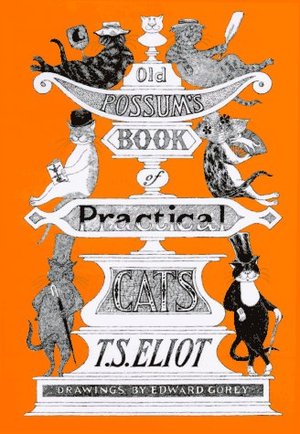
Last night my family attended a performance of CATS. We can seldom afford shows, or even movies for that matter, but when CATS comes to town it is non-negotiable with my daughter. It is a must-see musical. Anyone who has seen the show knows it is all just for fun with only the thinnest of plots and the most colorful of non-religious characters (they are, after all, cats). T. S. Eliot and Andrew Lloyd Webber, however, were/are solidly C of E, and that orientation comes through in both some of the characters from Old Possum’s Book of Practical Cats and the arrangement of the poems into the lyric of CATS. The basic message of the show is redemption, but the angle that I particularly noticed last night was the mosaic aspect of Old Deuteronomy.

Old Deuteronomy, the patriarch of jellicle cats and father of many of the cats in the junkyard, is a hobbled, old character who assumes the aspect of a law-giver to the younger generation. He has been to the Heavyside Lair and knows the path there. He leads Grizabella to her rebirth with the Everlasting Cat. Even his name suggests his association with the Torah, famously summarized in the book of Deuteronomy. When he is kidnapped (cat-knapped?) his return leads directly to the culmination of the show, the return to Mount Sinai.

No one would claim that CATS contains a profound religious impact, and yet the show conveys an unexpected emotional power. T. S. Eliot was not particularly known for his religious poetry, yet his personal beliefs permeate the children’s poems that form the basis for the show. His Moses is non-judgmental, a cat who was quite frisky in his younger years and who knows the value of a life well lived. A cat that believes in second chances. That simple message kept audiences returning to Broadway to see CATS on its incredibly long run. For those of us whose careers have run aground in mid-course, a Moses more like Old Deuteronomy would be a hopeful religious leader indeed.

Redemption through work


Baal Necessities

Baal has been on my mind lately, despite the limited time I’m able to dedicate to research. You see, Baal and I share a common interest in weather. One of those people whose moods synchronize with the atmosphere, I have always felt what the sky projects. So when a colleague asked me to lecture his class on the Baal Cycle, I felt it was a kind of catharsis after all the gray skies and snow we’ve had this year. Baal, or properly Hadad, was doyen of the skies. In modern perspective it is often difficult to realize that the seasons and climate of ancient Aram were quite distinct from our own. Whatever came from the sky came from Baal.

In the documentation we have on this god, we find him particularly associated with thunder, lightning, and rain. These were more common in the Mediterranean basin than the snows of the higher elevations. It stands to reason, however, that Baal meted out the weather to the denizens of Ugarit, no matter how wet or cold. Even his daughters’ names reflect their meteorological roles. Thunder and lightning may be the most dramatic expressions of divine power, but nothing makes you shiver like a good snow.

It is difficult not to take the weather personally when my long commute days are permeated with ice and snow. Continuing a pattern initiated last spring semester, my lengthy drive to Montclair has been accompanied by snow each class session I’ve been assigned so far this semester. Even the students have begun to notice. One co-ed asked why it always snows when I’m teaching. Meteorologists may have their naturalistic explanations, but somewhere deep down, I’m afraid that Baal has it in for me. It’s time to go and shovel the front steps again.

A Baal's eye-view


New Age Present

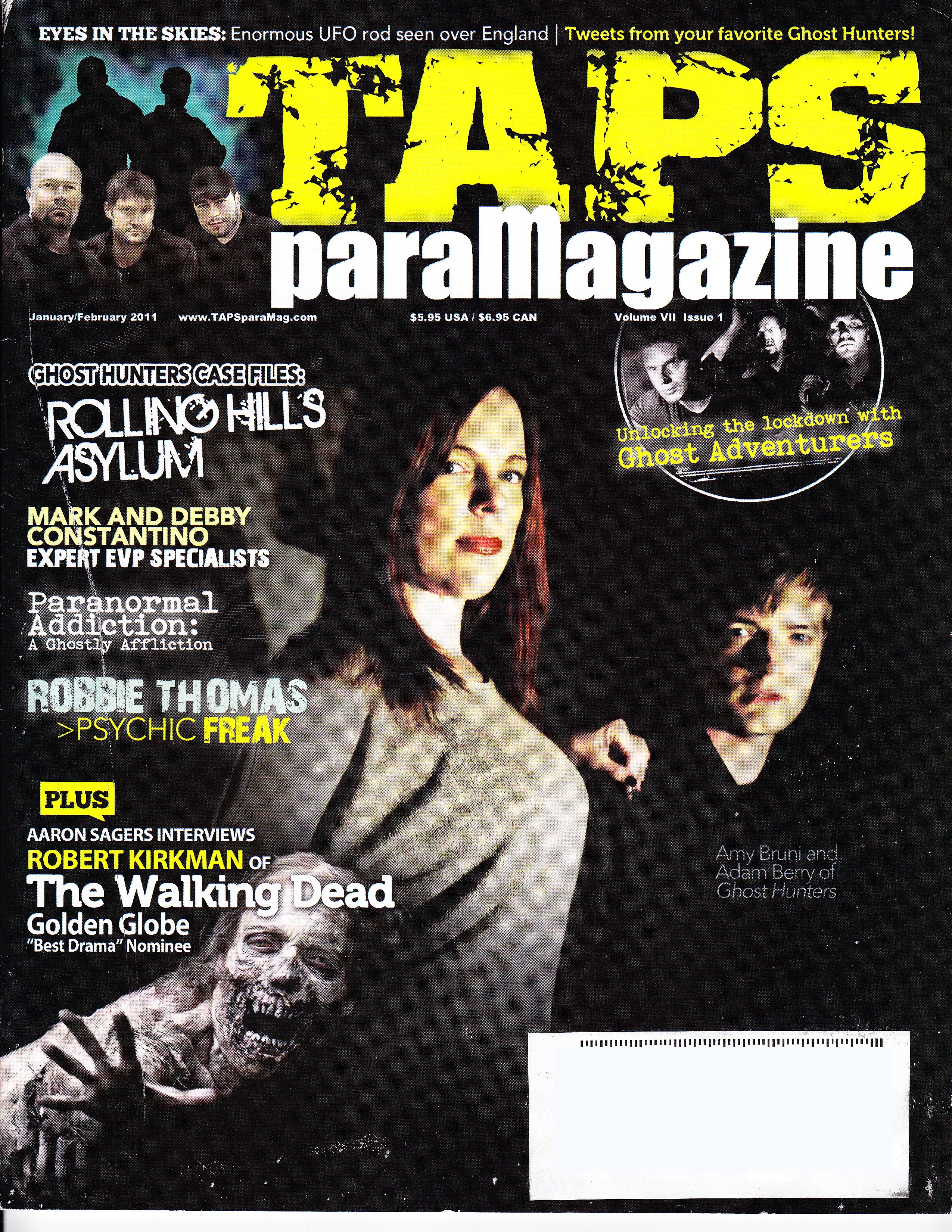
Okay, so I admit I’m curious. As my “six month” subscription to TAPS Paramagazine continues into its second year, itself somewhat paranormal, I get the feeling that I’m witnessing the birth of a new religion. I’ve been in this business long enough to know that new religions are hardly rare, but this one seems an accidental entry into the field. Now ghosts and religion are natural enough as corollaries. Both involve afterlife concerns and the unknown. Having watched TAPS Paramagazine feature fairies, tarot cards, and zombies, however, I wonder if the distinctions are becoming blurred. In this latest issue (January/February) many of the articles make explicit mention of God. God and ghost in the same breath, with the exception of a particularly holy spirit, is an odd combination, given the biblical injunction against mediums.

Spiritualism in the late nineteenth and early twentieth centuries was descried by famous debunkers such as Harry Houdini and accepted by famous intellectuals like Sir Arthur Conan Doyle. It is that liminal area that stays out of the reach of traditional Christianity and Judaism, but strays into the afterlife-prepared psyche. If the dead are out there, they should be able to communicate. Right? And with God’s full approval, so it seems. This latest issue alone suggests that UFOs may be demonic, that clergy may be legitimately interested in ghosts, God may speak through dead children, and that one may become addicted to paranormal investigation. Sounds like a recipe for a New Age mythology. Throwing in light-hearted contributions about the Walking Dead, and suddenly zombies become real as well. Oh, and skunks have a special wisdom.

Traditional Christianity cautions against all of these things (except skunks). When it comes to the supernatural, it claims, there is only one super, supernatural being. The rest are charlatans and wannabes. The Bible certainly does not encourage consorting with ghosts, and yet, in this New Age milieu it is possible to find any remotely spiritual entity touted as proof of reality beyond reality. As Bader, Mencken, and Bader observe in Paranormal America, citizens of this country are inclined to believe. Where does belief lead when there is no pole-star to guide the ship? I sense that we may be steering into uncharted waters. Anyone want to volunteer to be captain? Religions always get to make up their own rules, so feel free to devise your own compass.


Black and White Zombies

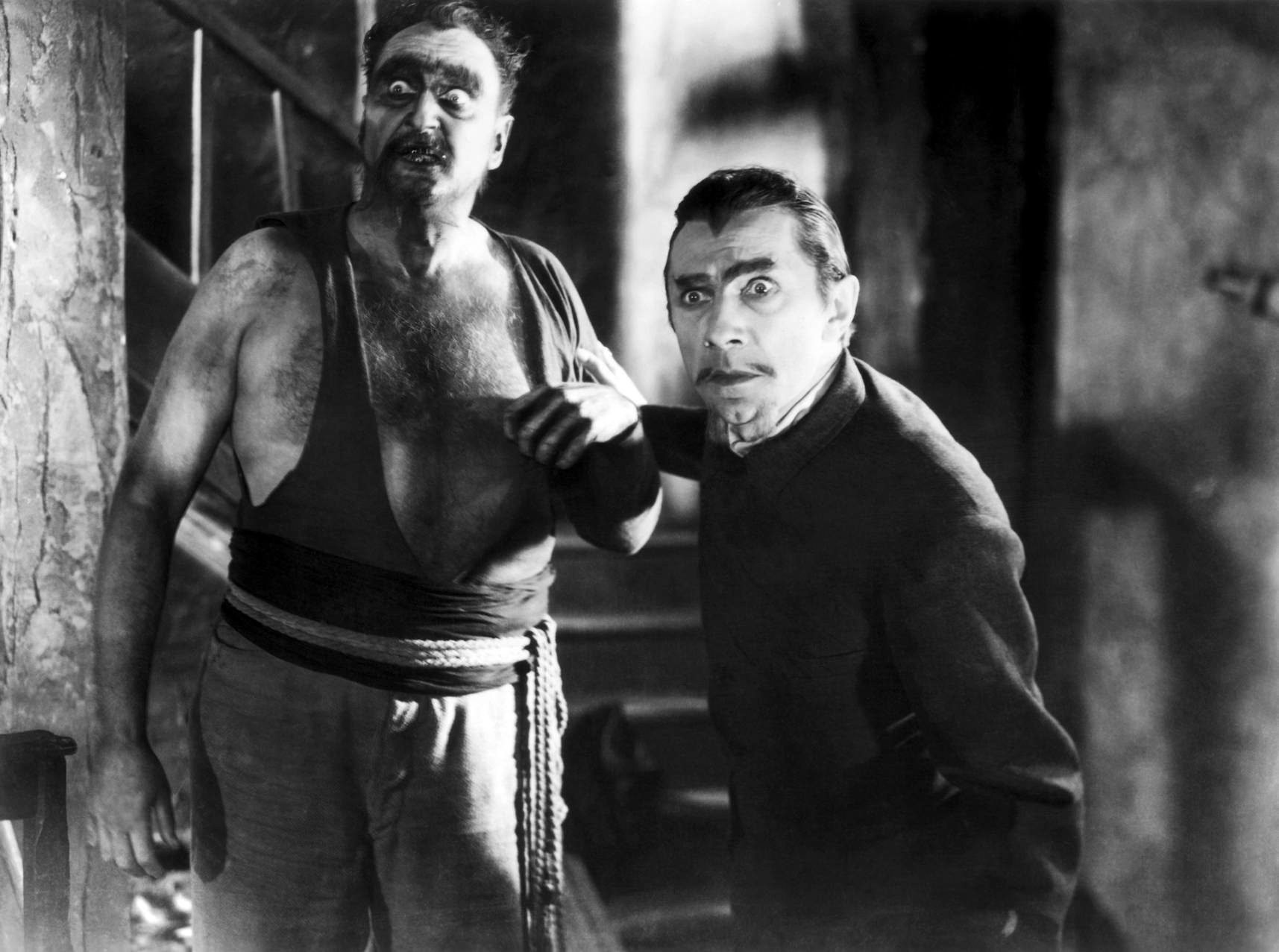
One of the sweetest privileges of a school-year weekend is the Saturday afternoon movie. The advent of relatively cheap, boxed sets of old films has opened the realm of many forgotten classics for me. My wife recently purchased one of those 50-movie boxes of classic horror films for me, and I’ve been making my way through it weekend-by-weekend, and occasionally there is a gem among the tailings. Yesterday I saw White Zombie for the first time. Back in the days when Bela Lugosi claimed a faithful following after his trend-setting interpretation of Dracula, he played a voodoo doctor with the power over zombies in this widely panned movie. In these days of the Walking Dead, it may be hard to appreciate that White Zombie was the first full-length film about our undead friends.

With the exception of the always professional Lugosi, the acting in the film received a well-deserved trouncing. Interestingly, the “van Helsing” of the drama, the doctor who overcame the monster, was a missionary. White Zombie is authentically set in Haiti, and it is never made clear whether the undead are really deceased or simply mindless. But the goofy, pipe-smoking missionary is the one who defeats evil at the end of the day. As noted elsewhere on this blog, monsters frequently emerge from the dark realms of religion, and the zombie especially so. Today, however, the zombie is all the scarier for being secular, unaffected by God or human deterrent. Originally it was a case of voodoo versus Christianity.

In what is perhaps an unintentional irony, the character who comes across the most sympathetically in the film, apart from the fetchingly pouting Madge Bellamy, is Murder Legendre (Lugosi). The missionary wins out by dim-witted happenstance, while the character responsible for the actual death of the zombie master is a partially aware zombie fighting against his fate. It may be assigning far too much credit to assert that the film had intentional social commentary, but White Zombie has had an often unrecognized impact on what has today become the symbol of corporate America: the once humble zombie.

A typical zombie


Souper Sensitive

Last night we had minestrone soup for supper. That’s a pretty bold claim for a non-Italian family in New Jersey, but we try our best. This particular recipe called for shaped pasta, and we have an entire cupboard dedicated to that particular starch. In the back of the cubicle my wife found a package of aleph-beth pasta shapes, a novelty for kids, I suppose. Vaguely I recall having purchased it a few years back to try to interest my daughter in learning Hebrew. (It didn’t have that particular result.) Well, pasta is pasta, and just in case it goes bad after the course of a decade, we decided to use it.

As I was spooning some of the soup out, I noticed the letters shin and a final mem in close proximity, bringing to mind ha-shem, “the name.” It then occurred to me that aleph-beth pasta might lead to theological conundrums difficult to swallow. What if one were to end up with a yod, he, waw, and he in the same spoon? Does ineffable also count as inedible? The larger extrapolation then took over; letters are but abstract symbols, only bearing the meaning we decide they bear. Yet extreme devotion is frequently ascribed to certain words in various religious traditions.

A spoonful of trouble

Soup is, by its very nature, chaotic. Spellings could be simply accidental. To eat or not to eat? That was the question. The purchase of the pasta had been with the purest of intentions. Never before had a wheat product put me in such a compromising position. As I slurped up ha-shemp (only in abstract form, along with zucchini and a bit of carrot) I reflected how much religion controls human behavior. While we may consider it a system of beliefs, its real-world applications are far reaching. Sacred texts and pasta all at the same time. It must be that another semester is about to commence.


Epiphany Perception

Our local parks and recreation department has a Christmas tree recycling program. While trees are biodegradable, it always seems crass to me to take such a symbol of joy, hope, and anticipation and have it just thrown in the landfill. The local trees are recycled into mulch, and those who own their homes are free to help themselves to the giant pile of finely chipped pine that smells like the north woods just minutes from Manhattan. The strange part is transporting a dried, outdated tree through town to the drop-off point. Pedestrians and other drivers stare at a car with a tree strapped to the top a few weeks too late for anyone’s holiday. They may find it just a little disorienting: why would someone be taking a dead tree out for a drive? It is not how we’re accustomed to seeing it done.

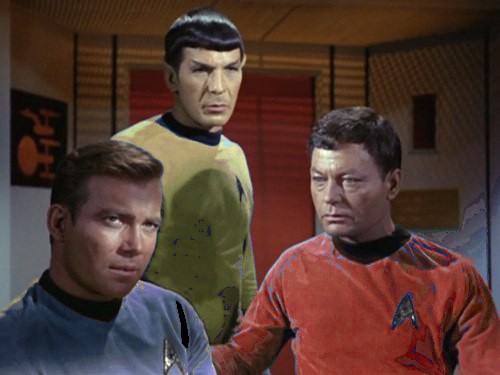
Perceptions, even if entirely artificial, see us through each day. Some continue to argue that perceptions are indeed reality. When we see something mildly disconcerting, we might ask what is happening. A familiar character in an unfamiliar costume is a trivial sort of dissonance, but it is enough to raise perception to a conscious level. We all know the accepted color scheme, so what (other than bad photoshopping) is going on when the Enterprise crew swaps shirts?

The issue is, however, a serious one. Many of the troubles we experience in society are based on fictitious certitudes. It is a strange human trait that me may not know why we believe something, but of that belief we are dead certain. From an absolute perspective, we have no way to determine which way space is oriented. If we see a globe facing “the wrong way” the dissonance drives us to correct that misperception. North, south, east, and west are relative terms. They are models that we overlay on our universe. Which way that universe actually tilts is anybody’s guess. Freshly hewn pine trees atop cars are common in December. When such things transpire in January, many people, to guess from the stares, believe their world has somehow gone askew.

Which way is really up?


Mummery and Divinity

The human psyche is a fascinating study. As an undergrad I stopped just shy of a psychology minor (partially this was due to the place, but also to a haunting feeling that psychologists are often attempting to resolve their own problems). Even as an armchair psychologist there are plenty of human tendencies to note. One that I occasionally mention in this blog is pareidolia, the attribution of significance to random information. Pareidolia often comes in the form of seeing faces, entire people, or even animals, where they don’t actually exist. This has been proffered as the source of belief in everything from ghosts and aliens to God himself. No doubt pareidolia is a strong tendency in the human mind. When my family recently saw Mummenschanz this was again confirmed.

This Swiss mime troupe – pioneers in experimental theater – makes simple objects come to life. The illusion works because of pareidolia. When we saw the show, even the youngest audience members could be heard exclaiming what obviously non-human tubes, slinky-like characters, and shapeless blobs were trying to do. “It wants the balloon!” “It likes that other one!” “It feels sad.” As the various abstract pieces moved about the stage, a laugh was guaranteed if they flashed a simple round orifice at the audience that clearly perceived it as an eye. We attribute intentionality and purpose to objects unvivified without the soul of Mummenschanz inside them.

Prior to the current tour, the last time my wife and I saw Mummenschanz was about two decades ago in Edinburgh. This was long before I’d been introduced to the concept of pareidolia, and, although I enjoyed the show, the more recent experience was more profound for it. Some of the adults present without children left at intermission, perhaps not finding the abstract personalities engaging. Children, however, seemed to comprehend what was going on. This does lend credence to the power of pareidolia to make sense of a bewildering world. When faced with the unfamiliar, we put a human face on it, ascribe it intention, and call it either a deity or Mummenschanz.


Hanny’s Voorwerp Factor 5

Staring at the mysterious green blob of Hanny’s Voorwerp, it’s hard not to imagine being Captain Kirk sitting cantilevered forward in that famous chair on the bridge of the Enterprise. Even for those of us who are not Trekkies, the giant space nebula looms between galaxies where no one expected stars to be born. Their own private intergalactic nursery. With my mind already on Star Trek, I think of the web-page sent to me by one of my winter term students at Rutgers: the Memory-Alpha Bible page. Since my loyalty to Star Trek only reaches as far as the occasional viewing of an episode for light relief – and only from the original series at that – I had no idea that the Memory-Alpha wiki had bloomed into existence like Hanny’s Voorwerp itself. This wiki dedicated to everything Star Trek has 32-and-a-half-thousand pages on every angle of creator Gene Roddenberry’s unintentional universe.

The Bible page’s first paragraph (accessed 1/12/11, sometime around 7 a.m. EDT) reads: “The Bible is a collection of ancient Earth writings usually bound together as a book. The Christian Bible is divided into the Old and New Testaments; however, other translations and versions exist and vary by faith groups. It is among these faith groups that the Bible is considered a sacred text, which is generally viewed as having been inspired by one of the Human gods.” Someone takes his/her future, wiki-writing persona very seriously. Nevertheless, it is a perspective that could be helpful in handling a Bible that has grown politically powerful without being understood here in the paltry twenty-first century.

The page also lists all of the episodes where the Bible is referenced or alluded to in Star Trek. As my student pointed out, almost all of these references (in the original series) are to the Hebrew Bible, with very few being from the Christian Scriptures. This makes sense, given the context of the 1960s when McCarthy’s aroma still hung heavily in the air and the war in Vietnam was daily in the newspapers. To offer up television fare that might have been considered “unchristian” in any way was a faux pas in such tortured times. The Hebrew Bible is great for providing allusions to paradise and apocalypse, but the words of Jesus were taken with a solemnity far too great to allow for fictional space explorers’ banter. So maybe it’s just an accident of astronomy that the amorphous, green cloud of Hanny’s Voorwerp appears to be wearing a galactic halo.

Hanny's Voorwerp on NASA-view


Ender’s God

Some time ago a colleague recommended Ender’s Game by Orson Scott Card, ostensibly because the protagonist is named Ender Wiggin, a surname suspiciously close to my own. I have generally been a reader of literary fiction rather than science fiction, but I enjoy a jaunt into the genre now and then. Set in a distant future, Ender’s Game occasionally references how religion is permitted but frowned upon, in that day. Those naïve enough to accept such old beliefs are relegated a less honorable social status. So far, so good; this is common enough in futuristic stories. Then Orson Scott Card came onto my personal radar screen again. I gave my wife a novelty quote book with feminist sayings as a stocking stuffer. One of the sound bites was from Orson Scott Card, a rare male figure in this tiny book. Then my wife pointed me to religious predictions for 2011 on CNN’s Belief Blog. Once again, Orson Scott Card was present, here classified as a Mormon.

Such convergences are somewhat unexpected in a short space of time. The revelation of Card’s religious orientation was a kind of epiphany to me as well. Considering the contempt for religion in his fictional future, I was surprised to find a faithful author. Then I began to see Mormon theology throughout Ender’s Game. While not an expert in the Latter Day Saints, their belief system was included in several courses I took as a religion major in college. As I read of Ender’s progress through the novel, to the point where he achieves a limited apotheosis, I could see elements of Card’s belief system playing out. The protagonist becomes the deity-figure of his own planet. It was suddenly all very familiar.

I suppose that an entire literary discipline exists where the religious outlooks of authors are extrapolated from their writings. Deeply held values are difficult to mask, even in fiction. When I read for relaxation, however, I don’t look for such information. I must admit that my view of Ayn Rand and L. Ron Hubbard’s fiction nevertheless forever changed when I learned of their belief systems. This is, I suppose, a danger of compartmentalized religion. As a youth I believed everyone should wear their religion on their sleeve. As an adult I know how divisive and dangerous this would be. Whether in the far distant future or in the right now, we take care to hide our religion. Not only does it keep us safe from those of other religions, but often also from those of our own flocks as well.