Strange Reading

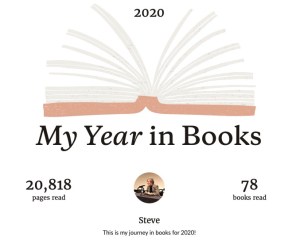
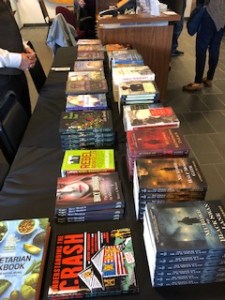
The internet has changed things.  Perhaps forever.  I’m thinking particularly of the way we read.  Not just ebooks, either.  I’m primarily a book reader.  That is to say, I prefer long-format, print writing.  Since we’re fairly isolated (this applied to me even before Covid-19), one of the ways we discuss books is via social media.  There are any number of sites where this takes place such as Book Riot or Goodreads.  I tend toward the latter because that’s what publishers tend to pay attention to.  Each year I participate in a couple of reading challenges.  On Goodreads my goal is a set number of books.  But this has a hidden aspect as well.  What counts as a book?

As a matter of course I don’t count the odd Dr. Seuss book I pick up and read in a matter of minutes.  Nor do I count the many, many books I read as part of my job.  The ideal method of tracking reading on Goodreads is to use the ISBN.  Older books, especially, come in multiple editions, often with differing content.  One way that publishers make money on public domain books is by adding a new introduction or preface to which they own the copyright even though the majority of the text is in the public domain.  The first commandment of capitalism includes the phrase “what the market will bear.”  You can price up until people stop buying.  In order to get value for money, short books are often bound together with other material.  This especially applies to novellas.   Who’s going to pay ten bucks for a book of under 100 pages?

The problem is counting them on Goodreads.  In order for the ISBN to count, you really need to read all the stories in a book.  In steps Amazon.  Making it simple to self-publish, many individuals have rushed in and have saturated the market with public domain material bound and distributed by their own print-on-demand editions.  If I want to read Joseph Conrad’s Heart of Darkness, the older dilemma was you couldn’t buy it alone.  It was almost always bound with some stories I didn’t want to read.  Now, however, some savvy book smith can download an electronic copy, word-process it, format it and sell it to you at a nice markup.  And you can enter the ISBN and get credit for only what you actually did read.  This is a strange new way of reading.  Before I had challenges to complete I’d read a short story or novella and not worry about the rest of the book.  For now, anyway, my reading patterns have changed just to keep up with the challenge.


The Abbey

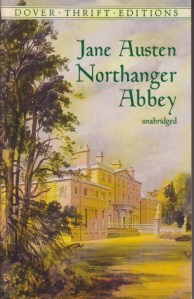
In my efforts to satisfy the Gothic longing of October—such a melancholy month—I’ve been reading Jane Austen’s classic, Northanger Abbey.  I avoided this particular title for many years because I knew that the Gothic frights were all rationally explained.  Austen was such an accomplished writer that she was able to poke fun at the Gothic genre while participating in it, at least somewhat.  I actually read this novel with no idea concerning the plot or characters.  Sometimes for works of the western canon these elements are so well known that you kind of know what to expect.  Northanger Abbey, although appreciated, isn’t often considered Austen’s finest work.  In fact, it was her first novel finished, but was only published posthumously.  As I writer I can understand that.

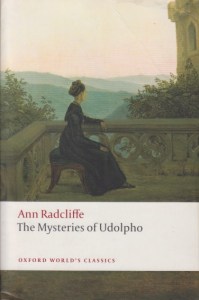
The story follows Catherine Morland in a satire of Gothic novels.  In fact, Catherine’s favorite book is Ann Radcliffe’s Mysteries of Udolpho, one of the Gothic standard-bearers.  The first half of the novel (pre-Gothic) sets the story up with two love triangles formed in the city of Bath.  Austen excels at making the reader uncomfortable with characters.  So much so that the second (Gothic) part of the novel ends up making one of the formerly noble Tilneys,  father of Catherine’s love interest Henry, look downright snobbish and petty.  O, the egos of the privileged!  The fact that she threw this in just about ten pages before the close (in my edition) made the ending all the more anxious.

There are no ghosts in Northanger Abbey.  No murders or poisonings took place there.  No secret manuscripts contained cryptic truths.  No secret passages led to hidden chambers.  Austen sets readers up for all of these, only to bring the conceit down in a showcase of her satirical ability.  The novel still frequently ends up on lists of Gothic classics.  I wonder if readers don’t get the satire.  I had put off reading it for many years because I knew it to be good-natured fun-poking at a genre I unaccountably enjoy.  At least I know I’m not alone in this.  I’m glad, in any case, to have finally read it.  Jane Austen was a most capable writer, a master of portraying human foibles particularly well.  The problems of the landed gentry, however, as I’ve noted before, aren’t really of interest unless there’s actually a ghost or monster lurking in the shadows somewhere.  Without monsters even an imposing abbey owned by a spoiled petty nobility is just an abbey devoid of purpose.


Gothic Tales

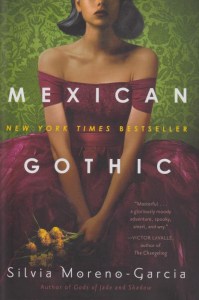
Each year when autumn worms its way into my consciousness, I begin looking for the ideal gothic book.  I can test this by looking at the Goodreads lists of best gothic novels and noting how many of them I’ve already read. The thing now, since I’ve already covered much of the canon, is to discover modern writers who can still evoke that feeling I seek.  This is all complicated by the subjective nature of what readers term “gothic.”  Many of the books on the lists don’t fit my own working connotation, so I keep looking.  One recommended title was Jennifer Giebrecht’s debut novel The Monster of Elendhaven.  I’m still trying to decide whether it is gothic or not.

It’s a little hard to classify, actually.  It certainly has some gothic elements, as well as some horror.  There are secrets and plagues and gruesome murders.  There is a monster from a polluted sea, but not quite your grandfather’s monster.  A human monster.  Or at least partially.  The tale is written with some tongue in some cheek.  There are funny elements and there are many serious moments.  There’s magic and mayhem.  If I were to try to characterize it the closest I might come would be a Tim Burton treatment of horror.  Like Burton, Giesbrecht creates a Halloween mood, but sometimes the humor undercuts it.  This makes it difficult to pin down the work as a whole and figure out if this is the gothic I’ve been seeking.

Set in a time difficult to define and in a fictional nation, it is the kind of novel that can be read without much consequence.  The references to the Allfather make comparison with Nordic regions natural, and there is perhaps a touch of Beowulf here.  In crafting the monster Giesbrecht has made a pretty unlikeable character.  He is a monster, after all.  But not a sympathetic one.  As in other modern treatments he is a stand-in for chaos.  There’s also an environmental sensitivity here.  The monster arises from a polluted sea that derives from, of all things, human greed.  So maybe there’s a parable here.  A short book, it doesn’t take too much of a time investment, but it may leave you wondering what exactly it is that you just read.  It is dark, and gritty, and fun.  A nice combination for an October night.  Is it gothic?  That one’s a little harder to answer.  It depends on how I’m defining it on any particular day.


Twain Shall Meet

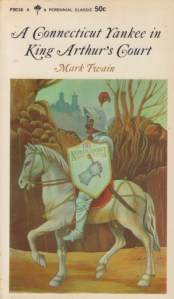
On a slightly hazy fall day, when the autumnal colors were alive, we stopped in Elmira.  To understand the significance of this stop, I should explain that from the time my daughter could appreciate it (and probably even before) we used to make fall literary trips.  We would take a long weekend and drive to where a famous author had lived.  Laura Ingalls Wilder in Pepin, Wisconsin, or Mark Twain in Hannibal, Missouri.  When we moved east we visited Edna St Vincent Millay at Austerlitz, New York, and Washington Irving in Sleepy Hollow.  More recently, in the spring, we went to see Rod Serling in Interlaken, New York.  So it was that we stopped in Elmira, New York, where Mark Twain rests.  I had always assumed Samuel Clemens was buried in Missouri, but his most productive literary period was his time in upstate New York, and it is here he remains.

His tombstone was covered with pennies and a few higher denomination coins, a rock or two, and a guitar pick.  People want to show their respects to the writers who’ve meant something to them.  I find this a moving tribute.  I suspect it happens at the tombstones of many famous people, but in Highgate Cemetery in London we found Douglas Adam’s small plot filled with pens stuck in the ground as mementos.  I travel through the world lightly, seldom carrying anything extra with me.  Somehow I never stop to think to bring a memory to the cemetery.  Fortuitously I had found a penny on the ground the morning we left for Elmira and I placed it among the others on Twain’s marker.  

What would make the appropriate calling card to leave?  I often wonder that.  If I had such a token, I suspect I would feel the need to revisit the various cemeteries of years past to leave a sign of my respect.  There are lots of them.  Edgar Allan Poe in Baltimore.  George Orwell in Sutton Courtenay.  H. P. Lovecraft in Providence.  Is there anything that ties them all together?  Pens seem an obvious choice, but stones are far more traditional (especially in Jewish settings).  The tradition is traced back to building cairns in biblical times, and the idea survives in that stones are more permanent than flowers and are a sign of respect.  Writers often have more elaborate items left, but it’s clear that they are removed from time to time by the grounds keepers.  Before I visit my next literary grave, I’ll give some thoughts to symbols and tokens and the importance of celebrating writing.


Not Sleepy Yet

Over a recent weekend I watched four versions of “The Legend of Sleepy Hollow.”  (I have two excuses.  One is that it’s October, and the second is that I have an article on Sleepy Hollow coming out on Horror Homeroom.  For the second, read on.)  The story is one that made an impact on me as a child, probably because of Disney’s Adventures of Ichabod and Mr. Toad.  The cartoon version, which was one of the four I watched, is silly and scary both.  It leaves it to the imagination whether the headless horseman is real or not.  Before that I watched the silent 1922 Headless Horseman staring Will Rogers.  Clearly in that film the headless horseman is what we’d now call a liberal hoax.  It was Brom Bones scaring Ichabod Crane away from Katrina Van Tassel.

The canon of characters grows with Tim Burton’s 1999 film Sleepy Hollow.  Although Burton is hit or miss for me, this strikes me as one of the best October movies I’ve seen.  The headless horseman is quite real and the spiritual world intersects with the rational, crime and punishment world in the haunted western wood.  I didn’t have time for the 1980 television movie this time around, but I decided to watch the 2007 television movie Headless Horseman.  A rather puerile splatter film set in Missouri, it posits that this is the real headless horseman behind Washington Irving’s story.  It has a lot of religious imagery, which is often what I’m looking for in horror.  The writing is poor and the characters shallow, but it isn’t a total waste of time.

What all of these films demonstrate is that Washington Irving’s story, as simple as it is, really resonated with Americans.  How can you reason or plead mercy from a headless man?  Look closely, for there is a parable here.  The headless are merciless and they have the ability to frighten.  The story is generally set in the harvest season.  The 2007 movie makes the horseman’s appearance as a crucified scarecrow.  Although the original story had no such religious elements, they’ve become a standard part of its accrued cultural heritage.  The headless horseman has gone from secular to religious, for it is an American story.  Originally set in the period after the Revolutionary War, it was part of an unsettled nation’s frustrated attempt at normalcy.  This, I believe, remains.  When we can’t make sense of our surroundings, we look back to those stories that seem to have some insight into who we are.  Headless horsemen are quite useful in that regard.


Ghosts, of a Sort

What happens when we die?  That question is perhaps THE question that drives just about everything we do.  Evangelicalism, masked behind love of Jesus, is really the desperate attempt to avoid Hell.  That idea is powerful and insidious.  The question of what happens, however, has also inspired a tremendous amount of literature.  Lincoln in the Bardo, by George Saunders, is a recent example of how diverse such views may be.  Written mostly epitaphicly, it is a conversation among the spirits in the cemetery the night Willie Lincoln arrives among them.  Fearing what is beyond, these ghosts don’t admit they’re dead, but rather think themselves sick, awaiting recovery.  When the profoundly bereft Abraham Lincoln arrives to mourn his son, things begin to change.  

All through my reading of this book I found myself wondering about the many ways we conscious creatures reassure ourselves about death.  Materialists say it’s like the turning off of a lightbulb.  All goes dark and there is no soul to remember anything.  Many of them claim science for proof, although science has no way to measure the non-physical.  Various religious sentiments of the eastern hemisphere posit reincarnation until one’s soul reaches the point of no longer having to cycle through all of this again.  Here in the western world, influenced by a Zoroastrian-inspired Christianity, we posit a Heaven and Hell.  Some include various shades of Purgatory, which, to the classic Greek, would’ve sounded familiar.  Those who’ve undergone Near Death Experiences often suggest a more dream-like reality of acceptance.

There are many more shades and nuances, of course.  We’ve entered the shadowy half of the year.  Those of us in temperate regions spend half of our lives with nights longer than the days.  Death, however, is generally a shunned topic.  We try to avoid talking about it since we really don’t know what comes after.  We have beliefs.  We have hopes.  We really just don’t know.  We often look to literature to help us explore these topics.  Lincoln in the Bardo does so with some humor, some sadness, and some soul-searching.  Those of us drawn to ghost stories naturally think about them as we wait later for the morning sky to lighten, and find it dark before we turn in for the night.  A great many options await us, some with a kind of historical anchor, and others that are completely made up for our edification.  The one thing they all have in common is they force us to think of that which we really don’t know.


Unintentional Patterns

Time, they say, is what prevents everything from happening at once.  I’ve noticed something about my reading life (is there any other kind of life?).  One of my favorite topics on this blog is books.  Both reading and writing them.  When I wake up and try to clear the cobwebs of sleep from my head to think about the day’s post, I always feel relieved when I have a book I’ve just finished because that’s an eager and ready topic.  When I’m in the middle of a large book, it seems like a long time until I’ll be able to jot down some thoughts on it, and the ideas don’t always flow.  It’s here that I’ve noticed a strange kind of pattern and it has to do with the way I read.  Interestingly, it isn’t intentional.  It goes back to my post-commuting literary lifestyle.

I read nonfiction in the mornings.  I awake early and after about an hour of writing I try to get in an hour of reading before thoughts turn to work and its unraveling effect on the fabric I’ve been weaving before the sun rises.  The nonfiction I read depends, to a large extent, on my writing projects.  Not exactly the kind of research that time and libraries afford academics, but still, research in my own way.  Often these nonfiction books are large—400 pagers seem to be the trend.  I’m a slow reader, so they take some weeks to finish.  At night (or actually evening, for I retire early) I read fiction.  It isn’t unusual for my fiction choices to be briefer than the nonfiction books of the morning.  It always seems, however, that I finish two books very near the same time.  Then I have two book posts in a week and many days without any.

Since we married over thirty years ago, my wife and I read to each other.  Usually she reads while I wash dishes.  Those reading choices are by mutual consent.  They sometimes make their way into my research, but more often they show up in my fiction writing.  In any case, they also seem to fit this same pattern.  When I finish a large nonfiction book in the morning, the same day, or the next day, I generally finish my fiction book.  Shortly after that our dishes-reading book finishes.  I’ve noticed this happening over the past couple of years and I always wonder about unexpected patterns that I find.  It doesn’t always happen this way, but it does often enough to make me wonder.  If I intentionally set out to do this it would be understandable, but as it is, it simply happens.  As they say, things tend to occur in threes.


BBW

It’s a measure of how busy I am when Banned Book Week has started before I realize it.  Most years I make it a point to read a banned book at this time, but my reading schedule is so crowded that I seem to have missed the opportunity this year—I didn’t see it coming.   I’ve read a great number of the top 100 banned books over the years, and I’m sure I’ll read more.  I’ve recently been reading about America’s troubled history with free expression.  Probably due to a strong dose of Calvinism combined with Catholicism, many of the books challenged and banned, as well as prevented from ever seeing the light of day, have to do with bodily functions.  Sex, especially.  In American society, as freely as this is discussed, we still have a real problem when someone writes about it.

Why might that be so?  Many religions recognize the privacy aspect of sexuality without condemning the phenomenon itself.  The Bible (which is on the list of Banned Books) talks of the subject pretty openly and fairly often.  Our hangups about it must be post-biblical, then.  Much of it, I suspect, goes to Augustine of Hippo.  Although he had a wild youth, Augustine decided that nobody else should be able to do so guilt free, and gave us the doctrine of original sin.  Add to that the legalistic interpretation of Paul and his school, and soon the topic itself becomes difficult to address.  Victorian values, obviously, played into this as well.  Literature, which explores every aspect of being human, is naturally drawn to what is a universal human drive.

Banned Books also treat race—another topic that haunts America—or use coarse language.  Some challenge religious holy grails, such as special creation or Christian superiority.  It seems we fear our children being exposed to ideas.  The wisdom of such banning is suspect.  The publishing industry has many safeguards in place to create age-appropriate literature.  Banning tends only to increase interest by casting the “forbidden” pall over something that is, in all likelihood, not news to our children.  American self-righteousness tends to show itself in many ways, making much of the rest of the world wonder at us.  We seem so advanced, but we fear a great number of rather innocuous books.  The reasons are similar to those behind why we can support tax-cheating, womanizing, narcissists as leaders: our faith blinds us.  I may be late in getting to my banned book this year, so I guess I’ll just have to read two next time.


In Black

When autumn rolls around my hankering for gothic literature ratchets up.  It’s really my gothic sensibilities that make me watch horror films, seeking some kind of transcendence.  Some time ago I heard about the movie The Woman in Black, but I’ve never seen it.  I learned about the novel by Susan Hill, on which it’s based, and decided to check out the written form.  (I almost always like the book better than the movie anyway.)  The story is indeed moody, set in, as these stories often are, a remote part of the coast of England.  A lonely house cut off by the tide.  A hidden past full of secrets.  The plot is one of a vengeful ghost, and therefore the whole is somewhat supernatural.

I couldn’t help comparing it to Andrew Michael Hurley’s The Loney, which is also set on the coast of England, and also features a house cut off by the tides.  The storylines are quite different beyond that, but it is often the setting that makes gothic tales so, well, gothic.  The Woman in Black builds up the story slowly, intimating that something is wrong near the start, but not really giving too much away until near the end.  It isn’t really the conclusion, however, that a gothic reader is after, as much as the feeling.  Being immersed in a spooky setting where you’re not sure what’s going on.  There’s a kind of release in that.

I’ve often tried to figure out why this type of story appeals to me.  It’s certainly something to do with my childhood.  We didn’t live in a very gothic place.  My hometown was working-class normal, it seemed to me.  When we moved into the first apartment I remember, the setting did become gothic to an extent.  It was an older building that still had gas jets jutting through the walls from the days before electricity.  One of the bedrooms was painted black.  There was a huge crack in the linoleum in the hall that had the potential to trip you if you weren’t paying attention.  It was there that I first became aware of liking gothic settings.  It was the place I discovered Dark Shadows and began to find it strangely homelike.  Many of us, even with less-than-ideal childhoods, often look back to them with a kind of happiness that we just can’t seem to attain as adults.  Mine included some gothic elements, and reading novels like The Woman in Black takes me back there, if only for a little while.


Bird Land

Since I like to blog about books, my usual reading practice is to stick with a book once I start it.  This can be problematic for short story collections because often there’s one in particular I want to read.  Somewhat embarrassed about it, I have to confess that sometimes it’s because I saw the movie first.  So it was with Daphne du Maurier’s “The Birds.”  Du Maurier, the daughter of a father who also wrote horror, caught Alfred Hitchcock’s attention.  Several of his movies were based on her works.  Not all of them can be called horror—a genre that’s difficult to pin down—but they deal with gothic and thriller themes that had an appeal for Hitch.  In fact some analysts date the modern horror film to the period initiated by this iconic director.

I have a collection of du Maurier’s short stories, written in the day when 50 pages counted as a short story rather than “product” that could be “exploited” in various formats.  (Today it’s not easy to find literary magazines that will publish anything over 3,000 words, or roughly 10–12 pages.)  In any case, “The Birds” is an immersive tale.  The movie is quite different, of course, set in America with a cast of characters that can only be described as, well, Hitchcockian.  Du Maurier’s vision is much closer to the claustrophobic pandemic mindset.  A single English family, poor, tenant farmers, far from the centers of commerce, must figure out how to survive the bird attacks on their own.  The suddenly angry birds attack their hovel in time with the tides (they live near the coast) so the family has to gather supplies between attacks and try to last another night of pecking and clawing.

The story is quite effective.  Reading it suggests the importance of self-reliance and willingness to accept a changed reality on its own terms.  No explanation is given for the birds’ change of attitude.  Human intervention in the environment is supposed but how would a simple family living of the fringes of the fabric woven by the wealthy know?  Forced to react, they try to keep the kids calm while knowing, at some level, this can never end well.  The movie maintains the ambiguous ending, which is probably what makes it so scary.  Corvid or covid, there are things out there that drive us into our homes where we must shelter in place.  Although I didn’t read the whole book, this choice of story seems strangely apt for the current circumstances.


Setting the Mood

I can’t recall how I learned about Andrew Michael Hurley’s The Loney, but it was one of those books I knew I wanted to read.  One thing I do recall is that I didn’t know it had anything to do with religion until I started it.  It became quite clear that the story—which is difficult to classify—revolves around religion and a kind of gentle horror of things not being what they seem.  Set on a lonely stretch of English coastland where strange things happen, a family takes their mute son to a shrine to have him healed.  The younger brother, not mute, narrates the events.  There are many creepy suggestions of what may be happening, but a full explanation is never given.  That’s kind of like religion itself.

While I don’t normally read the discussion points or classroom/book group discussion material after most modern novels, I found Hurley’s included essay on “Nature, Faith, and Horror” to be of interest.  Several of us, it seems, find the combination of religion, or faith, ties in well with fear.  That was a large part of what I was trying to get at in Holy Horror.  Hurley goes in a different direction with it.  A family under the overbearing religion of the matriarch does her bidding in the hopes of either keeping peace or participating in the healing her son.  We learn from the opening pages that her son Hanny develops into a minister, and therefore has some degree of normalcy.  Hurley is a master of revealing important factors only gradually.  It keeps the tension rising as the story goes along.  There’s no bloodbath, but there is unsettling mystery.

The story is probably best characterized as gothic.  That’s rare these days, and it is the sub-genre of horror that most attracts me.  The mood it casts is kind of a spell and it’s difficult to break.  The Smith family insists on the sacredness of place and on strict religion of the Catholic species.  Evangelicalism could easily lead to horror, and not infrequently it does.  The Catholic variety, however, feels older.  More arcane.  There are things only a priest knows.  And that knowledge can be a challenge to both the knower and the seeker.  The Loney will leave the reader with questions ticking away about what really happened.  These are things we’ll never know.  Those of us who’ve ever entertained religious vocations understand this feeling well.  It stands behind certain kinds of horror and in front of religion, tying them together.


More than Kids’ Stuff

Children and Young Adult literature (which has its own Library of Congress acronym!) has come a long way since I was a kid.  Don’t get me wrong—I enjoyed the books I read as a young person, but there are many more choices that use a lot more imagination these days.  I’ve been reading Robert Repino’s books since Mort(e) appeared in 2015.  Spark and the League of Ursus is his latest and it continues his trademark use of animals (and stand-ins) to get at very human situations.  Spark is a carefully crafted story based on the idea that teddy bears do more than provide cuddles at night.  They are, in fact, a force for good, protecting human children from monsters.

As usual when I discuss books, I won’t give too much away.  I’m one of those guys who doesn’t even like to read back-cover blurbs because I’m afraid they’ll spoil the story.  Instead, I’m going to applaud the use of imagination in a world that seems stuck on a limited number of plot points.  Books like this, which stretch the imagination of the young without talking down to them—why does it cost us so much effort to admit that kids are smart?—are a great addition to CYA literature.  I was exploring this concept with another friend who writes when I read Hank Green’s An Absolutely Remarkable Thing.  A story’s intended audience is often signaled by the age bracket of the protagonists.  I’d suppose ‘tweens might be about the age here, based on that metric.  (Green was more like New Adult, a category that lasts until about age 30.)

Reading material written for younger readers makes me feel younger myself.  I read Ransom Riggs first three Miss Peregrine novels (also published by Quirk, the house that publishes Spark).  You see, I’m really encouraged by this growth in younger readers’ material.  If we can get kids into books with such engaging stories I suspect there’ll be less chance that they become unimaginative, straight-laced adults who want to keep things just like they were when they were kids.  Imagination has that kind of liberating ability.  Besides, who doesn’t want their teddy bear to come to their rescue once in a while?  It’s not just children that can take a lesson from imaginative story-telling.  Repino’s War with No Name series was intended for adult readers but it is good preparation for getting a sense of the possibilities for readers who might, in all hope, never have to face wars at all.


Marching down the Middle

It is true that I have a fondness for nineteenth-century British novels.  Even though they often lack a strong speculative element they tend to be gothic, at least if written by one of the Brontë sisters.  I’d only ever read one of George Eliot’s novels before, and that was in ninth grade.  Middlemarch has been on my list for many years, but due to its intimidating size I’ve kept putting it off.  Now that I’ve read it I feel like I’ve accomplished something.  I had no idea what the story was about in advance, and no idea how it ended.  Unlike many pieces of literature of its time it hasn’t made a huge impact in pop culture, so this was the opportunity to lose myself for a few months in a world completely unknown.

I’m not foolhardy enough to try to summarize an 800-page novel here, but one aspect that the reader can’t help but notice is the prominence of clergy.  And not only prominence, but prestige.  In a world built around the solid belief in different classes of individuals, where pride takes a place in marriages that are supposed to be within class, the clergy are minor nobility.  Since this is the Church of England the vicars can marry and indeed, one such marriage sets off the tension that lasts throughout the hundreds of pages to come.  The clergy of the time were often gentleman scholars—the role that was envisioned for Charles Darwin as a young man.  Eliot plays on that idea with some of her preachers being amateur scientists.

The conflict—that now feels inherent—between science and religion has less to do with older forms of Christianity than it has to do with evangelicalism.  A relatively new expression of Christianity, evangelicalism set itself against modernity and its science.  Quite often today when commentators rail against “religion” it is really evangelicalism that they have in mind.  In the world Eliot sketches, she sees no difficulties between a rational view of things and an ecclesiastical one.  Clergy are often seen at the whist tables and taking long walks down country lanes.  The distinction between them and the average citizen is that they have been to university to study.  Today, in mainstream Christianity anyway, clergy are educated at least to the master’s level.  They’re no longer among the minor nobility, however.  Middlemarch has more than a hint of nostalgia to it, and the clergy roles show that clearly.


A Slice of Childhood

Few names from childhood are as well known as Dr. Seuss.  When my wife and I read Theodor Seuss Geisel, in the Lives and Legacies series, we realized that neither one of us had learned to read with his books.  It’s not that they hadn’t been written and widely adopted yet (they had by the time we started school), but rather that our districts had gone with other fare.  I learned with the famous Dick and Jane series, and I think there must’ve been some Seuss thrown in here and there.  We didn’t own any of his books, but I remember my mother reading from library copies of Hop on Pop.  When our daughter was born we read to her daily and Dr. Seuss was a large part of our informal curriculum.  Before reading this book, however, I knew very little about who Theodor Geisel was.

The series Lives and Legacies features short books, so this is a quick and no-frills way to meet the man.  Although Geisel was born into a middle class family, he experienced (ironically) the trauma of being in a German family during the First World War.  What we would call hate crimes today were committed against German-Americans during the war, even though there were sizable populations of Teutonic Americans by that point (including my mother’s family).  Not only that, but Prohibition put his father’s brewing company out of business.  Still, Seuss was accepted at Dartmouth and, like many who make it to the Ivy League, his connections helped him to a successful career in advertising and then in writing children’s books.

Geisel was a successful man, but wasn’t driven by money.  He was an artist both with images and words, and as Pease makes clear he approached his craft seriously.  As he matured he began to address social and political issues in his larger formatted books.  He eventually became the most successful children’s book author in history.  Reading to my daughter when she was young we discovered that, unlike the often idealized times of the fifties (followed by the sixties into which I was born) there is a wealth of quality children’s literature available.  It’s easy for middle-class kids to be raised loving reading.  Dr. Seuss knew that the pretensions of adults often created the seriousness with which we face life.  Children enjoy fun and the ridiculous.  He never lost sight of that simple fact.  We live in times when it is readily to be wished that many of the adults in power would go back and read a little Seuss and perhaps, just perhaps, learn their lessons.


Fiction

All writing is fiction.  I suppose that requires some unpacking.  One of the first things we do when we approach a piece of writing is answer the question “what kind of writing is this?”  We may not do this consciously, but we wouldn’t benefit much from reading if we didn’t.  If your significant other leaves you a note stuck to your computer monitor or the refrigerator door, you know at a glance that it likely contains pithy, factual information.  If you pick up a newspaper you know what to expect the contents to be like.  It’s quite different if you pick up The Onion.  Or a romance novel.  These categories are extremely helpful, but they can also be problematic.  Any writer knows that you write and others decide on your genre.

I read a lot of nonfiction.  It is a kind of fiction, however, since it follows a narrative and it contains mistakes, or perhaps faulty assumptions.  Moreover, nonfiction is a reflection of its own time.  Geoffrey of Monmouth’s England had giants in its past.  It simply did.  Today we question his working assumptions just as surely as future people (if we long survive) will ours.  This current generation doesn’t really excel at critical thinking.  Many academics, as critical as they are in their own fields, fall into standard assumptions once you get beyond their expertise.  They accept the fictions of their era just as readily as does everybody else.  In reality our nonfiction is not the naked fact we like to think it is—it is the narrative of one perspective.  It is perhaps the truth as it is perceived in its own time.

This may seem to be a subtle distinction, but it is an important one.  Genres are very convenient handles that we use to classify what we’re reading.  Very often they become straightjackets that constrain what writing has the potential to be.  The word “genre” is related to the concept of genus, the classification about species.  Zonkeys and other, perhaps rare, but possible cross-breedings show us that hopeful monsters of the literary world are also possible.  We would soon suffer without genres in a world as full of words as this one is.  We also suffer from simple distinctions that somehow become iron-clad over time.  Think about the narrative that comes out of the White House.  We’re accustomed to it being mostly nonfiction.  At least we were until recently.  Watergate broke our trust in that, and now we live in a world of fiction masquerading as reality.  Critical thinking is, perhaps, the only way to make sense of any of this.