Growing Shadows

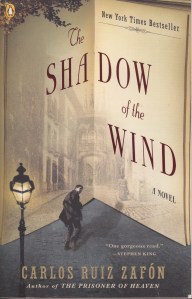
As summer wends its way slowly toward autumn my reading becomes more gothic.  It feels as natural as the progression of the seasons, I suppose.  While waiting for the turn I’d been holding onto Carlos Ruiz Zafón’s The Shadow of the Wind.  Not having read any Zafón before, I wasn’t sure what to expect.  My copy had been blurbed by Stephen King, and I figured that was pretty high praise.  I found the book through one of my web searches for the most gothic novels and this one takes a while, but I can see why it makes some of those lists.  I wasn’t sure at first if it was intended to be comic or serious, but that combination is an imitation of life itself.  We laugh, we cry, we shudder.

The story slowly builds, and I’ll address this further on Goodreads.  What I want to consider here is the nature of place.  Human beings—and I would argue animals as well—have a sense of place.  Space becomes sacred through events both dramatic and quotidian.  That’s why we make pilgrimages to places where our heroes lived.  Just to be there.  To think about it.  To feel it.  The Shadow of the Wind is a story of Barcelona during a time of war.  There’s no escaping the moody sense of old Europe in this tale.  In that sense religion is quite often casually mentioned.  It’s part of place in a way many Americans overlook.  The church bells I can hear everyday beg to differ, no matter how empty the pews may be.  Zafón wants to share his gothic Barcelona with a story that leads to real shivers.

It would be a stretch to call this a horror novel, but it is in the sense that V. C. Andrews’ Flowers in the Attic is.  It reminded me at several points of Wilkie Collins’ The Woman in White (my copy of which was destroyed in a flooded garage).  Many lives, I suspect, have quiet gothic elements to them.  I know that mine does.  While there may be a little supernatural at work in The Shadow of the Wind, most of the action is believable.  This is the way people behave.  The way they treat, and mistreat one another.  While the days are still hot around here, the angle of the sun in the sky doesn’t lie.  We’re fast approaching the equinox from which we’ll slide into the long nights of winter.  And reading, the more gothic the better, will help us make it through no matter where we are.

Cthulhu You Knew

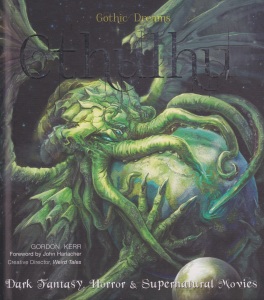
Humans tend to be visually oriented.  Arresting images stop us cold, causing us to focus on what we’re seeing.  As a tween I could be transported by large, lavishly illustrated, full-color books of other worlds.  While these went the way of Bradbury, I still sometimes recollect scenes that stopped me in my young tracks, making my juvenile mind wonder, what if…?  As an adult I realize “coffee table” books are heavy and a pain when you’re moving.  Printed on specialized paper, they have more heft than your mass-market paperback, or even most academic tomes.  Nevertheless, Gothic Dreams Cthulhu was a book that carried me, like a time-machine, back to my younger years.  Unlike in those days, however, I read the text as well as lingered over the images.  And I wondered about Cthulhu.

You see, I didn’t know about Lovecraft as a child.  The only reading regularly done in my family was Bible-oriented.  I discovered science fiction and gothic literature as a tween and, living in a small town, had no one to guide me in my choices.  Rouseville (the town pictured in the background on this website) had no public library.  My reading was left to my own, uninformed devices.  I discovered Cthulhu through my long fascination with Dagon.  I’d pitched Dagon as my dissertation topic, but settled on Asherah instead.  While teaching religion at the University of Wisconsin Oshkosh, I discovered Lovecraft, and Cthulhu, through Dagon.

Gordon Kerr, the author of Gothic Dreams Cthulhu, might be forgiven his hyperbole about H. P. Lovecraft.  Lovecraft was not a great writer—that’s not intended as any kind of slight, I hasten to add.  Classically, however, he didn’t have the level of literary finesse of Edgar Allan Poe, for example.  Still, Lovecraft created credible worlds.  His was a life of imagination—one might almost say divinity.  He was a creator.  Cthulhu has become a cultural icon.  With the magic of the internet bringing a writer still obscure to international attention, many people who never read horror fantasy nevertheless know who Cthulhu is.  Or they think they do.  As Kerr explains, the descriptions by Lovecraft himself are spare, thus the variety of ideas represented in the delicious artwork on every page of this book.  As Lovecraft earns more academic attention, surely others will notice the religious potential of the Great Old Ones that were, in their time, gods.  A guilty pleasure read, to be sure, Gothic Dreams Cthulhu fits well into this serious world of chaos we’ve created for ourselves.


The Persistence of Unity

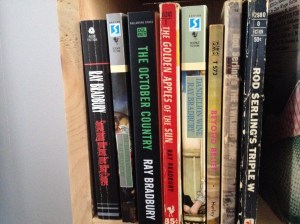
I came across some Ray Bradbury books while unpacking.  I recently learned that Ray Bradbury was a Unitarian.  Now, the religion of a writer is only ever an ancillary bit of information, yet for someone of my combination of interests, it’s compelling intelligence.  Having grown up reading Bradbury, my own fiction often comes out seeming like an imitation of his.  I discovered him the way I found most of my early, influential writers—through Goodwill.  Living in a town with no bookstores, Goodwill was a great venue for walking out with a good handful of books for under a buck.  Since Mom was there looking for “practical” stuff, I hovered over the book tables and discovered a new world.  Then I grew up.

Embarrassed by my childish interests, I gave away or sold most of my Bradbury books after college.  I was more sophisticated than that now.  I read Greek and was soon to learn Hebrew.  Books were meant to have footnotes, and lots of them.  Who wants to be seen with Bradbury on their shelves?  But the indiscretion of youth does come back to haunt one.  About two decades later I began to yearn for something missing from my life.  Perhaps like a good Unitarian I wasn’t exactly sure what it was, but I knew it was lacking.  Then my daughter was assigned Fahrenheit 451 for school reading.  I tried to read whatever she was assigned, and once I did memories of Bradbury flooded back.  I no longer had his books, but that could be remedied.

Occasionally I’m criticized for having too much in the way of books.  I’m sometimes asked if I will ever read some of them again.  The answer is how should I know?  I jettisoned Ray Bradbury with Episcopal pretention, only to find that behind the ceremonial there was a more unified version of things waiting.  A continuity with my younger self.  A lust for imagination.  A desire to remember what it was like to walk on Venus.  Or to see a man presciently covered with tattoos.  Or simply to thrill at the idea of October.  I began to acquire the old books again.  The newer editions lacked the visual resonance of the old, but the essence was still there.  Orthodoxy, I discovered, often isn’t true to life.  What’s true is what we discover early on.  Sophistication isn’t all it’s cracked up to be.  And yes, I may well just read that again after all.


Be It Resolved

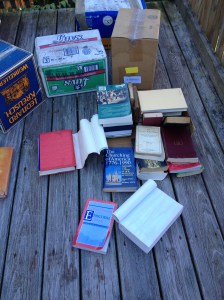
I’m not a believer in New Years Resolutions.  A constant and critical self-monitor, when I notice a bad behavior I try to correct it right away.  Sometimes I’m actually successful.  Now that I’ve finally removed all books from the garage—some were being held high above the water-line on plastic boxes—I’ve started to sort through systematically what is beyond redemption.  A comment of occasional visitors, however, has goaded me into a resolution; you see, people sometimes ask “Are you going to read those again?”  While aching to address the mindset betrayed by that very question, I cede a point; if I’m going to the expense of replacing a non-reference book, I should want to read it again.  My resolution—when I buy another copy, I will read it then and there.

One of the stinging parts of this resolution is that some of the books were read by me just this past year, or even earlier this year.  Jude the Obscure, although I enjoyed it, cost me a quarter year of my life of evening reading time.  On that basis alone I should replace it, but if I’m not going to reread it why should I incur the expense?  (Moving is anything but cheap.)   I will also face rereading old favorites that have been put aside for a while.  No house, for example, should be without Emily Brönte’s Wuthering Heights, although I read it again just months back, or so it feels.  

This is perhaps a way of making lemonade from a cloud.  Or finding the silver lining on a lemon.  Whichever it is, I sense that it will figure toward my reading goal for next year.  As I’ve spent the rainy weekend unpacking books, literacy is on my mind.  For those who see my literomania as some kind of disease, I was cheered to note just how many of the books on display I had indeed read.  The same goes true for a number of the academic books in the study, but, I must confess, while pulling them from their boxes I thought how boring most of them are.  Boring, however, doesn’t equate to useless when it comes to books.  Given their price points some of them may take years to replace.  That’s the point of a resolution, in any case.  It can cause some pain.  As I stuff the moldy, distorted tomes into their body-bags I hope that rereading their replacements will bring them back to life.  After all, resolution and resurrection are not so far apart.


Trending Horror

It’s not often that I can claim to be ahead of the curve.  A “late bloomer,” I was a timid child whose reaction to most of the world was a species of phobia.  It probably didn’t help that I watched monster movies and was an early fan of the original Dark Shadows.  As I learned to relate to others and take consolation in religion, these more macabre interests became latent rather than obvious, only to come out into the open when working at a Gothic seminary in the woods of Wisconsin and then being fired from said seminary, casting me into the outer darkness.  I found myself being interested in horror again although I’d put it aside from bachelor’s to doctorate.  Now it started to feel therapeutic.

My wife sent me an NPR story by Ruthanna Emrys titled “Reading Horror Can Arm Us Against A Horrifying World.”  The premise is one I’d read before—we find horror compelling because it gives us skills that we need to survive.  It teaches us how to separate evil from mere shadow and how to (or not to) fight such evil.  In other words, horror can be heuristic.  Those who know me as a generally calm, quiet—shy even—individual express surprise when I confess to my secret fascination.  One of the most common responses is the question of “why?”  Why would anyone want to watch such stuff?  My observation is that those who ask haven’t tried.  Horror is not often what it seems.  Or perhaps they have better coping mechanisms than I have already in place.

The names of many writers of what might be considered horror have gained mainstream respectability.  Stephen King’s name alone is enough to assure the success of a novel.  These days you can mention the name Lovecraft and a fair number of people will have at least heard of it (him) before.  Jorge Luis Borges has respectability for having been Argentine.  Joyce Carol Oates for being both an academic and a woman.  If you’ve read their works, however, there’s no doubt that something scary is going on here.  As Emrys points out, with our world becoming a more polarized and frightened place, horror may be ready to hang out its shingle saying “the mad doctor is in.”  In fact, it may become even more popular than it is already.  We human beings set ourselves up for horror constantly and repeatedly.  I’m seldom ahead of the curve.  I hang back to see what might happen to those out in front.  Call it a survival technique.


False Memory

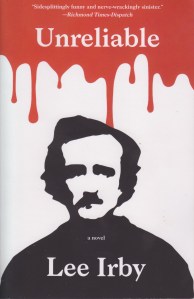
One of the reasons our recent loss of books hit me so hard is that each volume contains memories.  Among the more disturbing developments of memory studies in recent years is the fact that what we remember has a tendency to be unreliable.  In other words, our narratives about ourselves contains a good deal of fiction that we remember as fact.  Even if we write down our impressions shortly after an event, such scribbles are just that—impressions.  Lee Irby explores this dynamic in his novel Unreliable.  Now, since the narrator may be the most unreliable I’ve ever read, I don’t want to give away too much.  Irby knows what it’s like to be a professor (something that some of us share with him) and he has a good sense of Edgar Allan Poe.  It’s one of those books that touched on a number of things in my own life.  I think.

First of all, this was an impulse buy at Buffalo Street Books in Ithaca, New York.  I soon discovered why they stocked it.  Edwin Stith, the narrator, teaches at a fictional college in Ithaca.  The story, however, is set in Richmond, Virginia, where Prof. Stith has gone for his mother’s second wedding.  With characters compellingly drawn, he meets his new step-family, runs into an old-girlfriend, and tries to both avoid and hook up with a student of his that he’s dating, more or less.  He claims from the start, however, that we shouldn’t believe him.  The largest part of the story takes place over one feverish day following a very late arrival in town, with plenty of Poe references sprinkled throughout the tale.

Apart from the Ithaca and former professor connections, the book also mentioned, rather spookily, meeting a girl from Slippery Rock University—a rather obscure school from my old neighborhood.  I had dated a Slippery Rock co-ed who’d proved about as unreliable as our narrator, so this single, brief reference managed to jump-start some of my own memories, reliable or not.  Our pasts, along with the books we read, make us who we are.  I’ve lost track of how many times I’ve thought of a scene I’d supposed I’d forgotten from a book I’ve read years ago.  Just the other day I recalled, completely out of of the blue, apropos of nothing, a scene from a Doc Savage novella I’d read as a tween.  Was it a reliable memory?  I have no way to judge, I guess.  And that’s the scary part, as I’m sure Poe would’ve agreed.


Written Resistance

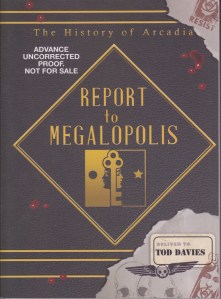
Power isn’t what you think it is.  That’s something autocrats never really learn.  Tod Davies explores this tale of our times in Report to Megalopolis, the fourth book of the History of Arcadia series.  The world is taken over by a single-minded dictator who discovers power isn’t what it seems to be.  Assuming power will bring fulfillment, the antagonist gets what he wants, but he doesn’t know what he wants.  (Like a certain rich fool whose name we can’t help but hear daily.)  Wanting for wanting’s sake, and refusing to be denied.  In that sense it’s a simple tale, but as with all of Davies’ stories, it’s more complex than it seems.  The message of resistance comes through loud and clear.

Laying out the groundwork for the tale, she describes, among other things, the religion of Arcadia.  Writers unafraid of reality will note that people have religious beliefs, no matter whether the narrator—or author—shares them.  Worlds without religion are fantasy worlds, or those of cyborgs; they’re difficult to accept.  To be human is to believe.  Not just that, however, but to believe in something more than one’s own wants.  There’s a basic morality to it.  And Report to Megalopolis is a kind of morality play in that it has a lesson that should be learned.  For those who won’t or can’t read, having the humility to admit your own insecurity might well save the world from nuclear holocaust.  If, like Pavo Vale, the antagonist, you insist that your own desire is entitlement, then the only option for all others is to resist.

Back when the harsh reality of Trump’s lackluster “win” became clear, among the artistic community there was discussion of how, from now on, creative expressions of the truth would take on a new urgency.  Songwriters, poets, painters, and novelists have been able to see what the feeble eyes of the GOP cannot—we are in trouble.  Deep trouble.  Elected leaders, caring more about their own wants than the wishes of those who elected them, power ahead to destroy the democracy that gave them power.  As Davies suggests, they have mistaken power for right.  We reach the end of Report to Megalopolis not knowing the end of the story.  We know that things are bad and they have the potential to tip either way.  We, the readers have a choice to make—remain silent and allow all that our founders worked to achieve pass away, or, as even as the cover states directly, resist.


Bitten by Religion

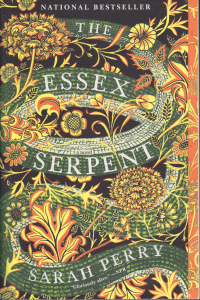
The Essex Serpent isn’t what it appears to be.  Sarah Perry’s debut American novel (although it’s her second elsewhere, publishing being the strange beast that it is) was much anticipated.  Like the serpent itself, the novel is difficult to describe.  It comes down to a minister, a widow, and the people with whom they associate.  Instead of going through the complex storyline, I would instead note that once again a novel that explores religion has garnered quite a lot of attention.  It’s difficult to believe the official narrative that we’re constantly fed that religion is well beyond its expiration date when it continues to appear in print media as a prime motivator for people in all kinds of situations.  Novels, however, aren’t popular in the way television, movies, and video games are, so this is worth pondering.

While novels are sometimes disparaged in higher education, their clientele tends to be an educated one.  It takes more commitment to sit down and read a 400-page tome than it does to flip on some device and meander from app to app, channel to channel, or website to website.  Novel reading takes some concentrated effort.  Remembering characters and connections across a span of days or weeks as you wend your way through.  And one thing novelists do, at least in my experience, is explore the way religion makes us who we are.  I don’t choose novels for that reason; I thought The Essex Serpent would be a monster story (remember, I don’t read reviews before reading the book).

My guess is that if you read this blog you’re a potential reader of novels like this, so I won’t offer any spoilers.  The book is suffused with biblical language, as befits a story with a clergyman as a major character.  The protagonist, however, is an irreligious widow on a journey of self-discovery.  Having been dominated by a wealthy husband, she now explores paleontology in a Victorian context.  Although the year is never stated, the novel manages to find that Gothic near-ghost-story feel with the close interplay of death by consumption and fear of the dark.  It’s not a scary book by any means, although there’s plenty of mist in Essex, and a little gruesome detail of what people can do to each other.  The novel caught my attention via reviews I never read and has left me pondering what I’ve just experienced.  And it has reinforced my conviction that, despite what the critics may say, religion is what motivates us, whether we admit it or not.  And serpents may not be what they seem.


The Pack

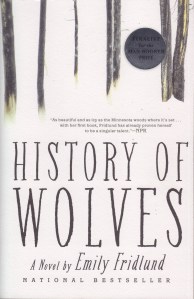
Maturity, in my experience, means knowing little and assuming even less. When I was young I grew up on a diet of books that were linear—plots were easily followed and there was clear resolution at the end. Who, as a kid, thinks that such a standard is impossible? One of this year’s reading challenges was a book nominated for an award in 2018. That assures a pretty current book, and I chose Emily Fridlund’s History of Wolves. Like life, it’s not linear. The narrator is unreliable. There are a lot of threads left hanging. It’s also a completely mesmerizing story. I selected it not because the content deals to a large extent with religion—I had no idea that it did when I selected the book, but, given what I do on this blog it was definitely a bonus.

I don’t want to give too many spoilers here since this is a novel well worth reading. I’ve always been impressed with writers who can convey accurately what it was like to be a teenager. A time of awkward discovery when we learn that things weren’t what we thought. Linda, the narrator, has been raised in a religious commune in the northern Minnesota woods. When a Christian Scientist couple moves into a cabin not too far away, she becomes a trusted “governess” for their young, sickly son. Unable, for religious reasons, to admit their son’s illness, they entrust him to Linda’s care. She comes to know each person in a unique way and learns that even adults don’t have the answers.

An interesting conceit for a story—one minority religion learning about another—the book ranges wide and far from that. Life as a teenager is when one typically both needs and rebels against religion. The awakening of adolescence, something our psyches aren’t equipped to comprehend much before this time, throws everything into confusion. History of Wolves won’t lead to any answers, but it is a useful discussion partner to have along the way. The Christian Scientists I’ve known have to face some of the same issues raised in this tale. Ironically, the advance of science has hit this group particularly hard. Novels such as this demonstrate that we, as a species, still turn to religion to explain our world. We’re frequently told that it’s safe to ignore—it’s from the childhood of our evolution. I wonder, however, whether Homo sapiens have just begun to reach adolescence and we are just starting to learn what it means to be adults in a world we don’t understand.


Faithism

Religion, in general, has come upon hard times. Many proponents of science and secularism point disparagingly toward what is, in all likelihood, one of religion’s strengths: its utter diversity. The fact is all people are believers. No amount of denial will change that. Whether the belief is in science or magic, we all take things as true, based on our outlook. My wife recently forwarded me a story about Faithism from the New York Times. A religion built around the Oahspe Bible, written about the same time as the Book of Mormon, Faithism very nearly went extinct before undergoing a modest revival in the present day. Instead of casting aspersions on it, a far better approach is to consider the basic, underlying human element to the movement.

Faithism was based on a book written by a dentist, a one John Ballou Newbrough. Although I’d never hear of Newbrough before, I can make a safe assumption about him—he was struggling with trying to understand a supernatural that can’t be measured or tested. This same element applies to scientists. Measurables have to leave at least a physical trace. Millennia ago, religions were already claiming that outside this mortal coil there was an entire realm that we could experience with our feelings but which would never offer any physical confirmation. There’s a pretty obvious difference between the living and the dead (at least to most people). Since nothing measurable changes at human death, it must be something incorporeal. Scientists begin to shake their heads here, but even they must face it some day.

The other takeaway from Faithism is that spiritual writings, like tiny particulate matter in clouds, can lead to the coalescence of something larger. Orally based religions, such as Zoroastrianism, seldom survive long. (Zoroastrianism, however, had very compelling ideas.) Written texts, once believed to be inspired, will naturally grow like a pearl over a grit of sand. The factuality of the text doesn’t matter, as long as it is the object of belief. When it rains, it pours. Some architects of new religious movements, such as L. Ron Hubbard, perhaps implicitly know that. While his science fiction may not have been inspired, his religious texts were. Unlike Scientology, science requires objective measures of what it considers reality. The title of Faithism, however, makes a trenchant point—it is belief in faith, like fear of fear itself, that makes religion. While historically few have believed in Faithism, even atheists have faith in what they don’t believe.


Only Which King James?

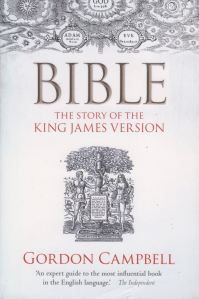
Nothing is as simple as it seems. Not that the Bible ever claims simplicity for itself. Among those who make up their minds before seeing all the evidence, there’s a strong preference for the “King James Version” of the Bible. Many with that preference will claim that they don’t interpret the Good Book, they just read it. Reading itself is an act of interpretation and stakes tend to be pretty high when the claim for divine authorship is on the table. So I figured I’d better interpret something about the King James Bible myself. Gordon Campbell’s Bible: The Story of the King James Version is an informative, authoritative, and often witty treatment of the topic. One of the immediate takeaways is that there is no single KJV.

Beginning in the beginning, Gordon tells the story of the Bible in English. There were translations before the King James, and its translation companies used these previous efforts and sometimes borrowed extensively from them. In other words, there’s nothing new under the sun. Once the King James was done in 1611 it had to be printed, and printing, being what it is, led to errors. Although these were of the secular, human kind, they nevertheless appear from the beginning and new typesettings led to corrections and other errors, some perhaps intentional. Then came the revisions. What readers buy—and some claim is an inspired translation—as the KJV is a revision of a revision. Of a revision. In other words, the inspiration seems to lie with the redactors rather than the translators themselves. There are many different “official” King James versions. Translations are never static.

King James Onlyists (a modern movement) may not realize that the New Revised Standard Version is the modern descendant of the King James. The Revised Version (RV), followed by the Revised Standard Version (RSV), and its more recent, feared progeny (the NRSV) are all based on the King James translation. That is the version “Revised” in each of these efforts. They consult improved versions of ancient texts that have been discovered since the Jacobean era, but where they earn the ire of conservatives is in the updating of the modern language. A Bible with no thees or thous hardly seems sacred at all. The line of continuity is there, however. Other Bible translations “start over” but still consult the KJV, such is its stature. The real problem comes in supposing that any one translation is the original. No original Hebrew or Greek biblical manuscripts survive, and no original King James Version exists. How uncomfortable these facts are, everyone will have to interpret for her or himself.


Taming Shakespeare

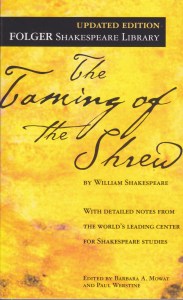
It hardly seemed credible, from what I heard in high school, that anyone would read Shakespeare if it weren’t required. I’m not completely naive, but I do wonder if we insist on introducing kids to the Bard before they’re ready for him. The real stumbling block is the unfamiliar words from the Elizabethan period. With enough regular reading they’re less of an obstacle to adults. Or should be. Or not to be. In any case, one of this year’s reading challenge books required that I read The Taming of the Shrew. I’d never read it before and kind of shied away from it because of the chauvinistic theme—Katherine has to be “tamed” by Petruchio so that her poor, sweet sister Bianca can be married. The overall theme is biblical—Rachel can’t be wed before Leah, so Laban declares. The play’s a comedy at the expense of women.

Those who know Shakespeare better than I question whether the playwright’s motives were as undeveloped as all that, but it is in keeping with the time. That’s not to excuse such patriarchal thinking, but we can’t rightfully blame people for thinking in the terms of their time. Yes, we now realize (except on Pennsylvania Avenue) that women and men deserve equal treatment. We are all human beings and should be treated as such, not as if one gender were somehow more important or better than another. In the Tudor Era, however, that idea had not yet caught on. The Taming of the Shrew contains clues as to why.

Perhaps the most reviled part of the play is Katherine’s closing speech as to why women should be subjected to men. Her reasoning is distinctly biblical. Indeed, the edition of the play I was reading took pains to point out the biblical allusions in the speech—primarily to letters of the New Testament. The fear, unaccountably real after all these centuries, is that we might go back to such thinking. The Bible, after all, doesn’t change much. The most conservative of society still read it in the King James, although the Bible Shakespeare’s contemporaries knew best was the Geneva translation. And, like the schoolchild reading Shakespeare, such conservatives need a little help with the language since words have changed their usages over time. They also may need some assistance realizing that not only words evolve, but so does our understanding of what it means to human. It’s not women who need to be tamed, Mr. Shakespeare. No, it’s quite the opposite.


Russian Passions

Dmitri didn’t do it; guilty anyway. That’s it in six words. I have to confess my tolerance for really long novels isn’t what it used to be. Blame it on being a child raised by television—every thirty minutes I’m ready for something new. I first read Fyodor Dostoyevsky’s classic The Brothers Karamazov when I was in seminary. Seminarians are an odd breed, and many of them relished the deep, ponderous novels with profound things to say about humankind. The Brothers Karamazov is such a novel. When you’re a student, reading’s part of the job description. As a writer Dostoyevsky gets away with things that’d lead to you failing composition class these days. Speeches that stretch on for chapters, characters taking 100 pages to die, and children talking like adults. It’s a heady mix.

I’ll have to admit that I remembered very little of the story from my last reading. I knew Fyodor Karamazov got killed. I couldn’t remember by whom. All the buzz in seminary was about the famous Grand Inquisitor scene. That’s the part where the Grand Inquisitor interrogates Christ and finds him wanting in the eyes of the church. So daring. So deep! And so early in the book. As I made my way through many heavy-lidded pages, with some dismay I realized that after I’d read the high point of the book I still had 457 pages to go, none of which I remembered from my reading three decades ago. I don’t mean to disparage the classic—I noted and underline several passages as I read. The blame is entirely on me. Still, the endless gloom of personal guilt that hangs on every character, even Alexei—whom Dostoyevsky states outright is his hero—become overbearing at times. This is a nation battened down by Christianity.

Often I’ve expressed the idea that we force children to read great novels before they’re ready to do so, ruining the classics for them for life. I first read Moby-Dick in seminary and I’ve read it several times since. It seems nobody’s really ready for Melville before their twenties. What is the age for Dostoyevsky? I think I comprehended more this time through. There were ideas here that, had I more time, I would likely have enjoyed lingering over. If life were so kind as to allow us the leisure to digest huge books I have no doubt that we would all be wiser, if not more satisfied. Fyodor Karamazov is dead. Alexei is cheered by the school boys. This long journey has itself been the goal.


Zombie Wars

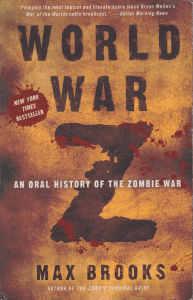
I suppose, rationally considered, most monsters can’t possibly exist. Maybe that’s the psychological relief required to enjoy the movies made about them. We can imagine the thrill, but we know we’re safe once we leave the theater. Culturally, monsters fight for supremacy. The early 2000s belonged to the vampire. They were everywhere. I once heard a literary agent advise wannabe authors to write on vampires since the publishing industry was showing no signs of slowing down on them. Then came the zombies. They’re still with us. World War Z came to my attention as a movie, but as one I never saw. I’ve watched many zombie films and none has lived up to the status of the spectacle that launched the genre, George Romero’s Night of the Living Dead. It remains a classic to this day. Still, I was curious and so I read Max Brooks’ World War Z: An Oral History of the Zombie War.

Let alone the chapter after chapter of tough-talking, cool-sounding reminiscers, I have trouble buying zombies. Yes, I get the scare factor, but maybe I’ve read too much science even to visualize myself into a fantasy world where a creature with no digestive system would be driven to eat. It just makes no sense. Human bodies can function with missing parts, of course, but without the integration of muscles, ligaments, digestion, and brain, it seems difficult to accept that they’d keep coming after you when they’ve been decaying for years. It’s all I can do to get out of bed most mornings, even as a healthy, living body. Analysts, I know, talk about zombies as metaphors, but with over 300 pages of stories in no way believable, I had to wonder about the limits of credulity. Maybe Carl Sagan was right after all.

I hope I’m not unsophisticated enough not to realize that the real point in Brooks’ novel is how the surviving humans treat each other. There is a moral to the story. We develop new and “better” weapons to kill one another. We’re smart enough to have world peace and prosperity, but wars are constantly erupting. We have a nation with many brilliant people and yet we elect a Trump. Self-destruction, it seems, is written into our genes. We consume one another. Even when the enemy is completely imaginary we find ways of believing. So I read World War Z, appreciating the irony. I still can’t get over, however, the trope that all you need is a human brain to want to destroy others.


Indie Bookstore Day

Although a year can seem like a long sentence, holidays are the punctuation marks that help us make sense of and organize it. Ordinary time, such as time at work, or commuting, can be endlessly tedious. Holidays, some personal, some local, others national or international, help us break up the time. Give us something to look forward to. My pity goes out to those religions that recognize no holidays and face time with a grim, Presbyterian determination to get to judgment day. The rest of us like to celebrate once in a while. So what’s today? It’s Independent Bookstore Day! Anyone who reads more than a post or two on this blog knows that I’m a lover of books. I first started taking solace in reading when things were difficult in my younger years, and reading has never let me down. In fact, I’ve often told myself that I could put up with just about any job as long as I could write.

It’s because of being in publishing that I learned about Independent Bookstore Day. Yes, it’s a promotional holiday, but it’s also a genuine celebration. As the outside world daily reminds us, those of us who read are a minority. The realistic author knows that the reading public is a small fraction of the whole. The number of people, percentage-wise, who spend their money on books is minuscule compared to those who fling their lucre elsewhere. But those of us who read appreciate the depth and reflection of each other. We may read different things, but we read. And that’s why I don’t mind going to an indie bookstore today and buying something.

One of the simple pleasures in life—call it a punctuation mark, a comma maybe—is being surrounded by unfamiliar books. Oh, I often worry what happens when we decide to move; we have lots of books at home. The last time the movers actually complained in our hearing that we had too many boxes of books. Talk about me at the bar afterwards, but don’t castigate my simple pleasures to my face, please. Books are the rare opportunity to commune with others on a deep level. How often have you put down a book and felt that you knew the author? Their soul was revealed in their writing and you had touched it. Just being in a bookstore is cause for celebration. If you have no plans for today, why not make your way to your local indie? Stand up and be counted as the literate resistance. It’s our silent Bastille Day, after all.