Movie v. Book

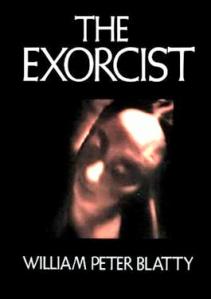
The debate is about as old as celluloid itself; which is better, the book or the movie? The response obviously depends on personal taste, and I suspect that many people base their answer on criteria that can’t exactly be quantified. Often it’s a matter of the specifics—which book? Which movie? In my own experience I’ve done it both ways, read the book first and watched the movie initially. I’ve even gone to movies not realizing there was a book and, of course, some movies aren’t based on books at all. You couldn’t grow up when I did, however, and not know that The Exorcist was a movie based on a book. I never saw the movie in a theater. There was a lot of buzz about it in my hometown, of course. I hadn’t been introduced to modern horror yet—still being a Fundamentalist at the time—and besides, it was rated “R” and I wasn’t.

I finally got around to reading the book. At this point in my life I’ve seen the movie several times, so I knew how the story was “supposed to go” beforehand. The fact that William Peter Blatty wrote the screenplay suggested it would be close to the novel, and indeed that’s the case. Novels, by their nature, tend to have more information about the storyline than is obvious from a film. The author can take time to explain things that don’t translate visually, including scenes where one character lectures another, like this blog. Since I’m writing a book about demons in movies, I paid careful attention to this. One of the themes from the novel that didn’t make it to the movie was witches.

That surprised me a bit. I had seen the movie first and it was plenty scary just as it was. I had to remind myself that my younger years coincided with the rebirth of the fear of witches. Literal ones. I’m not an astute enough sociologist to say whether the “witch hunts” of McCarthyism led to a hypostatized fear of real witches or not, but people were afraid in those days, as I recall. The Exorcist tapped into cultural fears in a way rare for a horror movie. It spoke to the fears of the era, but it didn’t mention witches. I couldn’t help but make the comparison with Rosemary’s Baby, which hit theaters shortly after The Exorcist. Rosemary believes the Satanists are witches. There’s a whole supernatural concoction of malevolent entities on the loose. Witches, ultimately in the novel, are simply one avenue the desperate Chris MacNeil explores to find out what’s wrong with Regan. The movie, wisely in my opinion, chose to leave it out. Demons are scary enough on their own, but of course even that’s debatable.
Here Before

Déjà vu can be quite disorienting. Déjà vu can be quite disorienting. One of the categories for my 2018 reading challenge is a book you can read in a day. Maybe it’s just me, or creeping middle age, but books seem to be getting fatter these days. Despite the amount of time I spend reading, I’m slow at it and it’s a real struggle to find something I can actually finish on a three-hour bus ride. That’s why I thought of a play. Plays are meant to be performed in one sitting, so you should, in theory, be able to read one in a few hours. My first thought was Shakespeare, but the books of Shakespeare you can find these days all have added pages of commentary and interpretative material and the books seem to have put on weight since the Bard’s day.

So I settled on Rosencrantz and Guildenstern Are Dead by Tom Stoppard. My wife had a used copy from college days and I’d been wanting to read it for some years. Here was my excuse. Then the bus ride began. Starting Act One I was sure I had read this before. It wasn’t just an inkling, like déjà vu often is, but an overpowering sensation. Of course I could tell what was going to happen—I’ve read Hamlet a time or two—but it was more than that. The sense that I had not long ago read this very sequence of words was nothing shy of overpowering. Uncanny even. As I moved into the latter part of the act, the feeling went away. This was new territory after all.

Consciousness is mysterious. Even with all our instruments and equations and theories, we still don’t know what it is. Materialists insist it must be simply a function of the brain, but that’s certainly not what it feels like. One of the hazards of reading a lot in middle age is that some things do start to blend together in your gray matter. Research, for example, means reading many books on the same subject with repeated ideas common among them. For fiction, however, we often hold a higher standard. Uniqueness and creativity are highly valued, even if the play you’re writing is a riff off the old Bard. In the end, I was able to finish the play in a day’s reading on the bus. Staring out the window after I’d finished, I was thinking how déjà vu can be quite disorienting.


The Power of Literature

Among the uber-wealthy families that America has produced were the Dukes. Most famous for the university that bears the family name, they made their money in tobacco and then electricity. And what a lot of money it was! Although many people can point to North Carolina as the home of Duke University, many don’t realize that they liked to vacation in New Jersey. A large property, regally landscaped, rests just outside the unlikely town of Hillsborough. When the last Duke heir died, the foundation opened the property to the public, taking Green initiatives to heart. It’s good to see money with a conscience once in a while. Since we’re not far from Hillsborough, when cabin fever sets in and there’s actually sunshine on a late winter weekend, Duke Farms is a convenient getaway for a few hours.

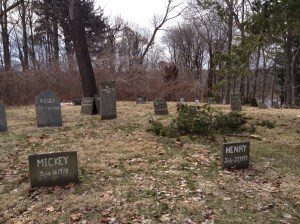
Surrounded by a rock wall, the main property once housed luxury that most people will never experience. Ancient sycamores line one avenue that leads to a coach barn far nicer than the houses hoi polloi live in. Although we’ve visited the grounds many times, we haven’t seen all of it by a long stretch. Over the weekend we came across a gravel trail we’d never taken. The main avenues are wide, blacktop, pedestrianized boulevards that lead past aging structures, fountains, ponds, statues, and quaint bridges. The gravel trail meanders back and forth through small hills and glens, and it’s easy to believe you’re in the middle of the woods from time to time. At the top of one of these hills we came to the pet cemetery, amid the leafless trees.

We can all understand the emotional attachment to pets. Even the wealthy feel it. The cemetery was large for non-humans, with stones going back to 1953. Even a pair of camels were buried there. I can’t visit a pet cemetery, however, without thinking of Stephen King. It was a blustery, chilly day. We were alone on this remote trail we’d just discovered, and thoughts of resurrection didn’t seem that far fetched. The rich, after all, can do anything they please. Nevertheless, there was a pathos here. We were being given a glimpse into private lives. The names of other people’s pets, and sometimes their species. The things that had touched the monied class deeply. I’ve buried a few pets in my time, and it is always a solemn activity. One from which not even wealth can protect anyone. And here was another testament to the power of literature. Groping for a way to understand this place, a favorite horror novel seemed just about right.


Testamental Annihilation

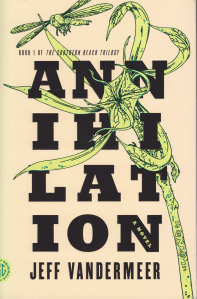
I’d be a hypocrite if I didn’t tell you there may be spoilers below. The book to which I alluded last week—the one made into a movie—was Jeff Vandermeer’s Annihilation. I first saw the book in a Green store in Ithaca, New York. I figured it must have a planet-friendly message if it were being sold at such a venue. I’ve finally had time to read it. There may be spoilers, so if you plan to see the movie, be warned.

Set in a kind of edenic dystopia not far from now, the novel gives none of its characters names. The narrator is the biologist of a four-member team sent into Area X—a region in the south from which no expedition has returned. Clearly intended to be part of a series, the novel does leave quite a few things hanging. Among the many unanswered questions is what has happened here. One of the problems with having Bible-radar is that you can’t overlook references to the Good Book. Without going into too much detail, the story has mysterious writing on the wall. That itself is a biblical trope, of course, but when the biologist discovers notebooks from previous expeditions, she considers that the writing is like something from the Old Testament. This description made me pause and ponder. The Hebrew Bible has, in the popular imagination, been cast in the role of a harbinger of doom and gloom. Granted, there are many passages that have earned that reputation, but on the whole it’s a very mixed bag. Still, in popular culture “Old Testament” means things are going wrong.

While not a horror novel, there are elements of horror here. People transforming into plants and animals, sloughing human skin. And resurrection—how New Testament! This made me think that maybe a penchant for horror isn’t such a strange thing for a guy who spent a decade and a half teaching the Hebrew Bible. My motivation for going in that direction had more to do with my interest in origins, but nevertheless, I also grew up watching monster movies. Maybe, unbeknownst to me, I was bringing the two together in this field of study. It’s difficult to tell at the end of book one what the overall message will be. But since I’m discussing the Hebrew Bible maybe I’ll take a stab at prophecy and predict that the second book of the series will be in my future. And I wouldn’t want to be a hypocrite.


Evil Masters

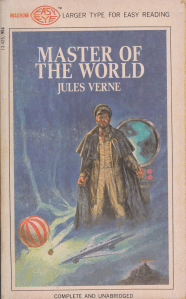
Whoever Modern Mrs. Darcy is, she keeps me honest. This is my third year of doing her reading challenge, and in an effort not to go out and buy all the books I want, I try to select from among my own pre-existing collection tomes I’ve never read. One of the categories this year was a classic you’ve been meaning to read. I spied on my shelf a copy of Jules Verne’s Master of the World that I bought before my high school years but had never actually consumed. I think I was a bit put off by 20,000 Leagues under the Sea. Don’t get me wrong—that’s a great book, but it’s dense and long and very detailed. And I was probably too young when I read it. Master of the World, like 20,000 Leagues, was part of Verne’s magnum opus Voyages extraordinaires, a set of fifty-some novels recounting, well, extraordinary voyages.

What makes Master of the World topical to this blog is the Devil. I’d better explain that. The story surrounds a somewhat naive detective trying to solve the mystery of a great, inaccessible, hollow mountain in North Carolina. While investigating this mountain (prior to the age of heavier-than-air flight) he learns of an automobile that is terrorizing the United States by driving 200 miles per hour. The credulous colonials seriously think that perhaps the Devil is driving this car. While that may be but passing fancy, it’s an image that replays itself throughout the book. Anyone who recklessly drives so fast—and the car can transform into a boat, submarine, and airplane as well—must be diabolical. The Devil’s amusements seem pretty tame, and the driver isn’t supernatural after all, once he’s discovered.

Robur the Conquerer is Master of the World, in his own opinion. At the climax he flies his marvelous machine into a hurricane, proclaiming his mastery like a good mad scientist. The machine, called The Terror, is destroyed and Robur is presumably killed in the storm. When our narrator returns home after several weeks missing (he was kidnapped by Robur and thus learned a bit more about the driver’s madness), his housekeeper has the last word. She declares that although Robur was not the Devil he was worthy of being so. The Devil has become a lot more nasty since Verne’s day, apparently. Why, our own government makes Robur the Conquerer look like an amateur demagogue. Either we’ve become terribly more accepting of everyday evil, or the dark lord has grown even worse over the century. I, for one know which one to believe.


Jewish Annotated

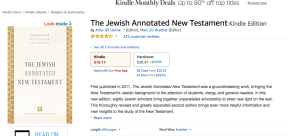
A project with which I have some small acquaintance is the second edition of the Jewish Annotated New Testament (some of you may be noticing an annotated theme lately). The idea behind it is deceptively simple: most of the writers of the New Testament were Jews. What do modern day Jewish scholars see in the text? This annotated Bible gets adopted into both Christian and Jewish courses, and many seminaries have an interest in learning what the writers might have been thinking as they were composing “the other testament.” So far, so good. I was looking at the Amazon page for the book the other day, specifically for the Kindle edition. As usual, you can’t please everyone, and some of the negative comments had to do with functionality. Then one said simply, “There is no such thing as a Jewish New Testament.”

I’m not so naive that I don’t know what trolls are, but I got to thinking about this comment. It didn’t come from a “certified buyer,” so it could be an opinion piece. The mononymed reviewer might be Jewish, Christian, or neither. From a Jewish perspective s/he might mean: Jews don’t accept the New Testament as scripture, so what else is there to talk about? From a Christian perspective the point might be: this is a Christian document so it doesn’t matter what Jews think about it. Either way there’s a call for some exegesis here. Both perspectives can be argued against. Jews have a very real interest in what Christians say about them. And, like it or not, the first Christians, and even Jesus himself, fell squarely within Judaism.

Christianity has become a religion of privilege. That happens when you’re the biggest religious body in the world. Christians get a bit testy when Islam begins encroaching on its numbers. There’s still some hard feelings about the Muslim expansion of the seventh and eighth centuries, too. Being an imperial religion will do that to you. Thoughtful Christ-followers, however, have begun to look back and wonder how this whole thing got started in the first place. Without Jews there would’ve been no Christians. Nobody’s claiming the New Testament is Jewish scripture. Neither side wants that. It’s simply a recognition that we might have something to learn from each other. And that’s not a bad idea. In fact, if we were willing to listen a bit more than talk, who knows how much true understanding might come to pass? The Jewish Annotated New Testament is one possible place to start.


Frankenfear

While re-reading Frankenstein the uncomfortable thought kept recurring that our tendency to save lives leads to undiscovered fears. I’m not suggesting that we should just let people die, but even from my own experience of doctors, the sense of personal agency has become somewhat eroded. You go to the doctor and s/he tells you, “You should have this done.” I’m still too busy trying to figure out what this box that’s attached to my TV should be called, so how am I qualified to assess a professional opinion about my health? We mend bodies with plastic and metals and chemicals. Some modifications, like fillings and glasses, seem no brainers. But what about plastic tubes and computers to regulate body functions? They’re all good, but have we thought this through, I can hear Mary Shelley asking.

Religion, which is now also eroding, was a traditional way of coping with the fact of our own mortality. Everyone dies. From the beginning of the world, with the possible exception of Elijah—and even he had to come back—everyone has died. Religion traditionally said that it wasn’t the last word. The body wears out, and in a materialist world there’s nothing that can be left. Technology can prolong life, but some may not want it to be prolonged beyond a certain point. I’m not being morbid; I just don’t like arguing with what can’t be changed. Religion, it’s easy to forget, is about finding peace. Some people misunderstand that, for sure, but that doesn’t change the facts.

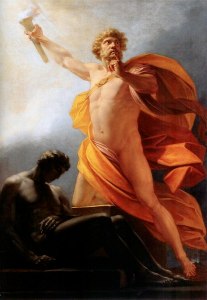
Did Prometheus overstep his bounds? Mary Shelley seemed to think so. In her recollections the story was intended to scare, not to predict. Victor Frankenstein creates the monster simply because he can. He does it alone, without thinking through the consequences even with a convenient Igor. Religion has often been cast as that annoying, moralizing sibling to science. (Philosophy could well join the ranks too, as some prefer it to religious thinking.) Without that sibling, however, how can we make informed decisions? Science, by its very definition, can’t tell us what should be done. The only values it knows are quantifiers. We live in a piecemeal world where some parts have been removed while others have been added. We don’t know if this is right or wrong since religion is one of the pieces excised without being replaced. Prometheus, ironically, translates to “forethought.” The problem with Frankenstein is precisely that Prometheus is missing.


Hey Jude

Reading Jude the Obscure was, at times, like reading my own biography. Authors strive for that effect, to be sure, but Thomas Hardy hits close to home on this one. I don’t mean in the aspect of marrying the wrong woman and losing his true love, but rather in the sense of what Jude was meant to and couldn’t be. For any readers behind on their Hardy, Jude Fawley was an orphan who grew up with scholarly abilities but no connections to university folk. Teaching himself Greek and buying what books he can afford, he eventually moves to Christminster (Hardy’s version of Oxford) in order to begin his studies at the university there. His application is summarily rejected because he is a working-class nobody who would be happier not overreaching himself. He then decides to try to become a parson only to find that path blocked to him as well.

Okay, so that’s a bit brief for a 400-page novel, but you get the gist of it. Hardy, according to the introduction, added the university theme later since the novel’s main focus is on the hypocrisy of the church regarding marriage. Both Jude and his true love (and cousin) Sue end up marrying other people who make them miserable. They each separate and then live together and raise children until tragedy causes Sue to have a religious conversion and return to her first husband. Jude dies in obscurity, as the title warns. Hardy was famous for his anti-church sentiments and Jude the Obscure was one of his most criticized works. The university theme, however, was the part I just couldn’t let go.

Being from the working class you may not have any idea how higher education functions. Even with raw talent and ambition, there are so few places available that you can easily find yourself in the rejected pile. Jude fatefully moves back to Christminster, hoping on some deep level that he’ll be accepted. That never happens although his fellow stone-cutters know that he is just as learned as the professors who regularly parade through town. The author didn’t intend to write cheerful stories. The friend who first suggested I read Hardy’s work knew about that tendency. The world is a place of comfort for some and struggle for others. Like Jude, those on the outside just can’t see what’s wrong with their own earnest application to be counted among the educated. Like any country club, however, the real point of it all is to learn how to game the system. Like taking a sad song and making it, well, better.


Winter Blossoms

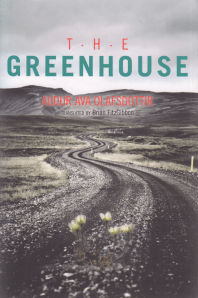
Audur Ava Olafsdottir is a remarkable novelist. Iceland, of course, is held to be the most literate country in the world. I began reading Icelandic fiction of a considerably earlier period while living in Scotland. There was still a trace of Scandinavian heritage from Viking days discernible there, particularly in the Orkney Islands. I started taking on reading challenges three years ago. Given that I spend many hours a week sitting on a bus, it seemed natural enough to put my time toward a specific goal. The Modern Mrs. Darcy’s reading challenge encourages me to move beyond the bounds of my usual fare. One of the categories for this year’s challenge is a translated book. I enjoyed Olafsdottir’s Butterflies in November so much last year that I selected The Greenhouse for this year’s translated offering.

The story of two young people who accidentally have a child together, the tale makes effective use of religious imagery in reflective ways. The young man takes a job in a monastery rose garden in a remote country. When his one-night stand visits him to have him watch his daughter while she finishes her thesis, everyone notices how miraculous the child is. She even bears a striking resemblance to baby Jesus in the painting in the chapel. The narrative is gentle and reflective. The monks are drawn out of their scriptorium by the beauty of the roses and the child that is so intimately tied up with them. There’s nothing preachy, or even overtly religious here. It’s a simple reflection that religion pervades life, even in secular Europe.

One of the saddest realities of the present is that religion has made itself so odious to so many. Human beings are naturally inclined toward religious thoughts and behaviors. When any form of orthodoxy enters the picture, though, it begins to fall apart. The young couple, unmarried—not even girlfriend and boyfriend really—transform the town they’re in, making it a more habitable and humane place. They’re not condemned for “living in sin.” Even a priest admits things can get pretty complicated where relationships are concerned. A coming of age novel, The Greenhouse has Icelandic magic that comes through even in translation. Olafsdottir is a novelist who doesn’t feel the need to apologize for describing what is plainly obvious to those who pay attention: religion is all around us, and it need not be something to condemn. In fact, if cultivated without the acidic soil of orthodoxy it might even make the world a better place.


Frankenstein and Co.

Authors, I expect, don’t anticipate that their work will be annotated. Since I deal with annotated Bibles on a daily basis, I often ponder that the anonymous writers—we know of few biblical writers with any degree of certainty—had no idea that they were writing the Bible. Nor did they realize that some day many people would make their livelihood from interpreting that book. Among the interpreters are annotators. When my wife gave me Mary Shelley’s Frankenstein for Christmas I was at first puzzled. I have a copy of Frankenstein already. In fact, I read it again just last year. Then I realized it was an annotated edition: Annotated for Scientists, Engineers, and Creators of All Kinds. Edited by David H. Guston, Ed Finn, and Jason Scott Robert, the book contains the original text and an introduction, as well as the said annotations. Like a typical study Bible, it also contains essays. The editors joke that it’s kind of like a Frankenstein monster itself.

The “value added” material isn’t all about science. In fact, quite a lot of it has to do with human relationships, and particularly women’s rights. Mary Shelley was an early feminist and her novel shows what goes wrong when men try to reproduce without women. Another recurring theme that, amazingly, had never dawned on me while reading Frankenstein was the Adam and Eve story. Victor Frankenstein, like God, creates a man. Then he creates a woman. Well, almost. Afraid what might happen should his creature find a companion too companionable, he destroys the second creature before she’s finished. The biblical parallels are nevertheless there.

Originally subtitled The Modern Prometheus, the novel was based on pre-Christian myth as much as on Holy Writ. Nevertheless, the Bible suffused British culture in the nineteenth century just as it has continued to overwhelm American culture to the present day. We ignore it at our peril. Morality in science is a major focus of the essays in this volume, but I wondered how many scientists might be enticed to read a piece of feminist fiction in order to learn some ethics. The largest ethical conundrum we face in the United States is that so few people read for personal growth. Spending time with a book is a sacred activity for those committed to the principles of literacy. Frankenstein isn’t a prefect novel; the pacing is pretty slow even for a gothic masterpiece. There are loose ends left hanging. The protagonist is often insufferable. Still, as the editors and annotators have demonstrated, there’s much to learn from this old story. All it takes is the willingness to read and deeply reflect. And perhaps read the annotations.


The Maelstrom

Some monsters can’t be destroyed. Today is Edgar Allan Poe’s birthday. Poe had his demons, for sure, but the twentieth century took personal fear and made it universal. Atomic bombs and mutually assured destruction were concepts any of us born since World War II have lived under our whole lives. Kids in the 1950s were drilled in schools about what to do in case of nuclear attack. We didn’t have such drills in the ’60s, but the Fallout Shelter sign was still quite familiar and frightening in its frankness. There are people out there that want you dead, and we tend to elect them to positions of power. Duck and cover. It’s all in vain.

Then came peace. Ever so briefly. When I started seeing newspaper articles about what to do in the event of a nuclear attack—not in my childhood, but just this week—I shuddered. We’ve apparently made no progress at all. When we’re all decaying corpses glowing eerily in the night there’ll be no point in figuring out who’s to blame. A species as endlessly inventive as our own spends its time and resources on distrusting, hating the other. “They” might get what’s ours. The acquisitive mind trembles. You see, there’s no end to the things you can own. As long as anyone else owns anything you can always hope to get it for yourself. Say you read the Bible and evangelicals will forgive you daily for breaking the tenth commandment. Just don’t let those foreigners have it.

Poe imagined nightmare worlds. Most of his stories, however, were on the individual level. Our monsters, on the other hand, are international in scale. Radioactive fallout with its slow decay and devastating effects on frail flesh may be the stuff of good horror, but they make for decidedly poor governance. Perhaps it’s no wonder that this comes up under a president who ran on a platform of hatred. Last weekend the people of Hawaii lived through fearful moments that were all too believable with the incompetent pretender of Pennsylvania Avenue. A man who can’t keep his tweet shut and who gets away with offenses that would easily impeach a democrat. I grew up watching Godzilla, the famed radioactive dinosaur, rising from the oceans to remind us of the consequences of atomic sins. For the too brief era of Clinton we felt that the world might be safe at last from such monsters. Problem is, some monsters just can’t be destroyed.


Playing Piano

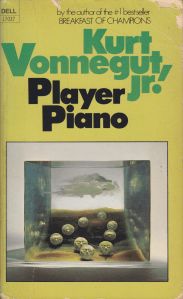
It must be very difficult to write books that make the future believable. With the speed of technological change, it’s getting more difficult all the time. Some exceptions are modern dystopias that take civilization back to square one. We’ve come close enough in reality already to be able to imagine such things. While not really a dystopia—although it kinda is—Kurt Vonnegut Jr.’s Player Piano extrapolates what a future in the service of machines might look like. Some elements are incredibly 1950s—everyone still smokes, all communication is on paper, computers run by punchcards, and attitudes are hopelessly parochial—while others are on point for today. The world has been mechanized and an even more obvious class system than our current one has been established. Of course, those top few reap all the rewards and wonder why those below them are dissatisfied.

What’s really noteworthy, though, is that Vonnegut uses religion to address the situation. In this, his first novel, he has a minister leading the revolution against the system. This clergyman does so by finding and nominating a “messiah”—a figure around whom the dissatisfied might coalesce. In a world many characters characterize as evil, the solution is offered by religion. Well, not exactly. Vonnegut’s famous satire is beginning to appear even here and the revolution that religion fuels can’t overcome the human love of machines and gadgets. In many respects, this book is an extended parable. I can’t help but think that Vonnegut would’ve recognized our love of devices as a symptom of his humanity being declared useless by machines.

Kurt Vonnegut isn’t a religious writer, but like many authors he recognizes the motivating power of belief. There are agnostics aplenty in Player Piano, Indeed, the protagonist is never sure of what he believes. The larger questions, however, still persist: do we advance human potential by making things easier? All of us now have to be varying degrees of experts on computers to find even the most rudimentary jobs. There is really no opt-out anymore, and what’s more, few would take it if there were. The phone in my pocket has changed my life in ways I can’t call entirely good. As we get closer and closer to our media, we’ll want more intimate contact—implants are already starting to exist. Vonnegut, in his sardonic way, was asking even in the early 1950s if we had really improved our lot via such invention. In the end, of course, it doesn’t really matter because for better or worse, our tech is here to stay.


The Big Shill

Once in a while I have to shill. As an erstwhile academic I’m aware of the cachet my employer bears for colleagues and the elite among the general public. Still, I find articles on the Oxford Dictionaries blog irresistible. I don’t work for the Dictionaries division, but I sometimes wish I did. A recent post by guest blogger Rebecca Teich discusses pulp fiction neologisms that have made their way into mainstream vocabulary. It’s not so much the individual words that interest me as much as does the phenomenon itself. Pulp fiction is antithetical to the sophisticated literature of the cultured class. Yes, there is status snobbery involved in such an assessment—we know those who find anything “common” to be vulgar and indicative of a lack of good breeding. The fact, however, that pulp fiction words make it to the mainstream belies the singular direction of cultural influence.

Many of us who grow up in working class families aspire to better things. We see (or used to see) on television and in movies how other people live. They have things and experiences that we covet. We work hard for many years to try to get there, often being kicked back down the stairs along the way. And yet we find some of our cheap, common vocabulary creeping into the consciousness of those who can afford better. There’s even a phrase for it. Guilty pleasures are those enjoyable books or other media that are really “beneath us,” but which we secretly enjoy. I post once in a while about Dark Shadows novels which are, quite literally, among the pulp fiction I grew up reading. They reached cultural cachet with a decidedly disappointing Tim Burton movie based on that universe, but regardless, they reached mainstream respectability.

Respectability. I suspect that’s what it’s all about. We want to be shown that our dirty collars and rolled-up sleeves mean something in this world of billionaire playboy presidents and congress that aspires only to greater wealth for itself. My first job, which I started when I was 14, involved physical labor. Brooms, paint rollers, and sledge hammers. I spent my evenings watching television and some of my weekends writing fiction. Pulp through and threw. Part of me finds its bliss in knowing that other rough-hewn writers have stamped their hallmark on the literary world by pounding out gritty stories of authentic human experience. Yes, I may be a corporate shill in this respect, but then, the shill is a respected member of the pulp fiction community.


2017 in Books

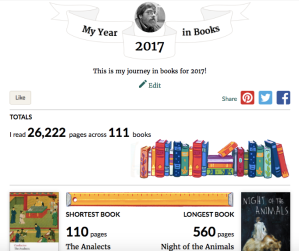
At the end of each year I think back over the books I’ve read in the past twelve months. Since I don’t blog about every single book, I use Goodreads to keep track of my numbers. I pushed my reading challenge at that site to 105 books for last year, and the meter stopped at 111. In 2018 I’m planning on reading some bigger books, so I’ll scale the numbers back a bit, I think. In any case, what were the most memorable books of 2017? It’s perhaps best to divide these up into categories since the number of books has become unwieldy. I’ve written a book about horror movies, and much of this year’s reading has been in support of that. Since my book addresses, among other things, possession movies, I’ve read several tomes on the topic. Noteworthy among them have been the three books by Felicitas D. Goodman that I read over the year. J. H. Chajes’ Between Worlds was exceptional, and Jeffrey Burton Russell’s The Devil, was likely the overall best on the topic. Also noteworthy for purposes of my book research were Catherine Spooner’s Post-Millennial Gothic and Monstrous Progeny by Lester Friedman and Allison Kavey.

For books on religion, Stephen Prothero’s Religious Literacy was an important start. Amy Johnson Frykholm’s Rapture Culture and James William Jones’ Can Science Explain Religion? addressed aspects of the topic that will continue to bear further exploration. God’s Strange Work by David L. Rowe and American Apocalypse by Matthew Avery Sutton stand out in my mind as a memorable treatments of William Miller, and of understanding American religion respectively. Chris Hedges’ American Fascists is remarkably urgent and should be read widely, especially since he has shown where current political posturing will lead if it’s not stopped cold. We will be struggling against a situation like Nazi Germany for many decades to come, and forewarned is forearmed.

It wasn’t all doom and gloom, however. Much of the fiction I read was excellent. Bill Broun’s Night of the Animals, Auður Ava Ólafsdóttir’s Butterflies in November, Robert Repino’s D’Arc, Matt Ruff’s Lovecraft Country, Christobel Kent’s The Crooked House, and Leah Bobet’s An Inheritance of Ashes all stayed with me long after I read them. And of course, Neil Gaiman’s The Ocean at the End of the Lane. Some non-fiction read just as engagingly. The autobiographies by Carly Simon and Bruce Springsteen were deeply engrossing. The Hidden Life of Trees by Peter Wohlleneben and John Moe’s Dear Luke, We Need to Talk were great guilty pleasure reads along with Dani Shapiro’s Still Writing, W. Scott Poole’s At the Mountains of Madness, and Mathias Clasen’s Why Horror Seduces. The latter title brings us full circle. I suspect that’s appropriate for rounding out a year. Many of the other books were also quite good; I tend to rate books favorably. Read the revolution—make 2018 a memorable year with books!


Let the Memory

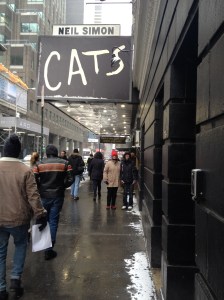
One of the rare and long-anticipated treats of being near New York City is the prospect of a live show. For practical reasons we don’t go to shows very often—years separate the occurrences—but once in a great while we manage to afford such a boon. Yesterday we attended the penultimate performance of the Cats revival on Broadway. The experience was transcendent. I’ve seen the movie version a number of times, and over the years I’ve caught a few live performances here and there. For whatever reason, this musical speaks to me. Although it doesn’t really have much of a plot—it’s more a series of vignettes—it is about redemption and being comfortable in one’s own skin. T. S. Eliot was a poet who knew spirituality intimately. Andrew Lloyd Webber, no one needs me to say, writes stirring music.

Cats, unlike many shows I’ve seen, requires athleticism as well as vocal ability. The performers are in nearly constant motion as they play out their roles, often with acrobatic flourishes. Most of the parts are for the young, while those dwelling on the experience of older characters—Gus, Grizabella, and Old Deuteronomy—tend to be recollections of youth as a commodity that slips away leaving as residue the wisdom that comes with age. It’s quite biblical in that respect. Even the old can appreciate back flips and double cartwheels and the grace of ballet. For this particular production the lighting stood out as an integral part of the story. Illumination, I might add, is a powerful metaphor.

In our family discussions afterwards, comparison with other versions dominated. Although my wife and I saw a community theater production long ago (placing us, I reluctantly suppose, in the ranks of the older characters), our main introduction was through the filmed adaptation. Again, like the Bible, we tend to think of canonical versions. This is how it should go. Because of both its running time and its demands on the players, not all vignettes are included in each production. The character who narrates the story may change. Choreography is adjusted. Each show, as is the case with live theater, is a little different. Standing in the snow on a cold, New York City December afternoon awaiting the opening of the doors, we wondered what would be changed. The original Broadway run had ended while we lived in the Midwest, so this was both our first exposure but also our fourth rendition over the decades. None, it turns out, could be called canonical. That, however, took nothing away from the inspiration of the event unfolding before our very eyes.