Reading Preferences

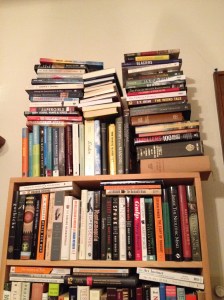
How do you decide on a favorite author? The question has been looming in my head as I’ve been reading through old novels on my shelves. It’s a question that strikes me whenever I walk into a bookstore. You see, my parents weren’t readers. As a child my literature was selected from the book table at the local Goodwill. I had no literary advice of ancestral pedigree. Teachers had assigned some books I’d liked, but nothing that really grabbed me. How was I to go about finding a favorite author? My favorite novel, hands down, was discovered in seminary. Moby-Dick is, to my way of thinking, the perfect novel. But I’ve never read anything else Melville wrote. I’d discovered Edgar Allan Poe as a child, but he was no novelist. Who suggested these books on my shelf?

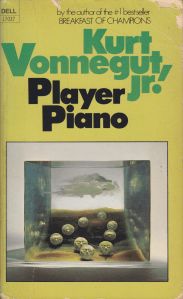
Among those responsible was a young woman I knew when I was in college. She was in high school, but she’d grown up in an educated family and she was passionate about her authors. Thomas Hardy and Kurt Vonnegut, Jr. Were among her favorites. I was startled to realize that among the books I found myself reading as 2017 draws to a close were both Hardy and Vonnegut. A blast from the past. Then, of course, my wife has suggested many books to me. We still read together—a practice we started as newlyweds (today commemorates the start of that status, by the way, which occurred 29 years ago today). There’s an intimacy involved in sharing books.

For the past few years I’ve been participating in Modern Mrs. Darcy’s reading challenge. Since it involves only a dozen books it’s seldom a problem to finish it. We go to our local independent bookstore and seek advice. I encounter writers unfamiliar to me. I still struggle, however, with that favorite author question. As I lay down each book I say to myself—was that the best I’ve ever read? Maybe the point is that there is no favorite author. If I were to sit down and try to list everything I’d ever learned from the fiction I’d read, I’d never stand again. The list would be endless. The lingering longing after closing a book, feeling as if I’d just had an intimate evening with the author, requires a certain literary promiscuousness. I enjoy many authors in many different ways. More often than not, they have changed my life. I look forward to the reading challenge of 2018. No matter the disappointments of politics and human folly, I’ll have good books to read as the world wobbles onward with no particular goal in mind.


Honest Doubt

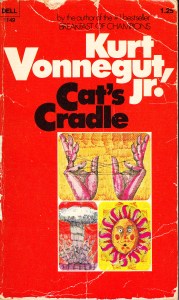
Kurt Vonnegut was never required reading in my high school English classes. I read Slaughterhouse-Five when I was in seminary, and picked up a few of his other titles in the dearly departed Boston Book Annex. A couple of these used books have been waiting patiently over the decades, and so I selected Cat’s Cradle to be perhaps the last book I finish this year. As far as I can recollect, the Vonnegut books I purchased while in seminary had no particular order or reason. A friend had recommended The Sirens of Titan, but Cat’s Cradle was what would now be called an “impulse buy.” Reading it, I rediscovered why I like Vonnegut so much. I also found out the book revolves around religion.

Regular readers know that I tend to find religious themes in secular books. It’s partially human radar and partially an unfortunate occupational hazard. Occasionally I’m pretty certain the author had no intention of including or developing the themes I discover. Cat’s Cradle, however, places religion front and center. The story involves a journalist on the trail of one of the developers of the atomic bomb. He unintentionally coverts to Bokononism, a religion made up by a castaway on the island of San Lorenzo. The religion, based on the teachings of a still-living sage, revolves around the idea that all its sacred writings are lies. Think about that a moment.

Lies, in which we’ve all had a crash course since January, are among the most insidious of human accomplishments. We value and crave the truth. We all believe that we believe it, but there are differing opinions as to what it is. Some opinions are backed with evidence, and others with flimsy fabrications. To declare a religion based on lies is, of course, to undermine the whole enterprise. Vonnegut was a noted iconoclast, but there’s a brilliance in declaring a religion to be knowingly based on falsehood. In fact, we’re seeing it happen before our very eyes. The religion formerly known as Christianity, once upon a time, took into account the teachings of Jesus of Nazareth, as recorded in the gospels. Modern Christianity—Evangelicalism—has completely thrown Jesus out of the equation in all but name. Branding, after all, is everything. This modern faux religion suggests hating your fellow creature, taking advantage of the poor, and believing falsehoods to be the most sincere of truths. It’s alive and released on the earth even now. And it is far more scary than even ice-nine.


Investment Advice

One of the more obvious transitions to adulthood involves Christmas becoming less of a holiday for receiving gifts. As we get older we learn that very few things in life are actually free, and that gifts often have some kinds of obligations involved. My favorite gifts have always been books and movies. Each comes with a required investment of time. That doesn’t mean I’m not grateful, or that I don’t want these things—quite the opposite! It simply means that time is required to enjoy them. Or benefit from them. In the workaday world, time is the rarest gift of all. The gifts I received fell mostly into these genres, so I’ll be sharing a number of these books and movies with you over the next few months.

A knowing relative gave me a refrigerator magnet. Our fridge is covered in these, mostly from places we’ve visited. We do have one of the more colorful iceboxes around. This magnet is red and reads “Make America Read Again.” If anything can combat the evil spewing from our nation’s capital, reading can. Those who’ve decided that rhetoric from documented lying lips is more Christian than compassion for the poor need to learn to read again. The election of Trump has ushered in an era of attempted murder of the truth. The tactic of calling any news you don’t like “fake news” so that your own distorted version of reality rules is among the most dangerous in the toolbox of autocracy. Sacrificing truth on the altar of expediency seems like a very strange means of promoting the evangelical message, at least in my opinion. If people would read, they’d know when they were being lied to.

Reading forces you to confront the mind of another. This exercise is unique among human beings, as far as we know. It’s a kind of telepathy, involving the considered contents of another person’s thoughts coming directly to you. Lying is a possibility, of course. Even liars write books. The more widely you read, however, the greater likelihood of discovering the truth. Reading requires investment. It takes time and mental energy. Other activities must be laid aside. The potential benefits, however, are beyond measure. If we could make America read again, the results would be the greatest gift anyone could hope to find under any tree. It’s time to begin reading through the books that made their way to me this holiday season. This is a gift whose costs I gladly accept. It’s an investment in the future. Even Christmas trees require daily watering.


Remembering Catherine

Literature has been on my mind lately. Although I’ve not read all of Charles Dickens’ oeuvre, he’s been in my consciousness what with the new movie and somewhat older book, The Man Who Invented Christmas. Those who analyze literature sometimes claim Dickens invented the modern novel. In my unprofessional opinion, however, the roots go back a bit further than Boz. Still, it’s an enviable position to hold, even if it’s just in the minds of admirers. Dickens came back to me yesterday in one of those apparently random emails from WikiTree. WikiTree is a genealogy website to which I’ve contributed from time to time. I have no famous ancestors, so WikiTree sometimes helps me borrow them. Turns out I’m 28-degrees separated from Charles Dickens.

Perhaps their algorithms are getting better, or perhaps one of their robots is reading my blog (goodness knows few actual people do!) but the connections are getting closer. I posted earlier that I’m 37-degrees separated from Bob Dylan and 43-degrees from J. R. R. Tolkien. I’m closer to Dickens than to either of these famous individuals. This is the beguiling aspect of genealogy—it shows how unexpected connections can be part of our unknown background. The maze back to Dickens is through my grandmother on the Tauberschmidt line. This is the one of the four grandparental lines for which I have the least information. Nobody in my family even knows my great-grandmother’s name. She died young and, as with women in that era, was known in census records only by her husband’s surname. I may never learn who she was.

Although the reason for women changing surnames makes sense in its historical context, it is one of the great injustices of both gender equality and history. Signs are indicating that society is finally waking up on this point: women are half of the human story. As a dabbler in fiction writing, knowing that half the story is untold is a troubling phenomenon. Reading about Dickens I learned that he left the wife of his youth for a younger woman. Although such things are common, my reaction was to wonder who Catherine Thomson Hogarth might’ve become, had women had the opportunities they’re starting to have today. She was, after all, from Edinburgh. She has biographies, but not nearly as many as her feted husband. And if my math’s correct, I’m only 29-degrees separated from her. And this may well be the more important connection; the story untold.


Endings

It’s hard not to feel sorry for survivors. In a hostile world, the ability to resist the entropy lapping at your toes is a feat that inspires admiration. Although independent bookstores are making a comeback, there aren’t many around. An evening spent at Barnes and Noble, if allocated well, can evoke some sympathy even for a dying giant. While my wife had an appointment next door, I spent a good while in the fiction section—really the only part of our local B&N that is well stocked. My time among books, excessive to some, is my solace. It’s not a bad vice to have. Seeing others out shopping for books also delivers a message of hope to a world disinclined to read.

In the B section I saw an edition of A Clockwork Orange. If you read my post on Anthony Burgess’s book in the last few weeks, you’ll know that the American edition has always lacked the last chapter. I wondered if maybe, just perhaps, if this edition might contain the missing ending. It has been several decades since the original embargo. I picked it up and, indeed, the last chapter was intact. I stood in the aisle and read it. Say what you will about Barnes and Noble, but nobody thinks this kind of behavior odd. Once again I was transferred back to Alex and the world of his droogs, only to discover that the ending was something like I had anticipated. If you’ve read the standard American edition you know that it ends abruptly. Writers know how to draw a story to a close. Herewith I offer a spoiler alert.

Alex, now 18, has a new band of droogs. They sound quite a bit like his previous gang. Then he notices he doesn’t feel like the old ultra-violence one night. He goes to a coffee shop where he finds Pete, his old gang-mate, now married and holding a respectable job. He realizes with a kind of horror that having a child and wife appeals to him. He’s growing up. Critics often said Burgess was a moralist with Christian sensibilities. The original ending to A Clockwork Orange might suggest that’s true. Alex may be converted, but he’s unrepentant. Indeed, as he thinks of being a father he envisions his son being just like he was, and the cycle of violence and reform spinning on and on into the future. Shortly after I closed the cover, my wife met me in the store. I was amazed at how 15 or 20 minutes immersed in reading had shifted the mental world I inhabited. New information had changed me. This is the power of books, even when they’re found in Barnes and Noble.


Inventing Christmas

While not always classified among the most intellectual of writers, Charles Dickens was a complicated man. Able to conjure words that reflect emotions, often making readers laugh and cry, he was the undisputed bestselling author of his day. This holiday season the movie The Man Who Invented Christmas explores one of the probable reasons for Dickens’ celebrity—the resuscitory success of his first holiday novel, A Christmas Carol. The film was based on a non-fiction work by the same title, written by Les Standiford, subtitled How Charles Dickens’s A Christmas Carol Rescued His Career and Revived Our Holiday Spirits. As an author who found early fame, it might seem counterintuitive to those of us who’ve never found any that Dickens’ career would need rescuing. In the publishing world, fame has to be sustained since few books keep on selling and selling. And Dickens didn’t always help himself.

Dickens’ choice of Christmas as a theme was, obviously, driven by his own warmth regarding the season. As Standiford makes clear, however, it was also driven by money. Like many in today’s world, Dickens had established his comfort at pecuniary liability—he lived on credit. He also supported other family members and although he cared for the poor he often resented those who cost him money through irresponsibility. Christmas was a time when, he hoped, people might be encouraged to give. Some of that money, naturally, would go toward the purchase of his book. Although the story was secular, it gained the approbation of many in the church—it encourages thinking of others and being generous. Complicated.

As we get closer to Christmas this year, it seems that Dickens’ message bears loud and constant repeating. Here in the States, our government has taken on a decidedly Scrooge-like cast when it comes to the poor and unfortunate. Indeed, “bah, humbug” might well be the new motto of the Grand Old Party. Shown evidence of the guilt of the miser in chief they only claim that those who discover such truth are lovers of false truth, such as claiming that the poor really suffer with want. They close ranks to ensure that the downtrodden can never vote them out of power and claim that Bob Cratchit’s problem is that he’s lazy and Tiny Tim is a burden on the misunderstood wealthy who only ever wanted to help others. A huge difference is that Dickens knew his novel was fiction. This holiday season the ghosts visiting us will be the emaciated spirits of democracy past, present, and future, and that of human decency.


Home of Cthulhu

Travel by train seems to be so much more civilized than flying. You don’t need to arrive at the airport two hours in advance for the privilege of standing in long lines to be practically strip-searched. You just hop on the train and find a seat. The wifi is free and you don’t have to set your phone on “train mode.” Amtrak isn’t perfect, of course, but it’s not bad. When I’m flying I often wonder where I am. I guess at each large town we fly over, although some natural features can’t be mistaken from the air. The Great Lakes, Grand Canyon, and even Niagara Falls are all pretty obvious. The names of many towns, however, remains unknown from above. On the way from New York City to Boston, each stop is announced, small towns and large. I noted that one of the later latter was Providence.

Providence is, of course, many things to many people. To me it will always be the home of Cthulhu. Yes, I know that Brown University and Providence College are both located there, but higher education doesn’t seem to have a room for me, so I revel in the imagined monsters of H. P. Lovecraft. You can’t help but experience a bit of Lovecraft’s New England on the train. Skirting not far inland, the tracks take you through swampy lowlands with grand houses and dilapidated hovels overlooking them. Miskatonic University, as is widely known, is based on Brown, which Lovecraft never attended. He was a writer keenly aware of place. These tracks take me through the world of his murky water gods on the way to Boston.

The train station in Providence turns out to be subterranean. Well, not really, but it is under the street level with no noticeable distinguishing features. Lots and lots of graffiti cover every concrete surface along the tracks coming into the city. It’s hard to tell from the train, but none seem to make reference to Cthulhu. I thought of Lovecraft’s gravestone with it’s famous epitaph, “I am Providence.” Idling in the shadowy station, unable to see anything of the enjoyable town I recall from my few visits here, it’s easy to suppose that this might be Cthulhu’s home after all. Caught somewhere between civilization and the sea, in the half-light of a late autumn day, buried under what we think is somehow progress, I think perhaps Lovecraft was right. Cthulhu may be dead, but he is dreaming still.


Inventing Breaks

Breaks are good for many things. Time with family and friends. Hours of non-bus time for reading. Watching movies. So it was that we went to see The Man Who Invented Christmas. It really is a bit early for my taste, to think about Christmas, but the movie was quite welcome. Being a writer—I wouldn’t dare to call myself an author—one of my favorite things to do is talk about writing. Watching a movie about it, I learned, works well also. The conceit of the characters following Dickens around, and refusing to do what he wants them to should be familiar to anyone who’s tried their hand at fiction. My experience of writing is often that of being a receiver of signals. It is a transcendent exercise.

Not only that, but in this era of government hatred of all things creative and intellectual, it is wonderful to see a film about writing and books. The reminder about the importance of literacy and thought is one we constantly have to push. If we let it slip, as we’ve discovered, it may well take considerable time to recover. Getting lost in my fiction is one of my favorite avocations. Solutions to intractable problems come at most improbable times. Although publishers tend to disagree with me, I find the stories compelling. In the end, I suppose, that’s what really matters.

On an unrelated note, this is the second movie I’ve seen recently that attributes non-human actors their real names in the cast listing. What a welcome break from the blatant speciesism that pervades life! Animals have personalities and identities. Humans have often considered the privilege of being named to be theirs alone. True, animals can’t read and wouldn’t comprehend a human art form such as cinema. But when they communicate with each other, they may well have names for us. The beauty of a story such as A Christmas Carol is that it reminds of the importance of generosity. We should be generous to those who take advantage of our kindness. Our time. Our energy. We should also be generous to those who aren’t human but are nevertheless important parts of our lives. The movie may have come too early for my liking, but the holiday spirit should never be out of season. If we’ve made a world that only appreciates kindness because much of the rest of the year is misery, it means we’ve gone too far. Films can be learning experiences too, no matter the time of year.


Devolving Apes

It would be difficult to overestimate the effect the movie Planet of the Apes had on me as a child. Raised a biblical literalist, evolution was, naturally enough, anathema to me. And yet here was a movie based on the idea that evolution had taken a different course. It was a transgressive film, but the screenplay had been written by Rod Serling, so well known for his trusted work on The Twilight Zone. I was utterly fascinated by it. Until the most recent iteration, I’d seen every sequel, spinoff, and reboot ever made. So important was this story line that as a child I found a copy of the book, in English, of course. Pierre Boulle told the story somewhat differently. Spying the book on my shelf after some four decades of my own evolution, I decided to read it again.

We all evolve. I noticed the improbabilities more this time through. The fact that, unlike the movie, humans wore no clothes at all must’ve scandalized my young eyes. I would’ve agreed, however, with Ulysse Mérou’s sentiments that humans were created in the image of God, not apes. In fact, there is an undercurrent of a somewhat conservative theological outlook here. Humans may experiment on animals, but when it’s reversed, it’s evil. In many ways, the cinematic version improves the story, but Boulle’s telling grows in intensity as the novel unfolds. Mérou develops a moral sense that includes the apes as well as human beings. The story, of course, is largely about prejudice and its evils. In that respect, it’s timeless.

As a child I realized that we lose something if we accept the fact of evolution. We lose that special feeling of having been intentionally created by a deity that made us God-shaped. Ironically, I also came to realize that those who rejected evolution often treated their fellow humans like animals. They held onto prejudices against other “races.” They castigated the poor for being lazy. They wish to remove healthcare from those made in the image of God. The contradictions and cruelties simply don’t comport with the Good Book they adore and ignore. Evolution, with the realities of nature impinging on our security, is far less dangerous than what biblical literalism has evolved to be. I can’t say why this book and its cinematic renditions became so deeply embedded in my young mind. But having read the book again, it’s pretty clear that the ideas have remained there, even as they have modified, with descent, over time.


Predestined?

This particular doctrine struck me as evil. It violated every experience and thought I’d ever had, even raised as an unquestioning Christian as I was. Then, at Grove City College I was faced with it for the first time—predestination. If free will is an illusion, what crueler God can be conceived? I couldn’t avoid such thoughts upon re-reading Anthony Burgess’ A Clockwork Orange. A non-conforming non-conformist at the college assigned it in a science fiction class, so it has been decades since I’d read it. Now I found it perhaps more profound than before. Much has happened since my initial reading of the book, o my brothers. (And sisters.)

The framework of the story is well known. Alex and his friends are teenage punks who love ultra-violence. Alex is betrayed and imprisoned. Considered incorrigible, he’s reprogrammed to the point that he can’t even defend himself in a society that’s grown even worse during his time in jail. In the hospital after a suicide attempt, he awakes to find his old self restored, whether this is a good thing or not. The main point that’s behind this, it seems, is that without free will, repentance means nothing. In fact, in my edition of the book, an afterword by Stanley Edgar Hyman makes the point that some interpret A Clockwork Orange as a fictional defense of Christianity. Certainly the comparisons are there, from Judas through Jesus, healing, sin, and suffering. How much it actually meets that idyllic vision of God in Heaven directing the lives of individuals is, of course, an open question.

The idea that human beings are born as Hell-fodder posits a cruel and sadistic deity. Not only are the majority of human beings going to face eternal punishment for matters beyond their control, there is a divinity who planned it that way. We are all, literally, puppets in a universal morality play written by a being whose moral compass is horribly skewed. Indeed, even at Grove City some of the faculty would state that philosophically there could be no contest—free will was right. But, they would add, tapping the Bible, it’s not true because the Word of God says so. When I protested, it was declared, without irony, that even my protest had been predestined. In other words, in this clockwork universe I was clearly an Alex. Upon closer inspection, however, the truer analogy would be that we are all the victims of Alex and his droogs. But only if we have the freedom to make such an observation.


Autumnal Ashes

I once told someone that a book I was reading was a “good autumn book.” The friend looked at me quizzically and asked what I meant. Seasons have a feel to them, even as books do. When the days grow shorter and the chill seeps in through the storm windows, I start looking for a book that matches the mood of a year that’s dying beautifully. So it was I came upon An Inheritance of Ashes by Leah Bobet. While I like Amazon just fine, the magic of the brick-and-mortar bookstore is finding that book face out that you’d otherwise never have seen. I read a lot of fiction—more than I post about on this blog—and a great deal of it come from the unexpected find in the local indy.

The story’s difficult to classify. Set in a future that sounds quite a lot like post-Civil War days, two sisters, Marthe and Hallie, try to keep a living at Roadstead Farm. The last of the soldiers have made their way back from the war where the Wicked God was killed. We never see the Wicked God clearly. He’s from a parallel world and is championed by his prophet. The death of the Wicked God was largely thought to be the end of the war. The passage between worlds, however, isn’t as secure as they armies thought. Religion doesn’t play a strong role here, but it was the cause of the war that has devastated the nation.

Fictional worlds require believers. Stories need not be religious to include religion. Without it, many tales lack verisimilitude. People are religious creatures by nature. Belief drives us, whether secular or sacred. This novel about a family trying to pull together in the aftermath of an evil god’s death. There’s a purgatory here from which those who believe can be rescued. And Hallie, who believes, ends up saving her own entire world. Religious? Not really, but it is all about belief. We need books that encourage faith in dark times. Indeed, An Inheritance of Ashes is about a dark period of uncertainty. What used to be true is open to question in these days when one belief system is determined to wipe out all others for good. Not so much live and let live as it is give and not give back. Ashes, whether literal as in Bobet’s world, or figurative as in our own, are appropriate reflections as the year begins to die.


Stranger Things

Albert Camus preferred the label “absurdist” to “existentialist” to describe himself. The problem with labels is that we don’t always get to pick our own. As a young man fascinated with existentialism, I was introduced to Camus as one of their number that I should read. Categories, of course, are only abstractions to complex realities. So, for learning about existentialism Camus was recommended reading in those days. I selected The Stranger. So many years have passed since then that I only recollected a single part of the plot. Coming back to it as an adult is like walking down that beach a second time, unaware that you’ve just been down this way and something bad happened last time. Existentialism is like that.

Meursault is little effected by life. He has no strong opinions since, at the end of the day, everything seems pointless to him. He sheds no tears at the death of his mother because death is to be expected. When a heat stroke confuses him sufficiently he unintentionally kills a man. At his deposition the examining magistrate finds Meursault’s atheism inexplicable. In the face of the possible consequences of his actions, such indifference leads him to refer to the prisoner as “Mr. Antichrist.” Awaiting his execution, Meursault has a final confrontation with the priest that has come to his cell unbidden. The prisoner is convinced that even on death row he believes more sincerely than the man of the cloth. Camus’ story is surreal but realistic. A parable for his day and ours.

I’ve lamented before about the decline in philosophical literature. Taking philosophy straight requires the kind of concentration that I lack on the bus or before going to bed. Novels like The Stranger express such ideas in digestible form. The reader identifies with and despises Meursault. Why doesn’t he do something to help himself? Boredom and indifference will literally kill him. He is, however, steadfast, and that is something to admire. Along the way existential ideas are woven into the character’s thoughts and dialogue. Everyone is like an actor in a play—they did not write it, they simply perform the roles assigned to them. When it’s all over they end up in the same place. Absurdism and existentialism aren’t very far apart. They’re both categories devised to help us comprehend the enigma that we confront in books such as The Stranger. Meursault can’t give the chaplain any false belief since, as he notes, those who believe have more need of convincing than those who don’t.


Hiding Out

It’s seen better days. The spine is coming unglued and the pages are brittle, fracturing into tan snowflakes as I turn the pages. Still, this unusual little book is crowded with memories. I recall the used book store where I bought it—the Boston Book Annex, now sadly defunct. Unlike any other paperback I’d purchased, this one has gray-dyed page edges, adding an appropriate October gloom to the reading. Friedrich Duerrenmatt may not be properly among the existentialist novels, but that’s where he lives on my bookshelf. I picked up The Quarry three decades ago when “Der Besuch der alten Dame” was still relatively fresh in my mind. If I were a younger man I might’ve tried to find an edition in German, but the internet didn’t exist in those days and after a few years of no use, my Deutsch was dusty. It had been my gateway language.

As I read The Quarry I wondered why I had waited so long to do so. The story is brief but intense. And like novels of the period, it is philosophical and theological. (Like many translations it is sold under different titles; this one is also known as Suspicion, but The Quarry captures the duality nicely.) Hans Bärlach, a Swiss police commissioner, is on the trail of a Nazi war criminal. Suffering from cancer, Bärlach is bed-ridden but his quarry is a doctor and he finds a plausible excuse to become his patient. To help him set the trap, he enlists the aid of Gulliver, a Jewish concentration camp survivor. Their dialogue is what makes this brief story so theologically pregnant. Gulliver calls Bärlach “Christian” and reflects on how that feels to a Jew who was intended to be exterminated. I won’t spoil the ending here, but when Bärlach meets his quarry and realizes that he is also the quarry, the conversation once again turns to religion.

There’s an honesty to such novels as this. Writers were not yet afraid to invoke philosophical dialogue. A friend at the time I purchased the book once told me “nobody writes like that anymore.” Since his father-in-law was a novelist, I supposed he was right. I should have instead relied on my memories from high school German. We read “Der Besuch der alten Dame” and even went to see a stage adaption at the local community college. I’d shortly discover the existentialists. Their views on the absurdity of life mingled so readily with a theology becoming broken, tired, and top-heavy. Those ideas I’d met in class such as, if memory serves, Ilse Aichinger’s “Wo Ich Wohne,” became a part of my young psyche and, not surprisingly, many years later I’m finding myself their quarry.


Novelty Religion

Religion is dead. So they say. They have been wrong before. One of the great things the web has given us is book fan sites. There are a number of them, and my wife frequently sends me stories from BookRiot. Often they are lists, and the most recent one is Teresa Preston’s “100 Must-Read Novels about Religion.” As I scanned through the tons of tomes to see which I’d read, it struck me once again just how many novels touch on—at the very least—religion. Many are based on it. That’s because religion is an inherently fascinating phenomenon. We don’t really understand it, and even the staunchest of atheists believe something, no matter how secular. Novelists are those who, successfully finding a publisher, express their views of living on this planet in terms of fiction. It’s often factual fiction.

One of the best bits of advice I can give to academics who want to write for a wider readership is this: read fiction. There’s been a time-honored stigma, of course, outside literary studies, of academics reading fiction. Once, at a conference, I was awaiting an author meeting. It was a small conference so I had taken a book to read between appointments. When my author came up, he asked what I was reading. (I’d cautiously removed the book jacket before taking my novel along, not wanting this topic to come up.) “Just some fiction,” I explained. His eyebrows shot up and he questioned why an academic should be reading fiction at all. I have known academics successful in the fiction market, but they’ve had to use a pseudonym because their real name might discredit their scholarship. We are a divided, perhaps schizophrenic, society.

Not all academic novels, of course, are cases involving religion. Still, it’s often there. I recently finished Annie Proulx’s The Shipping News and Neil Gaiman’s The Ocean at the End of the Lane. Both involved religious themes at various points. This is so much the case that unless it’s really obvious or unusual I don’t always discuss such tropes on this blog. (Although I do register the books I read on Goodreads, yet another excellent book fan site.) If they want to appeal to the deepest of human needs, novels must address religion from time to time. Paying respect to the dead is, after all, a very human thing to do. And should it prove true that rumors of its demise have been greatly exaggerated, we shouldn’t be surprised. Like they say, reading is fundamental.


The Falls

I can’t recall if I’ve been to Mexico City before. You see, back in the late 1980s I frequently read the novels of the existentialists, and although a copy of The Fall has been on my shelf since then, I don’t recall if I read this Camus classic. It’s sometimes that way with existentialists. In late 1980’s Back Bay, a used bookstore called the Boston Book Annex charmed my days. The Annex has sadly closed, but I do remember buying my Camus novels there. This one, however, I don’t remember reading.

So, unsure of my past, I decided to read it. Perhaps again. The existentialists make sense to me. I have to say that in today’s rushed and harried lifestyle it’s a little more difficult to find time to spend in Mexico City. Although the book is short, it’s not quick. There’s much to ponder as you wend your way through an evening bending elbows with Albert. Perhaps that’s an unwonted familiarity regarding a man who died before I was born, but existentialists know that kind of thing happens.

One of the more compelling aspects of this literature is that the existentialists often address religion. The Fall is a first person narrative throughout, and about four-fifths of the way through Jean-Baptiste Clamence begins to address Christianity explicitly. Since this is a retelling, in secular terms, of the biblical “fall,” this is not unexpected. Jean-Baptiste is a lawyer who is making his confession. He states that his clients “probably feared that heaven could not represent their interests as well as a lawyer invincible when it came to the code of law.” Genesis, of course, is attributed to Moses, himself a law-giver. From this point until the end of the chapter he reflects on the fact that although no one is innocent, all are glad to find the crime in others. He describes torture devices of the Middle Ages, exonerating God from their invention. He respects Jesus, but not what people have made of religion.

Reading, perhaps re-reading, this reminded me of why I found the existentialists so compelling as a seminarian. They force you to think. I read Kafka, Camus, and Duerrenmatt, pondering how much wisdom could be crammed into such brief books. Ironically, it takes time to read them. Our world is crowded with concerns about money over meaning. Matter over mind. Once in a while we need to step back, spend an evening or two in Mexico City, and consider how we’ve become a fallen race.