Church Vampires

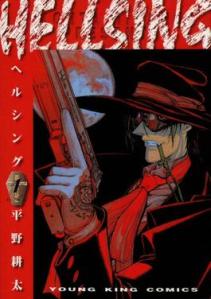
For people my age manga is a new form of reading that is easily ignored. Although I’ve read a graphic novel or two, “comic books,” no matter how adult the theme, seem juvenile. Note that word “seem.” I do know some younger folks, and one of them insisted that I read Kouta Hirano’s Hellsing. This particular friend is as interested in vampires as I am, and, knowing my history with religion, suggested this might down my alley. Dubious, I gave it a try. In this manga universe Hellsing is a Protestant organization for fighting vampires and ghouls (non-virgin vampire victims who come back as zombie-like creatures who are very hard to stop). Their activity is in England, but when they cross into Ireland they encounter a Catholic organization that kills all vampires, including the “secret weapon” of Hellsing, who is indeed a vampire.

What made reading this tale so interesting is that the reader’s sympathy is drawn to the Protestant sect. The Hellsing characters are engagingly drawn—handsome or beautiful, resilient, and naturally good fighters. The Catholic characters are ugly and maniacal. They kill all monsters, regardless of their “heart.” In this the direction from the movie Van Helsing is reversed. There Van Helsing is a hireling of the Catholic Church who won’t kill a monster unless it’s evil. The idea of the graphic novel is that religious rivalry runs deep between these two Christian organizations. Thinking about this, I wondered how Christianity might look to someone from Japan. In this context, it makes sense. Christian missionaries penetrated east Asia from both Protestant and Catholic evangelistic efforts. Although they worship the same deity, they are quite different religions. At least it must look so to anyone not raised in this strange milieu.

Colonialism, in all its forms, has forced peoples to make decisions about new religions in a somewhat violent way. Imagine someone confronting you with your way of life and warning you that you’re going to suffer never-ending torment unless you accept a faith of which you’ve likely never heard. Then you discover that there are two very different versions of that faith that mutually condemn each other. The natural result, if you acquiesce at all, would be to choose the one that either makes the most sense, or the one that got to you first. Hardly the way to gamble with eternal life. I’m not sure Hellsing is intended as commentary on the experience of the colonized. It seems reasonable to me. And if vampires are a problem, you’ll want to be sure to select the right belief system the first time around.


Good Wrinkles

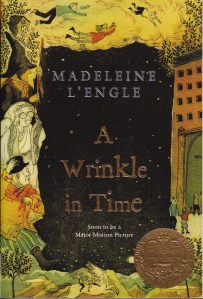
Since I was late getting my Banned Book in order this year, I went to something that I could read within a week. While my bus time is generally reserved for non-fiction reading, I had to pick something fairly easy so that I could get back to more serious stuff. Madeleine L’Engle’s A Wrinkle in Time was published the year I was born, and I’d never read it. It has ended up on banned and challenged lists every decade since it was published, so I was prepared for some radical stuff. Instead what I found was a well-written book for young readers that quoted the Bible quite a bit and even had a worldview that was appropriate to the Gospel of John. When the Murry children try to name the forces that fight the encroaching darkness, the first name offered is Jesus. The differences between good and evil are the subject of discussion among the characters and it’s pretty clear there’s an obvious distinction. So why is it a challenged book?

Never underestimate the sententiousness of the self-righteous. Objections to a medium, and characters—perhaps best understood as guardian angels in the book itself—perceived as witches, have led to the now familiar accusations of the occult. Here is a book that quotes the Bible, upholds the distinction of good and evil, and encourages children to fight for the former rather than the latter. Yet it also teaches tolerance. Parents who want children to think that only those like them can possibly be righteous start to shudder a little at that. The only good heretic is a dead heretic.

When I saw just how benign A Winkle in Time was, I had to think back over my own Bible. In addition to stories of horrendous violence, explicit sex, and with even a “witch” or two, the Bible contains diverse views. Paul argued with Peter in public, after all. Madeleine L’Engle was concerned about the book burning tendencies of Nazis. We now seem to think that the place for illiteracy is in the White House and, more recently, Alabama. Reading the news convinces me more and more each day that a steady diet of banned books is just the catholicon our society needs. Different viewpoints, like the rays of the sun, will shrink the mildew that finds its ways into dark corners, rotting the very fabric of our universe. A Wrinkle in Time may not sway adults in the same way it has engaged the wonder of children for the past half-century, but it is a start in a battle against darkness that is never-ending. There’s always time to read a banned book.


Sense or Ship

I can tell I’ve been too busy when I haven’t planned for Banned Book Week. A kind of unofficial holiday since, well, it’s about banned things, the point of this observation is that we should be free to read. A fairly large portion of the fiction I read anyway, at one point or another, ends up on the banned list. Not surprisingly, most banned books have diversity content—racial or sexual minorities portrayed in sympathetic ways. Trump has shown us clearly how dangerous such thinking can be. It’s well known that such perspectives are allied with some evangelical Christian interests, or, perhaps I should say, lack of tolerance. There are lots of ways of looking at the world out there, and many of them aren’t evil. I should’ve planned ahead.

Censorship implies a certain arrogance. One way of looking at things is right and all others are wrong. Although we all know that any logical system runs up against its limits (we call them paradoxes) we’re reluctant to let go of that which we suppose, with or without justification, to be right. Banning is an effort to control minds. It’s no coincidence that many of the titles on banned and challenged lists are intended for younger readers. Those who favor censorship want to close the eyes of the young and pretend the real world will just go away. Yes, many of the banned books are fiction, but fiction tells us truths. Those who ban books are uncomfortable with such truths. That’s not to say all literature is created equal, or that all banned books are great literature. As someone who writes fiction, though, I can attest how difficult it is to get it published. That in itself tells us something.

It’s banned book week and here I am without a banned book to read. I’ve got some ideas, of course. My wife and I both take on book reading challenges each year. One of this year’s books (at least) was a banned title, but one that I read too far in advance. Besides, although we have too many books in our apartment already, I used Banned Book Week as an allowance to go to the bookstore. What better way to fight literary fascism than to buy a book? The problem is deciding which one. The lists are long and grow longer each year. Intolerance, it seems, knows no limits. I’m about to do my civic duty for this time of year. I’m about to go to a bookstore and buy a banned book.


Clown King

Like many people, I enjoy a Stephen King novel from time to time. King has a talent for drawing you into his tales, and whether or not they’re scary you feel a kind of relief when they’re over. A few years back I read IT. I was prepared to be scared because many people talked about fears of bathrooms after reading it, and, of course, of the terrifying clown. Not being a fan of serialized television movies, I never saw the 1990 movie adaptation. Besides, reading a novel that long is a serious investment of time, and since I like to hear lots of different voices in my reading, I spread out the wealth. In any case, the novel didn’t scare me beyond the neighborhood bullies (who’ve since moved to Washington DC) and I moved on to other things. The new film adaptation has people talking about IT again, and clowns, and clowns always remind me of college.

During the late 1970s and early ‘80s, it was fashionable for Christians to clown around. Taking cues from Paul’s one-liner about being fools for Christ, evangelicals began to experiment with clowns as a means of witnessing. I got involved my freshman year at Grove City College. I researched clowns. Where had they come from? What was the proper way to do it? Was there a deeper meaning? A friend recently sent me a video from Origin of Everything on the subject. I see a lot has been added to the history that I once studied. The idea of the circus clown is one of the more recent innovations of a character that was, in origin, a bit frightening. In classic horror movie style, heavy makeup functions like a mask and we rely on faces to know if someone is friend or foe.

We were taught, in our rudimentary training, that clowns do not talk. To express yourself you had to exaggerate gestures. I learned that makeup did indeed free you from social constraints. The Christian clown, however, had to be good. We weren’t meant to scare anyone into heaven. As nights are growing longer and people’s thoughts are coming to grips with the end of summer, clowns make good companions in the dark. IT may not be King’s scariest novel, but he did understand that bullies and clowns are fears that never go away. And when you combine the two, and move them into the White House, vaunting white faces and corrosive social values, well, maybe it’s time to go to the movies and try to have artificial fears for a while.


Reason to Believe

Gods, the experts say, are on the way out. Have been for some time. The loudest voices in this arena are the New Atheists who suggest science alone explains everything. Problem is, the gods won’t let go. My wife recently sent me an article from BookRiot. (That’s a dangerous thing to do, in my case.) Nikki Vanry wrote a piece titled “Dallying with the Gods: 16 Books about Gods and Mythology.” Most of what she points out here is fiction, and that makes sense because gods and fiction go together like chocolate and peanut butter. The first book she lists is Neil Gaiman’s American Gods—a book I read years ago and which has subsequently become an American phenomenon. There’s even a television series based on it now. Like Angels in America, only more pagan.

What surprised me most about this list is the books I hadn’t read. Or even heard of. After American Gods, I got down to number 10—Christopher Moore’s Lamb—before reaching another I’d read. Then down to 16, Till We Have Faces, by C. S. Lewis. There are, as Vanry notes, many more. Our experience of the world, as human beings, suggests there’s more to it than what we see. Not everyone would call these things gods, nevertheless there certainly does seem to be intentionality to many coincidences. Things pile up. Then they topple down on you all at once. Seeing such things as the works of the gods makes for a good story. At least it helps explain the world.

Many materialists do not like to admit that humans believe. Call it the curse of consciousness, but the fact is we all believe in things. Even if that belief is as strange as thinking fiction only comes from electro-chemical reactions in a single organ in our heads. Gods often appear in fiction. Frequently they’re in the background. Sometimes they’re called heroes instead of deities. At other times they’re right there on the surface. Such books carry profound messages about believing. It doesn’t matter what the authors believe. Believe they do. And such books sell. As a culture, we may be in denial. What we sublimate comes out in our fiction. There are gods everywhere. Singular or plural. Female, male, or genderless. Almighty or just potent. Reading about them can be informative as well as entertaining. We’ve got to believe in something, so why not gods?


Hieroglyphs

The word “hieroglyph” translates to “sacred writing.” If you’re like me, your first attempts to learn writing were probably not very sacred at all. Tongue pressed to the corner of my mouth, eyes staring fixedly at the paper flat in front of me, my hand going anywhere but where I wanted it to, writing was a burden. I soon grew to love it though, not realizing it was changing my brain even as I was assimilating how to do it. Anne Trubek introduces quite a few new angles to the story in The History and Uncertain Future of Handwriting. She begins at the beginning, cuneiform, not hieroglyphics, and offers a brief sketch of how handwriting developed into the phenomenon we know today. And how it is now becoming something very different than what it once was.

Trubek’s book is full of delightful surprises about the development of scripts and the technologies that attend them. Like most non-specialists in cuneiform suppose, she suggests handwriting is basically anonymous therein. In fact, it’s not. Molding clay into a smartphone-shaped tablet doesn’t seem like technology, but the process of writing took a leap forward when someone figured out how to do this. Those who work with cuneiform can learn to identify handwriting. In the Ugaritic corpus, the tablets “signed” by Ilimilku can be distinguished from those written by others, and not just by his name. Technology has been devised to measure depth and order of stylus strokes in the clay, the angle the stylus was held, and many other seemingly insignificant features. Handwriting was present from the very beginning.

Perhaps what is most striking about Trubek’s study is how religion enters the discussion at almost every stage. Very early on writing was identified as a sacred activity. This continued through the middle ages when monks were those who performed writing as part of their non-secular duties. Even those who piloted penmanship in the modern period often noted that a person’s moral, Christian disposition could be measured by how said person made their letters. Writing, as those who do it for a good while know, becomes a sacred activity. Most world religions have holy books. Many of those books were the reason for an interest in literacy in several cultures. Even a surprising number of secular writers have understood the activity to have spiritual dimensions. Trubek’s book gives bibliophiles plenty to ponder. She doesn’t see the rise of keyboarding as a threat to writing because even in the computer age, individuality comes through. And for those who truly understand hieroglyphs, all writing is sacred.


Shocking Truth

The electrician recently stopped by. We’re renters and although I don’t mind doing minor household repairs to benefit the landlord, I draw the line at electricity. It’s a scary thing. I’ve been shocked too many times to want a jolt bigger than I can handle. I even once accidentally grabbed the metal prongs when unplugging something as a child (it was a microscope light, I remember) and that helpless feeling of being unable to drop the plug even while my body jerked uncontrollably left me with a healthy respect for those who actually understand insulation, capacitors, and those impossible electrical diagrams. So when the pull chain came out of the ceiling light I wasn’t going to try to fix it.

The electrician, like most people who see our apartment, commented on the books. “You like to read,” he said. I can’t help but feel guilty about that. It’s almost as if you should apologize for requiring the stimulation of so many tomes. I confessed that I did, but I wanted to justify it. “I work in publishing,” I feebly offered as an excuse. Concentrating on the fixture above his head, he said, “I don’t ever read a book unless I have to.” He fixed the pull chain and left. I couldn’t have fixed the thing so quickly, or safely. He even had a metal ladder. I was grateful for the light, but once again felt somewhat freakish for my bibliophilia.

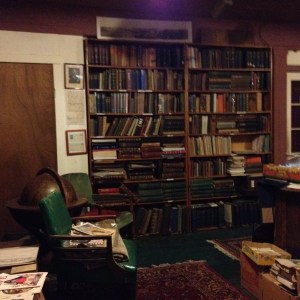
Those of us who write books must read books. You can’t learn how to do one without the other. Because of movies and television, we picture writers as people with large houses and separate rooms as libraries where they can sit surrounded by books as they type away at their next bestseller. Those of us who work for a living seldom have such luxury. A separate room just for books? I like letting my books reside in whatever room they feel like. Most affordable apartments don’t come with a study. There are living room books that you want people to see, and kitchen books that suggest good things to eat. There are bedroom books that you might not want others to see. What I don’t have is a library. A book zoo. My books roam freely about my home. It occurs to me that one area lacking in my collection is one about household wiring. Maybe instead of feeling weird I should get wired. I’m sure there are books out there that will tell me how. Or at least that will let me know that a wooden ladder makes a poor conductor.


First Look

Youth might be described in a number of ways. One, of course, is in biological years. Another may be in exposure to experiences which change your life. There was a time, for example, when you can’t believe you were ever so naive. No matter how youth might be defined, a patina of fond memories tends to cling to images from that time with the passage of years. For me, unsurprisingly, those images are frequently books. I still recall the cover images of books from my tweenage years, and often think that if I found such books in a second-hand store, I would buy them for their ability to conjure past times. One such book comes not from my physical youth, but from my days teaching at the University of Wisconsin, Oshkosh. It was at that time, when the internet was also still young, that I began to try online research into H. P. Lovecraft. I found an edition of his stories titled The Shadow over Innsmouth for sale on a used book website. I was under-employed, but it was cheap and my curiosity inflamed.

Mainly I was interested in what I would now call the reception history of Dagon. Dagon is an ancient Mesopotamian deity mentioned briefly by name in the Hebrew Bible. He is also part of the pantheon of gods borrowed and invented by Lovecraft to populate his eldrich, watery world. I purchased this book for the titular story, where Dagon doesn’t actually appear, but his worshippers do. It is often claimed to be Lovecraft’s best story. As I sat down to read the whole book, however, I was struck by the strangeness of the collection. This edition, from 1971, included such unusual choices as “The Transition of Juan Romero,” “In the Walls of Eryx,” and “The Festival.” Also bundled here was the Houdini ghostwritten “Imprisoned with the Pharaohs.” When I first purchased the book I’d only read “The Shadow over Innsmouth” and “The Colour out of Space.”

As my interest in Lovecraft grew, I acquired other, more representative editions of his work and have consequently read most of his oeuvre. It was that sense of yesteryear, however, that led me back to this browning, aged collection. It was, in truth, the cover. Looking at it brings back that very office in Oshkosh where I sat as I found the edition online for less than five dollars. No doubt, I was younger then. The call of Cthulhu has echoed across the web since then. For me, however, the first exposure will always be a beat-up paperback that I ordered secondhand.


Planet A

Two of the classics of ecology, A Sand County Almanac, by Aldo Leopold, and The Sea Around Us, by Rachel Carson, were published by Oxford University Press. In its present-day iteration the press has a Green Committee, on which I’ve sat from very nearly the beginning of my time there. As a committee, we’re reading these classics to see what we might learn some half-century-plus after they were published. I’d never read A Sand County Almanac before. It’s a pity, since I lived in southeast Wisconsin, from which the book takes its genesis, for about a dozen years. The writing is poetical prose, but the ideas are solid science—the land on which we’ve evolved knows how to take care of itself. When one species becomes too greedy, all suffer. Leopold ends his book by suggesting a land ethic should be put in place. Now, a human lifespan later, has it?

Hardly. Watching the Trump Administration doing everything it can to commodify any aspect of the environment that might make a buck—or at least a buck for the wealthy—is alarming in the extreme. There is no soul in the land, to this way of thinking. They believe that because they themselves lack a functional soul. A soul cannot exist without ethics. What we do to this planet is one of the largest ethical issues imaginable. No species, rational or not, destroys its own habitat. Except our own. Arrogant to the point of supposing ourselves divine, we think we can take what we want and give nothing back. And everything will be just fine. I wonder that we’ve had this inexpensive, readable guidebook this last seven decades and have continued to ignore its sage advice. Maybe we’re too busy making money to read something that sounds suspiciously like poetry.

One of the observations I had about the Almanac was how attuned to the philosophy of nature it is. Philosophy has many enemies these days, from prominent scientists to Republicans. Nobody seems to value the capacity for deep and thorough thinking through of a problem that is unbeholden to any orthodoxy. The philosopher can ask “what if?” without regret. When it comes to the environment, humans aren’t the only philosophers. We’ve convinced ourselves so completely that we’re more advanced than other species that we suppose they can’t teach us anything. One thing they do, however, without our interference, is create balance in nature. It’s an ethic to which even our species might aspire. If only we would listen to the wisdom of those who pay attention to the world that has given them life.


Fighting Nightmares

Some things are so personal, and inexplicable, that they’re difficult to put into words. Not only that, but they often involve other people and I try not to comment on those who actually know me in person. Still, having just watched Apocalypse Now for the first time, I feel I must. One of the people I admire most was a high school teacher. Although I never really said as much to him directly, he is one of the most formative people in my life. He served, and was shot up in Vietnam as a youth. His outlook on life, one that I’ve tried to emulate especially when my petty foibles overwhelm me, is an inspiration. I’m sure that he doesn’t know it, but every time I think of Vietnam he’s always in my mind.

Never a fan of war movies—I’m baffled that anyone can think of war as anything other than pure barbarism—I generally can’t watch them. Apocalypse Now, however, was widely discussed when I was in high school. It was released in 1979, just four years after the war had ended. It illustrates well the fog of war, and the Doors have been seeping in my head ever since the movie faded to black. When my wife and I began renting movies—VHS, of course—we made a list of must-see titles. First, partially for alphabetic reasons, was Apocalypse Now. That it took us almost two decades to get to it says something about the nature of life. And also my fear of war movies. Still, I knew I needed to see it. I figure that unless someone is even more behind the times than me, nearly forty years is safe from spoiler alerts.

The idea, based on Joseph Conrad’s Heart of Darkness, is that Colonel Kurtz has gone insane and Captain Willard has been called in to assassinate him. As he makes his way upriver Willard finds out that Kurtz is treated like a god. He has a cult following and does appear to have lost touch with reality. In the climatic scene, Willard hacks Kurtz to death as a cow is being hacked to death outside as a sacrifice. Ending with Conrad’s original words, “the horror, the horror,” an ambiguity lingers over what a people will do once their god has been killed. In fact, language of people being gods occurs early in the film as well, bookending this concept. The truth, of course, is that there are no gods here at all. I can’t guess what Conrad would’ve thought of this adaptation of his story. I know that when I saw it my thoughts returned to one man whose impact on my life continues in ways unexpected and deeply hidden.


Celestial Happenings

Science fiction used to be the mainstay of my reading. Unlike a true fan, I was never exclusively devoted to it—my tastes are far too eclectic to be contained by any genre. Nevertheless, at a used book sale, on a whim, I picked up Frederik Pohl’s The Day the Martians Came. It had a cool looking spaceship on the cover, and I recognized his name from my childhood reading. I prepared myself for an adventure. Instead I found a disillusioned tale of humans and their foibles, many of them religious. Many tales, in fact. Indeed, I wasn’t surprised to find out that this was originally a set of discrete short stories later laced together into a novel. The point, it seems, would be appropriate to Qohelet. Human beings run around doing their pointless things and failing to communicate with one another. That much was true to life.

The Martians, who are more evolved and intelligent than humans, but who appear to be mere docile animals, are discovered near Christmas. Much is made of the fact that humans still celebrate Christmas on Mars. And, if you can cut through all of the snark, there’s also a message that we like to live out our prejudices whenever possible. So the humans, excited about Martians being transported back to earth, try to take advantage of each other any way they can. Some of the most complex of the stories involve religious leaders who dismiss science and assert mystical knowledge of these extraterrestrials. These leaders, of course, are only after the money of the gullible. They’re playing the popularity circuit, or running cults, and the clueless are drawn to them. And so the book isn’t really about Martians at all, but about human folly. Mainly religion.

Science fiction means different things to different people. In a used bookstore I noticed Neil Gaiman under science fiction. As much as I enjoy his work, I’d classify it as general literature instead. Genres are there to help us find related material. The name Frederik Pohl and the word “Martians” in the title suggest science fiction, but the book itself doesn’t really meet the criteria. At least for me. Perhaps it’s because we’ve landed rovers on Mars and are now talking about a human expedition. Mars has become somewhat less exotic. Religion, meanwhile, continues to churn and muddy the waters. Not always as cynical as the leaders seem to be in this book, nevertheless they are part of the discussion since once we get off this planet we’re going to have foreign deities with which to deal. Whether we respond with snark or science fiction is entirely up to us.


Lovecraft Legacies

Although long fascinated by popular culture, I’ve not really been part of any fandom. I suppose this is because my interests tend to be quite broad, and finding one piece of pop culture over which to obsess is difficult. I might miss something somewhere else! While not really a “fan” of H. P. Lovecraft, I’ve read much of his writing and I’m amazed at how pervasive his cultural influence has been and continues to be. W. Scott Poole, who’s taken us into realms historians often shun, has done a great service to those interested in Providence’s most famous son. In the Mountains of Madness: The Life and Extraordinary Afterlife of H. P. Lovecraft is a thoughtful, honest, and in-depth consideration of both the man and his fiction. The basics of Lovecraft’s life are easily accessed, but the probing questions Poole puts to the evidence are thought-provoking and, in many respects, revelatory.

Perhaps the largest Lovecraft demon that Poole tackles is H. P.’s racism. There’s no secret about this, but fans often find ways of excusing it or explaining it away as being a product of his time. Those of us who write can understand that Lovecraft didn’t get out much. When he did get out he preferred it to be among people like himself. (Male, white, and gentrified.) It’s difficult to say what the origins of prejudice are, beyond the natural tendency to fear those who are different. Still, intelligent people can generally figure out that such biases are based on lack of experience or willingness to learn about other cultures. There are many, many cultures in the world and it’s often hard to think that yours isn’t the best. A large part of today’s political turmoil is based on this very thing.

An added benefit to reading Poole’s book was the realization that although Lovecraft really didn’t travel much (he didn’t live very long either, and the two are at least partially related) he did at one time visit the small town in New Jersey where I live. That came as a bit of a surprise. The last time I visited Providence, there wasn’t much in the way of signage or plaques to mark where Lovecraft had left his stamp. That may have changed in recent years as his literary star has continued to ascend. Still, to find out that he’d passed this way once upon a time was a nice little bonus in the investigation into who this man was. There’s a lot more to dig out of Poole’s book, and fan or not, if you’re interested in Lovecraft this is a must read.


Might As Well Read

During my recent travels I had a layover at Sea-Tac Airport. Since I don’t get out much, I always find a walk through the airport a way of measuring what other people find important. At least in a circumscribed way. When you’re traveling you’re limited in your options. Most airlines have addressed passenger ennui by offering devices with electronic entertainment. Instead of an in-flight movie, you’ll have choices of what you want to do, courtesy of the endless magic of in-flight wifi. So the thinking goes. Airports, it would stand to reason, will offer plenty of travel-size diversions. The kinds of things you’re allowed to take onto a plane but which won’t or can’t be used to harm others. A sign at Sea-Tac reads “Books. Food. And yes, beer. Just ahead.” An interesting choice of offerings.

I was strangely heartened by the pride of place given to books. Yes, people still find the book on a plane satisfying. Stories have a way of drawing us in. Making us forget that we’re in a cramped space filled with strangers and recirculated, pressurized air. Books have the ability to take us far away. It’s a magic that movies can’t always achieve. Books leave more to the imagination. I recently rediscovered this on a solo trip across the Atlantic. I used the opportunity to read a novel cover-to-cover. The impact was incredible. For those six hours I was on the ground, following the adventures of young people caught up in the liminal zone of adventure and love. It was a powerful experience.

On my daily commute I tend to read non-fiction. Perhaps it’s the result of earning a doctorate, or perhaps it’s the stigma of enjoyable reading being “fluff.” The great majority of books I read this way teach me a lot. I read about many different subjects, and have recently learned to make commuting time a type of research exercise. But then, a cross-country plane ride is different. While an evening commute from New York City can stretch to three hours or more, that’s fairly rare. Instead, air time is unbroken time. I look forward to it with the prospect of a good novel. Airports are one place where hoi polloi don’t mind hanging out in a bookstore. Yes, the fare will be mostly bestsellers, but anything that gets people to read is a good thing. And, of course, if that doesn’t work for you there’s always beer. Just ahead.


Making Lovecraft

Perhaps it’s all just coincidence, but once in a while a number of unexpected things come together. Since I do a lot of reading this often happens in the context of books. The current case begins with my first noticing Matt Ruff’s Lovecraft Country. I saw a review online, and since I enjoy contemporary novels that build on the worlds created by H. P., I added it to my reading list. The first coincidental aspect of it was that I found in Buffalo Street Books in Ithaca. Like most independent bookstores, it’s not huge, so the selection of books that cater to my odd tastes is always adventitious. I found it on the staff recommendation shelf and recalled that it was on my reading list. A second coincidence came in finding Neal Stephenson’s name under a cover blurb. My brother-in-law’s name is enough to get a book onto the bestseller’s lists, but I had no idea this kind of book would be to his tastes as well.

I began reading it right away. The third happenstance is that Ruff crafted a biblically literate story here. In a day when those of us associated with the Bible are definitively passé, it is nice to see popular fiction fighting back a little bit. Not that Ruff is advocating or proselytizing, but his finely tuned story is definitely enhanced with a bit of biblical knowledge. He’s unapologetic about it. In our religion-critical outlook these days we sometimes forget that the Bible has several stories that maintain, and even reward, contemporary interest. The most obvious example in Lovecraft Country is the story of Cain. There are plenty of others that can be dug out as well, and Ruff even leaves some on the surface so that they aren’t hard to find. Not that this is a religious book. It’s just not afraid of religion.

Some may find that odd in a homage to the noted atheist Lovecraft. What they may not see is that the master himself used religion from time to time in his tales of horror. Also, for those who are willing to be honest, we know that an unsavory racism resided in Lovecraft’s outlook. Ruff, like other writers who see the positive side of this author’s work, tells a story of African-American struggles in the “idyllic” 1950s. The protagonists, dropped into a world of real Lovecraftian magic—and in a very self-aware way—are all a close-knit black family and their friends. Which led to another coincidence. Quite unconnectedly, I’d been reading Dr. Jekyll and Mr. Hyde. This plays an important part in the story as well. Sometimes reading itself can lead to a cascading set of coincidences. Lovecraft Country is one instance where it happened, but that may just be my unusual taste in books.


No Place to Hyde

“I was driven to reflect deeply and inveterately on that hard law of life, which lies at the root of religion and is one of the most plentiful springs of distress.” These words occur near the beginning of Dr. Henry Jekyll’s confession, the very manuscript that closes Robert Louis Stevenson’s The Strange Case of Dr. Jekyll and Mr. Hyde. Upon reading the book, along with the preface and afterword clearly meant to pad out the thin volume, I realized that I was not alone in having known the story all my life but never having read it. Western culture is steeped in the idea like so much strong English tea. The story of the divided self. The eternal question of who I really am. Like Frankenstein’s creature, Jekyll and Hyde found immediate resonance in the pantheon of monsters. Here was something with which we could all identify, but which we all would deny. Or would we?

Jekyll notes that the root of religion—proper behavior, moral living—is a source of distress. And this before the era of Nones and non-believers. Religion has that reputation. “Be good or else!” Or fire insurance, as some call it. Religion, in the popular imagination, isn’t so much about sublimity any more. Or transcendence. Somewhere along the way it got fixated at about the level of our genitals and what we should never, ever do with them. Hyde’s sins, as commentators frequently note, are anything but explicit. He tramples a young girl and kills an old man. Beyond that we know nothing of his monstrosity. Is it so hard to believe the restraint concerns his sexuality? After all, his friend Utterson—well, Jekyll’s friend Utterson—enjoys his wine. Both respectable men seem to have hearty appetites. Apart from violence, what other dissipation is there?

Like many first-time readers I can’t recall how I first learned of the mad scientist and even madder thug that make up the namesake of this story. For some reason I never made—even remotely—a religious connection with it. It was a monster story, after all. Innocent fun for a Saturday afternoon. The experience of reading the book was a bit more jarring than that. Jekyll’s confession isn’t exactly easy to read. It is like going to the confessional with the curtain drawn and all the lights on. And yes, the implications are religious after all. It is a little book with a big point to make.