Not Quite Thursday

I discovered Jasper Fforde, as these things so often happen, at the recommendation of a friend.  A writer of rare talent, he’s conjured a few meta-worlds where fiction is the subject of fiction.  Probably best known for his Thursday Next novels, the premise is that fiction can be distorted by malevolent sorts within the Book World, which is like the Outside (our world) only much more interesting.  The sole problem with series is that in order to follow the storylines, you need to be able to recall where things were left the last time.  That’s complicated when you don’t read the books in order.  I haven’t followed Thursday Next in sequence—I find Fforde’s books sporadically and pick them up when I do (I prefer not to buy fiction on Amazon, for some reason).

The latest installment I found is One of Our Thursdays Is Missing.  It’s a bit more convoluted than the last plot I recall, but the writing is still good.  In this story, which mostly takes place in Book World, the written Thursday Next has to find the real Thursday Next (who is, of course, also written, thus the “meta” I mentioned earlier).  This is probably not the best place to start the series for neophytes.  There was an interesting aspect, however, that I feel compelled to share.  The majority of this novel takes place on an island dedicated to fiction, divided into different “countries” by genre.   Just north of Horror and east of Racy Novel is Dogma.  It’s just southeast of the Dismal Woods.  This plays into the plot, of course, but the placement is interesting.  As Thursday tells it, the full name of the region is Outdated Religious Dogma.  Then I realized something.

Simply placing Dogma on this island plays into the idea that religious thought is fiction.  There are other islands in Fforde’s world, including non-fiction.  Dogma, of course, is not the same as religion.  The definition of dogma is something that is incontrovertibly true, by the authority that states it.  Problem is, nothing is inconvertibly true any more (if it ever was).  When Christianity ruled Europe, such ideas became highly politicized.  Indeed, parts of the world could well have fit into the Book World map.  Fforde’s novel is really just for fun, and Dogma doesn’t play a major role in the story.  That doesn’t prevent it, however, from being a legitimate point over which to pause and wonder.  Fiction can be factual, but not in a dogmatic way.


The Truth of Fiction

The thing about reading is that it’s a lifestyle.  I record books both here and on Goodreads, but I read a lot more than books.  Although I don’t have much time for magazines or even newspapers, I read a lot on the web.  And billboards.  And sidewalks.  I’m quite content doing it.  One thing I’ve noticed in all this reading is that fiction writers tend to be more often cited as experts and intellectuals than do non-fiction writers.  Oh the non-fic practitioners get their footnotes, and other specialists mention them, but fiction writers get analyzed, probed, and explored.  Literary types wonder what they meant by some obscure doggerel they wrote.  When’s the last time a non-fiction writer drew that kind of attention?  It makes me wonder about all the time I’ve been spending on non-fiction lately.

I suffer from graphomania.  There’s no cure.  The other day I went looking for an old, pre-electric typewriter to get my fix in case the power goes out.  I have notebooks, zibaldones, commonplace books.  I carry one in my pocket.  I have one on my bedside stand.  And the thing I’ve noticed is that the ideas that come to me unbidden are often fictional.  You see, I have a hidden life as a fiction writer.  That persona is very poor since he’s never made any money from his writing.  He was nominated for a Pushcart Prize some years ago, but he never won.  That fiction writer has been suffering cabin fever because I’ve been finding publishers for my non-fiction work.  I wonder, however, if maybe I shouldn’t be spending my time on fiction.  It’ll never get me to the point I can make a living on it, but it might get quoted after I’m gone.

Writing, after all, is a stab at immortality.  Those of us who do it are legacy builders.  Even as the web has moved us more and more toward visual, iconic forms of entertainment, it has still left a few dusty corners for the written word.  When I pass the sometimes impressive graffiti on the way into New York I think I know what the vandals are feeling.  We’re kindred spirits.  We don’t want to be forgotten.  Whether with spray can, fingers on a keyboard, or fountain pen (or maybe even an old-fashioned typewriter) we are trying to say, “I was here.”  I used to print out all my blog posts in case the web failed.  It grew to thousands of pages.  I had to stop.  I was beginning to act like a fictional character.


Care and Keeping of Books

I take good care of books.  It’s my personal goal that after I’ve read a book you won’t be able to tell.  I used to mark books up, but it occurred to me that I want the books to outlast me and if someone else is to get the full benefit of them I shouldn’t be doing such scribbling.  Of course, when a book has to commute with you there’s bound to be some scuffing from being put into a briefcase along with other necessities.  On the days I don’t commute, I try to replicate bus time for reading.  I curl up in a chair with my book and a cup of coffee to warm my fingers, and read.  The other day as I did this, a drop of coffee made its way from my mug onto the open page.  I was aghast.

Reading a marred book page is eternally distracting.  My eye is immediately drawn to the imperfection and I sometimes can’t even make sense of the sentence in which the blemish occurs.  Not because I can’t read it, but because I can’t get beyond the hurt.  Coffee rings are chic, I know, on the cover of a book or a notebook page.  It’s one of the truest clichés of the literary crowd.  Coffee and a good book.  Not coffee in a good book!  I tried to get back into the flow of the narrative.  My eye kept wandering back to the spot I’d unintentionally marred—I’d violated my own principles.  Unintentionally of course—this isn’t Starbucks where the heat is set at a reasonable level and you don’t have to scrunch up to keep warm.  But still.  But still.

After many minutes of feeling like I’d shot a friend, I managed to move on.  I kept turning back to my coffee page to see if the damage was as distracting as I thought it was.  After work that night when I picked my book up again—commuting is a twice a day activity—I turned back to the damaged page and frowned.  Books are, to some of us, friends.  I want to treat them right.  I line them up in order on their shelves, knowing just where to find them when I need them again.  One careless drop of coffee had taken its eternal toll on an innocent tome.  I realize this world lacks perfection; I’m not naive.  Still, this book, which wasn’t cheap, now bears a scar that I dealt it.  Will I ever comprehend what that one page says?  I hope my silent friend will forgive.


Bookish Dreams

Driving into upstate New York via interstate 81 you’ll find a remarkable rest stop.  To put this into context, I should say that my wife and I have driven from Maine to Washington (not on a single trip) and from Wisconsin to Louisiana and South Carolina.  We’ve laid down considerable mileage together, and never have we encountered such a nice rest stop.  Clean, modern, and featuring local goods for sale, it’s a loving homage to the southern tier, the New York outside the city.  One of the features of this unusual facility is a terrazzo floor fresco highlighting the various points of interest within a couple hours’ drive.  Mostly when we stop here we look toward Binghamton and Ithaca, the cities we most frequently visit.  We stop to use the restroom and then drive on.

When we stopped over the holidays, however, we lingered a little bit.  There’s a display on Mark Twain—he lived in Elmira, New York for a time—and there’s an in-ground plaque outside to Rod Serling.  I spent some time looking over the points of interest in the floor map when my wife pointed out a site listed as Hobart Book Village of the Catskills.  I couldn’t believe that I’d been in this building dozens of times but had never bothered to look that far east.  Curious, I did a web search once we reached out destination.  There is, it turns out, a village in upstate known for its main street of book stores.  What perhaps impressed me even more was that it was considered significant enough to be given a kind of “Hollywood star” treatment in what is an often overlooked part of the state.

Now I can’t say what my impressions of Hobart are.  I’ve never been there, having just learned of it on a recent roadtrip.  What I can say is that my world suddenly began to feel just a bit more friendly knowing that such a place exists.  We live in a country that could indeed use a bit more positive influence.  Some of my happiest memories involve bookstores.  Back in my teaching days we made regular autumnal literary weekend trips, visiting sites haunted by writers.  Often we’d find an independent bookstore near such sacred places.  To many, I realize, this would smack of nonsense, but to those ensconced in literary dreams, it created pleasant memories.  You feel something in the air as you stand near the house or grave of an author.  Places are made sacred by what transpires within them.  The writing of books shapes the very space-time around them.  At least it does for those who even find inspiration in an interstate rest stop.


Yearn Books

While this blog ranges over an outdated map of my mind, one of the two common elements that hold it together is books.  I don’t have many bibliophile followers, but for any who happen upon my pages, welcome.  Each year at this time I look back over the year in books.  I started doing this when I joined Goodreads.  I don’t put every single book in Goodreads, but it’s a fair register of what I’ve been up to.  This year I set a reduced goal of 65 books (I knew I’d be moving and commuting less, and I do most of my reading on the bus).  Happily I ended the year with 83 officially read, but then the first five months of the year were still spent in daily commutes.

Three years ago my wife discovered the Modern Mrs. Darcy’s reading challenge.  I can’t say just how much I look forward to the new year just to begin reading the books I select to meet that challenge.  The reason I do this is to force myself into reading things I might not feel like reading, or often, books I’ve been putting off for some reason or another.  It only amounts to a dozen books and if I can’t get through twelve in a year, something’s terribly wrong.  Margaret Atwood once said something like “Show me a person who’s read a thousand books and I’ll show you an interesting person.”  I didn’t really need that quote to set a goal, and I don’t think of it as bragging for readers to share their experience with books.  I started getting into books in middle school, and although I didn’t keep track in those days I likely read a thousand books before I graduated from high school.  Branches begin to bend to the light early on.

So, were there memorable books this year?  My reading, due to contractual obligations (I brought them on myself), has tended to be dark.  There were, nevertheless, spots of light.  Thomas Hardy’s Jude the Obscure and Paul Bogard’s The Ground Beneath Us were early favorites.  I managed to stop my ears enough to miss spoilers from Jeff Vandermeer’s wonderful Annihilation.  Carl Sagan’s The Demon-Haunted World was artfully done, and Gregory Alan Thornbury’s Why Should the Devil Have All the Good Music? was a saunter down memory lane.  Selections from my reading challenge fiction that I really enjoyed were Anne Tyler’s Vinegar Girl, and Emily Fridlund’s History of Wolves. And Lee Irby’s Unreliable.  And and Carlos Ruiz Zafón’s The Shadow of the Wind.  The last inspired non-fiction title I read was Susan Fair’s American Witches.  I always appreciate suggestions, just sayin’.  Reading is the balm in my personal Gilead, and I look forward to a 2019 full of books, even if I can’t keep the pace of years past.


Reading Lights

Late one night in Wisconsin—I had just come off the train from Champaign-Urbana—one of the students from Nashotah House was driving me to my spooky apartment on campus as part of his work-study job.  He mentioned what seemed an obscure topic to me, and I asked him why he liked it.  “Who can say,” he responded, “why they like anything?”  He had a point.  Work on Nightmares requires reading current studies of horror, and one that came out just before Halloween was Darryl Jones’ Sleeping with the Lights on: The Unsettling Story of Horror.  I don’t know why I like such things, but when the book was first announced I knew I’d need to read it, and soon.  It had to wait until the Warren books were finished, however.

This little gift book (with a novelty cover, even) contains quite a bit of insight.  In fact, while reading it I discerned that Jones had spotted something that I’d begun to write down independently.  Horror does that to people.  The book is divided up into chapters addressing different genres of monsters and analyzing why they have proven so popular with both horror authors and auteurs.  The discussion is lively and even witty at times, as befits a topic that most people really misunderstand.  I myself used to misunderstand it—I went through a terrible period of repudiating the things I liked when growing up (who could say why?).  I jettisoned my interest in the Gothic even as I visited ruined castles in the Scottish highlands, and thought that horror was something best left to the uneducated.

One of the realities of my own life—perhaps some of my readers will find it true as well—is that once you’ve been put through the mill once or twice your mind starts going back to childhood in what may be a vain effort to start all over again.  The likes of your youth come flooding back—this is why I began reacquiring Dark Shadows novels.  They aren’t fine literature, but they were one of the guilty pleasures with which I grew up.  As Jones notes, vampires are one of the most enduring of monsters.  He suggests that Bram Stoker’s Dracula was among the notably influential books of Victorian English literature.  As Jones points out, there are people who back away from him when he tells them he studies horror.  He also makes a clear case for its enduring connection with religion.  I might add as a coda here, that telling people you study religion often gets the same response as telling them you study horror.


Better Late Than

It seems that Holy Horror is now available, although I haven’t seen it yet.  According to the McFarland website it’s in stock just in time for the holidays.  Those of you who know me (few, admittedly) know that I dabble in other social media.  One of my connections on Goodreads (friend requests are welcome) recently noted that he does not like or watch horror.  Indeed, many people fall into that category.  His follow-up comments, however, led me to a reverie.  He mentioned that reading the lives of the saints and martyrs was horrific enough.  One of the claims I make in Holy Horror is that Mel Gibson’s Passion of the Christ is a horror film.  My friend’s comment about martyrs got me to thinking more about this and my own revisionist history.

Traditionally horror is traced to the gothic novel of the Romantic Period.  Late in the eighteenth century authors began to experiment with tales of weirdly horrific events often set in lonely castles and monasteries.  From there grew the more conventional horror of vampire and revenant tales up into the modern slasher and splatter genres.  I contest, however, that horror goes back much further and that it has its origins in religious writing.  Modern historians doubt that the mass martyrdoms of early Christianity were as widespread as reported.  Yes, horrible things did happen, but it wasn’t as prevalent as many of us were taught.  The stories, nevertheless, were written.  Often with gruesome details.  The purpose of these stories was roughly the same as the modern horror film—to advocate for what might be called conservative social values.  The connection is there, if you can sit through the screening.

Holy Horror focuses on movies from 1960 onward.  It isn’t comprehensive, but rather it is exploratory.  I’ve read a great number of histories of the horror genre—a new one is on my reading stack even as I type—and few have traced this phenomenon back to its religious roots.  Funnily, like horror religion will quickly get you tagged as a weirdo.  Perhaps it’s no coincidence that both goths and priests wear black.  As I’ve noted before on this blog, Stephen King’s horror novels often involve religious elements.  This isn’t something King made up; the connection has been there from the beginning.  We may have moved into lives largely insulated from the horrors of the world.  Protestants may have taken the corpus from the crucifix for theological reasons, but for those who’ve taken a moment to ponder the implications, what I’m saying should make sense.  Holy and horror go severed hand in bloody glove.


Carrie On

Stephen King was still a fairly new writer when I first read “Lawnmower Man” for an English class in high school.  Carrie had been published by then, but I didn’t read any more Stephen King until after my academic job ended.  (There is, for those who are curious, a correlation between that traumatic change and my interest in horror.)  Like many, I suspect, I saw some of the movies before reading the King books behind them.  With a writer as prolific as King there’s always the issue of where to start, and I’m often subject to the selections independent bookstore owners make.  I seldom buy fiction through Amazon—I have to see the book for it to grab me (a kind of King thing to happen).

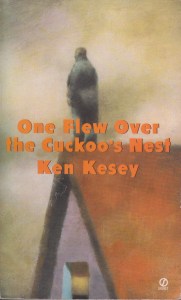
A used copy of Carrie recently came my way.  Now, I’ve seen the movie (both versions) many times; it is discussed at some length in Holy Horror.  I’d not read the novel until now.  Obviously there are differences between book and movie, but as this was Stephen King’s debut novel it struck me just how central religion was to the fearful scenario he paints.  That’s pretty clear in the film, I know, but it’s even more so in the novel.  Carrie is made into a monster by religion.  One could argue that she was born that way—telekinesis as a genetic marker is also a theme in the book, although absent from the films.  Still, it is Carrie’s rejection by others, largely because of her religion, that leads her to use her powers to destroy Chamberlain, Maine.

In a strange way, Carrie is a coming-of-age story from a girl’s perspective.  Strange because King is a man and some literary magazines won’t even accept stories written from the point-of-view of someone of the opposite gender.  Men can’t know what women go through.  Indeed, most of the male characters in the story are less than admirable, while some are downright wicked.  The real question is whether religion saves from wickedness or causes it.  There’s not much ambiguity here on the part of Mr. King.  Holy Horror, although it deals with movies and not novels,  makes the point that films based King don’t infrequently use religion as a source of horror.  Long-time readers of this blog know that I frequently make the point that this genre, more so than most, relies on religion as an engine to drive it.  And religion also has a role in repressing women.  Coincidence?  Ask Carrie.


Personal Gothic

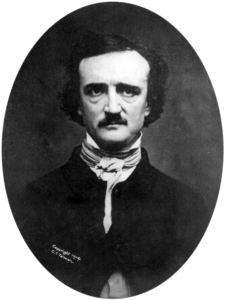
As I continue work on Nightmares with the Bible, I am reminded just how influential Edgar Allan Poe has been in my life.  It’s not that I read Poe every day, but it’s more that his stories have stayed with me since childhood.  For an English term paper in high school, the last one I recall writing, I selected Poe as the subject.  Something of the sadness of his life made me feel as though we were kindred spirits, although I could never meet him, and never let him know that he would have had a friend if he had been born a maybe a century and a half later, and if possible, in Franklin, Pennsylvania.  If his fondness for drink came with him, he would likely have met my father in such circumstances.

Even today I feel a kind of fiercely protective interest in Poe, as if his poems and stories had been written exclusively for me.  Seeing a handwritten fine copy of “The Raven” on display in the Morgan Library and Museum brought tears to my eyes.  Like Poe, I strive to make a living as a writer, but unlike Poe, I cop out.  I’m too afraid of losing everything.  Jobs necessarily interfere with writing, and some jobs actively discourage it.  Nevertheless, I still feel the shudder when I think about the first time I read many of his stories.  This was, I suspect, what fed my young interest in horror.  It wasn’t the blood and gore of the slasher film, it was the quiet, sad, disturbing atmosphere of Poe.  It has been recaptured by few, in my experience maybe only by Shirley Jackson.

Those who write are connection seekers.  Writing is a way of testing to see if we alone see the world in our own way.  Will others respond?  Poe somehow, mainly after his own lifetime, touched a responsive chord with many.  His work is now very widely known.  His visage appears on everything from bandages to socks.  His stories and poems are endlessly retold, adapted, and parodied.  When I read Poe I hear someone speaking from a life of hard knocks.  His response was to strike back, through his writing.  The life story written by one of his relatives suggests that he wasn’t as gloomy and tortured as he is generally portrayed.  Perhaps not.  Nevertheless, those of us who find gothic literature somehow redemptive know, once we close the cover, who it is we should thank.


Creatio Nihilo

Just when I think I’ve reconciled myself with technology, this goes and happens.  These precise words, in this order, have been written before.  In fact, all words in the English language have already been laid out in every conceivable order.  Technology can be friend or foe, it seems.  The website Library of Babel—with its biblical name—has undertaken the task of writing every conceivable combination of letters (using our standard English alphabet) and putting them into a vast, if only electronic, library.  This was not done by a human being like me, with intent or even any interest in the meaning of the words, but rather as one of those things people do simply because they can.  This entire paragraph can be copied and pasted into their search box and found.

The Library of Babel has made plagiarists of us all, even as it plagiarized everything written before it was programed.  After I learned about this library the wind avoided my sails for a while.  You see, what’t the point in writing what’s already been written?  Then it occurred to me.  Context.  The fact is, had I not scriven these very words, and put them on this blog, they would never have come to the attention of the kinds of people who read what I write.  The words have been spelled out before, but they’ve never been written before.   Those of us who write know the difference.  We spend hours and hours reading and thinking of ways to combine words.  We’re not out to kill the creativity of our species, we simply want to participate.

There should be limits to human knowledge, otherwise we’d have nothing for which to strive.  The internet may make it seem that all knowledge has been found—it is so vast and so terribly diverse—and yet there are people who never use a computer.  Their wisdom counts too.  It may seem that everything is here, but there is material that still has to be looked up in physical books.  There are crates and crates of clay tablets from antiquity that have never been transcribed and translated.  When that finally happens, the words they contain may be found, in a strangely prophetic way, in the Library of Babel.  But they won’t have any meaning there until it is given by the context.  And what can a library preserve if it isn’t the context that a (human) writer has given the words?


October’s Monsters

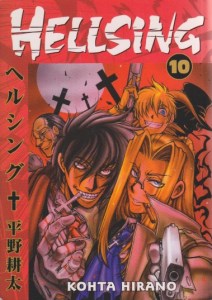
Blood and vampires go together like October and, well, vampires.  Although I don’t understand manga, I do know it’s extremely popular, and a friend has been lending me the volumes of Hellsing by Kouta Hirano.  In the past couple of weeks I’ve read numbers 4 and 5.  Hellsing sets up a world where the Catholic church destroys vampires, as does the English, Protestant organization Hellsing Organization.  The latter, however, has as its secret weapon the vampire Alucard who, in nearly every number, gets dismembered in some bloody way before pulling himself back together to overcome the enemy.  In the latest issues I’ve read the Catholics and Protestants have to cooperate against the threat of neo-Nazis (and this was before Trump was elected), who also employ werewolves.  (It’s October, remember.)

Having been pondering the vampires of Maine, I decided to read the next in my own generation’s vampire hero, Barnabas Collins.  I’ve been reading the Dark Shadows series by Marilyn Ross to try to find a lost piece of my childhood.  There was a scene in one of these poorly written Gothic novels that made a strong impression on me that I finally re-encountered in Barnabas, Quentin and the Nightmare Assassin.  Interestingly, in this installment Barnabas, the gentleman vampire, is cured of his curse while traveling back in time with Carolyn Stoddard.  The story doesn’t explain how some of the characters from the twentieth century appear a hundred years earlier, but it does bring an early encounter of the vampire against the werewolf—an idea monster fans know from its many iterations such as Hellsing or, famously, Underworld.

You might think vampires and werewolves would get along.  In both the Dark Shadows and Hellsing universes the personalities of both come through clearly.  Both monsters have deep origins in folklore and people have believed in them since ancient times.  Just because they’re not human, however, is no reason to suppose they’ll get along with each other.  As soon as Universal discovered that monsters translated well to film the idea began to develop that monster versus monster would be a great spectacle.  We had vampires and werewolves clashing on cheap budgets with fog machines.  A new orthodoxy was created that the undead just don’t get along.  It’s a idea that continued into the relatively bloodless Dark Shadows series, and on into the violent and gleefully bespattered Hellsing.  And since it’s October nobody should be surprised.


Classic Education

A few months ago now, just after moving, our garage flooded.  Our books, unpacked, were stored there at the time, resulting in many casualties.  As I sorted through what was destroyed—a process still ongoing—I decided that if I replaced books I would re-read them as I did so.  Emily Brontë’s Wuthering Heights was the first replaced, and therefore re-read, volume.  For those who never had the opportunity to attend seminary, I would note that it is the ideal time for reading.  One of my professors, Harrell Beck, although he taught Old Testament, encouraged wide reading.  The Bible, he suggested, didn’t stop at the last verse of Revelation.  It was in seminary that I discovered the Brontë sisters and their remarkable literary achievements.

Wuthering Heights is fine autumnal literature and Heathcliff one of the greatest protagonist villains of literature.  An interloper among the privileged classes, Heathcliff finds delight in making others share in his suffering.  One of the more memorable characters is Joseph, the Bible-toting, Bible-quoting caretaker who sees nothing good in the younger generation.  Even Emily Brontë, the daughter of a clergyman herself, spies the hypocrisy so clear in the lives of literalists.  Joseph enjoys scolding as much as reading Scripture, and even the other servants find him tiresome.  Born in the year Frankenstein was published, Emily had Gothic sensibilities.  With the protracted death scenes and atmosphere  of loss and mourning, this classic can be a restorative in an era such as ours.  In more than one way.

Since Wuthering Heights is a classic, there’s no need to recount the story of lost love and damaged human beings.  What is important is to realize that we continue to support a social structure that repeats the sins of nineteenth-century England.  And like that setting, we do it firmly believing we are a “Christian” nation.  Joseph would surely nod in agreement.  Stripping the safety nets from the vulnerable so that the privileged classes might enjoy more of their ill-gotten gain, we live the hypocrisy of the self-righteous.  It the era of the Brontë sisters, women were not encouraged to write.  They, like the servants of the wealthy, were believed to exist for the comfort and pleasure of the master.  Not paying attention to the classics, we’ve come back to that era, claiming that wealthy white men are the true victims in all of this.  The denizens of the swamp will find their place in history next to Josef Stalin, Mao Zedong, and Benito Mussolini.  Wuthering Heights, like 1984, will, however, remain a classic that sees through hypocrisy.


Banned Wagon

In celebration of Banned Book Week (go ahead, let your hair down!), I thought I might muse about some good news.  Since I already posted on my banned book (Slaughterhouse Five) I need another angle of approach.  One of the less envious aspects of being an editor at an academic press is being yoked to facts.  Many authors have a basic misconception about numbers in their heads.  They think their book will sell on the scale that Barnes and Noble, such as it is, will stock them on the shelves.  I have to admit that I dream of walking into a bookstore and finding one of my titles on the shelf—and I know it’s not likely to happen.  Those of us who work in publishing see the hard figures, how many copies have actually sold.  And the results can be quite sobering.

The news isn’t all bad, though.  I ran across an article by Andrew Perrin titled “Who doesn’t read books in America?” and the way the question was phrased made me think.  I’m used to thinking of it the other way around: how many people read, or buy, books?  I once read that about 5% of the US population constitutes the book-buying market.  Now, that is a large number of people, even if it’s on the smaller end of the overall spectrum, but Perrin’s article from the Pew Research Center states that only 24% of Americans state they haven’t read a book, whole or in-part, over the past year.  This, I think, is cause for celebration.  It means more of us are reading than are not, even if we don’t always finish the books we’ve started.

Think of it like this: whether print or electronic, people know to turn to books for information.  Oh, there are all kinds of details I’m leaving out here—the safeguards of a reputable publisher over the self-published manifesto, as well as the self-published brilliant book over what managed to squeak through the review process at a university press because an editor felt the pressure of a quota—but the numbers are encouraging nevertheless.  Looked at this way, more people are reading than are not.  And the best way to promote books is to suggest they should be banned.  That’s why I don’t despair of the shallow books praising Trump—if they’re banned they become prophetic.  Academic books, my colleagues, don’t sell as many copies as you might think, even if they’re not banned.  The good news is, however, that we haven’t forgotten whence to turn for knowledge.


Free Reading

I think I was driving through Montclair, New Jersey when I first noticed one.  A “little free library” in someone’s front yard.  Then I began to notice them around elsewhere.  Neat little outdoor kiosks filled with books.  Despite my love of literacy I’m not inclined to take books from such places.  For one thing my reading tastes are odd, and for another I want other people to catch the interest in reading.  And “free” is a great motivator.  The idea is simple: set up a little free library on your property, seed it with books, and watch it work.  People are encouraged to take what’s there for free.  And leave books they want to donate, if so inclined.  Now that we’re in Pennsylvania we discovered one in a nearby park.  A community feels more homey with books.

Searching for the concept online, I came to LittleFreeLibrary.org.  I’m not sure if they started the trend, but it provides the basic idea.  They even have plans for how to build your own and get your neighborhood reading.  If anyone wants a clue for making America great, here’s a free hint: it will involve books.  They’re a commodity unlike any other.  Mass-produced (often too enthusiastically so) they are generally inexpensive and can be used over and over again.  One of the biggest headaches for publishers is the used book market—since a book is a handful of ideas, once they’re released they’re difficult to control.  They can be sold again for less than market value, and yes, even given away.  Those who read see the value in giveaways, even if there’s no personal profit in it.

Early in our tenure here we decided to take a book to donate each time we go to the park.  Sometimes we forget, of course.  Our first donation was there for two weeks, but then found a new home.  A strange kind of joy accompanied finding the book gone.  Perhaps we’d done some good simply by opening a door and leaving something we were no longer using.  Then something unexpected happened—I saw a book from my reading list in the local.  Should I take it?  I have a list of books to seek in used bookstores, for, to the chagrin of my own industry, I participate in the used book market.  I had been looking for this tome for a few years, reluctant to pay full market value since it has been around since the sixties.  In the end I couldn’t resist.  Next week, I told myself, I’ll take two books to give back.  Literacy’s that way—it’s something even introverts can share.


Firestorms

Banned Book Week technically doesn’t start until the week after next, but I have a pathological fear of being late.  I don’t know why.  It could be that I’m aware time is of limited quantity and much of it is owed to the beneficent corporation that keeps you alive, so you have to trade it for food.  And books.  Not much of it is left to do what you want to do.  In any case, my last book for the 2018 Modern Mrs. Darcy Reading Challenge was in the banned book category.  Long ago I had decided it would be Kurt Vonnegut’s Slaughterhouse Five.  I’ve read it before, of course, but it had been long enough that the details had been sanded away and I could only remember parts.  One thing I’d forgotten is how much Vonnegut brings religion into the story.

Writers who avoid religion miss the motivating factor of the majority of human beings’ lives.  This has always seemed a strange denial to me.  I’m not suggesting that every novel should mention religion, but since it is concerned with ultimate interests, it is somewhat surprising that it’s so often overlooked.  Not that it plays a major role in Slaughterhouse Five, but any novel concerned with death is inherently in the realm of ultimate concerns, I should think.  Right, Dr. Tillich?  In any case, I’d forgotten that Slaughterhouse Five was such a poignant, funny, and sad novel.  Vonnegut’s experience of World War Two clearly haunted him—most writers are haunted by something—and his musings were, and often are, banned.

If there were banned books in my high school (and I grew up in a conservative area, so surely there were) I didn’t know about them.  Let’s face it, teens seldom sit around talking about significant novels.  Many, at least among my classmates, didn’t read those that were assigned in English class.  Slaughterhouse Five wasn’t one of them.  I learned about Kurt Vonnegut from a friend while in college.  This is the third of his novels that I’ve read in 2018.  The first two I’d never read before.  So it goes.  I’m keenly aware of time.  I’m also aware that those who would ban books are often those who obtain elected office.  And when you find that your own nation has turned on you, remembering the fire-bombing of Dresden is an appropriate response.  For such reasons Banned Book Week remains important.  It should be a national holiday, at least among those of us underground during the firestorm.