Six Impossible Things

Solipsism, as a philosophy, has its attractions.  The idea behind it is that since all we can truly know is our self, the self is the only being that really exists.  This outlook is expressed in tragicomic form in Kurt Vonnegut’s Breakfast of Champions.  Written in Vonnegut’s characteristic style, there’s confusion and continuity, and almost a mockery of the gullibility of readers.  Kilgore Trout, a penurious science fiction writer, wrote a novel where one character was human amid a planet of robots programmed to act like people.  Dwayne Hoover comes to believe this is true and acts on it, with several other characters ending up in the hospital.  The story ends with the narrator realizing, I think, that he’s the only real human being because he made up this entire novel.

As someone who generally works alone, and whose lifestyle includes early rising and early sleeping, solipsism suggests itself from time to time.  Writers tend to spend quite a bit of time in their own heads, either reading or expressing their own thoughts via their craft.  Anyone who’s been a victim of a solipsist (and we all have) knows that such a viewpoint is wrong, but it does address one of consciousness’ deepest fears—how do we know what others know or experience?  We keep secrets.  We hide our weaknesses and insecurities.  We show others, most of the time, only what we want them to see.  Addressing the individualism of the late sixties and early seventies, Vonnegut takes to task a society that still promotes prejudice and wages war.

Vonnegut experienced war and it’s clear that it haunted him for the remainder of his life.  He tried, and often succeeded, in finding some hilarity in life, but it always seems to stop short with a slap of cruelty.  I’ve been reading quite a few of Vonnegut’s novels over the past few years.  He’s a writer that mixes profundity with frivolousness in such an easy way that it’s beguiling.  Breakfast of Champions is, despite being an easy read, a difficult book.  Quickly finished with its goofy doodles and swift pace, it leaves you feeling as if you’ve been poisoned with an idea, somehow.  Or maybe it’s just me.  For this year’s reading challenge I’ve selected two more of Vonnegut’s novels, but I haven’t decided which ones yet.  I think about asking others, but then I remember that if he’s right in this one, there’s really nobody else to ask.


No Refuge

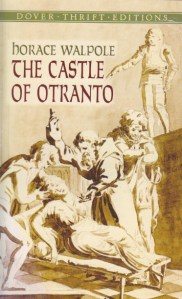
A convention in histories of the horror genre is to trace it to Gothic fiction.  Gothic fiction itself is traced to The Castle of Otranto, by Horace Walpole.  Having grown up reading Gothic stories along with religious texts, perhaps surprisingly I never came upon Walpole’s oeuvre.  Some weeks back I happened on a used bookstore, which, by convention, had its cheapest fare on sidewalk carts.  I was surprised to see a negligibly priced copy of The Castle of Otranto, which I took in to the counter.  The clerk looked puzzled a moment, then asked if it was from the carts.  “Oh,” he sniffed, “that explains it.  We don’t carry Dover editions; they’re too cheap.”  Perhaps that remark haunted me a bit, but I finally got around to reading the slim book and it left a kind of unanticipated horror in my mind.

Okay, so this was written in the eighteenth century, and set further back, in Medieval times.  A spooky castle, knights and knaves, and fainting damsels all populate its pages.  Religion, particularly in debased form, became a standard characteristic of the Gothic.  Here a monk, an erstwhile lord, holds a secret that leads to the downfall of a house of pretenders who have claimed ownership of the castle.  All pretty straightforward.  Even the ghosts and talking skeletons fail to raise fear.  One aspect, however, does hold horror.  The three princesses in the story are completely at the whim of the men.  They acknowledge as much and claim it against piety to declare any different.

It would be unfair to assert that such sexism was intentional—like most human behaviors it evolved over eons—but in this era to read it is to shudder.  We have moved beyond the horror fiction that men own women and that they have any right to determine their fate.  Especially in these days, it’s embarrassing to be reminded that such was ever the case.  Despite the word from on high we cannot hide from history.  The domination of men has been a testament to how poorly civilization has been run.  Some of its benefits can’t be denied, but on a whole we see a succession of aggression and wars, suffering and poverty, generally brought on my societies that have taken their cues from patriarchical ideals.  My reading of The Castle of Otranto brought this back with a force not unlike that of the giant ghost haunting its walls.  Is it too much to hope that some two-and-a-half centuries might show some evidence of progress?


Winter Travels

Every now and again you read a book that drops you into a world of wonder.  That’s how I’d describe Italo Calvino’s If on a Winter’s Night a Traveller.  What’s it about?  It’s difficult to say.  It’s a novel about reading, and more specifically, interrupted reading.  You might call it Post-Modern, but in a good way.  I came across the book in a manner that, like the story itself, emerged from different narrative structures.  First of all a colleague sent around a quote from the book that grabbed my attention.  I decided that if I ever found a copy in a bookstore I’d buy it, based on that quote alone.  A second stream was the Modern Mrs. Darcy’s reading challenge.  One of this year’s categories was a book in translation, which this is.  And yet a third factor was that I found the book on the shelf of a used book vendor in Ithaca.  And so I read.

Like David Mitchell’s Cloud Atlas—and having nothing to do with the fact that it was the most recent novel I’d read—If on a Winter’s Night a Traveller is a nested story, a story within a story.  Breaking the “fourth wall” Calvino addresses his readers in the second person and makes them characters in the plot.  The reader buys a defectively printed book and when he tries to return it to the seller, a fantastical world opens up.  I’m not sure that there’s a particular genre here—literary fiction constitutes a genre of its own—but there are a few speculative elements that keep the story pulling you along without really giving any conclusions (that the po-mo aspect to which I referred).

Apart from being merely fun, the story is thought-provoking.  What goes on when we read?  Do we not get absorbed into the mind of the writer?  And not only of the author but also of others who’ve read the book with whom we might discuss it?  Writing is an endlessly addictive activity.  One of my observations about careers without sabbaticals is that those who wish to practice the art must carve time out from days interrupted by work to be writers.  For me that means awaking early, for this blog is only one of many writing projects I have going.  To write well, however, means reading much.  And if you’re casting about for a story that’s hard to classify and difficult to put down, I would gladly recommend If on a Winter’s Night a Traveller.


Double the Magic

Since The Prestige came out over a decade ago I’m not going to worry too much about spoilers below.  This post also comes with another caveat: if you watch this film you’ll be left scratching your head and finding yourself strongly tempted to punch the replay button immediately.  Like most Christopher Nolan films, the movie is complex and intelligent.  It also plays on an age-old horror theme of the doppelgänger.  There be spoilers here!  

Following the rivalry of two stage magicians seeking the ultimate illusion, there’s a great deal of sleight of hand in the way this movie manipulates its viewers.  You are in the audience of a magic show and you’ve volunteered to go up on stage.  I watched this film on the recommendation of a friend without even checking the genre.  That can be a disorienting experience in itself.  One of the first questions we bring to movies as well as to texts is “what kind is it?”  I had the assurance that it was “the good kind” and that was about all.  That assessment was right.  While the credits rolled—it was already late at night, for me—I was strongly tempted to start it all over.  Sometimes people ask me why I watch horror films (and no, this is not horror) and I think the answer is related to what I find here.  Like most people I want the advice of others on what to do should things go wrong.  And in The Prestige they do go wrong.  Spoilers follow.

The crux of the film involves actual doppelgängers that result from Nikola Tesla’s experiments.  Tesla was a mysterious person in real life, and without knowing the genre you can watch this film and find it believable.  There’s a kind of faith involved in movie-going, after all.  One of the early exploiters of the doppelgänger was Edgar Allan Poe.  In “William Wilson” he narrates a tale of a double that might indeed be the real William Wilson.  The Prestige plays the same card.  Most of us live knowing that daily our senses can be fooled.  We actually enjoy it once in a while.  Stage magicians stake their livelihoods on it.  Nolan is a master of bringing complex twists to the silver screen.  In Holy Horror I briefly discuss his Memento.  I have a suspicion that I might’ve had more to say about it had I watched this film earlier, with a copy of Poe in hand.


Chilly Fluids

I’m not sure why I did it.  Read In Cold Blood.  I’d known of Truman Capote’s main claim to fame for years, but an accidental recent mention, a cheap copy in a used bookstore, and a week of grabbing time to read did it.  I’m not a fan of true crime, and despite my fixation on horror movies, I try to steer away from anything that doesn’t have a hint of the speculative about it.  There’s a difference between horror and terror.  I’d happily lived a half-century without ever hearing about the Clutter murders and kind of wish that were still the case.  Yes, there are doubts about the veracity of Capote’s account at points and novelists are often convincing liars, but still, at the heart of the matter more than just four people are senselessly murdered in the course of the tale.

A few elements stood out in the reading of the book.  One was that given the naiveté of the 1950s I wonder how anyone could ever really want to go back to that decade.  We’re run by a government full of doddering old men who seem to idealize the falsity and utter conformity of an age that was really a pressure cooker in which cases such as this would explode.  I was born in the much idealized 1960s but I don’t think we should go back to them.  We learn, we change, we grow.  Knowing what we now do, it was kind of painful reading how blissfully ignorant so many people were.  We may be more afraid these days, but at least we’re more realistic.

Another factor, very much at home in this world older but no wiser, is how the Bible is cited at the trial in support of capital punishment.  Although it may not have been intentional on Capote’s part, he demonstrates a deep truth about Scripture.  It can be read in more than one way.  In conservative Kansas in 1960 it could sway jurors to seek the death of other human beings.  The murders were indeed savage and pointless.  Capote’s account of them is difficult to read.  Perhaps more difficult is the way the Bible is used to unleash the basest instincts of people against other human beings.  Yes, parts of the Good Book require the bad thing, but if we’re over fifty years beyond Holcomb we’re over fifty score beyond a time when just one interpretation stands for all.  If it ever did.  There’s a difference between horror and terror, but the Bible can participate in both.  I prefer to stick to the former.


Patchwork

I don’t wear clothing with advertisements.  Perhaps it’s my Quaker-like sensibilities, or maybe it’s just that I hate being a shill.  What has any corporation done for me that I should give it free advertising?  Actually, not free—advertising that I have to pay to give?  I do have a few college sweatshirts, though.  Always a booster for education, I don’t mind wearing that brand.  Otherwise, I sit back and marvel how marketers get people to think it’s cool to strut their (the marketers’) stuff.  Brand names declare one’s tribe, one’s level of affluence.  I used to rip any exterior labels off my clothes but it became clear it was a losing battle, especially when brands are incorporated (note the word) into the very design.  And we play along.

I shouldn’t be too harsh.  After all, corporations are people too.  At least in the cataract-infested eyes of the law.  They have rights just like, or even more than, individuals do.  We live this fiction and watch the wealthy grow loftier, and we wear their brands so that others will sense where we belong.  Long ago I began to object to this.  Maybe it was because I grew up poor and wearing cheap knock-offs of brand names was embarrassing.  The cut of your trousers said something about what your folks could afford.  I actually began buying all my own clothes at the age of fourteen and, consequently, habitually wear things until not even Goodwill will consider them appropriate for resale.  And I still tend to buy generic.  Thoreau, in a patched quote from Walden and Civil Disobedience can be made to say it well:

As for clothing, […] perhaps we are led oftener by the love of novelty, and a regard for the opinions of men, in procuring it, than by a true utility. […] No man ever stood the lower in my estimation for having a patch in his clothes; yet I am sure that there is greater anxiety, commonly, to have fashionable, or at least clean and unpatched clothes, than to have a sound conscience.

The fact is we despise the patch-wearer for not playing the capitalist game.  You’ve got to pay good money for jeans with tears already in them and the world of the facile has no room for posers who actually wear through the knees.  If we ever meet you’ll know me by the frayed edges of my sleeves and cuffs.  I’ll likely be the guy sitting on a bench without a Starbucks cup in my hand, cradling Henry David and nodding vigorously.


Quoth Hardy

There are days when the quote from an author is the best thing to happen to me.  You probably know those kinds of days—days when there’s nothing really to stay up for so you go to bed early.  Lengthy days when your Muse wins easily any game of hide-and-seek.  You see, I save most of my fiction reading for bedtime.  If I turn in soon enough I can read quite a bit before falling asleep.  Not to sell you a false bill of goods, but that’s not the source of the quote.  It actually came to me from an unrelated email about the Bible.  The quote, while lengthy, comes from Thomas Hardy:

By the will of God some men are born poetical. Of these some make themselves practical poets, other are made poets by lapse of time who were hardly recognized as such. Particularly has this been the case with the translators of the Bible. They translated into the language of their age; then the years began to corrupt that language as spoken, and to add grey lichen to the translation; until the moderns who use the corrupted tongue marvel at the poetry of the old words. When new they were not more than half so poetical. So that Coverdale, Tyndale, and the rest of them are as ghosts what they never were in the flesh.

This comes from a letter to Professor D. A. Robertson of the University of Chicago, dated to February 1918.  Hardy was a known critic of religion, but like most writers of his day he knew the Bible.  Now, I’d never generally put myself on the same page with Hardy, but something similar to this thought had occurred to me long before I saw this quote.  We treasure ancient writing simply because it has survived.  This should be a sobering thought to any of us who try to forge our thoughts into words.  We have no way of knowing if, at the time, an author was considered great.  Merely the passage of time can make writing unfashionable in its age appear brilliant.  Like rocks tumbling over each other at the base of a cataract, they find polish over time.

My particular context for receiving this emailed quote was the King James Version of the Bible.  Often considered sacred in that translation, it was not uniformly well received when first published.  There had been English Bibles before, and since the Good Book is the foundation of western literature, a new translation commanded attention.  It had its critics, but over the centuries the translation itself became holy, whether it deserved it or not.  Similarly, Martin Luther’s translation of the Bible helped to codify the German language.  We shouldn’t be too quick to dismiss Scripture, not for its theology, but for its immense influence on western thought.  As Hardy noted, it may be the passage of time that makes writing great.  Even so we might be wise to pay attention.


Mostly Clear

“Chiasm” is a literary technique based on the name of the Greek letter chi, shaped like a latinate X.  The idea is fairly simple and generally resembles a sideways V more often than an actual X.  It goes like this: a poem, or story, begin at a large, or wide premise, narrows down in steps to a center, and then, by corresponding steps, again out toward a larger, or wider resolution.  Another way to think of it is a set of Matryoshka dolls; first you take them apart, and then you put them back together.  David Mitchell’s Cloud Atlas is a chiastic story.  Starting on a cross-ocean voyage at an indeterminate time in the recent past centuries, it moves on to a Briton on the continent in about the turn of the last century, then a mid-twentieth-century American investigative journalist, a late twentieth-century or present-day rogue publisher in Britain, a clone in future Korea, and finally, to a planet of the apes-like Hawaii of the distant future.  Not really finally, though, since after the center of the X, it moves back outward through the nesting stories to bring us back to the beginning.

I’m not going to attempt to retell the story here, so don’t worry—it doesn’t get any more complicated.  There are, however, a couple of remarkable things about the tale.  In the brutish, nasty, post-collapse future that marks the center of the narrative, religion is central.  Some of the Hawaiians have come to believe the protagonist of the nesting story, the clone mentioned above, was a god.  To find her story, however, you’ll need to read the book.  Suffice it to say, that origin myth is part of the overall complex structure.  The second of the remarkable features, and one that makes this book very salient, is that in all the ages the issue of accepting those who are different is central.

In the outside framing story, the initial and terminal points of the chi, one of the characters is a missionary.  He’s trying to “improve” he life of Polynesians by making them into slaves, whereby they benefit from the largess of Christianity.  Quite a bit of the narrative draws its energy from the eventually faltering sense of superiority of the AngloSaxon “race.”  In that sense it’s definitely a parable for our time.  A story that deserves to be read.  Defying easy genre identification, Cloud Atlas is a thought-provoking novel that doesn’t fear religion and its larger implications.  A couple of the nesting stories have exquisite twist endings worthy of the Twilight Zone.  This book will make some demands on your time, but its message makes it a sound investment in a world rapidly heading toward a future that reveals just how troubled our species is.


Strange Ending

Perhaps it’s from growing up as a biblical literalist, but I’ll probably always have problems with post-modernism.  You see, when you’re taught as a kid that there is one absolute right and you already know it (it’s Genesis to Revelation, no Apocrypha, please), you kind of get the idea that things are just what they seem.  Po-mo teaches, among other things, that there’s no true objectivity—reality is subjective and there is no neutral ground upon which to stand.  I’m down with that, but the old ways of looking at things remain.  This is a long-winded way of saying I finished Kohta Hirano’s ten-volume manga, Hellsing.  Over the past year I’ve been reading for a friend of mine, but manga has never really been my thing.  I read The Watchmen as a graphic novel, but looking at pictures somehow feels like cheating.  It’s that literalist thing again.

I might be dropping some spoilers here, so if you’re even slower than me be warned.  There’s quite a bit of shape-shifting here and it’s not always easy to tell who’s who.  In a kind of homage to my childhood monsters there’s vampires, werewolves, and even a Frankenstein’s monster in the series.  All of them are engaged in a constant state of combat against which the Protestant Hellsing organization stands for a stable civilization.  The Catholics are associated with Nazis along the way.  It’s a fascinating look at how an eastern culture might view the religious wars of those in the west who all go by the name “Christian.”  I think this is the genius of the series.  The friend who lent me the volumes has no declared faith, but he finds the dynamic fascinating.  Real religious fighting has made it easy for him.

The story, however, falls clearly into the generation of those without absolutes.  For someone my age a plot clearly laid out is a thing of beauty.  In college we used to argue about how absolutes might exist.  Where did they come from, and which is the strongest?  Did God make them or does God have to conform to them?  Even without the answers, the fact that absolutes existed was assumed.  Argument-driven science tells us that a theory is never proven.  Science is the best explanation we have at the moment, based on the evidence amassed.  In its own way, it has become post-modern.  Hellsing is a kind of mind-blowing work.  It will likely be a long time before I attempt another manga series.  Although I accept the po-mo premise, I still find old-fashioned fiction my favorite.


Remembrance

When reading C. S. Lewis’ Surprised by Joy, a number of things stood out in high relief.  One of them was his statement that the early years of autobiographies are often the most interesting.  Now, many people may have difficulty drawing a straight line between Lewis and William Peter Blatty, but the overlaps are there.  I’ll Tell Them I Remember You is a young man’s autobiography, so mostly it deals with early years.  Even more than that, it deals with Blatty’s mother.  Those of us who write often find a kind of inspiration in the life stories of other writers.  To hear Blatty tell it, or rather, to read him tell it, it was his mother who made him the man he became.  It’s a nice tribute.

Blatty is probably best remembered as the author of The Exorcist, but his background as a comic screenwriter comes through in his account.  (He also wrote, for example, the Pink Panther screenplay A Shot in the Dark.)  But more to the point currently, with a spoiled child wanting to try to force a wall that America doesn’t want on it, Blatty’s parents were immigrants.  From Lebanon.  It may be that since I’m writing a book about demons in movies that The Exorcist seems like an important national achievement to me, but it also seems an apt parable for the situation in which we find ourselves.  It worth thinking about—the invasion of evil and how to expel it.  Metaphorical writing is often the best.

Perhaps writers are naturally obstreperous people.  If my novels ever get published you’ll see that characters don’t do what you want them to.  And yet we like what happens when they don’t.  I would have found a bit more information about Blatty’s life an asset.  His mother certainly makes an impression, even if its third-hand.  Writers, if my own experience is anything to go by, often feel they are conduits.  Receivers.  It’s like listening to the radio when driving a car through the mountains.  Suddenly a station comes in clear, but just for a moment.  Ideas for stories are like that—they often arrive when you can’t do anything about them.  Writers carry notebooks for a reason.  I used to have a waterproof one in our shower.  You never know when the signal’s going to come in loud and clear.  And you never know when the people you’re trying to block out might be adding more value than you’d ever imagined.  You might be surprised.


Terror Text

Dystopia reading and/or watching may be more practical than it seems.  History often reveals authors who may be accused of pessimism more as prophets than mere anxious antagonists.  Two books, according to the media, took off after November 2016.  One was George Orwell’s 1984,  and the other was Margaret Atwood’s The Handmaid’s Tale.  I’d read both long before I started this blog, but I recently asked my wife if she’d be interested in seeing the movie of the latter.  While teaching at Rutgers, I had a 4-hour intensive course and to give students a break from my lecturing I’d have us discuss Bible scenes from secular movies.  The Handmaid’s Tale was one of them.  Watching it again last night, I realized the problematic nature of Holy Writ.

The Handmaid’s Tale is a movie (and novel) that involves what I call “Bible abuse” in Holy Horror.  That is to say, the Bible can be used to oppress rather than to liberate.  To cause human suffering instead of eliminating it.  Sure, to make Atwood’s dystopia work a future catastrophe of fertility has to occur, but the military state, the assumed superiority, and the will to control on the part of men are all too real.  We’ve witnessed this in the United States government over the past two years.  A lot more has been revealed than personal greed—that side of human nature that quotes the Good Book while doing the bad thing.  In the movie it’s literally so, while our “leaders” are only a metaphoric step away from it.  Although it’s not horror, it’s a terrifying movie.  I still have trouble watching The Stepford Wives.  Why is equality so easy in the abstract, but so difficult when it comes to actual life?

Aggression is not a social value.  This is perhaps the most ironic aspect of using Scripture to enforce oppressive regimes.  The whole point of the New Testament is self-denial for the sake of others.  That may be why the only Bible reading in the movie comes from the Hebrew Bible, the story of Jacob and Rachel.  Although this isn’t one of the traditional “texts of terror,” to borrow Phyllis Trible’s phrase, it nevertheless illustrates the point well.  A culture that values women only for their reproductive capacities is dystopian to its very core.  When a book, no matter how holy, is divorced from its context it becomes a deadly weapon of blunt force.  Atwood moves beyond Orwell here—the government that sees itself as biblical can be far more insidious that one that only weighs evil on the secular scale.  Not only the Bible ends up being abused.


Epigraphic Ephemera

Photo credit: Napoleon Sarony, via Wikimedia Commons

“We live in an age when unnecessary things are our only necessities.” ― Oscar Wilde

In certain kinds of books, epigraphs are popular.  In fact, I’m currently reading a book where every part of every chapter begins and ends with an epigram.  It starts to taste like an epigram cracker after a while.  Don’t get me wrong, every great once in a while there’s a quote that just illustrates your point in a chapter so pithily that you can’t resist.   Still, epigraphs ought to come with a warning label.  Working in publishing one of the first things I learned is that unlike quotes in the body of a text, an epigraph that’s covered by copyright isn’t considered “fair use.”  It’s an ornament, an embellishment.  If you want to use one, you need to get permission from the rights holder.  (Unless it’s in the public domain.)

While the idea of copyright itself isn’t that complicated—the creator of intellectual property is the owner of said property—copyright laws can be complex.  Publishers discourage the use of epigraphs (which only academics seem to use any more) because of permissions complications.  You see, when you publish a book (or article) you’re trading your copyright for whatever emoluments the publisher or the journal has to offer.  Most publishers, no matter how noble, are businesses.  There are costs with producing books.  If someone wants to reuse part of a another book—apart from the standard academic quote—they must have permission to do so.  Epigraph permissions can really slow a book down.  And make it expensive.

Reading is an involved process.  We human beings are seldom given such direct access to the interior lives of others.  Think about it—books are private thoughts made public.  Sometimes writers like to show that others have been thinking along similar lines, especially if what they have to say challenges convention.  Thus the epigraph.  The quotable quote.  But did you have permission to take that?  I like poetry.  It takes longer to read than prose, but it says so much in so few words.  That means using poetry in epigraphs becomes a nightmare.  Rights holders often charge by the percentage of the poem used.  And once a book becomes e book there no stopping the spread of its epigraphs used so carefully by permission.  Indeed, e-books are easily pirated, increasing the concerns of those who sell other’s thoughts for a living.  Before sticking that clever quote at the start of your chapter, it’s worth pondering the epigraph above (in the public domain, of course).


Prejudices of the Time

When my daughter was in middle and high school, I made an effort to read every book she was assigned for her English classes.  This gave us something to talk about during the years when many teens grow laconic and uncommunicative.  Some of the books I’d read before, but one frightened me off.  Ken Kesey’s One Flew Over the Cuckoo’s Nest pressed the wrong buttons.  You have to understand that I saw the movie for a class in college.  It disturbed me.  Even before encountering H. P. Lovecraft, one of my deepest phobias was insanity.  Children of alcoholics sometimes fear those who are out of control, and mental patients had become, in my head, associated with the non-rational behavior of my father that frightened me so.  During a clown ministry event we visited the local state hospital for mental patients.  I trembled for about a week after we left.

One Flew Over the Cuckoo’s Nest is in many ways a sixties novel.  One reflection of that is the fact that the religious imagery in the novel is presented in the form of punishment.  Everyone knows the narrative of R. P. McMurphy’s battle of the wills against Nurse Ratched.  The latter uses electroshock therapy as punishment and she tries to wear McMurphy down by using it repeatedly after the fight in the shower.  The electroshock table is described as a cross.  The metal headset is a crown of thorns.  Indeed, one of the patients is described as being crucified to the wall of the ward where he hangs throughout the novel.  The sixties frequently saw religion—especially the staid, conservative evangelicalism of the 1950s—as a form of punishment.  That’s pretty clear here.

Although the novel celebrates the freedom of the sixties, it also reflects the prejudices of the times.  The African-American attendees on the ward aren’t portrayed sympathetically.  The women—nurses and prostitutes alike—are there for the pleasure of the male patients’ gaze, exemplified in the leering laugh of McMurphy.  Still, there’s a kind of catharsis to this tale.  The Chief, from whose point-of-view the story’s told, is arguably cured by the antics and special attention McMurphy shows him.  Beneath the callous, self-serving conman there is a human decency that “the system” fails to find.  Indeed, McMurphy is a kind of Christ figure.  A fallen savior, no doubt, but a liberator nonetheless.  This was a difficult novel to read.  I couldn’t make myself pick it up half-a-decade ago, but I suspect somewhere beneath the surface I’m glad I’ve finally read it.  It didn’t cure any of my phobias but it made me think.


Poe et Tree

When winter gets a little dreary with its constant chill and perpetually gray skies, I often think of Edgar Allan Poe.  There’s been so much going on lately, however, that I overlooked that today is his birthday until my friend over at Verbomania reminded me of the fact.  I’ve posted on Poe many times, but this morning I had an email concerning my work on Nightmares with the Bible stating that my use of Poe in that book was a nice touch.  Sometimes I need to be hit over the head with things, though, to make them sink in.  It seems impossible that it was 210 years ago that Poe was born.  Our Januaries have become remarkably crueler since those times, what with inaugurations and all.

I have often mused that we’ve lived beyond the era where one person can have the widespread impact (for good, that is) that influences an era.  In the area of my doctorate, for example, like him or not William Foxwell Albright rearranged the field of Bible and Ancient Near Eastern Studies.  Nobody has been able to do it since because, well, Albright already did it.  Poe gave us many things—the struggling writer determined to make a living by his pen, the scary short story, detective fiction, the Raven.  Those of us who dabble in fiction do so in his shadow.  (I know Poe wasn’t the only writer of his era, but it’s his birthday, so let’s celebrate him!)  Other writers like H. P. Lovecraft, now a hot commodity, would draw their inspiration from Poe.  And from Poe and Lovecraft came the early work of Stephen King.

A winter storm advisory is in effect.  Outside it looks bleak and the clouds appear as if they wish to weep.  A nation founded by immigrants (my apologies, first nations) has come to believe that it was here first in a world full of need and suffering.  Building a silly, expensive, and utterly pointless wall is a telltale sign that the heart has ceased to beat.  Two centuries and a decade ago a writer was born.  He had penetrating insight into what makes people behave wickedly toward their fellows.  Just when things seemed to be making progress we find ourselves prematurely buried under masonry and rubble.  How could I have forgotten Poe’s birthday?  Too much has been crowding my January, I’m afraid.  I don’t take the time I should to gaze out at the winter and wonder.


OBSO

Oxford Biblical Studies Online is a subscription service for institutions that gives access to many biblical studies resources produced by the press.  It also features current essays that stand on this side of the paywall, written on contemporary issues.  In a shameless self-promoting plug, I’d direct you to this link to see my latest publication.  You see, I’m not alone in looking at Bible through the lens of horror.  As the acknowledgements to Holy Horror reveal, many conversations were going on that led to that book.  While the ideas contained in it are my own, I’m by no means the only one to have noticed that the Good Book makes guest appearances in genre fiction.  One of the points I made to my students when I held a teaching post was that the Bible is ubiquitous in our culture, whether we know it or not.  Just look at the Republican Party and beg to differ.

The idea is not without precedent.  For those who read the Bible real horror isn’t hard to find.  The Good Book can be quite a scary book.  Consider for just a moment the final installment—Revelation, apart from being full of amazing imagery, is an amazingly violent book.  Attack helicopters and atomic bombs may not yet have been invented, but there was no shortage of ways to kill people in the pre-gunpowder world.  Revelation paints the world in the throes of horrible suffering and death.  Indeed, the completely fictional Left Behind series rejoices in the death of the unrighteous who are, well, left behind.  Even today there’s a significant segment of “Christianity” that rejoices in the chaos Trump has unleashed.

In the OBSO article I sketch a brief history of how this came to be.  The history could work in the other direction as well.  The fact is the Bible and horror have always gone fairly well together.  Among genre literature, however, horror is a distinctive category only after the eighteenth century (CE).  Early horror novels, under the guise of Gothic fiction, often involve religious elements.  Culture was already biblically suffused then.  This is a natural outgrowth of a would steeped in violence.  Personally, I don’t like gore.  I don’t watch horror to get any kind of gross-out fix.  My purposes are somewhat different than many viewers, I suspect.  What we do all have in common, though, is that we realize horror has something honest to say to us.  And it has been saying it to us since from in the beginning.