Just Sagan

Perhaps the most famous resident of Ithaca, New York, during his career at Cornell was Carl Sagan.  The astrophysicist had had a noteworthy career, becoming a household name with his popularizing television programs and books.  When he died prematurely, there was a real sense of loss among many of us who appreciate those who dumb down science so the rest of us can understand.  Over the weekend in Ithaca, which still bears his physical legacy in a scale model of the solar system, we went to find his final resting place in Lakeview Cemetery.  There is something oddly peaceful about passing time among the dead.  It was late afternoon and we were the only ones in the graveyard.  We also had no idea where his plot might be, so we surveyed a good bit of the grounds, finding the Cornell family mausoleum along the way.

When my wife found his plot, with a simple tombstone laid into the ground, it was impossible not to notice the grave goods.  The leaving of mementos at the burial places of the famous is nothing new.  Douglas Adams’ grave in Highgate Cemetery in London had a profusion of pens pressed into the ground.  H. P. Lovecraft’s final resting place in Providence likewise had remembrances scattered about.  Among the items at Sagan’s grave were various bits of money, a teddy bear, and a somewhat lengthy letter written to the late scientist, expressing how much he had influenced the life of the writer.  After paying our respects, it struck me how even in a cemetery where death, the great leveler, has visited all, we still seek out the famous.

I couldn’t help pondering the implications of leaving behind something for the dead.  Money is of no use where goods and services can’t be traded.  Approaching the cemetery from the upper entrance, we first encountered a Jewish burial area where many of the tombs had rocks characteristically laid on top.  Sagan’s grave is on the border where stones on tombs begin to give way to crosses.  The custom of placing rocks on gravestones is ancient, but the reasons it’s done are disputed.  One of my favorite explanations is that flowers die but rocks do not.  There’s a simple elegance to it.  Many Christian graves appear neglected by comparison.  We don’t live in Ithaca, and it’s difficult to guess how often this somewhat hard-to-find cemetery is visited.  When it is, however, it is in the spirit of remembering a life that was ever focused outward, to an infinite yet expanding universe.


Whelmed Over

I have to admit I feel overwhelmed by the task.  You see, I spent twelve years living in a town that went from one small used bookstore to none.  Within a half-hour’s drive I could be at two bookstores—indies, of course, since B&N doesn’t always count.  One of the shops was the Princeton University bookstore, so that was almost unfair.  Now I live in a region with many bookstores.  I wasn’t truly aware of this when deciding on where to settle; the decision was made on practical matters such as being able to get to work, and affordability.  It turns out that central eastern Pennsylvania is unexpectedly bookish.  I’m not complaining, you understand.  I haven’t had much time to explore, and that’s why I’m overwhelmed.  That, and Banned Books Week.

I’ve been to the oldest continuously operated bookstore in the world, The Moravian Book Shop, in Bethlehem.  Twice already.  But there are many more within an easy drive from here.  “Lead us not into temptation,” the prayer goes, but if we’re honest we’ll admit we love the challenge.  Home owning is expensive.  There’s always something that needs to be done—the sort of thing you used to let the landlord handle—they are lords, after all.  And time for reading is scarce.  Add to this that there are bookstores I haven’t even entered yet, not far away, and a kind of anxiety grows.  You have to realize that even in Manhattan reaching a bookstore on lunch hour was difficult.  They are few and far between.  It’s overwhelming being in a region where indie bookstores have held on.

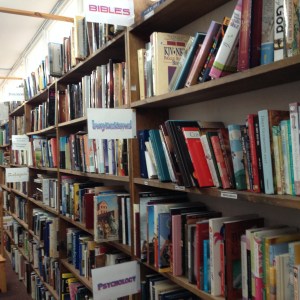
My wife recently showed me an ad for an indie bookstore over the border in New Jersey.  They were looking for new owners.  We’ve often discussed how perhaps a retirement job for us might be just such a thing.  Of course, business sense isn’t my strong suit—just learning how to own a house seems pretty hard.  The idea of making a living surrounded by books, however, is appealing.  (You might think an editor reads all day, and while that sometimes happens the reading is generally embryonic books.  Besides, there’s something serendipitous about discovering fully fledged books that you didn’t know were coming.)  To buy a business requires capital, and we’re more the minuscule type, when it comes to finance.  As we settle into our house we decide which books go where, and it is remarkably satisfying.  After I’m done being overwhelmed by all there is to do in the house, I’m looking forward to being overwhelmed by exploring the bookstores of central eastern Pennsylvania.


All Things Being Equinox

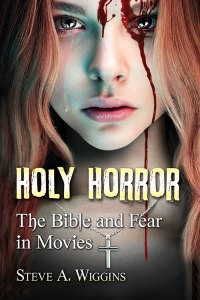
The weather around here has been appropriately gloomy for the autumnal equinox.  Although Hurricane Florence gave us a day of rain, the heavy clouds have been part of a pattern that has held largely since May.  Given the gray skies, we opted to watch Alfred Hitchcock’s The Birds last night.  My wife isn’t a horror fan, but she does like Hitch.  We’ve watched The Birds together many times, but this is the first time since I wrote Holy Horror.  I was somewhat surprised to recall how much Scripture plays into the script.  This is mostly due to a drunken doomsday sayer in the diner.  After the attack on the school kids of Bodega Bay, he declares that it’s the end of the world and begins citing the Bible.  He’s there for comic relief, but the way the movie ends he could be right.

When I was writing Holy Horror I had a few moments of panic myself.  Had I found all the horror films with the Bible in them?  Could anyone do so (without an academic job and perhaps a grant to take time off to watch movies)?  I eventually realized that I was merely providing a sample in that analysis.  Several weeks after I submitted the manuscript I watched The Blair Witch Project.  There was the Bible.  The same thing happened last night under a glowering late September sky.  The Birds has the Bible.  Two weeks ago I saw The Nun; well, that one’s almost cheating.  But you get the picture—the Good Book appears rather frequently in horror.  That’s what inspired me to write the book in the first place.

Now that nights are longer, and cooler, the grass has somewhat poignantly relinquished its aggressive summer growth.  Most of the ailanthus trees have been cut down (I must be part lumberjack).  My outside hours are limited not only by work but by the fading light.  In the words of the sage, “winter’s tuning up.”  We moved to a house we saw in the spring as days were lengthening.  Now we’ve come to the dividing line that will slowly leech the light from our evening skies.  I suspect that as I go back and watch some of my old favorites again I’ll discover something I already knew.  The Bible and horror belong together because both are means of coping with the darkness.  Call it puerile if you will, but there is something profound about this connection.  It just has to be dark for you to see it.


Capital Idea

Capitalism encourages a kind of racketeering among businesses, in my experience.  Take the case of utility companies after a move.  To date I have received well over a thousand dollars in bills for services not rendered.  These bills were from utility companies claiming that I owed them final amounts for bills that had been paid in full, on time, for over twelve years.  I should, it seems, be able to bill them for my time on the telephone setting their records straight.  The “final bill” is a racket.  And it is deployed just after a customer, formerly a “valued customer,” has entered into new financial obligations—moving is not cheap!  Most of these bills are for multiple hundreds of dollars for services, that when I used them, were generally billed at a mere fraction of that amount.

Corporations, according to the law, are people.  And like people, they are exceptionally greedy.  Just yesterday I received a bill from a heating oil company—which shall remain nameless for the moment—stating that I owed a multi-hundred dollar final balance.  I had notified them in April that we would be moving and that I had paid their final bill and no more deliveries should be made.  None were.  Fully five months later I receive a “final bill” politely reminding of an outstanding balance.  For what?  Heating oil delivered in July?  Have I suddenly switched hemispheres or is this some kind of racket?

Come to think of it, while unpacking I came across a budget book.  My accounting is pretty much in the range of horseshoes and hand-grenades—I know the regular bills and can guess how much they are likely to be.  I’ve got other things on my mind besides money.  The budget book had never been used.  Budgets, to my understanding, project a stable world.  That’s not like the capitalist world.  When we bought the budget book, some 30 years ago, could we have projected monthly expenses for the privileges of using an internet that at that time didn’t even exist?  Capitalism is creative in finding new things to make you pay for, even if they are only virtually real.  Like heating oil that was never pumped off the truck.  It’s always your word against theirs, and corporations are bullies, being bigger than regular people.  So I sit here with a blank budget book and a stack of “final bills” for things never delivered.  And I think to myself, what a crooked world.


Jericho’s Folly

The sound was compellingly familiar although it had been years since I’d heard it.  We were visiting the Quakertown farmer’s market for the first time—this weekend event is widely advertised and we were curious.  Part fresh produce, but mostly flea market, it was a tribute to my generation.  You could find stuff from my childhood years here, making it a species of time travel.  We stepped out of the car on a gray morning when I heard it.  I was drawn to it.  I’m at the age where I recognize things before I can name them.  “Where are you going?” my wife asked.  “Toward Pink Floyd,” I replied.  Music has a way of doing that to you.  It took another minute for me to place the song.  It was from the album The Wall.

After we returned home I had to hear it again, uninterrupted by the distractions of a flea market to new home owners.  It was a frightening experience in the age of Trump.  Although they’d never been my favorite band, I had a long history with Pink Floyd.  My older brother used to listen to them, and when I was working as a church intern (yes, there is such a thing) while in college, the kids in a family I was staying with took me to see The Wall on laser disc—an affluent family in the neighborhood had just bought a player, and I was curious both about the technology and the film.  The Wall is one of those concept albums that requires attention—you kind of need to listen to the whole thing.  The accusations against those who are different being sent “up against the wall” chilled me with thoughts of Trump and American fascism.  I can only listen to the album within prescribed headspace.

Even those who’ve never been sent to boarding school can imagine how it lends itself to abuses and horror.  At Nashotah House the album was almost as frequently cited as Hotel California.  When the religious isolate themselves odd things begin to happen.  On one of the occasions when I was left home alone in our New Jersey apartment, I pulled out my DVD of The Wall and began to watch it.  As the years melted away, I suddenly felt young and intensely vulnerable.  The visuals, like a little pin-prick, were jabbing at nerves a little too close to the surface.  I had to turn it off and watch a horror film instead.  It’s even scarier to listen to the album when democracy has failed its constituents.  The wall, after all, is a most protean of metaphors.


Look Both Ways

One of the things I miss the most about my teaching career is learning from the young.  While some professors in my experience believed the learning only went one way, I always found a kind of reciprocity in it.  I passed on what I learned from taking classes and having my face in a book all the time, and they taught me about popular culture.  Academics don’t get out much, you see.  It’s a basic issue of time—we all have a limited amount of it and research, if done right, takes an incredible chunk.  In fact, when hot on the trail of an idea, it’s difficult to think of anything else.  Pop culture, on the other hand, is what the majority of people share.  Now it’s largely mediated by the internet, a place that some academics get bored.

Speaking to a young person recently, I was initially surprised when he said that his generation was more interested in the Devil than in God.  Parents have always been concerned that their children not go astray, but this was, it seemed to me, more of an intellectual curiosity than any kind of devotion.  God, he averred, was thought of as aloof, pious, self-righteous; in a word, Evangelical.  The internet can be downright ecclesiastical in its affirmation that our inclinations can be what used to be called “sinful.”  Not that these things are always bad, but they are the kinds of things we’re taught to feel guilty about.  The divine response?  Anger.  Displeasure.  Shaming.  Young people, my interlocutor thought, found the Devil more understanding.

Perhaps this is the ultimate result of Evangelical thinking.  We’re watching in real time as the party of Jesus is becoming the party of intolerance for anyone different than ourselves.  Rather than turning the other cheek, it’s fire when ready.  Eager to retain the “brand” of “Christianity,” they slap the secular label on any outlook different than their own, although their own faith is without form and void.  It used to be that this was the realm of the Devil.  This sheds a different perspective on what my young colleague was saying.  Instead of bringing people to God, the Evangelical movement is driving them away.  Traditionally, the Devil was after the destruction of human souls.  That seems to be one of the new values of the right wing of the church.  There’s quite a bit to think about in this observation by this young one.  I’m glad to know that traffic still moves both directions on this street.


Appily Ever After

While in the theater to see The Nun (which ended up being the biggest take) this weekend, I couldn’t help but notice that the pre-movie adds were all about apps.  I couldn’t help it because, much to my own chagrin, I’d left the house too quickly and I hadn’t brought a book to read while waiting.  This may not be news to some people, but different cinema chains have different “channels” of what passes for entertainment and ads to try to draw viewers in early.  The movie house we used to frequent in New Jersey had a variety of goods on show, most of the time.  The one we visited here in Pennsylvania presumed that everyone had their phones in hand, waiting for the show to begin.  On screen was the idolization of the app.

My phone is old enough that most modern apps don’t work on it.  Most of the time that doesn’t matter to me since I’m not addicted to the device.  Of course, when you’re trying to park your car in a town that offers only online options for such a convenience, I sometimes wish I could download the relevant necessary software.  Otherwise, I often wonder what we’ve lost in our lust for connectivity.  Coming out of New York on the longer distance bus recently, the driver called out, as leaving the Port Authority, “Lights on or off?”  The unanimous chorus, for I didn’t speak, answered “Off!”  I glanced around.  I was surrounded by devices.  I carry a book-light with me on the bus, for this has happened before.

“Drink the Kool-Aid” has become post-Jonestown slang for simply following the suggestion of someone without considering the consequences.  I sometimes wonder if our smartphones come in more than one flavor.  I’m not talking about features or physical colors.  As apps chip away at our money, a little bit at a time, they also take larger pieces of our time.  I’ve experienced it too, but mostly on my laptop (I don’t text—my thumbs aren’t that limber, and besides, the apocopated messages often lead to misunderstanding, emojis or not), the wonder of one link leading to another then realizing an hour has disappeared and I still feel hungry.  Perhaps that’s the draw to the modern commuter.  Or movie goer.  I’m sitting in the theater, taking a break from unpacking.  In my version of multitasking, I’m also doing research by watching a horror movie.  Around me eyes glow eerily in the dark.  I’m lost in the forest of unsleeping apps.


Somebody Else’s Heaven

Ailanthus is known as the “tree of heaven.”  It’s an introduced species in North America and, like many such species, it outcompetes its rivals.  The tree of heaven isn’t bad to look at—in fact its handsome appearance was one of the reasons it was brought to these shores.  Heaven isn’t all that it’s cracked up to be, however.  The tree is aggressive and resilient, and difficult to eradicate.  Among the many unexpected “gifts” the former owners of our house left us was a back yard full of ailanthus trees.  At first I thought they were pleasant but then I had to remove a small one.  The smell almost knocked me off my feet.  I then learned that the Chinese name for it translates to “foul smelling tree.”  Whose version of heaven is this?

Over the weekend I spent some time lopping off trees of heaven.  Mosquitoes, I found out, love its shade.  It keeps the kinds of friends you might expect.  Heaven is, after all, a construct.  The word can refer to either the great dome of the sky in which the ancients believed deities dwelled, or the realm of blessedness to which the righteous go after death.  In either case, it was assumed to be a pleasant place.  Any trees there (and there are some according to the Good Book) would likely have a pleasing fragrance.  The ironically named version we get down here didn’t get the memo, it seems.  As best as I can determine, the name of the tree refers to its rapid growth, as if it’s grasping for the sky.

A problem with our own species is that we seem to think we know more about this world than we do.  We introduce species from other parts of the planet without considering how they impact the local environment.  In the case of a property with lazy former owners, it can translate to a real problem with heaven trees.  We’re often taken in by the innocence of names.  The first time I saw a tree of heaven, in a public park in New Jersey, I thought I should write a blog post about it.  It took being invaded by heaven, however, to make it seem relevant.  Heaven is a foreign nation, it seems.  It should smell nice and be open to people of all nations and creeds.  According to Revelation the trees up there bear fruit every month of the year.  Presumably in heaven someone else has to take care of the yard work.


Growing Shadows

As summer wends its way slowly toward autumn my reading becomes more gothic.  It feels as natural as the progression of the seasons, I suppose.  While waiting for the turn I’d been holding onto Carlos Ruiz Zafón’s The Shadow of the Wind.  Not having read any Zafón before, I wasn’t sure what to expect.  My copy had been blurbed by Stephen King, and I figured that was pretty high praise.  I found the book through one of my web searches for the most gothic novels and this one takes a while, but I can see why it makes some of those lists.  I wasn’t sure at first if it was intended to be comic or serious, but that combination is an imitation of life itself.  We laugh, we cry, we shudder.

The story slowly builds, and I’ll address this further on Goodreads.  What I want to consider here is the nature of place.  Human beings—and I would argue animals as well—have a sense of place.  Space becomes sacred through events both dramatic and quotidian.  That’s why we make pilgrimages to places where our heroes lived.  Just to be there.  To think about it.  To feel it.  The Shadow of the Wind is a story of Barcelona during a time of war.  There’s no escaping the moody sense of old Europe in this tale.  In that sense religion is quite often casually mentioned.  It’s part of place in a way many Americans overlook.  The church bells I can hear everyday beg to differ, no matter how empty the pews may be.  Zafón wants to share his gothic Barcelona with a story that leads to real shivers.

It would be a stretch to call this a horror novel, but it is in the sense that V. C. Andrews’ Flowers in the Attic is.  It reminded me at several points of Wilkie Collins’ The Woman in White (my copy of which was destroyed in a flooded garage).  Many lives, I suspect, have quiet gothic elements to them.  I know that mine does.  While there may be a little supernatural at work in The Shadow of the Wind, most of the action is believable.  This is the way people behave.  The way they treat, and mistreat one another.  While the days are still hot around here, the angle of the sun in the sky doesn’t lie.  We’re fast approaching the equinox from which we’ll slide into the long nights of winter.  And reading, the more gothic the better, will help us make it through no matter where we are.


Quaker States

Religions have always fascinated me.  Having grown up in one that was self-assured that it alone was right, I didn’t have much opportunity, as a child, to look closely at others.  I had to assume that other religions took their beliefs just as seriously as we did, but that they were dead wrong.  Majoring in religion requires a bit more broadmindedness.  We looked, as objectively as possible, at other traditions.  Still, Grove City College is unapologetically evangelical, so some professors weren’t shy about stating this or that belief was just plain wrong.  Things improved from then on, academically speaking.  By the time of my doctorate, and as an Episcopalian, I learned to distance myself a bit; dispassionate was the only way to be in the face of sometimes conflicting accounts.

The other day, following my natural curiosity, I was researching Unitarian Universalists.  Having a strong biblical background, I was curious about this denomination that represents Scriptures quite differently.  The Google metrics brought up a page with logos of various traditions: the Unitarian one I recognized, as I did the Episcopal and United Methodist Churches, having been a member of both.  Then I noticed the symbol used for the Quakers: the Quaker oats man.  I was inclined to laugh and be horrified simultaneously.  The “Quaker” Oats symbol is a commercial mock-up, and had Google read Wikipedia it would’ve known that the company has nothing to do with the faith.  Capitalizing (literally) on the reputation of Quakers for purity, the company used William Penn as a model for a guy who wouldn’t cheat you.

Now that I live in the Quaker State (again), I’ve grown curious about the Society of Friends.  This is particularly so since they are one of the few Christian groups to have been expropriated by the commercial world.  Who’s ever heard of Presbyterian laundry detergent?  Well, with the exception of hospitals and caregiving institutions, which are happy to take the name of a denomination, religion is hardly a trusted commodity these days in these parts.  The Quakers do have a symbol—two superimposed, four-pointed stars.  Metrics, however, are based on search frequencies, I suspect.  As far as religious denominations go, the Society of Friends isn’t massive.  Far more people search for Quaker Oats than the actual religion whose name the company borrowed.  Such is life in these United States—the ultimate corporate venture.  Now a wholly owned subsidiary of The Trump Organization.


Searching Again

Research can be addictive.  Those who know me are generally aware of how I can’t let ideas go.  I suppose this is necessary for those who write books—concentrating on one subject for a long time is mentally taxing and can lead to early loss of interest.  Those of us inclined to embrace this activity live for the thrill of uncovering new ideas and making connections that we’d overlooked.  My work on Nightmares with the Bible is a case in point.  Before submitting this book proposal I’d done a lot of reading on the subject of demons.  This is a dark topic, but those of us who live in temperate zones spend quite a bit of time without daylight, so I might think of this as a kind of therapy.  Or an excuse to do research.

Here’s often what happens: I’ll be writing along when suddenly a new question pops into my head.  Why was this or that the case?  The internet makes amateur research quite easy, but as someone raised on solid scholarly food, I need to check my sources.  When a professor I would’ve headed to the library with interlibrary loan slips in my hand.  These days I tend to turn to my own books and lament that I don’t have just the right one (there’s a reason, you see, that there are so many tomes in this house).  I try to find workarounds and used copies.  Perhaps I’ll pick up an adjunct class or two to be given library access again.  Meanwhile, the idea, like an ear worm, is burrowing into my conscious mind.  Until it’s time to go to work.

That great eight-hour stretch of day drains my energy.  Indeed, many employers count on taking the best you have to offer and making it their own.  What you do with “the rest of your time” is up to you.  Thing is, research is a full-time job.  Fortunately some of what I learn while on the clock will help me with my own research agenda.  The overlap isn’t especially strong, but now and again something I read in a manuscript will sync with what I do in the pre-dawn hours before I commit myself to the time-clock.  It’s a strange way to do research.  Back at Nashotah House I’d use the summers to follow the clues laid before my mind and, as long as I went to chapel, it was considered part of my employment.  Now it’s considered an avocation.  I can’t help myself, though.  Personal research is not part of the job description, but I’m an addict when it comes to learning new things.


Slow to Travel

A family friend recently died.  I was in New York City when I received the news, and I mused how recent a phenomenon this speed of information is.  The news wasn’t necessarily a shock—this friend had been experiencing failing health, he was a close friend of my grandfather—but for some reason Samuel F. B. Morse came to mind.  The story goes that Morse invented the telegraph because of his experience of being away from home when his wife died.  By the time he received the news and was able to get home by the conveyance of the day, she’s already been buried.  He set his inventive mind to improving the speed of communication over a distance.  In these days of receiving texts mere seconds after something momentous happens, it’s difficult to imagine that for the vast majority of human existence, personal news traveled slowly.

Feeling in a reflective mood I recalled how when I was in college I wrote letters home.  Yes, the telephone existed by then—don’t be so cynical!—but long distance bore a cost and college students find ways to save their money for girlfriends or spending a weekend in Pittsburgh.  News traveled more slowly.  Back before Morse, the swiftest option was the letter.  The death of a friend might take days or weeks to reach those close.  Distance in time, as well as space, may not have lessened the shock, but the immediacy of a text wasn’t there.  The death had occurred days or weeks ago.  There was nothing left to do but grieve and get on with life.  Like Samuel Morse—perhaps the only point of comparison between us—I was unable to get away immediately.  New York City isn’t easy to escape quickly.

We move swiftly and slowly at the same time.  I know news moments from the event, but this physical mass I inhabit is sluggish takes some time to get around.  Manhattan’s an island, and although it’s not Styx we’re crossing, the Hudson creates barriers enough.  Now my journey includes crossing the entire state of New Jersey before I can even reach home.  Were I to drive back to my original home, it would add another five hours at least in the car.  Sometimes I wonder if the immediacy of knowing is a blessing or a curse.  The shock is immediate and visceral.  But like an injection, the sharpness is quickly over and the dull ache sets in.  Our family friend had been suffering for some time.  Now he’s at peace.  I like to think he’s with my granddad, and that the two of them together won’t judge me too harshly for moving so slowly.


Horrible Delays

It’s not that the delay is actually horrible.  Horror movies, after all, come into their own with the darkening days of fall.  Nevertheless it occurred to me that now August is about to exit stage left, some may be wondering where Holy Horror is.  After all, the website originally said “August.”  The truth is nobody really understands the mysteries of the publishing industry.  Like so many human enterprises, it is larger than any single person can control or even comprehend.  I work in publishing, but if I were to subdivide that I’d have to say I work in academic publishing.  Further subdivided, non-textbook academic publishing.  Even further, humanities non-textbook academic publishing.  Even even further, religion—you get the picture.  I only know the presses I know.

It suits me fine if Holy Horror gets an autumn release.  I don’t know, however, when that might be.  I haven’t seen the proofs yet, so it’s hard to guess.  Appropriate in its own way for horror.  The genre deals with the unexpected.  Things happen that the protagonists didn’t see coming.  In that respect, it’s quite a bit like life.  My work on Nightmares with the Bible is well underway.  When you don’t have an academic post your research style necessarily changes, but I’m pleased to find that books can still be written even with the prison walls of nine-to-five surrounding one.  It may be a bit like Frankenstein’s monster (happy birthday, by the way!), but it will get there eventually.

Of my published books so far, Holy Horror was the most fun to write.  It wasn’t intended as an academic book, but without an internet platform you won’t get an agent, so academic it is.  It’s quite readable, believe me.  I sometimes felt like Victor Frankenstein in the process.  Pulling bits and pieces from here and there, sewing them together with personal experience and many hours watching movies in the dark, it was horrorshow, if you’ll pardon my Nadsat.  We’re all droogs, here, right?  I do hope Holy Horror gets published this year.  Frankenstein hit the shelves two centuries ago in 1818.  Horror has been maturing ever since.  So, there’s been a delay.  Frankenstein wasn’t stitched up in a day, as they say.  And like that creature, once the creator is done with it, she or he loses control.  It takes on a life of its own.  We’ll have to wait to see what’s lurking in the darkening days ahead.


Galilean Blues

Call me nostalgic, but growing up Fundie, “Capernaum” tripped easily off my lips.  In fact, it was a word I heard very frequently at church, always pronounced “kap-er-NEE-um” (please pardon my amateur phonetics).  Even though no one I knew had ever been to Israel, we all knew it was in Galilee and that it figured large in the early life of Jesus of Nazareth (although we assumed he was surnamed “Christ”).  When I attended seminary I was surprised to hear the geonym pronounced “ka-per-NUM.”  It sounded so sophisticated—aristocratic, even.  Still, everyone at Boston University School of Theology knew what, and roughly where, it was.  It was a household name, no matter how you pronounced it.

Spellcheck disagrees.  It doesn’t recognize one of the most famous places in the New Testament.  Now, I’m aware that my view of things is idiosyncratic.  This blog should be proof of that.  Those who grow up from Fundamentalism often know this experience—something that everyone knew when you were young and informed is arcane knowledge to the rest of the world where Kardashians and Sedarises are household names.  The Bible, irrelevant at best, is a foreign country.  Then the religious right comes to power and everyone’s confused.  They don’t speak the same language as the rest of the world.  They say kap-er-NEE-um.  Others scratch their heads and glance at their knee caps.

When I visited ancient Capernaum it required some imagination to reconstruct what it had been, back in the day.  Since the ruins were relatively recent—only a millennium or two—some of the buildings were still above ground, including the famous synagogue.  Even among the unchurched archaeologists, everyone knew the connection of the city to Jesus of Nazareth.  That doesn’t mean, however, that the programmers responsible for spellcheck recognize the name.  Kardashian doesn’t get a red underline on my word processor.  Even in the first century, however, Galilee was a backwater (with real water!).  Important people came from big cities and had family connections.

Some things don’t change much over the millennia.  The famous often find their spotlight because of connections.  If the deity decided to incarnate today, s/he’d know to get a website put together first.  And it would help to have some product endorsements.  Even salvation at a click isn’t enough to draw most people in.  Of course, the matter of name—excuse me, “brand”—is important.  More than anything, you want something people can pronounce.  And just to be safe, anchor it to either New York or the city named The Angels.


Stand-in Line

Pop culture borrows from religion without knowing it.  Or maybe it’s just that religion has become so irrelevant that people no longer care.  Whichever may be the case, those who contribute to pop culture have a rich treasury from which to take withdrawals.  This occurred to me while waiting for a bus into New York.  Many people don’t want to stand in line (who does, really?).  In the Park-n-Ride subculture, you may leave an avatar in your place.  It’s probably not called an avatar, but since there’s nobody here to ask, I’m going to use the pop culture name.  You put your bag on the pavement, marking your place and then go sit in your car.  Since I’m going to be sitting in a big car for the next two hours, I prefer to stand outside.

The idea of an avatar is mediated to most people through either computer language or the movie.  I first encountered the term in the former sense in Neal Stephenson’s Snow Crash.  I was an internet neophyte and had trouble conceiving a virtual world in those days.  Some time later came the latter.  James Cameron’s film embodied the idea—linked through software, the tired hardware of physical bodies could be given new life.  In some senses it was an even better life.  Now everyone knows what an avatar is.  Perhaps except that the idea is native to Hinduism.

Hinduism was never an organized, intentional religion such as Christianity.  It is rather a wide array of traditional beliefs that, in the light of missionary activity, had to be given a name.  There are many gods in Hinduism, and when a deity descends to earth s/he appears in a form recognizable to humans—an avatar.  Not being an Indologist, my understanding of the concept is very basic, but it’s enough to know that this religious idea found a role in pop culture first through computer representations of human beings.  We had flattered ourselves with being gods, since we had created a virtual world.  A world we couldn’t physically enter.  Avatars were, therefore, how we wanted others to experience us.  Snow Crash is peopled with all kinds of representations.  The internet today, nearly 30 years on, has many more.  After all, there are many gods.

I glance at my watch.  The bus should be here any minute now.  When it enters the lot I’ll see the deities behind these canvas and leather avatars.  They’ll be less impressive than I’ve imagined them, I’m sure.  And although we’ve created virtual reality, I still have to get on a physical bus to go to virtual work.