The Name of the Game

I have a confession to make. I’m not a gamer. Just like everyone old enough to be aware in the 1970s, I was amazed at Pong. Television, which had always only been a passive producer of entertainment, could now be interactive. Slower than real table tennis, the game nevertheless easily consumed hours of life otherwise productively spent. I went off to college and left the burgeoning video game market behind. Then in the late 1990s Myst appeared. The new Macs of those days came loaded with action games about dinosaurs stealing eggs. My daughter was fascinated and so I played. Then I lost interest again. That had been family bonding time, so it wasn’t completely wasted. Now we live in a world where, writers tell me, the real money lies not in movie rights to your novel, but game rights.

Kids, developmental psychologists assure us, need to play. It’s how they explore their world. As the human world becomes more and more electronic, games become more a part of virtual life. Some even have plots and genuine character development. A friend sent me a link to a story on Mashable, “Jesus battles the Buddha in fighting game hellbent on offending.” Victoria Ho describes Fight of Gods where deities of all denominations duke it out for dominion. After posting about god novels recently, it seems to me that we’ve begun to enter a time when the divine world hasn’t disappeared, but has transmuted. In this new world while all gods are not exactly created equal, they all have a shot at supremacy. It’s a matter of who can hit hardest.

No matter whether one finds this offensive or not, there is an element of profundity here. Historically religions have made gods of the things we fear. Storms, diseases, wars, and death—all of these have been, and continue to be, represented as deities. Human insecurity is deeply rooted in our psychology. We’re afraid of things we can’t control. In periods of governmental chaos, phobias naturally rise to the level of personal panic. What can we do in the face of such forces? Especially when prominent figures tell us all religious belief is for the weak-minded and feeble? Don’t we have to strap on our virtual armor and hope some powerful divinities are on our side? In such times as this we need our gods, no matter their tradition of origin. For me, I fear I won’t be able to spin this dial fast enough and that strangely square ping-pong ball is going to get past my virtual paddle.


Clown King

Like many people, I enjoy a Stephen King novel from time to time. King has a talent for drawing you into his tales, and whether or not they’re scary you feel a kind of relief when they’re over. A few years back I read IT. I was prepared to be scared because many people talked about fears of bathrooms after reading it, and, of course, of the terrifying clown. Not being a fan of serialized television movies, I never saw the 1990 movie adaptation. Besides, reading a novel that long is a serious investment of time, and since I like to hear lots of different voices in my reading, I spread out the wealth. In any case, the novel didn’t scare me beyond the neighborhood bullies (who’ve since moved to Washington DC) and I moved on to other things. The new film adaptation has people talking about IT again, and clowns, and clowns always remind me of college.

During the late 1970s and early ‘80s, it was fashionable for Christians to clown around. Taking cues from Paul’s one-liner about being fools for Christ, evangelicals began to experiment with clowns as a means of witnessing. I got involved my freshman year at Grove City College. I researched clowns. Where had they come from? What was the proper way to do it? Was there a deeper meaning? A friend recently sent me a video from Origin of Everything on the subject. I see a lot has been added to the history that I once studied. The idea of the circus clown is one of the more recent innovations of a character that was, in origin, a bit frightening. In classic horror movie style, heavy makeup functions like a mask and we rely on faces to know if someone is friend or foe.

We were taught, in our rudimentary training, that clowns do not talk. To express yourself you had to exaggerate gestures. I learned that makeup did indeed free you from social constraints. The Christian clown, however, had to be good. We weren’t meant to scare anyone into heaven. As nights are growing longer and people’s thoughts are coming to grips with the end of summer, clowns make good companions in the dark. IT may not be King’s scariest novel, but he did understand that bullies and clowns are fears that never go away. And when you combine the two, and move them into the White House, vaunting white faces and corrosive social values, well, maybe it’s time to go to the movies and try to have artificial fears for a while.


The Way, the Truth

It’s striking how similar world religions can be. Granted, the concept of “religion” as a separate sphere of life is a western one, but throughout the world thinkers have drawn similar conclusions. Until the World’s Congress of Religions of 1893 in Chicago, however, most Americans knew only of the monotheistic traditions. Jews and Muslims had been in this country almost as long as Christians. Nobody paid much mind to the indigenous religions of the original occupants. In any case, in 1893 other religions—those of eastern Asia—entered American consciousness. Buddhism and Hinduism were exotic, if pagan, belief systems. There wasn’t much of a conceptual foundation upon which to build, however, so early on people tended to focus on the differences between them rather than the commonalities.

For me, I first really learned about such traditions in a World Religions course in college. I’d never heard of Daoism (or Taoism) before. The Dao, or “way,” pervades ancient Chinese religious thought. There’s a sense of flow to it—one of the main ideas is not to resist the way, but to bring yourself in line with it. Doing so helps you to realize that you need not be rich to be happy. Sufficiency is, well, sufficient. Meanwhile in the west, Christianity mostly bought into greedy consumerism. Our happiness is measured by what we have. And having, we want more. I’ve been reading about Daoism recently, and it occurs to me perhaps there are some accidental Daoists here in the west. This reading made me think of my father.

I can’t speak much for who he was, since I barely knew him. I only saw him once as an adult, before he died. For a brief moment he took me into his apartment. He owned practically nothing. A television, a few things to sit on. A magazine or two. That was about it. Did he want to acquire more? I didn’t know him well enough to ask. He was raised as a Christian, and I do not know what his religious beliefs were, if any. Thinking back to that experience, however, was the result of reading about Daoism. Being content with little. Not all of us are cut out for monastic life, but my visits to such communities have always left me with the sense that having less is more than enough. I know I’m over-simplifying here. I’m not an expert on Daoism. I’m certainly not an expert on my father. I do believe, however, that things can weigh us down. And even Christianity, read in a certain light, agrees.


Shocking Truth

The electrician recently stopped by. We’re renters and although I don’t mind doing minor household repairs to benefit the landlord, I draw the line at electricity. It’s a scary thing. I’ve been shocked too many times to want a jolt bigger than I can handle. I even once accidentally grabbed the metal prongs when unplugging something as a child (it was a microscope light, I remember) and that helpless feeling of being unable to drop the plug even while my body jerked uncontrollably left me with a healthy respect for those who actually understand insulation, capacitors, and those impossible electrical diagrams. So when the pull chain came out of the ceiling light I wasn’t going to try to fix it.

The electrician, like most people who see our apartment, commented on the books. “You like to read,” he said. I can’t help but feel guilty about that. It’s almost as if you should apologize for requiring the stimulation of so many tomes. I confessed that I did, but I wanted to justify it. “I work in publishing,” I feebly offered as an excuse. Concentrating on the fixture above his head, he said, “I don’t ever read a book unless I have to.” He fixed the pull chain and left. I couldn’t have fixed the thing so quickly, or safely. He even had a metal ladder. I was grateful for the light, but once again felt somewhat freakish for my bibliophilia.

Those of us who write books must read books. You can’t learn how to do one without the other. Because of movies and television, we picture writers as people with large houses and separate rooms as libraries where they can sit surrounded by books as they type away at their next bestseller. Those of us who work for a living seldom have such luxury. A separate room just for books? I like letting my books reside in whatever room they feel like. Most affordable apartments don’t come with a study. There are living room books that you want people to see, and kitchen books that suggest good things to eat. There are bedroom books that you might not want others to see. What I don’t have is a library. A book zoo. My books roam freely about my home. It occurs to me that one area lacking in my collection is one about household wiring. Maybe instead of feeling weird I should get wired. I’m sure there are books out there that will tell me how. Or at least that will let me know that a wooden ladder makes a poor conductor.


First Look

Youth might be described in a number of ways. One, of course, is in biological years. Another may be in exposure to experiences which change your life. There was a time, for example, when you can’t believe you were ever so naive. No matter how youth might be defined, a patina of fond memories tends to cling to images from that time with the passage of years. For me, unsurprisingly, those images are frequently books. I still recall the cover images of books from my tweenage years, and often think that if I found such books in a second-hand store, I would buy them for their ability to conjure past times. One such book comes not from my physical youth, but from my days teaching at the University of Wisconsin, Oshkosh. It was at that time, when the internet was also still young, that I began to try online research into H. P. Lovecraft. I found an edition of his stories titled The Shadow over Innsmouth for sale on a used book website. I was under-employed, but it was cheap and my curiosity inflamed.

Mainly I was interested in what I would now call the reception history of Dagon. Dagon is an ancient Mesopotamian deity mentioned briefly by name in the Hebrew Bible. He is also part of the pantheon of gods borrowed and invented by Lovecraft to populate his eldrich, watery world. I purchased this book for the titular story, where Dagon doesn’t actually appear, but his worshippers do. It is often claimed to be Lovecraft’s best story. As I sat down to read the whole book, however, I was struck by the strangeness of the collection. This edition, from 1971, included such unusual choices as “The Transition of Juan Romero,” “In the Walls of Eryx,” and “The Festival.” Also bundled here was the Houdini ghostwritten “Imprisoned with the Pharaohs.” When I first purchased the book I’d only read “The Shadow over Innsmouth” and “The Colour out of Space.”

As my interest in Lovecraft grew, I acquired other, more representative editions of his work and have consequently read most of his oeuvre. It was that sense of yesteryear, however, that led me back to this browning, aged collection. It was, in truth, the cover. Looking at it brings back that very office in Oshkosh where I sat as I found the edition online for less than five dollars. No doubt, I was younger then. The call of Cthulhu has echoed across the web since then. For me, however, the first exposure will always be a beat-up paperback that I ordered secondhand.


Ned Ludd and Company

I’m sure you’ve seen them too. Maybe in the movies, or on a newsreel, or maybe on a filmstrip in school. I’m referring to those scenes, usually in some foreign location, where bicycles, ox-carts, cars, buses, and pedestrians all crowd the same streets in a holy confusion of conflicting human intentions. Some can afford no transportation at all beyond their own feet. Others can own, and use, automobiles. On a scale like this I’d put myself around either the bicycle or ox-cart-driver level. I’m referring to technology, of course, and not actual transportation. At a recent family discussion I was left completely in the dust and exhaust fumes of new technology, trying hard to comprehend the words that other family members were speaking so fluently. Software names, devices that do things I can’t divine, and what is a dongle anyway? I’ve fallen behind not only on my movies and books, but on technology as well.

Tech develops quickly despite how slowly the rest of the world moves. Some members of my family don’t have computers or use the internet. Others have devices so advanced that they might’ve been salvaged from Roswell, and I wonder how all this happened when I thought I was paying attention. I’m a late joiner when it comes to tech. Although I’d been warned, I made it through my Master’s degree having barely touched a computer. When I took a decidedly low-tech job teaching at a medievalizing seminary, we couldn’t afford television service and we haven’t really watched TV since. Now I hear that you don’t need to pay for the privilege. If you have the time, black boxes, sticks, and even software downloadable on your phone can be your television. I look at our flatscreen at home and wonder where the on/off switch might be. How have I fallen so far behind the times?

The real problem, from the view on my bicycle seat, is that in order to maintain some level of expertise in my field of study, I have to dedicate quite a bit of time to it. While others tickle their devices on the bus, I’m reading my books made of genuine paper. I’m thinking such activities will make me better informed. Most of these books address the past. If I want to upgrade from to an ox-cart, however, I have to learn a whole new language and the nouns that accompany pieces of hardware that look an awful lot alike to these antique eyes. Perhaps we have become cyborgs after all, and I just missed the introductory session. I wouldn’t know; I’m too busy trying to keep this bicycle out of the path of that speeding lorry.


Oil Heritage

I love optical illusions. Apart from the sheer fun of ambiguity, such illusions are really all about perspective. Shifting perspective can be one of the most powerful ways of changing a person’s life. One of my more stalwart perspectives is that those who originate something deserve recognition. If that something is important, they may even deserve acclaim. And sometimes that thing may turn bad, in which case the discoverer may end up being notorious. Originality, the subject of bestsellers and media gurus, is sometimes the result of thinking differently than other people do. It can be cultivated and grown. Sometimes it’s simply fortuitous.

Every time I visit my own place of origins in western Pennsylvania, I think of the oil industry. It’s pretty hard not to around here. “Pumping jacks” still operate in some back yards, and petroleum tanks suddenly appear along beautiful rustic roads. The presence of fossil fuels isn’t as evident as it was when I was a child, for all the big refineries have closed down. Many of them have been dismantled. Still, I can’t drive by the site where a refinery fire glowed beyond the next hill from my childhood home and not wonder about it. Seeing those huge oil tanks melted and crumpled as if they’d been made of wax is an image that doesn’t get easily erased. Today, that’s all gone. Still, the oil industry itself was originally from this region. The auto industry—although increasingly electric—would’ve never started without the obvious boost that petroleum production gave transportation.

In the light, or perhaps dark, of Hurricane Harvey we’re set to see increasing gas prices. They will impact the economy in other ways, and energy giants will continue to degrade the environment in the quest for cheap and abundant crude. I’m not sure if that makes the discovery of oil in this region worthy of acclaim or notoriety. It does seem, from my perspective, that since big oil is so lucrative, a lifeline ought to exist for the struggling communities in my childhood home. Empty storefronts were rare here in my youth. Now they are almost as common as shops that remain open. I know; if people can’t move on, then maybe there’s a reason the economy is sagging. There are ghost towns in this area, and there may be more in the future. I just wonder how all this will looks from another perspective. Will it all be an illusion once electricity makes the past superfluous?


Night of the Museum

I admit to being a relative stranger to contemporary commercial television. We don’t have “triple play” at home, and since the internet provides more information and entertainment than one person can possibly handle in a lifetime, why pay extra? On a visit home, however, where internet does not yet exist, I fell to the default of watching TV. Scrolling through the cable channels available in this small town, I start to understand why we don’t pay extra for this at home. Much on offer appeals to the lowest common denominator, and although some educational programs exist, they have to put somebody in danger in some remote location in order to draw the viewers in. Then I stumbled on Mysteries at the Museum.

For those of us hopelessly enamored of the past, museums are an irresistible draw. I joined the program already in progress. It was talking about Stroudsburg, Pennsylvania, through which we’d driven to get here. A resort town in the Poconos, I always think of Stroudsburg as a traffic bottleneck, particularly on a holiday weekend. Instead the story was telling of a haunted jail in which a prisoner had to be exorcised after it was found that he could make it rain inside his cell. Then the name of the Warrens was mentioned. The Bible used in the exorcism is from their occult museum (thus the tie to the title of the program). Ed and Lorraine Warren, as my regular readers know, get mentioned here every once in a while. Real life ghost hunters, they kept a museum of the occult in their Connecticut home. I’d missed the part of the program where they revealed the provenance of the artifact. Now things started to make sense. After the commercial break, however, the story shifted to a historic pair of hiking boots.

Image credit: Creative Commons Share Alike 2.0 Generic license. Photo by Doug Kerr, Wikimedia Commons.

What was so striking about this brief segment of the show was not the implied credulousness of the investigation, but rather the certainty with which those interviewed declared this was a water demon case. Okay, so I’d just finished a seven-hour drive and I may not have been at my sharpest, but where did such certainty come from? Who were these experts telling us what had happened? I’ve read enough of the Warrens’ accounts to get a sense of how they worked, but not even the name of the priest was presented, let alone that of the demon. What we had, then, in this 15-minute segment, was a Bible and an anecdote of rain falling in a Stroudsburg jail. As I switched off the program to go to bed, I knew that I’d find the missing information on the internet. Even without triple play.


Birth of a Notion

Childhood is an impressionable time. Our phobias begin then. Children are vulnerable. (Of course our current government is intent on making us all afraid of bullies again.) This theme of childhood keeps coming up in interviews with directors of horror movies. A friend recently sent me a New York Times article by Erik Piepenburg about Annabelle: Creation. The piece includes some horror auteurs discussing what frightened them as children. We all experienced fear at a young age. For some of us it hung around awhile longer. Horror movies have, despite their low brow reputation, been reliable revenue streams from the beginning. People will pay to be scared, for a little while.

I have to confess to having fallen behind on The Conjuring diegesis. Since I’m the only one in the family who really likes to watch horror, I don’t see these movies in theaters and, well, there’s a lot to do besides watching movies these days. And finding DVDs is getting harder as well. Streaming scares me. Anyway, I missed The Conjuring 2 and the original Annabelle. I’ve read accounts of what supposedly happened in real life—Annabelle is one of the cases investigated by Ed and Lorraine Warren—and it has been written about a number of times. The Warren’s take on it was that a doll can’t actually be possessed. (Sorry Chuckie.) They suggested that it could act as a conduit that would’ve eventually allowed a demon to possess the two young women who kept the original Annabelle in their apartment. The doll showed up in The Conjuring, although it wasn’t part of the main story. The haunted doll trope is scary enough that the second knock-off in this universe focused on it.

Interviews with older horror directors reveal that they often grew up without fathers. Despite the gender profiling, for kids fathers are generally thought to represent protection. A child without a father often feels insecure. Even today when people talk of their fathers I have to remind myself that they can be a good thing. I often wonder if those of us who like horror films had childhood parental issues as a regular part of our pasts. I’m generalizing, of course. Growing up into Trump’s America has given us all plenty of things to fear in the present. Since January a number of high profile horror films have gotten notice in the press. Sometimes a real bully can cause as much fear as a possessed doll. That’s especially the case when our government wants us to submit like a bunch of frightened children. Childhood fears may, in some cases, serve us well.


Fighting Nightmares

Some things are so personal, and inexplicable, that they’re difficult to put into words. Not only that, but they often involve other people and I try not to comment on those who actually know me in person. Still, having just watched Apocalypse Now for the first time, I feel I must. One of the people I admire most was a high school teacher. Although I never really said as much to him directly, he is one of the most formative people in my life. He served, and was shot up in Vietnam as a youth. His outlook on life, one that I’ve tried to emulate especially when my petty foibles overwhelm me, is an inspiration. I’m sure that he doesn’t know it, but every time I think of Vietnam he’s always in my mind.

Never a fan of war movies—I’m baffled that anyone can think of war as anything other than pure barbarism—I generally can’t watch them. Apocalypse Now, however, was widely discussed when I was in high school. It was released in 1979, just four years after the war had ended. It illustrates well the fog of war, and the Doors have been seeping in my head ever since the movie faded to black. When my wife and I began renting movies—VHS, of course—we made a list of must-see titles. First, partially for alphabetic reasons, was Apocalypse Now. That it took us almost two decades to get to it says something about the nature of life. And also my fear of war movies. Still, I knew I needed to see it. I figure that unless someone is even more behind the times than me, nearly forty years is safe from spoiler alerts.

The idea, based on Joseph Conrad’s Heart of Darkness, is that Colonel Kurtz has gone insane and Captain Willard has been called in to assassinate him. As he makes his way upriver Willard finds out that Kurtz is treated like a god. He has a cult following and does appear to have lost touch with reality. In the climatic scene, Willard hacks Kurtz to death as a cow is being hacked to death outside as a sacrifice. Ending with Conrad’s original words, “the horror, the horror,” an ambiguity lingers over what a people will do once their god has been killed. In fact, language of people being gods occurs early in the film as well, bookending this concept. The truth, of course, is that there are no gods here at all. I can’t guess what Conrad would’ve thought of this adaptation of his story. I know that when I saw it my thoughts returned to one man whose impact on my life continues in ways unexpected and deeply hidden.


Surface Tension

Montclair, New Jersey, is distinguished by having two bookstores. On Saturdays when my wife has to work there, I sometimes come along. Apart from the pleasant company, it isn’t every day that one can visit two bookstores. By supporting such shops, I am protesting the ignorance rampant in this nation. One, the Montclair Book Center, specializes in used books. Not always competitively priced, I nevertheless seldom leave empty-handed. It’s a healthy walk from there to Watchung Booksellers, a compact indie up by the train station. For a small store they always have an intriguing selection and I’ve never seen it empty on a Saturday. As I was walking the distance between the two, I noticed that Montclair’s downtown (and I’m not picking on Montclair, which I love) focuses on appearances. This is true of almost all shopping malls as well. Salons, clothing stores, eating places, tattoo parlors, health clubs. Places you go to help hone your image. Where are the stores catering to the mind?

Don’t get me wrong, I also have a body. I like to keep healthy too. I jog when I can, and I’m a vegetarian of nearly twenty years. Yes, there are the necessary places like drug stores and specialty shops where you can get your vacuum cleaner repaired, but few places to go explicitly to encourage mental growth. Hot, I stopped into a coffee shop for a bottle of juice. Patrons were busy at their phones and laptops. I recalled how there was a time when intellectuals hung out and conversed in coffee shops, exchanging ideas over mugs long grown cold. Even those sitting outside on the sociable, colorful chairs were busy texting, Instagramming, or tweeting away their weekends. I closed my book and walked on. I felt a vague but pressing need for intellectual engagement. I headed to the second bookstore.

On the way home one of those industrial-sized lawn-care vendors cut us off on the highway. Lawn-care is big business around here. It’s all about appearances. What has happened to the life of the mind? Allow me my curmudgeonly years—I recall walking downtown as a child and seeing the office supply store with actual paper, smoke-shops with their abundant magazines and wire spinner racks full of questionable paperbacks, and even the Christian bookstore with its tracts and Bibles. I didn’t have the benefit of living in a university town, but people I saw were talking to one another. Exchanging ideas with someone actually present. Self-consciously I look down. I’ve had these cargo pants for many years. This shirt I’m wearing I purchased in Wisconsin in another decade. Even these shoes haven’t been replaced after all these miles. This hat on my head is almost older than my college-graduate child. I can’t be bothered with my appearance right now, though, because there’s another bookstore just ahead.


An Odyssey

Once again in Ithaca, I find myself thinking of the classics. Although it’s difficult to believe these days, even rural Americans used to value a classic education. Take upstate New York. Not only is there an Ithaca, but also a Rome, Syracuse, and Homer, among other locations. This speaks of a time when the non-urbanites wanted to be considered sophisticated rather than gun-toting, bigoted rubes who actively hate higher education and all that it stands for. My maternal line of ancestors came from this region, and although they were simple farmers, they still named my grandfather Homer. And his sister was Helen. They knew the Bible, yes, but they may also have know the Iliad.

In a recent, flattering online game, Oxford Dictionaries offered a quiz to help you identify which classical hero you were. This is flattering because most of us aren’t heroes, but instead work-a-day types just trying to survive in a Republican world. I had to confess being pleased to find the result suggested I identified with Odysseus. Odysseus was king of Ithaca, you see, and considered one of the heroes more inclined to use his brain than his brawn (although he could use that too, if push came to shove). Perhaps it felt right to me since my own life feels like an odyssey. And my grandfather was Homer. I was first exposed to classical mythology in fifth grade, and I have loved it ever since. Besides, I’m more of an upstate mentality than a downtown one. The thing about an odyssey is that you’re not always in control of where you end up.

Sitting here in Ithaca I wonder how Americans came to despise the notion of classical education. The standard of living is higher in college towns like this. People treat each other well and there’s a strong sense of community spirit. On the way here yesterday we had to drive through rural New Jersey. We stopped in the decidedly non-classically named Buttzville for gas. The car in front of us had “Blue Lives Matter” and pro-Trump bumper stickers all over it. Yet the guy who limped out and made his way into the vehicle looked like he had probably benefitted from government largesse over the years. Proud of a president who brags about not reading. Who wants to bomb a country he can’t find on a map just because it’s different. I think to myself, I’m glad I’m on my odyssey to Ithaca.


Citation Anxiety

As a recovering academic, I sometimes am compelled to look when Academia.edu sends me notices. Academia, most of my academic colleagues don’t realize, is a for-profit website that advocates open access. “Open access” (or OA in the biz) is academic trash talk for making the published results of research available for free. It’s a great idea, but it often doesn’t take into account how complex publishing really is. Peer review, printing, and distribution of articles all take money and to make all research free cuts out what those who publish the research can use to fund the venture (with a cut taken out, of course, to make the whole thing worth their while). That’s the way capitalism works. (Look it up under economics.) In any case, not realizing that Academia is also a profit-making venture, lots of us put our published papers on it, making them freely available to anybody who cares.

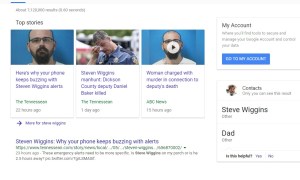
Once in a while Academia will send its users a flattering notice: “X-hundred people have cited your papers.” Be still, my throbbing heart! Desperate for any attention, most academics (let alone us exes) are thrilled that more than 100 people have read their stuff. So I clicked their link. “309 papers mention the name ‘Steve Wiggins’ or ’S.A. Wiggins’” it cheerfully reads. I know something the robot apparently doesn’t. I’m not the only Steve Wiggins on Academia. There is a slightly older agronomist whose name I share. He’s employed in academia and has more papers than me. And “S. A. Wiggins” could be anybody. My 309 paper mentions shrinks to double digits. Not high double-digits either. Names are hardly unique identifiers. With some seven-and-a-half billion people, there’s bound to be some reduplication. I always tell the few curious to search “Steve A. Wiggins”—with the quotation marks—to find the few, true references.

Taking on the internet is a fool’s errand. This blog gets a few piddly hits a day. I often consider closing it down. Readers don’t share it enough to get any attention. It takes a lot of effort on my part since I write books (both fiction and non) in my hours not at work. So when Academia shows up in my inbox my excitement spikes, just for a moment, and I go on with my other work, which never seems to get done. And then, when I’m sure nobody else is looking, I go ahead and click on the link.


New Religious—Bang!

Religion, no matter what the skeptics say, gives us something to believe in. Even those who claim no religion believe in their non-religion. We can’t escape belief. It’s no surprise, then, that new religions constantly emerge. As people find new things—or events—meaningful, and they come together around the phenomenon or episode, a religion eventually emerges. Take the example of the Chelyabinsk meteorite. On February 15, 2013 a resounding explosion rocked Chelyabinsk. What was likely a former asteroid had headed for Russia (which they seem to prefer almost as much as Donald Trump) and became a meteoroid (the name for meteors while they’re still in outer space). Once it entered the earth’s atmosphere and became a meteor proper, it superheated and exploded in the sky—a phenomenon known as a bolide. For those of us who’ve experience them, bolides are unforgettable. Once the pieces of the exploded meteor hit the earth they became meteorites.

Image credit: NASA/ESA, public domain

Meteors are an everyday occurrence. Any time you see a shooting star—which you can do any clear night—you’ve seen one. Large, exploding meteors are rare. Shortly after the Chelyabinsk meteorite fell, according to Astro Bob, the Church of the Chelyabinsk Meteorite formed. This group did not wish for the main body of the surviving meteorite to be raised from Lake Chebarkul, where it fell. Their protests became religious as they chanted, prayed, and sang. A new, if temporary, religion was born. Astro Bob goes on to say that religions and meteorites are no strangers. Indeed, up until the Middle Ages and even a little beyond, it was believed that rocks could not fall from the sky. A meteorite, then, was a sign from either God or, well, you know who. When the impossible happens religions are quick to follow. Astro Bob’s story was written in 2013, so he doesn’t declare the fate of the Church. The meteorite was raised from the bottom of the lake in October of that year.

New Year’s Day in 1987, while I was home from seminary on break, putting a puzzle together with my brother, our house shook. A loud boom accompanied the shock wave. We ran outside to find the neighbors staring at the sky, and a few casting a wary glance toward the petroleum refinery in town. The news later that day told us a bolide had exploded nowhere very near us. We were within the shock wave, and those fortunate enough to be outside that January saw a flaming meteor in the daytime sky. I remember it well thirty years later. I already had a religion at the time (Methodism, starting to tend toward Episcopalianism) so my plate was already full. It was nevertheless a dramatic event, and when your world is literally shaken, you will naturally look for something to believe.


The Price of Worship

The wind resistance alone must drive the cost of gas up considerably. Of course, with Yahweh on your side you don’t need to worry about pocket change. We were driving through a sleepy town in the Poconos. A light rain was falling. We came upon a truck advocating not for the usual and expected Christ, but instead for Yahweh. Promising “dramatically affected” lives for those who do so, the implied message on this portable billboard is somewhat ominous. We are apparently being restrained by “non-mortal, non-native beings of ill-intent.” The grammar of the placard confuses things a bit since it seems to suggest that calling on Yahweh will “release restraints on” said non-mortals, and that’s hardly a good thing. I suppose they can’t reveal the nature of these entities without giving away spoilers for drawing the curious in.

This vague, supernatural world presided over by the personal name of the deity seems just a little out of place in Bible country. There’s a kind of literalism about Pennsylvania that I find strangely comforting. It is where and how I grew up. I never encountered God’s personal name—at least not with first-person familiarity—until I attended college. Even then we were encouraged to be careful with its use. The commandment about taking the divine name in vain is just a bit disconcertingly unspecific, considering that it isn’t spelled out in more detail. And who exactly are these beings of ill-intent? They’re all the more frightening for not being named. Demons, I must suppose, but I don’t recall the Good Book saying anything about their restraints being released. This is a new kind of apocalypse maybe.

The thing about the Bible is that it’s everybody’s book. Some modern translations use Yahweh rather freely, opting for the admission that translating it leads only to more questions and “Lord” is obfuscation. Still, it seems awfully familiar. The need to air one’s personal beliefs, in some quarters, is very intense. There’s a passion behind this proclamation that I can’t help but admire. People stop and stare. Some, like yours truly, will want photographs of your vehicle. I suppose that’s the point, nevertheless, not too many people like being stared at. Evangelical culture demands it, as I recall from my youth. Putting your personal beliefs out there comes with a price. Part of that may be reduced gas milage and, consequently, pocket change.