Real Dreaming

I keep odd hours. Although we don’t live far from New York City, as the pigeon flies, public transit sets the schedule for my day. (I’m merely writing as a representative here, since I know others keep my hours as well.) Since I’m usually waking up around 3 a.m., I have to go to bed pretty early. One night recently I turned in around 8:00 p.m. and fell into a fitful sleep. When I awoke three hours later, it was as if my gray matter were a thunderhead. Ideas, worries, and memories flashing like lightning. Concerned, I watched the clock since I knew it was a work day. When three rolled around with no more sleep I hoped it would be like one of those rare days of interrupted rest when my conscious mind does just fine. Would it function that way on just three hours of sleep?

This incident brought home to me once again the mystery of consciousness. I had a meeting in New York I couldn’t miss that day, but by mid-morning (in real-people time) I was seeing things that weren’t there—an almost Trumpian dissociation from reality. Then I’d snap back to awareness and realize my mind was drifting off to steal some of the sleep it refused during the hours of darkness. Using the usual tricks I stayed awake for the workday and even for the bus ride home, with only brief momentary lapses where what had been reality had stopped making sense. Consciousness, it seems, functions best with a well-rested brain. A good night’s sleep put me back to normal the next day.

Reflecting back over that previous 24 hours, I thought how surreal they’d felt. Not to put too fine a point on it, but they were like an altered state of consciousness. Religions, some claim, began because of such altered states. They are strange and powerful. And fairly universal—almost everyone experiences them from time to time, whether by sleep deprivation, controlled substance use, or prayer and meditation. Even knowing the cause (going to bed with a lot on your mind when you have to wake early, for example) doesn’t change just how real the experience feels. This is one of the reasons that rationality doesn’t explain all of experience. In the same brain there are Jekyll and Hyde aspects to consciousness, interchanging with each other every few hours. As the movie Inception underscored, you don’t remember how you entered the dream. You’re just there. And when that world intrudes on the conscious, rationally ordered territory of wakefulness, the questions can become quite religious. Unless, of course, I’m still dreaming.

Original Sinner

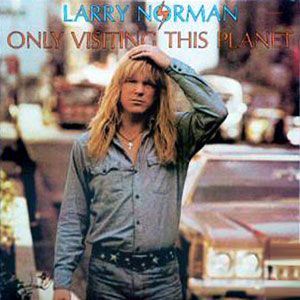
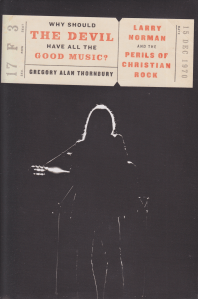
Musical preferences are a personal matter. In the case of the kind that loudly thunders from open car windows, often they should be more so. Still, music is a deeply moving phenomenon. When a musician is paired with a compelling personal story, it can be quite a gripping narrative. Gregory Alan Thornbury’s Why Should the Devil Have All the Good Music?: Larry Norman and the Perils of Christian Rock is one such account. Although Larry Norman was never popularly famous—many people today have never heard of him—he was a tremendously influential person. Like most true innovators he was, as Thornbury shows, a difficult person. He often had more enemies than friends, but there can be no doubt that he lived, at least in his own mind, by his convictions. And on his own terms.

I didn’t know until reading this brief biography that it was common for Larry Norman to wait around after concerts and talk with fans. When a friend invited me to see Larry in concert I was, as is generally the case, so wrapped up in my own issues that I hadn’t done much research. I was thrilled to see the artist that I, like Thornbury, had discovered during college. It was my friend’s idea to go backstage to talk to him. To this day those few minutes remain some of the most thrilling of my life. Norman was a name dropper, according to those who know, and I’ve met a few famous people over the years, including Jeff Bezos, but Larry was different. The breadth of his impact on rock in the 1970s and into the ’80s, was vast. Many secular artists count him among their most profound influences. And he had time to sit and chat with a seminarian from nowhere.

While my friend and I waited to see him, the guy in front of us wanted to play Larry a song. In an act of hubris I can’t fathom, he’d brought his own guitar to the concert. Larry kept saying “I don’t understand why you want to do this.” But surely he knew. Throughout his career he helped start many younger artists on their track, some to Christian stardom, others to more quiet lives. He had, however, something he couldn’t give away. Larry Norman was a true original. Despite his uneasy dalliance with fame, he was willing to sit and talk with a star-struck young man who would go on to become a lifelong admirer of an artist who remained true to himself, even if he was too Christian for some and too secular for others.


Watching Research

Now that Holy Horror’s been announced, I’m at work on my next book based on horror movies. Although some people might question the aesthetic of the horror genre, these films are sometimes remarkably intelligent and can indeed be good cinema. Having spent the better part of last weekend watching multiple flicks, however, I’ve come to realize that watching films for research is quite different than viewing them for fun. We all know the feeling of going to the theater to be exposed to the mythology of the present day; movies are the new mythology and are a common source of meaning and hope for individuals in a post-religion era. We go for the spectacle and the story. We leave, if the movie is good, with a renewed sense of purpose, or in a thoughtful state. That’s what mythology does.

In writing up my analyses of many films, I’ve noticed how little the detail is generally acknowledged in many synopses. They can make a flick seem banal. I’ve even had very intelligent people ask me why I think watching movies should be considered intellectual exercises. One reason for this, at least in my experience, is how often people rely on what they see in movies to inform them of important things. Historical events, for example. For the average person, an historical recreation on celluloid can provide recall better than a detail from some 400-page tome on the topic. Human beings are visually oriented by nature and evolution. It takes us years to learn how to read, and if we don’t keep up with the practice our ability to comprehend advanced writing atrophies. It’s easier to watch a film.

No doubt movie scripts are available for purchase. To get the message of a film, however, you need to watch. Immerse yourself in a kind of flickering light baptism. Research watching, however, involves multiple viewings. Taking notes. Watching again to make sure you got that detail correct. Some may doubt that this is an intellectual exercise at all. Still, one of the concerns that some scholars feel is that we’ve lost touch with what hoi polloi believe. People have turned to mythology from the beginning of time in the quest for meaning. Science tells us how the world works, but not why. For such questions we need our mythologies, ancient and modern. Since Nightmares with the Bible focuses on demons, I’ve had to construct a cinematic demonology that’s quite different from those of the Middle Ages. It requires, after all, a modern research method for a modern mythology. And movie watching. Lots of movie watching.


Kakistocracy

While in seminary I had the interesting job of teaching a visually impaired student Greek. This wasn’t an arbitrary choice on the part of my professors since, as an undergraduate I had exhausted the Greek curriculum at Grove City College and my fourth year the professor suggested I teach the course to the second years. This was, however, strictly koiné—I’ve always been from the lower class echelons. Trying to figure out how to explain a dead language to a student who couldn’t see required some creativity. At that point in my life ministry loomed as a career and it was still fairly easy to learn new languages. I was studying Hebrew at the time with the inimitable William Holladay at Andover Newton Theological Seminary, both of which are now gone.

I recently ran across a story in the Washington Post that utilized an unfamiliar word based on Greek: kakistocracy. It seems that the present administration has officials scrambling for new words to describe the depths to which our government is willing to sink. There’s an old saying: “the Greeks have a word for it”—I suspect the ancients would be shocked to see this particular word emerging again after centuries of progress. The translation of kakistocracy is quite logical for those with some Hellenistic training; it means “rule by the worst.” The sad thing is that democracy has come to this. Anyone with a fragment of a brain stem could see that 45 didn’t win the election in any sense but an electoral college one—giving us a new direction to sling the related word “kaka” around. It was the fact that those privileged to vote simply didn’t get around to it. As it was, the “incumbent” lost by three million votes. Nobody, however, is willing to do anything about it. It’s kaka.

If the swamp has been drained, it’s been to become a cesspool. With complete disregard for decency, decorum, and democracy, the directives issuing from the potty mouth on Pennsylvania Avenue demonstrate just how diabolical government can become. The sad thing is, the Greeks already had a word for it. One thing we know about our species is that we like to repeat our worst moments over and over again. Even worse, we seem to be proud of it. So as the kakistocracy grows to include porn stars, genital grabbing, and treasonous relations with foreign nations, the world looks in wonder and concludes people like George Washington and Thomas Jefferson had gotten it wrong after all. At least the student I was tutoring, although she couldn’t see, wanted to learn to read. And that made all the difference.


Situation Norman

It was in a locker room. I couldn’t believe I was here. First of all, at Gordon College—that bastion of conservative Christianity. Second of all, in the same room as him. A friend had offered to drive me up here from Boston, where we were both in seminary. I was a little saddened to see less than 200 chairs set up on the gym floor, carefully arranged on a tarp so as not to mar the shining wood beneath. Larry Norman came onto stage to great applause, and was remarkably intimate with his fans. He’d been a big name in the 1970s, almost single-handedly starting the Christian rock genre. After the concert was over, my friend said “Do you want to meet him?” Here he was, in the locker room, taking the time to speak with fans, individually. He refused to sign autographs, preferring to give the glory to the Lord. But he listened, he responded, and, it was clear, he loved.

While the sections of the brain that process religion and music may not be the same, we know that our gray matter is intricately interconnected. Analysts have noted that the most famous religious leaders of modern times have quite often been deeply affected by music. Religious services without some form of music are in the minority for a reason. And it really doesn’t matter what style said music takes, it moves people. Instead of apologizing for my own musical tastes, I’ll simply note that I was exposed to Larry Norman at a young age. Although his religious perspective and mine had parted ways before I had the chance to meet him, I’ve never disparaged his music. It is authentic, innovative, and above all, sincere.

Gregory Alan Thornbury has just published a biography of Larry Norman. I will surely read it. Although Christian rock has grown insipid and cloying since it began, it is still a remarkably lucrative business. Evangelicals will pay good money to get those rock rhythms with unthreatening words and praise of Jesus thrown in. Norman’s songs, however, were complex and nuanced. Equal parts love and social justice, they might not even mention Jesus. Or when they did, they might suggest he was a UFO. Unconventional. Blasphemous to some. As the ‘70s faded into the ‘80s, Larry Norman was considered old news. He had, however, started something that was bringing other people lots of money. And he looked me directly in the eyes late one night in the locker room of a conservative Christian college, and told me to keep on believing. Obscurity, he showed by his life, is no measure of a person’s actual importance. And music and religion can never be separated.


Private Browsing

Montclair, New Jersey, is a diverting place. At least it is for me. I used to teach—strictly as an adjunct of course—at Montclair State University. And like many other diverting towns, Montclair has multiple bookstores. On the occasions my wife has to spend a Saturday working in Montclair I often accompany her. If the weather is decent I can walk to both bookstores and have a leisurely browse. Since anything leisurely is rare these days, I eagerly anticipate such trips. Typically I’ll sit in my wife’s work place counting off the minutes until I can leave to get to the Montclair Book Center just as it opens. Used bookstores are a bit like archaeology—you never know what you’ll find, and some of the treasures may be unique. I often have the store mostly to myself, for private browsing.

This time, however, I had another task to accomplish first, before I could go to the first bookstore. By the time I arrived, it had been open for over an hour and there were, surprisingly, plenty of people there. We’re accustomed to hearing that people no longer care for books. While it’s true they won’t bring in the numbers of, say, those wanting the latest video game, it’s also true that on a pleasant Saturday morning an independent bookstore can be a crowded place. It warmed my heart to see so many readers out. And they weren’t all old like me. Younger people talking about the merits of this or that author, browsing in the sections I frequently haunt. Although I found none of the books on my list, I still had that blessed feeling you have when you discover you’re not really alone.

The other store, Watchung Booksellers, is a couple miles to the north, at least by the walking route I use. A small indie, it typically has what modern-day people might be expected to be interested in. I arrived to find it crowded as well. I’ve been there a number of times in the past and usually there are two or three others browsing. This time it was actually a little difficult to get around the small space. Seeing children there made me especially glad. A crowded bookstore is a sign of hope. As we struggle against the forces of ignorance and hatred that seem to have gripped the privileged classes, Saturdays at bookstores doing brisk business are an indication that the future may correct such ill-informed sentiments. Bookstores are termometers of national health, and seeing them busy made my Saturday. It’s worth getting up early just to spend such a day in Montclair.


Dreaming Reality

It was like that dream—you know, the one where you find a penny on the sidewalk, stoop down to pick it up, and discover that there are hundreds more of them. Maybe that’s the kind of thing those born in humble circumstances dream of, but we all recognize the draw of a windfall. People are pretty tight with their money in Manhattan, but it was early in the morning, still dark, and rainy when I saw it. A hundred dollar bill on the ground. Then I noticed more—a while bunch of them. When I reached down to pick one up, it came apart in my hand. Of course, it was a novelty replica of an actual piece of currency. When I walk through the garment district I often find great swatches of scrap cloth that have spilled out of designers’ trash bags. I’m tempted, I’ll confess, to pick them up and save them for future use. Nevertheless, this hundred dollar bill wasn’t what it appeared to be. Many things aren’t.

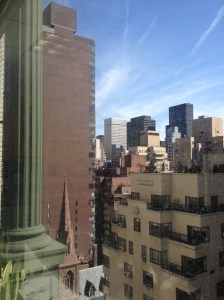
Religions around the world are predicated on the fact that what seems to be real isn’t. Even long before The Matrix came along. The idea that what occurs in our heads—or to use more conventional religious language, our hearts or souls—is truly real automatically takes us a step away from material reality. It’s not to say that this soggy, pulpy piece of paper in my hand has no existence, but it simply isn’t what it pretends to be. On mornings when the fates are all synched just so, I’ll look out the window of the bus from the helix and see Manhattan laid out in front of me like a picture postcard. “It’s not real,” I whisper to myself. Unlike the tourist in awe during a first visit to the city, I actually mean it. This concrete, glass, and steel world is not real. I’d feel a bit exposed suggesting such a thing on this blog had I not the biggest names in world religions behind me. One thing that they all seem to agree upon is that reality isn’t just what we experience in this corporeal vehicle that we currently call home.

Religion has been called the opium of the people. Marx wasn’t the first to suggest that the more needy among us were the driving force behind belief. Nevertheless, belief is present in all forms of thinking from extreme rationalism to naive acceptance of what your parents told you. The thing about religion is that it conscientiously advocates belief. It admits up front that it holds certain things to be true. One of those beliefs happens to be that things are not what they appear to be. Here in Manhattan we’re all so busy rushing around that who has the time to stop and think like that? I frequently walk past Holy Innocents church on my way to work. I may function, in this world, as an editor of biblical studies, but as I pass that edifice to a faith to which I don’t even belong, I feel the draw. Inside those doors—and I know this is true because I can sometimes hear the bells—a different reality awaits. Out here there may be hundreds of dollars scattered on the ground. When you look closer, however, you discover that they’re not what they appear to be.


Updates

So, I’m getting ready to update this website. I’ll give you a warning before things change. Another update, however, is in order. I’ve been promising that I’d let you know when my forthcoming book with McFarland received its final title. Well, drum roll please! The final title is actually the first title I proposed—Holy Horror: The Bible and Fear in Movies. And it has an ISBN: 978-1-4766-7466-7. And a cover design too, but I can’t share that just yet. It is appropriately lurid, matching the subject. But in all seriousness, the book makes a case for the fact that many people understand their religion via popular media. Being a bad boy, I look at it through horror movies.

The title Holy Horror was a play on Douglas Cowan’s excellent book, Sacred Terror. I recall reading that book, starting the night I bought it as SBL, curled up in the swank conference hotel bed, turning pages until I couldn’t hold my eyes open any longer. It had honestly never occurred to me that religion scholars could get away with writing about horror movies. Cowan had the natural advantage of being a Canadian, something I’ve always longed to be. He also has a secure university post. I was, at the time, just a guy trying to feel secure in what seemed like (and turned out in reality to be) a threatening seminary position that was shortly to end.

It may be difficult to understand how horror can be consoling. It can. I’m a squeamish guy. I don’t like blood and gore. I hate being startled. Nevertheless, I took comfort in this genre as my career was falling apart. Holy Horror was a cathartic book for me to write. There’s more than a little metaphor in it. One thing that will become clear to readers is that the Bible is no stranger to horror movies. Ironically, many of them are strangely conservative—Carol J. Clover’s classic Men, Women, and Chainsaws (which I’ve reviewed on this blog) made that point clearly. Horror often has the same message as your typical Disney film, although it’s presently slightly differently. How so? Well, I can’t say very much here or you’ll have no reason to read my book. McFarland does a great job with publishing this kind of title. You won’t find it in Barnes and Noble, and not likely in your local indie either, but it’ll be available on Amazon and these days that’s enough. And before long these pages will change to reflect its coming.


Ithaca Musings

Ithaca may be the ultimate hippie town. Open and accepting of diversity, it’s a place where anyone can speak out against what’s going on in the government and not worry about finding any objectors. Yesterday when I was in Buffalo Street Books, customers openly vented their frustrations with the way Washington’s handling things, and others joined in. There’s a sense of righteous anger here that hasn’t been fashionable since the days of the biblical prophets. You have heard it was said Watergate was a bad thing, but verily I say unto thee something much worse than Watergate is here. And although winter is still holding on in upstate New York, nobody doubts global warming is real.

From my first visit here, I knew that I wanted to live in Ithaca, but it is one of those places you can’t afford to live. Amazing how the liberal cities are the places people want to reside. Places where you can’t just turn off the realities of a diverse world just because some things make you uncomfortable. Places where if you notice that other people are different you are reminded that you, in their eyes, are the different one. There is no static, monochrome, cookie-cutter American. Why is this an idea so hard to sell? Capitalism leads to and fuels the desire to own. And owning leads to the desire to own more. I’ve often noticed this since being out of higher education—even within your own company others want what you have. The basic civility of the socialist is missing. That’s where the “me first” attitude leads.

In upstate New York, as in many parts of the nation, the very names remind us that others “owned” the land before Europeans arrived. Native American concepts of ownership were so different from the capitalist ones that forcefully landed on these shores that those views were forced, under firearms and steel, to assimilate to the foreigners’ ways. Capitalism takes no prisoners. Turnabout, they used to say, is fair play. We no longer feel that way as a nation. The interlopers have taken over. We’ve made the country in our own image. And it certainly isn’t any more noble for it. Being in a place like Ithaca always makes my spirits ebullient. The very concept of ownership is an odd one, I realize. Mere mortals can never really own anything. We can pretend to, or perhaps we can take a more enlightened view. We are all borrowing things here. And I would love to borrow a piece of real estate here in Ithaca.


Power in the Bus

“You’re not in control on a bus” my friend Marvin once wrote, in his short story “O Driver.” The commuter is the consummate captive. I don’t like to beat dead horses—we might need all the horses we can get before this is all done—but some commuters need to learn silence is golden. I take a very early bus with some hope that we might beat the inevitable traffic jams coming into New York in the morning. Every minute counts. Some people, however, feel compelled to comment when they think the bus is early. They’re already sitting on the bus, so what’s the problem? There’s another coming in 30 minutes and those of us concerned with getting in before the traffic make a point of being at the bus stop, well, early. The other day a guy got in at the stop after mine. He told the driver that the bus was running early (it actually wasn’t) but the driver obligingly sat for several minutes. The commuter’s always right, right? We got into the Port Authority late that morning. All because of one man’s mouth and his inability to keep it shut. I wonder why they even have that sign saying not to talk to the driver. That only applies when the bus is in motion. So…

The very next day the driver on the route was new. She was on time. Until. To understand this, you need to know my route is an express—it is entirely highway except for one short jog into another town about 10 miles down the road. My driver was doing great. “You missed the turn,” another passenger said. The driver apologized. A three-point-turn in a bus just isn’t possible on the highway, so she had to drive to an exit, wait for the light, and turn around. We were now speeding west, heading to New York City. The passenger, now acting as GPS, didn’t know this area very well. “Take the next exit,” she instructed. The driver dutifully did. It was a ramp with no reentry to the highway. We were touring rural New Jersey for some time before the driver found a place to make another U-turn. “Missing the turn,” the passenger now said, “That turn’s inconsequential. There’s another bus that comes just after this one.” She’s right. No less than three routes into New York follow that jog. But it was too late for us now. Finding our way to the highway, we again headed west. This time our driver took the correct exit, apologizing all the way. The next day we had a new driver.

Actions have consequences. For each and every action there’s an equal and opposite reaction. I learned the latter in physics class. The former is a life lesson that might properly be called the mother of morality. When you talk on the bus you’re taking charge of about fifty lives. It has become clear to me through my years of commuting that most people shouldn’t have that kind of power.


Americanism

I’m a bit too much of a contrarian to be a regular bestseller reader. I do occasionally bow to curiosity though, and I do have a lot of time on the bus. But that wasn’t the reason I turned to Michael Wolff’s Fire and Fury: Inside the Trump White House. Purchasing this book was a statement. Another in a long line of protests in which I’ve taken part since January of 2017 (and even before). You see, I mourn. I mourn what our country has become. My first indication that I should write (which I of course ignored) was the winning of a statewide essay contest my senior year in high school. The topic of the essay was “Americanism.” My piece was respectfully cynical; I was surprised I won. This was in the days before personal computers and I didn’t think to keep a typed, or even hand-written copy.

The essay was cynical not because I don’t believe in America, but because I do. I’ve been confronted on this issue concerning my blog occasionally. My jeremiads. You see, you only get this fed up with things when you love them deeply. I sometimes rail about higher education, for example, because I care about it. Fire and Fury created in me a—to borrow from the book’s vocabulary—Kafkaesque bewilderment about how a nation based on high principles could possibly sink so low. Politicians are perhaps the most self-serving of human beings, but at least they try to make sure the country doesn’t go off the rails. This train leapt the tracks months ago, and our elected officials refuse to do anything about it, each playing their own angle, hoping personally to come out of it ahead. Worth a jeremiad, I’d say.

I was a Republican in high school. I wasn’t old enough to vote, so that party affliction was never official. When I did register at 18 it was as an independent (remember, contrarian). As a Fundamentalist I was ahead of the Tea Party, at the time. Even with this level of patriotism I wrote an essay taking my country to task. I was raised in a poor family. Told an education would improve my chances, I found myself facing predatory loan officers and others eager to wring my blue collar until it was possible to twist no further. If I had no money, my future money would do. I’d already had a taste of that as a high schooler. That was three-and-a-half decades ago now. I kinda hoped the country might improve in all that time. And I kinda wish I’d kept a copy of that essay as a memento of more optimistic days. Fire and Fury sells so well, I suspect, because I’m not really alone in feeling this way.


Urban Evolution

They say ten city blocks are a mile. They also say the internet is fast. Putting these two theorems to the text, I’ve logged several foot-miles in Manhattan to find things that aren’t there. I don’t mind the exercise, but apparently the web can’t keep up with Midtown. I’ve been working in Manhattan for going on seven years now. I very seldom leave the office during the day, eating at my desk and trying to give the man his due. Once in a great while there’s something I’m either compelled to see, or that I must find for various reasons. Almost without fail, such lunchtime expeditions lead to frustration. I recently had to visit a business that shall remain nameless (conflict of interests, you see). According to Google Maps it was a mere ten blocks—a mile—from my office. At a brisk pace I could make it there, transact my business, and return to my cube all well within an hour. As I grew close, I got that sinking feeling I recognize now as internet ghosting. Nothing remotely like my goal was at this location.

I walked in and smiled at the man at the security desk. He was even older than me. “Ah, they used to be here,” he said, “but they left a long time ago. Long time ago.” Apologizing in advance, I asked if he had any idea where they might’ve gone. “I heard they moved across from Bryant Park, on 6th Avenue. But I heard they moved from there, too. You might try it, though.” Since this was roughly in the direction of my office from where I was, I decided to swing by. When I worked for Routledge I went by here every day, and I didn’t recall ever seeing this particular business there. Their security guard was equally as friendly. “I’m afraid there’s nothing like that here.” I had to return to work. When I got back to my office and googled their store locator, the website froze. This was truly unobtainable via the internet.

Some times you’ve just got to let your feet do the walking. Things aren’t always where the internet says they will be. I’ve come to realize that New York City is constantly changing. Buildings now stand where mere holes in the ground used to be when I began working here. Commuting in daily all these years is like time-lapse photography of a plant growing. Buildings emerge behind the green plywood walls, and next thing you know what used to be a synagogue is a new retail opportunity. It may not, however, be the business you’re looking for. Before spending your lunch hour walking a mile to get there, you might try calling first.


Good Company

It’s a matter of scale. If you read this blog chances are you like books. If you like books you probably know about remainders. When you walk into a bookstore and see a shelf or section of really cheap new books, you’ve found the remainders. This happens when a publisher overprints and, instead of pulping books (that hurts even to type!) the remaining stock is sold at just above cost so that retailers can add a small markup and make a marginal profit. Most authors don’t like to see their books remaindered, since it means demand wasn’t as high as the publisher anticipated. Expectation was that the book would do better than it did, now the publisher and bookseller just want to recoup some of their losses. Often there’s a marker stroke across the bottom pages of the book so you can’t return it for the retail price.

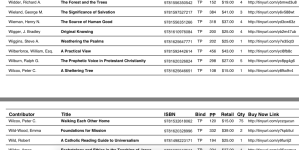
For those of us whose books sell in the double digits, seeing yourself on a remainder list would be kind of a thrill. The other day I looked at Wipf & Stock’s 50 percent off sale to find a copy of Weathering the Psalms listed. Probably it was overprinted for the AAR/SBL annual meeting, since I saw that they did have copies there again last November. If they hadn’t bothered to print out a bunch, I would never be on the remainder shelf in Eugene. I don’t mind because I’m in good company. Looking at the list I feel like I belong in some kind of academic crowd in the reduced bin. There’s a sense of community among the overprinted.

Turnabout, they say, is fair play. I’ve bought plenty of remaindered books in my life. Lately I buy used academic books because the new editions are out of the reach of an independent scholar who isn’t independently wealthy and who doesn’t have access to a university library. If I buy others cheaply, I turn the other page and expect the same back. Most of us who write academic books aren’t in it for the money. We want to be remembered for our contributions to the discussion. We took the many months and years it takes to research, write, and polish a book, and we want others to take an interest in what we have to say. It’s all about the dialogue. It’s all about the community. For those of us who never really found a home among the established academy, publication can mean a lot. It doesn’t matter that the books are sold cheaply—in fact, that’s good, because it means somebody might just read what you wrote. It’s all a matter of scale.


Two Cities

Augustine of Hippo wrote that there were two cities. If you’re reading this blog you probably know what they are. Today, according to some, is Easter. For others it’s not quite there yet. Call that one city. It’s also very near that other national holiday—tax day. That’d definitely be the other city. Now, I’m not going to go into any detail here, but I’ve always done my own taxes. If you’re old enough to remember going to the public library to pick up two or three copies of the paper forms, sitting at home with a pencil, eraser, pen, and TI-30, and spending an entire Saturday reading through the instructions and scribbling, you know what I’m talking about. These days everything’s online.

I can’t recall how many years I’ve used TurboTax. It was free, easy, and generally led to a refund. I miss those days. This year when I sat down with Intuit’s child, it started asking questions I didn’t understand. Perhaps you’ve run into some industries that do this—they make up their own vocabulary and if they use the words in a way the dictionary doesn’t, well, it’s the dictionary’s fault for not keeping up. TurboTax started doing that. And unless you want to pay even more than they’ve already sold you up for, there’s no way to ask questions. The answers online use the same obscure lexicon. So this year I had to do probably the most adult thing I’ve ever done. I got an accountant.

Setting up the appointment for after work, it was a matter of looking at dates both my wife and I, and more importantly, the accountant, had free. It was only as judgment day dawned that I realized it was Good Friday (for some). Arranging to work from home that day so I could get to the office before the buses rumble out of New York, I ran into a traffic jam. No doubt people out to do their last minute Good Friday shopping. We were meeting the accountant for the first time, and I wanted to make a good impression. Be punctual. I had neglected to coordinate the two cities on my calendar. The accountant was understanding. He commented on how easy our taxes were, compared to many. Turns out TurboTax had been closing off many perfectly legal options and charging us for the privilege. So now it’s Easter. Taxes are due in a couple of weeks. There are two cities, and if either is neglected there’ll be Hell to pay in the end.


Books and Editing

My life has been about books. It was only as I became what is now known as a tween that the passion took hold, but since that time I’ve been addicted to them. As some readers know, I have a Goodreads account. Each year I try to take out a Goodreads challenge on how many books to read. That recently got me thinking; as an editor you read lots of embryonic books, but they don’t count. Being an editor’s a funny job. Not ha-ha funny, but the other kind. When I was having trouble breaking back into higher education, I ran across a quote that went something like this: What’s an editor? A writer who actually has a job. (Rimshot.) I have a tendency to take things literally, so I thought I’d discover lots of writers among professionals in the publishing world. I haven’t.

It could be that other writers keep it well hidden. I publish my fiction under a pseudonym and it may be that the other editors I know live hidden lives too. Somehow I doubt it. They check their email at midnight and all day long on weekends. One thing I know about writers is that we need time to write. If your workday is already eight hours and your commute is three-plus hours more, you won’t be checking work emails on weekends if you want to get any writing done at all. But what about the reading? Does it count when you read books that aren’t even born yet?

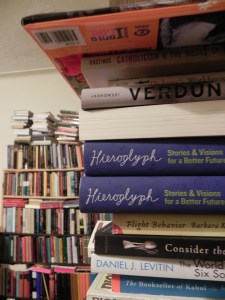
On Goodreads I enter my books by the ISBN. The International Standard Book Number (for which you have to pay, I’ve learned) is a tool used so that booksellers can keep track of titles with a unique identifier. The system is fairly recent (at least according to some of the books I read), and not all books have one. For those of us who read ancient documents, those can’t count either. Ilimilku didn’t think to stamp 13-digits on the bottom of his clay tablets. There’s no way to trace just how much s person reads in an actual year. I measure myself by my books. I get a profound sense of fulfillment when I finish one. That’s why I so often post about them on this blog. Books mean something. Call it a bad habit if you will. We’re outgrowing our apartment because I find it hard to part with books. There are those who spend their lives building arsenals. Then there are those who spend theirs building libraries. I know which I prefer.