Gallows Hill

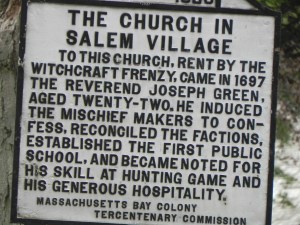
Over the past couple of weeks it has been in the news that the site of the “witch” hangings in Salem, Massachusetts has been identified. The actual site had long been suspected, and it was only recently confirmed by a group of historians using the empirical evidence available to historians. Although my interest in the Salem trials pre-dated my wife, nothing brings you so close to history as being a part of it. Descended from the brother of three of the women accused of being witches at Salem, my wife brings a sense of reality to the tragic accusations of three centuries ago. Although toyed about in the media (an episode of Sleepy Hollow, “Spellcaster,” in season two, featured an actual Salem witch) the fact is that nineteen innocent people were executed for a fanciful belief that the Devil was roaming about New England, and when you can’t catch the Devil, you have to use a scapegoat.
DSCN0518

One of those investigating the location of Gallows Hill was Benjamin Ray of the University of Virginia. I’m sure Professor Ray wouldn’t remember me, but one day as I was doing a campus visit for Routledge, I had taken AmTrak to Charlottesville to visit the religion department. Many of the faculty declined to see me, and as I sat on a bench in the hall (one of my academic dates had stood me up), Dr. Ray walked up to me and asked me if he could help. I explained who I was and he invited me to his office where we talked about Salem. I told him was wife was related to Rebecca Nurse, Mary Eastey and Sarah Cloyce, the two former, as he knew, executed for an imaginary crime, and the third accused. A strange quiet settled over the office. He told me his interest began because he too had descended from a Salem family. His ancestor, however, had been an accuser rather than a victim. It was a strange rapprochement. Opposite sides brought together in scholarship.

What truly frightens me about Salem is that we have not outgrown it. Presidential hopefuls spew the same fear and hatred toward Muslims, the hispanic immigrants who make our economy possible, and women (this should sound familiar) trying to “take the place of” men. And the crowds cheer, as crowds will do. Even though Donald Trump cussed twice in his Liberty University speech (an infraction for which a student would have to pay), President Jerry Falwell, Jr. (typing that makes me shudder) shrugged it off saying that we’re all sinners. Some sinners, however, carry a wicked, knotted rope with them while other sinners try to eke out a living in a nation where some can get rich by owning casinos while others frantically spend their inadequate cash hoping to win Powerball. We now know where innocent people accused of witchcraft died, but have we learned anything from it over these past three centuries?

Long Revision

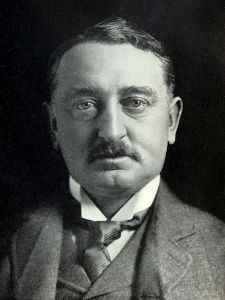
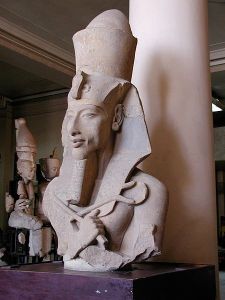
Cecil_Rhodes_wwThose of us who write know all about revising. You go back to a piece you wrote, maybe even just days ago, and you see all the things you want to change. Corrections, improvements, deletions, retractions. Histories are particularly prone to being viewed in new ways with the passing of time. I once thought histories were factually true, but in this postmodern age we’ve learned that while histories contain some facts, they are largely interpretations of those facts. Even the Gospels are interpretations. Recently I’ve been reading about student movements wanting to efface some facts of history because they make current-day people feel bad. A piece in The Guardian, for example, explains how some students want to remove the statue of Cecil Rhodes from Oriel College, Oxford, because Rhodes was an imperialist and a racist. A similar movement is afoot at Princeton University to give Woodrow Wilson the old Akhenaton treatment for similar reasons. Student interest groups, as The Guardian points out, don’t want to be reminded of their once marginal status. Removing Rhodes (or Wilson) from his pedestal, however, won’t change history.

I wonder if those in these special interest groups have enough experience to realize the implications of their complaints. What if, for the sake of argument, one of these student leaders became a national leader? What if her (or his) nation became oppressive during her or his lifetime but s/he didn’t see it because it was the operating milieu of the age? And what if their nation later repented and brought those from their former oppressed colonies to their homeland and those who came turned against that past leader? The point of this scenario is to suggest that none of us—or at least very few of us—have the ability to think beyond our age. Can we be blamed for being children of our time? Will removing our mementos change the facts of history that will have transpired? Will it make us feel better to bury the truth of what happened?

What's behind that self-satisfied smile, Akhenaten?

What’s behind that self-satisfied smile, Akhenaten?

An issue that often weighs upon my mind when I hear of these groups of the marginalized is that there is a very large, and very diverse marginalized class that has no voice, even today. The poor. Sure, some of us raised in poverty can claw our way to a descent living, but succeeding in a world where you need connections and favors owed and special knowledge of how a system works will be forever beyond our grasp. I knew a refugee, once upon a time, who was a student of mine. He used to complain to me of the costs of having his shirts sent out to be laundered. His clothes were tailor made. He refused to use a washing machine. He was also quick to point out that I was the oppressive race. This he did without a nanogram of irony. Cecil Rhodes may have been as evil as some say he was. His money, however, made it possible for some of the heirs to his oppression to study in his shadow. And I write that with a heavy dose of irony. Do they not realize that Akhenaton is now considered by many to be the most interesting Pharaoh of them all because he was erased from history?


Silent Light

One of the first things I notice during and after a snowstorm is the silence. Part of it, I suspect, is the dampening effect the blanket of snow has on ambient sounds, but another part of it is the lack of usual frenetic human activity. Here in New Jersey it often feels like being in a perpetual motion machine. People are always going some place. Movement is constant and even if I have to head to the airport at 3 a.m. there is other traffic on the road. We are all too busy. Snow has the power to make one stop and reflect.

We live on a fairly busy street since we’re just a couple blocks from the county hospital. Further along our street in the other direction are the county jail and social services offices. People are going by constantly. When yesterday’s snow began, the traffic died down. For once people seemed to take forecasters seriously—driving would be dangerous, and the snow would keep coming well into the night. By mid-afternoon we had more snow in my town that I’d ever seen at a single time during my decade in New Jersey. It was as if winter came in a single day. But it was quiet. Very occasionally a snow plow would rumble by, but most of the day our busy street was deserted. A few kids ventured out, but not many since this was a blizzard (the definition of which is that wind is strong enough to lift snow off the ground and make it airborne again). The silence was almost disorienting. It was like living at Nashotah House once again.

DSCN6193

Silence has long been understood to be a spiritual virtue. Both eastern and western religious traditions recognize the value of listening. The noise may be internal or external, but it is nearly constant. Taking time to try to shut it out, if only for a few minutes a day, can be a spiritual exercise. A snowstorm can help to quiet the constant reminders that we have to do this or that, or that we have to be here or there. During a snowstorm we only have to be where we are, and we only have to do what we’re doing. Soon enough the roads will be cleared and the traffic will begin again. Until it does, however, it is worth exploring what the silence has to offer.


First Stronghold

FIRST Robotics has a way of getting into your blood. Like many people of my generation, I learned about FIRST Robotics through my daughter. Our local high school has a robotics team and, as we quickly learned, the decision to join FIRST is a four-year family commitment. My wife and I were both involved at some level, despite being the world’s least likely engineers. I even served a term as the president of the foundation (responsible for funding the team). We made lasting friendships and grew in the lingo and odd humor that is FIRST. The founder and chief promoter of FIRST, Dean Kamen, is an unapologetic geek and has helped develop what some journalists are calling “the new cool.” Yesterday was launch. If you are a FIRST follower, I don’t have to explain that. In case you’re not, “launch” is the revelation of this year’s game. Teams now have six weeks to plan, design, and build their robots.

IMG_3125

Launch is a big deal. We haven’t been part of the competition for three years now and we still watch the live web-broadcast. The major players (Kamen, and Woodie Flowers) get in character and meet kids from various teams. They give inspirational talks. Dean Kamen told the kids “Don’t get stuck into today.” Technology changes too fast. What you learn in school are tools, because facts are available instantaneously on the internet. Those of us who retain facts are so yesterday that we’ve become the trivial pursuit generation. Any computer, let alone robot, could beat us. Woodie Flowers told the young audience thinking about careers that they must do what machines cannot do, otherwise their jobs will become obsolete. What could be more human than religion? What’s religion got to do with it? This is science and technology!

This year’s competition is FIRST Stronghold. The entire buildup of yesterday’s launch was a takeoff on Monty Python and the Holy Grail. What is this I see before me? History? The Middle Ages were nothing if not religion run wild. This was a world ruled by bishops, popes and nobility. It was a world where no matter who you were, God trumped all. Technology meant that a trebuchet was a pretty sexy device and long distance communication traveled at the speed of a horse or human runner. (Or, I suppose, a trebuchet missile.) Now that the humanities have fallen victim to science, we look back to them for inspiration. It reminds me of John Keating in Dead Poets Society: “And medicine, law, business, engineering, these are noble pursuits and necessary to sustain life. But poetry, beauty, romance, love, these are what we stay alive for.” This hasn’t changed since 1989. Or even 932 for that matter.


Thoughts in a Cemetery

DSCN6136

Being distinguished, indeed, getting noticed, is increasingly difficult to accomplish. When you read a lot of history, you realize that anyone who managed to write coherently in the past few centuries seldom had difficulty getting a publisher, for instance. The key to getting noticed was publishing books, or being lucky enough to have landed a highly visible job. I was reminded of this, and was given a slight inferiority complex, by a recent visit to the Nassau Presbyterian Church’s cemetery in Princeton. I’ve gone by this cemetery dozens of times, but only recently took the time to get out and explore.

DSCN6129

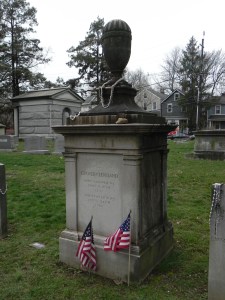
History buffs will know that Aaron Burr is buried there. Burr was from a family of privilege; his father Aaron Burr, Senior, was one of the founders of the College of New Jersey, better known by its current name of Princeton University. The vice-presidential Burr was also the grandson of Jonathan Edwards, who also rests in this very graveyard where one hopes God is somewhat more forgiving of sinners than rhetoric might suggest. Although he was the third Vice-President of the United States, Aaron Burr is now remembered for killing Alexander Hamilton in a duel not far from where my bus rumbles every workday. One kind of conflict exchanged for another. This odd and tragic duel ended Hamilton’s life and Burr’s career. As the bad boy “founding father” Burr has found a number of supporters posthumously. His grave is perhaps the most celebrated in Princeton. This despite the fact that President Grover Cleveland is only a few yards away.

DSCN6122

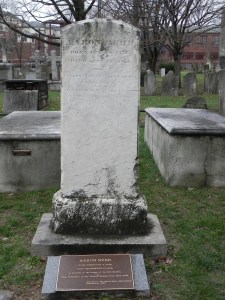
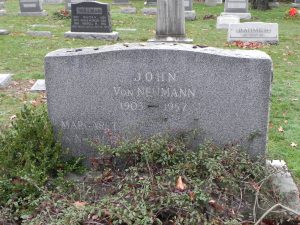
There are, however, more enlightened minds buried here as well. Being in the presence of Kurt Gödel and John von Neumann is a humbling experience. The presence of Albert Einstein, perhaps Princeton’s most famous resident, is, however, missed. Einstein was cremated and his ashes scattered at an undisclosed location. Standing in the cemetery in which so many of his compatriots rest on an overcast, damp December day, it felt like some slight compensation. Political power and ambition often lead to obscurity. I look to those who would be president and shudder. Here in this quiet cemetery, thinking of the common fate of us all, self-aggrandizement seems to be in such bad taste. Einstein, as so often, had it right. Those who are truly noteworthy seldom leave any traces in this world.

DSCN6123


Local Lore

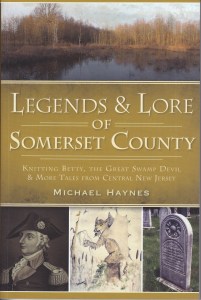
SomersetOne of the true joys of having more than a day off work at a time is the privilege to spend days reading. Although I read on the bus as a matter of course, it is a defined time, and editing isn’t as much reading as most people think it is. While doing research for my Sleepy Hollow paper, the question naturally arose: where did Washington Irving get the idea for the headless horseman? According to Irving’s biographers, the story was not an uncommon one. Headless ghosts are not unique, and he wrote the story while living in Europe as part of the serialized Sketch Book of Geoffrey Crayon, Gent. There is no practical way to know where he first heard the story. During my research I heard of a local source: Legends and Lore of Somerset County (New Jersey), by Michael Haynes. In this little compendium of stories of my current county, there is a claim that Irving learned about the story right here in New Jersey, where a traditional headless ghost rides. Again, it is impossible to say where he got the idea, but people like to feel that their local traditions are important enough to engage a major writer’s imagination.

Haynes presents several other regional tales that may rival the Jersey Devil and give ghosts a location just down the road. I suspect most places have tales of ghosts and mysterious beasts. It is always interesting to find out about those lurking in your own neighborhood. Scholars are now beginning to turn their attention to the sanctity of space. Location is very important to mobile beings like ourselves. The place where we find ourselves becomes “our place” and with the patina of time, often a personally sacred space. Tales of what happened here often take on the cast of the supernatural.

Local history has always held a deep fascination for me. Any region that I know, in a sense, intimately, is a region that has become part of my personal history. My region of Pennsylvania, for example, defines me although neither of my parents, or their parents were born in that state. And Massachusetts, Michigan, Scotland, Illinois, Wisconsin, or New Jersey, places I’ve lived, have become somehow alive with history. Legends and Lore of Somerset County contains tales that are not always believable in the workaday world we inhabit, but that’s the beauty of sacred space. Going beyond the mundane is entirely the point. Although Washington Irving may or may not have first heard of the headless horseman here, we have that legend, and there’s only so much that history can do to remove such a claim.


Simple Gifts

Thing Explainer, a whimsical gift for my daughter at Christmas, is perhaps the trendiest present found here this year. Randall Munroe, who makes a living as a web comic artist (who knew this was even possible?) wrote/illustrated the book to explain complicated things in simple words. Indeed, he limits himself, with some license, to the thousand most common words in English. Due to the almost viral success of the book, websites now exist so that even those of us with advanced degrees can explain things with common words. It reminds me of the Common English Bible in that it attempts to make something complicated easy to understand by using a level of writing accessible to the majority of readers. Thing Explainer is, naturally, for fun. There is, however, an underlying question.

Have we reached a point where reading itself has to be enhanced by making it simple? Some things are, by their very nature, complex. At a time when more and more kids are being encouraged to attend college, the traditional basis of higher education (the classics, classical languages, the humanities) has eroded so far that higher education is not what it once was. My daughter’s engineering program is highly technical and doesn’t naturally promote the things I recall as “college.” Maybe I need someone to explain it to me in simple words. What’s wrong with being literate? With finding challenging books worth the effort to get through? Some things are complex.

A young couple's anniversary in Wales.

A young couple’s anniversary in Wales.

I wonder how a society survives when complexity disappears. Today my wife and I celebrate our twenty-seventh anniversary. Marriage can be a complex thing, but it is something that can be explained in simple words. When we decided to marry the idea was lifelong commitment, not knowing the twists and turns that life would take. If the Internet existed in those days I didn’t know about it. (Certainly, being a web comic artist wasn’t a job that yet existed.) Doctorates still led to teaching careers. 9/11 hadn’t happened so that living in a modified police state wasn’t yet part of daily reality. There weren’t really words to explain it. It was one of those most basic human things. Turning to Thing Explainer I find that love is one of the thousand most-used words. It does perhaps show, after all, that complex things can be stated in a word we all understand.


Sorry about That, Chief

What’s worth $20,000? An apology. That figure may require some adjustment for inflation, but back in the days when I was taking conflict management training it was right. Our teachers informed us that court decision costs were lowered by $20,000 when a client apologized. I’m sorry, but I don’t see that money should be necessary for an apology. Nevertheless, in a world motivated by money, this is a factor to keep in mind. With some of the very late apologies that have come out in recent years (the church apologizing to Galileo, and to the “witches” executed in the Middle Ages) comes the realization that too late is, perhaps, better than never. Often in cases such as these, a religious bravado just can’t back down. Doctrine is doctrine and you can’t change it without losing face. This doesn’t just impact large bodies like the Vatican, either. Lots of religious groups have apologies that they could, and should, make.

Grove City College is a small school. It has, from reports I see, become more conservative than it was when I was a student there. One suspects there may have been some apologies due over the years. I was surprised, however, to find GCC mentioned in the Christian Century. A former professor at my alma mater was fired for refusing to register for the draft in World War II, according to the story. Howard Pew, chair of Sun Oil (and the board at Grove City) accused him of being a communist. Now, over half a century later, the former president of the college delivered an apology to his door. That’s a nice gesture. Former faculty are generally, in my experience, shoved far from mind. We don’t like to treat those who educate too well, some times.

Photo by "the Enlightenment"

Photo by “the Enlightenment”

For the unapologetic professor, the greatest sense of satisfaction comes not from humbled administrators, but from grateful students. On very great occasions I still hear from some of mine. It makes up for some of the pitfalls along the way of an academic life. Teaching religion, naturally, puts you in some company that you might not expect. Of all anathema topics, teaching about being decent to other people earns you the most rancor. So it is, unfortunately frequently the case among our educational institutions. Pew, whose shadow still loomed large over campus in my undergraduate days, never personally apologized. Those with plenty of money to spare seldom do. $20,000 is not too much to pay to feel completely justified in taking another person’s livelihood away. We can only hope for a better educated future.


Only Hummus

I remember the moment well. I was in Jerusalem on my own. Although in my early twenties, I really didn’t know much. The man at the vending cart didn’t speak English, but I was hungry. My first experience of falafel would certainly not be my last. After I married a few years later, I introduced my wife to the various Middle Eastern foods I’d tried. Hummus became a personal favorite, especially after I became a vegetarian. There are plenty of things for vegetarians to enjoy, and many cuisines of the world have less meat-heavy options than many restaurants I’ve experienced in the States. Hummus, to get to my point, can be rather bland. It is generally inoffensive, and people of many dietary and religious restrictions can eat it. The Christian Century ran a blurb recently about a hummus restaurant in Netanya, Israel. This eatery offers a fifty percent discount to Jewish and Arabic customers who sit together. Here is a workable idea for peace.

We all have to eat. Half the trick to world peace is getting people who dislike each other to sit down and do it together. Those of imperialist bent may not realize, or even be able to see, that we have more in common than most agitators think. Human needs are the same, and often, very easily provided. You like hummus? I like hummus! We must not be so different, after all. If instead of weaponizing themselves, radical believers armed themselves with food to share, not nearly so many warplanes would have to take to the air. I admit I’m an idealist. I don’t think peace is impossible. We can choose to focus on what divides us, or on what we have in common.

IMG_2641

Perhaps if I’d never traveled to Jerusalem I would never have tried hummus. I didn’t travel for the food, but travel led me to a kind of serenity. Both falafel and hummus are made primarily of chickpeas, a versatile vegetable that has a verisimilitude of peace. If we could learn to eat together we would find it harder to hate each other after that. Sharing our mutual needs sometimes, as the restaurant owner in Netanya understands, requires a financial incentive. Although it may be lucre that lures those who are different to the same table, it is the peace itself that, I believe, will keep them coming back.


From Solid to Gas

“Ignorance of the law is no excuse.” I couldn’t believe that the woman at the police station actually used that phrase on me. The only time I’d ever heard it uttered before was on Gilligan’s Island. After all, we were talking about a parking ticket. I’d arrived in Boston, after driving through four states, with a massive headache. I was moving into an apartment in Winthrop, and all the cars along the street were lined up with their left tires along the curb. I simply did what everyone else had done and went to bed to sleep off my debilitating pain. In the morning I had a ticket under my windshield wiper. I explained that I’d just moved to town from another state, I was a student, and that all the other cars were parked the same way. Then she said it.

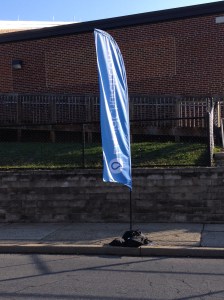
IMG_2625Ignorance, it seems to me, is the only response in the face of laws far more complicated than they need to be. I always thought, for example, that it was against the law for churches to meet in public schools. I’m no lawyer and what with voucher programs and other legislation that has been approved by the Reagan-Bush empire, I’m just not sure any more. So when I drove past the local middle school I was surprised to see banners all over the place proclaiming Liquid Church was meeting there. Liquid Church? They have a slick website (advertised on the banners) and they had guys directing traffic in the local school lot, which was frighteningly full. When had this happened? When had the school which had refused to allow a robotics league, approved the meeting of an evangelical church in the building? I can’t guess about the legality.

One of New Jersey’s fastest growing churches, according to its website, Liquid Church is flashy and trendy. This is God for the twenty-teens. Like businesses these days, it has “core values” as well as beliefs. Those values? Grace wins. Truth is relevant. Church is fun. The beliefs are pretty basic evangelical standards. But what is it doing in my local school? Having attended churches where anything fun smacked of Satan, perhaps I’m just a little bit jealous. Maybe as a guy who tries always to obey the rules, who doesn’t speed, and who actually follows traffic conventions in parking lots, I’m just a little confused. I thought there used to be a wall here. Now there seems to be nothing but rules anyone is free to concoct. I miss Gilligan’s Island.


Book Deaf?

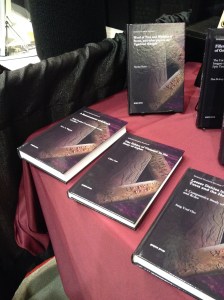
It’s Tuesday morning and I have been listening to authors pitching their books for three solid days now. Truth be told, I am a bit jealous. I’ve got a few more books in me yet, but research time simply does not exist in the world of capitalism and its discontents. Not that I envy being on the author’s side of the table—I remember how it felt to pitch Weathering the Psalms to several editors and to receive an icy “no” in response. I think now I begin to understand. Yesterday one of my appointments asked if I was “book deaf” yet. It was a term I’d never heard, but I immediately knew what he meant. Editors hear pitch after pitch. I pull out my phone and look at my calendar and see a new project every half-hour throughout the day, but no, I’m not book deaf. In fact, I have to constrain myself to keep my credit card firmly inside my wallet. Being surrounded by books is like being in a jungle teeming with deadly animals.

IMG_2614

From the exhibitor’s booth, Tuesday is a day of relief and worry. Most of the papers are over at AAR/SBL, and most of the participants have already left. As at any conference, fair, or exhibit, we are strictly forbidden from taking down the booth before closing time. We stand about, straining our ears to hear that first transgressive ripping of strapping tape from its roll, indicating that someone in another booth is being naughty. We’re tired, weary even, but not book deaf. Never book deaf.

IMG_2615

In my unguarded moments I sometimes think that maybe some day I’ll have a book here that others will clamber to find. Maybe someone like me will prowl to a pre-selected booth with a specific title firmly in mind, and that title will bear my name. I suppose it could happen, although it isn’t likely at this point. I hear each pitch and more. I hear the dreams and deep desires of every author. We want to be heard. We want others to think us respectable, honorable even. There are publishers out there who will publish anything. They will accept books to fill catalogues and websites and you’ll never hear from them again. Still, you’ll find some interesting things if you wander by their table. And if someone sees that you’re an editor while you’re browsing you’ll never turn a deaf ear. This is what religion scholars live for. Books are our reality.

IMG_2617


Go to, Let Us Make Brick

Next year marks a quarter century. It’s a sobering thought. A quarter century of attending the Society of Biblical Literature annual meeting. A lot has changed over the years. Much of the loss, I fear, has been of innocence. When I first flew into Kansas City, naive at 29, and still believing the world offered opportunities for those who would work hard enough, the academic job market was tight. I had no interviews whatsoever, and spent many hours in the employees’ hopeless lounge, dreaming that someone might call my name. Although no jobs came of it, I could hardly blame the academy for “market conditions” outside their control. An economy based on unadulterated greed and emulating the worst practices of the business world was eating higher education alive, from within. I had no way of knowing. For a couple of decades I attended more often than not, optimistic that the lies I’d been told might yet turn out to be false. That those who had the gifts and abilities would be recognized for what they were. I was so terribly young then.

Through a variety of roles I have continued to attend this conference for all these years. I have not seen so much hopelessness until this. Colleagues come to me, barely holding back tears. Conditions in our universities are bad and are getting worse. We have no students, but clients. The hours of preparation for the classroom are now being measured in metrics like “return on investment.” The basic vocabulary of higher education has evolved to the point that it is a new Tower of Babel. It sits on Wall Street and considers what is offered to our young as commodities. Nobody worries if they learn anything or not. The exchange of goods at personal advantage is the only way that one can exist in a market economy.

IMG_2610

The only hope any culture may dare to claim for its future lies in education. Those economies that have not suffered as much as our own are those where education is still revered. Where you don’t have to hold a MBA to speak with authority. Where truth might just be an abstract and where not all things can be measured in shekels. I have been attending this conference for a quarter century and never I have I seen despair such as this. I have to wonder about a nation that takes those highest achievers and those with the most initiative and slaughters their hopes on the altar of the angry deity of vain baubles of self-aggrandizement. We bet on futures that are no futures at all. My beard is whiter now, and my glasses stronger. I am still able to see, however, the folly of launching into the North Atlantic in early April before any kind of radar has been invented with lifeboats made only of money. I only hope I’m wrong.


As Others Think

As analysts step in where angels fear to tread, we have been given expert opinion on why ISIS’s terror in France was counterproductive to its goals. A few voices have chimed in stating that the result of escalation is just what an apocalyptic group hopes for. Rational people, having no idea how a fundamentalist thinks, are scratching their heads. Long I have wondered why universities and other bastians of higher education haven’t sought the advice of experts. No one can understand fundamentalism who hasn’t experienced it personally. Problem is, most people who have experienced it are experiencing it still. Those of us who thought our way out of fundamentalism are passed over repeatedly for university posts, while those better connected (surely not of fundamentalist stock) are handed influential positions from which to scratch their heads. You want to understand fundamentalists? Ask someone who’s been there.

There is nothing rational, in the common parlance, about fundamentalism. It has, however, its own internal logic. If you believe with every mitochondria in your body that the Bible (or any holy book or doctrine) that you were taught is true, and truly believe it, no amount of reason can convince you otherwise. This is (partially) because the ultimate cause of all events is open to question. Science does not address ultimate causes—it can’t. The endlessly creative human mind, however, can rather simply conjure them. If God is the ultimate ultimate cause, and if God said, x, y, or z, then other interpretations are simply wrong. If God has decided an apocalypse is necessary, what use is reason in the face of the impending certainty? Is there no way out?

There is. Some of us have made it. We, no matter our credentials, are not generally well-connected drones of the middle class. Fundamentalism is prized by the poor. Those who have no future on this earth look for another, better world. This is a perspective I understand very well. Our increase in ease of communication and exploding technology with ease of access have only given new tools to those who think in terms of ultimate causes only. You can’t talk a suicide bomber out of action with reason. You need to know the language of belief. We glory in our lack of belief and rationalism. We, however, close our eyes to the fact that the vast majority of people in the world are believers. And we won’t talk to them because they make us uncomfortable. We have written our own recipe for apocalypse.

From NASA's photo library

From NASA’s photo library


Ports of Call

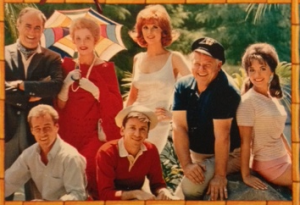
“Just sit right back and you’ll hear a tale,” so began far too many evenings of my childhood. Well, although as an adult it may seem that the time was ill-spent, Gilligan’s Island was the induction to popular culture that I had to undergo some time. The series has aged well; we bought the DVDs (speaking of aging) as soon as they came out and watched them all, multiple times. But what must it really be like to be on a boat, and for more than a three-hour tour? Here’s where I’m lucky in my extended family. A cousin, who is much younger, has been working as a musician on a cruise ship for a couple of years, and has recently started a blog. If you’ve ever wondered what it might be like to be a singer on a vacation vessel, check out David Tarr’s take. He has a more realistic outlook than Ginger did, although seeing Tina Louise in person was still quite a thrill, back when she stopped into the local Borders. Back when there still was Borders.

TheIsland

It seems to me that we don’t often enough take the time to wonder what other people’s lives are like. We are a myopic species. Apart from the occasional educational tour in school, we don’t have much opportunity to consider what it feels like to be someone else. I grew up in a working class family that lived at the poverty level. I didn’t get along with my step-father, but I have, in the years since he died, thought back on his perspective. He worked long hours, had little education, and was very patriarchal. When he was too old to do his duties as a laborer, he took a job running an elevator in one of the five-story buildings in a nearby town. I once went to visit him on duty. He was sitting in the tiny cube of a metal box, waiting for the very rare customer. I asked if I could bring him something to read, something to do, to pass the hours of tedium. No, he replied, he didn’t want to miss any calls from potential passengers. What must it be like in the head of such a man?

The internet has given us a chance to learn the lives of others. David is living a young man’s dream, with the good and bad. We have lost all hope when such things are no longer possible. Too soon we find ourselves chained to a desk, 9-to-5, working to make money for others. Dreams are strictly forbidden, at least on work time, which is the only time there is. Somewhere on an ocean, there is a ship. It may take a three hour tour, a three week cruise, or a three month voyage. It is more than a ship, regardless. It is the people on board, and their lives, and hopes. I’m not sure of the course charted for me. I suspect it has no cruises to exotic climes. It has, however, writing written all over it, and that is one thing I share with a talent cruise singer in my extended family.


Matins

At a certain time of year, around November after the time change, early morning immigrants to Manhattan see the light. As they stumble out of the Port Authority Bus Terminal and head to the east, it is as if the sun is rising like a monster from the sea. In Midtown the streets run east-west and the avenues north-south. I trip out onto Eighth Avenue and have to make my way to Madison, and the entire walk is facing into the unrelenting sun. You might think at 7 a.m. this should be no great challenge, but then you would betray the fact that you don’t commute in early. Hundreds of people pour in a human stream out of the Port Authority and head in all directions, many of them east. The streets are crowded and you literally can’t see what’s in front of you. You are, in the words of a young Bruce Springsteen, “blinded by the light.” I’ve watched in fascination as this happens for the past four years now. It isn’t the much touted “Manhattanhenge,” but simply the angle of the sun at this latitude at this time of day. It may be fun for a few minutes, but then you realize how dangerous it might be.

IMG_2595

One of the most basic elements of religion is care for others. Indeed, some religions suggest that you should treat others as more important than yourself. When I was growing up I was taught to think of things from somebody else’s perspective: if you were in that position, would you want someone to do that to you? It’s a message I took to heart and to this day I can’t pass a homeless person without a backstab of guilt for not pulling out my wallet and dropping a dollar or two into their outstretched hands. Having been on the receiving end of a pink slip more than once, I can easily imagine being there. Seeing from another person’s perspective can be dangerous. Not considering that perspective can be even worse.

Those out and about at 7 a.m. are go-getters. Climbers. They get to work early. Some, no doubt, stay late as well. The person walking west has the sun at his or her back. The street in front of them is brilliantly illuminated but not blinding. How many times I’ve nearly collided with them because they don’t realize that those of us going east just can’t see. You have to step into the shadow of a banner or awning or streetlight post just to get a nanosecond of relief and make sure you’re not about to step into a hazard like an open freight door. The photo doesn’t do it justice because if it were truly to show what I see, you’d see nothing at all. Raised as I was I can’t help but think of the beast rising from the sea, and the woman clothed with the sun. And the homeless being awoken by beams far too bright after a night on the streets.