Same Old Story

Once upon a time fairy tales were considered appropriate only for children. Unlike myths, fairy tales are frequently oral (yes, there are oral myths but this is not the place to discuss technicalities) and have origins that are obscure. A friend recently sent me a story entitled “Phylogenetic analyses suggests fairy tales are much older than thought” by Bob Yirka on phys.org. Using phylogenetic analysis, researchers have traced some fairy tales back thousands of years, into the Bronze Age of the ancient Near East. This will no doubt surprise some analysts who supposed fairy tales were a more recent, European invention. The tales change with time and distance, no doubt, but the basic story is very deeply rooted in who people are. Fairy tales are adult fare, after all.

I tried to make this point in an academic article that was rudely rejected by the journal Folklore some years back. I mean “rudely” literally. I’ve had academic articles rejected before—many of us have—but the letter that came with this one was insulting. My “error”? Suggesting that the story of the musician who travels to the underworld came from ancient Sumer. The article had its origins in my wife’s reading of the Mabinogion. The story of Bran’s head being washed down the river still singing reminded me of an Edinburgh ghost story the tour guides used to tell right outside our window. You’ve probably heard similar: a tunnel is discovered, a musician (a bagpiper, since this was Scotland) is sent down while playing so that those above can follow the sound, but the musician never emerges. I traced the story through the Celtic tradition of Uamh ‘n Òir, the cave of gold, through Bran, Orpheus, and finally back to Ishtar’s descent into the underworld. It was a fun piece, but serious. It ended up published in a Festschrift to a scholar with a noted sense of humor.

Photo credit: Kim Traynor, Wikimedia Commons

Photo credit: Kim Traynor, Wikimedia Commons

The fact is, traditional stories often go back very far in history. We haven’t the tools to trace many, nor can the results be taken for Gospel, but the implications can. People are storytellers by nature. We find meaning in what would today be called “fiction.” Too often I’ve had to hang my head in embarrassment when admitting to a fellow academic that I read (and sometimes write) fiction. It is something, however, that ancient mythographers and folklore singers would have understood. We can be academic some of the time, but we are human full-time. And telling stories is something that predates even the Bronze Age. Of that we can be completely certain. And they lived happily ever after.
Gods and Rods

DramaGiftedChildThe human mind is an unsolved mystery. Oh, we know a lot about the brain, and advances in neuroscience have been startlingly swift. The mind, which is not the same as the brain, still eludes us. I took enough psychology courses in college that I could’ve declared it a minor, but being a minor I didn’t know enough to do so. Like many people from what used to be called broken homes, I wondered what made me think and act the way I did. I still do. Psychology shed some light on that, and although antipathy towards one’s parents has become a bad joke among those who belittle the science of the mind, there can be little doubt that there are patterns. Our youngest days, although we can’t remember them, make us who we become. I know my youngest days were difficult. I know they are with me still. I can’t remember them, but there are witnesses.

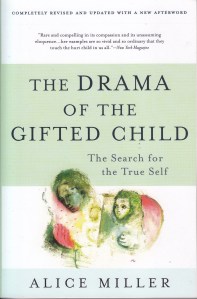
One of my readers suggested The Drama of the Gifted Child, by Alice Miller, to me. I was hesitant at first since I’m not gifted. My career has taught me that, if nothing else. Gifts are valuable, right? But the subtitle won me over: The Search for the True Self. Life has been that indeed. Miller, who is deceased, argued in this little book that unless the damage done early in life is recognized and mourned, it will lead to depression. This isn’t easy reading. It’s so easy to damage a child. Although most of us pretend differently, there are an awful lot of our species walking around with very deep, but invisible, scars. Just when I’m ready to dismiss the thesis, Miller provides examples. Examples in which I recognize something I wish wasn’t there. Consciousness can be a curse as much as a blessing. We don’t know where it comes from, or even what it is. It can drive you crazy, though.

Religion often prescribes child-rearing techniques. Many of us have the Bible to blame for being spanked as children. Larger, powerful adults violating the weak and controllable. Just because they can. Psychologically this is wickedness. I’ve read memoirs of children spanked excessively because the religion of the parents recommended it. Those who read Miller carefully will see that her case is well made. Perhaps one will dispute the conclusions, but the facts are there. Our childhood is necessary for our adulthood. And things that are impossible to see cause us to do things we don’t understand. Any religion that suggests beating a child is the path of righteousness has its directions utterly confused.


Long Distance Commute

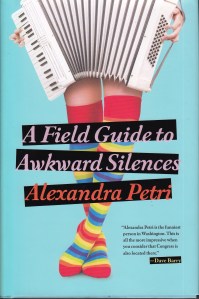
AwkwardSilencesWhat should my next book be? This is the perpetual question of the long-distance commuter for whom electronic devices are mere distractions. If that commuter is socially awkward and believes that only books truly understand them, that is. I’m as eclectic a reader as I am a voracious one. Each book suggests, in some measure, the next one. I always have to keep an eye ahead. Then I read (present tense) a book without peer. I feel lost because what will replace that experience I’ve had for the past few days of looking up and finding myself at my destination? Of actually looking forward to getting on the bus so I can read? I’ve been doing this commute for over 400 books now, and I’m at a loss for what to read next. I blame it on Amazon.

In the publishing world we use Amazon to purchase competitor’s books. Then Jeff Bezos decides to buy the Washington Post, you know, the way people do. Since my email address is on their list I get sent a daily invitation to read the most read stories on said Post. I read a story by Alexandra Petri and I was hooked. Where could I get more? A Field Guide to Awkward Silences is the rare kind of book that makes you laugh out loud on the bus, which, at six in the morning, generates its own kind of awkward silence.  Petri makes you feel like it was actually okay to be that dorky kid who read all the time.  Like there’s a world out there that responds to your longings, somehow.  A world of possibilities.

Now here I am about to climb on the bus without Petri. I’m like a kid staring disconsolately at an empty candy wrapper. “That was so good!” you think. “I wish there was more.” Petri writes as if she’s achieved Bob Dylan’s blessing and has stayed forever young. The time of life when the future seems so full of possibilities. Hers is writing that reminds you of a time when you didn’t spend hours a day nursing hemorrhoids, sitting on a hard bus seat. That reminds you it was possible, unlike your own experience of it, to be cool as an Episcopalian in Wisconsin. That reminds you of the time when you had A Field Guide to Awkward Silences to look forward to reading. No, this book didn’t make that choice of next book any easier at all.


Or Just Sleeping?

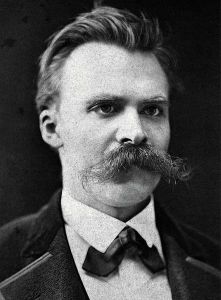
442px-Nietzsche187aYesterday was the anniversary of the death of God. The Time magazine cover, the first to be text only, asking “Is God Dead?” was one of the iconic images of the 1960s. Fifty years ago yesterday, the media ventured out onto a limb that hasn’t snapped but hasn’t exactly bloomed either. Maybe it’s because the idea wasn’t original. Philosopher Friedrich Nietzsche had suggested that God is dead in 1882, nearly a century before Time. A friend in seminary reported seeing graffiti that read “‘God is dead’—Nietzsche; ‘Nietzsche is dead’—God.” Although we laughed over it, this waggish statement contained a profound truth. The concept of God has proven remarkably resilient. Indeed, it may be part of what makes us human.

The media, nothing if not endlessly self-referential, responded. In fact, an article by Lily Rothman on time.com, is a Time story about a Time story. An endless regression of unbelief. Roth mentions theologians in her column— theologians still, and perhaps always have, debate the question of God’s existence. The ultimate untestable hypothesis, God, in that sense, is an easy target. The media reach readerships of which the rest of us only dream. I didn’t see the Time cover as a child (we did not subscribe), but it made its way into Rosemary’s Baby as a statement of the Zeitgeist more effective that a declarative sentence. It is a question that haunts. Miracles, according to the Bible, used to be large and spectacular. Today they don’t happen at all. What went wrong?

Rothman’s story begins with a seminary professor being fired. William Hamilton, at the then Colgate Rochester Divinity School, was dismissed over the question of God’s existence. Seminaries have been particularly sensitive to questions of God’s continuing presence. We sometimes forget, however, that magazines exist to make money. The same is true of some theologians. If you wanted to get noticed when the Vietnam War claimed so many headlines, you needed to say something striking. As the article points out, the question of God’s death seems a lot less radical today. Living through this campaigning season running up to the Republican National Convention it might be less difficult to disbelieve. I wonder what Nietzsche would’ve said.


Fossilized Views

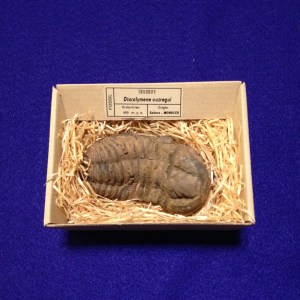
Not all Fundamentalists are the same. I grew up believing the Bible was literally true, but in my family we recognized that fossils indicated the earth was older than just a few thousand years. Keep in mind that I never tested this with any preachers—we didn’t need to. We knew that evolution was wrong, but that didn’t mean there had never been dinosaurs. Kids are as sure of dinosaurs as they are of angels. Besides, we lived beside a tributary to the Allegheny River that was rich in fossils. We’d spend summer days wading in the water looking for rocks with impressions of various bivalve shells in them. They weren’t hard to find. And being collectors of just about anything inexpensive (or free, as in the case of fossils) we brought them home. We really didn’t see any great disconnect between the black book on the table and the rocks in our hands. There was room for both.

It must’ve been a slow news day at Huffington Post recently when a story titled “This Guy Is Pretty Sure He Found Fossils From Noah’s Flood” ran. The guy in question is from Texas, and, finding fossils probably not unlike those we used to, supposed that they were laid down during Noah’s flood. This was an idea that I only encountered after I’d left home. We couldn’t afford many books when I was growing up, but we did have conventional dinosaur material. Nothing strange enough to suggest that the flood created all the landforms and fossils on the planet. That would’ve sounded just a bit strange. Today, however, it is common to suppose all Fundamentalists are naive and enemies of science. Not all are. Some, I hope, are like I was, trying to find a way to fit their faith into a world that science has come to help define a bit more clearly. Positions have, however, polarized a bit since my tender years. We now fight over things we used to wonder about.

IMG_2734

The fossils I found as a kid found their way back into nature before I grew up. If I ever have the time when visiting home these days, I still try to get an hour or two to spend down by the river to look for the rocks that filled me with such awe as a child. That was a world where belief was fairly easy. I loved science. I loved my religion. I loved the fossils that told me the story was a complicated one. Only I wouldn’t have believed that decades later I’d still be trying to suggest to others that the world is big enough for both facts and faith. I haven’t been a Fundamentalist for decades, and given a few million years, who knows how even the nature of the debate might evolve.


GF or TGIF?

For some today is Good Friday. Others are saying “TGIF!” There’s a basic disconnect that has grown between days of remembrance (okay, let’s just call them “holidays”) and the days required of capitalism. Easter is not generally considered a work holiday. As I’ve mentioned elsewhere, coming on a Sunday, it is safely out of the reach of much commercialism. Although, vis-à-vis Christianity, it’s a stronger holiday than Christmas, it isn’t a federal holiday. In a world of religious pluralism, that’s no doubt correct. Still, for those who ponder deeply the tradition that wrought them, shouldn’t we be allowed to contemplate our loss without spending a vacation day?

It will come as no surprise to my regular readers that I often think about the ministry as a vocation. After all, I paid my good money and attended seminary. When I was teaching at a seminary and there was some pressure to move that direction, however, I felt that I was adequately served by daily masses and the opportunity to minister in the classroom. Before those days, however, I trudged into work in Ritz Camera in Brookline, Massachusetts, on Good Friday wearing black and feeling depressed. From long habit I wished to be in church. From financial necessity I stood behind the counter and smiled. Good Friday is that way. It’s hardly a holiday when loss lies all around. It’s a bleak day, one might say. Few bosses who don’t feel the depth of symbolism can quite understand. Work week interruptus.

No doubt it’s vain of me to try to encapsulate this into words. As a culture we prefer the bright, sunny colors of Easter—a holiday with considerable spending but without loss of work efficiency. We should be smiles all around. “Smiles, everyone! Welcome to Fantasy Island!” But we can’t get there without going through Good Friday. Meanwhile, those who don’t observe the day are glad that it’s Friday. Not exactly a holiday weekend, but a weekend nonetheless. Have we outgrown Good Friday? I should think not. For although we bring our cheery flowers and bonnets out for all to see, we all know that Monday is just another day at work.

Elihu_Vedder_-_Soul_in_Bondage_-_Google_Art_Project


Palms and Psalms

At Nashotah House, where I spent many years of my career, it was often felt that the weather during Holy Week was, in the best of circumstances, appropriate. With spring just around the corner, however—the date of Easter is based on the Vernal Equinox, after all—a number of surprises came. Particularly in Wisconsin. The ideal scenario would look something like this: sunny then partly cloudy on Palm Sunday; it was a a joyful day for a parade, but clouds make for nice foreshadowing. Nobody really commented on the weather for Monday through Wednesday, and Thursday—Maundy Thursday—was largely spent inside the chapel. Good Friday, however, should be rainy. Saturday gloomy. And, of course, Easter Sunday should be a perfect, sunny spring day. It seldom, if ever, worked out that way. The weather is not beholden to liturgical celebrations. The same holds true for New Jersey. At least the snow has been removed from the forecast today, only to come in the night.

It was at Nashotah House that I wrote Weathering the Psalms. Being a lexically driven book, it was never intended to be a commentary on global warming. It should have been, in retrospect. Already by then we were nearing the point at which, even if greenhouse gas emissions were stopped, runaway melting of the polar ice would continue apace and the weather would grow more and more unpredictable because of human action. Human action of everyone except the industrialists, of course, since they don’t believe in global warming. We cling to our palms and shout “Hallelujah” while the sea level’s rising and our weather grows increasingly erratic. We have a theology with which the weather disagrees.

IMG_2721

The liturgical year is, like its Jewish predecessor, cyclical. Some have suggested that holidays were invented to remind the laity of when it was safe to plant again. Of course, the climate in the “Middle East” is quite different than that of northern Europe and the United States where the Bible seems to have its proper setting. As I was walking yesterday, I enjoyed the daffodils that I always associate with Easter. When I returned home I saw snow in the forecast. Leap year, Daylight Saving Time, and my general level of sleepiness conspired to cause me to overlook that today is the Vernal Equinox. I look for the snow, grasp my palm, and think of spring.


Can of Worms

A great variety of food comes in cans. My mind naturally turns to vegetables and beans, but “tinned meat” was a staple of my childhood, including the now derided Spam. When I see octopus and squid in cans I’m glad I’m now a vegetarian. Once—it may have been in Canada—I even saw bread in a can. My wife and I used to can vegetables at home when we had a garden and commuting didn’t eat up every spare second of the day. For the store-bought can, however, a can opener is essential. The idea is to seal the outside world out, to avoid contamination. To get to the goodies inside you need a tool. A can opener. In these days of emergency preparedness, a can opener can be a matter of life and death, or so we’re led to believe. Dry goods can survive without special preservation, but most require cooking and if the power’s out, well, cans can be much easier. I’m writing about cans because our can opener doesn’t work. We don’t have one of the electric machines that takes up counter space and would be useless in an emergency, but the basic hand-held device that’s designed to remove the lid from a can. I hope there are no hurricanes before we can get another.

A little context is in order here; after all, this blog is about profound things. We’ve gone through four can openers in the past six months or so. (Similar statistics apply to rotary cheese graters and garlic presses, but they are less crucial in an emergency.) The underlying issue is ethics: when you buy something durable, you expect it to last. Now you’re probably thinking, “don’t buy cheap merchandise, then.” We tried getting all of these devices from kitchen stores (not outlets!) and for a price that edged us beyond the comfort zone for a basic tool. These were the ones that went defunct the quickest. Our economy is built on the premise that people have to spend. When I was a kid, we had a can opener that remained the same through my childhood and college years. And we were poor. Now that we’re warned of terror on every side, you’d better have access to a store when that emergency comes because your can opener can fail you.

I know how to use a pocket-knife can opener. In fact, over the holidays I had to resort to one since stores weren’t open and our most recent addition to the can opener family had died. I made sure to show my daughter how to use the pocket knife device. When we lived in Wisconsin we learned how to make our own candles too. During Hurricane Sandy, a decade after they were dipped, these candles proved their worth. With no electricity for three days, we did rely on a can opener. Since then we have not found one that lasts. It seems that our economic plan as a nation is at odds with our national emergency preparedness. Even in the event of a war, we’re told, companies won’t produce weaponry unless they can make a profit. In days like these it seems that a pocket knife might be the wisest investment of all.

Why would anyone need two?  Now I get it!

Why would anyone need two? Now I get it!


Moral Money

Yesterday I spent at the Mid-Atlantic Regional American Academy of Religion and Society of Biblical Literature meeting. Not a registered guest, I was there in mufti. Those who know me stopped by to greet me, even without a name tag, but I noticed, as I increasingly do, the youth of the attendees. Apart from the business discussed, the issue of these younger colleagues kept arising. It’s as if the tap was left on but the glass is already full. Presidential aspirants aside, we live in a world where people are increasingly realizing that you can’t squander resources. We have compulsory education to try to make the next generation smarter, more fortunate than our own. And those who have the inclination and ability to go on for advanced study, we throw into menial jobs and poverty because, despite the myth, a doctorate doesn’t help your financial prospects. Universities have become businesses and one of their top-end products is the doctorate. The doctorate with no future.

Sitting in the lobby between appointments, I can’t help but thinking back to a younger me. I am part of what older colleagues are calling “the lost generation” of humanities scholars. Those who have the credentials but no opportunities. A wasted resource of a nation that loves reality TV and blustering windbags, as long as the windbags are billionaires. It makes me sad to think that instead of making a place for those driven to high achievement, that we’ll offer them poverty-level adjunct positions with Obamacare, food stamps, and excessive hours. When they burn out, like a high wattage bulb, we’ll go to the closet and screw in another to replace them. Just don’t turn off the tap. Graduate students bring in money.

This is a moral issue. Since it involves what are scare-quoted as “the elite” we seem not to care. Isn’t it fun to knock down those who think they know too much? I sit in the lobby and watch the bearded young men, the young ladies with heavy backpacks thrown over their shoulders, and I want to warn them all. And it’s not just me. My colleagues, lost generation or not, all agree. We’re sending our best students to oblivion. In the most prosperous nation in the world. You can tell we’re prosperous because all it takes to gain the confidence of a political party is lots of money. Lots and lots of money. I won’t mention the obvious that such loose lucre could be put to good ends, making jobs for those who’ve poured their lives into bettering their minds. Or maybe I will. It is a moral issue, after all.

IMG_0213


Seminary History

Seminary is where you go to learn what they didn’t tell you growing up.  Many people have rather idealized views about clergy and somewhat untrained views about their church (the same may apply for religions outside Christianity, but I wouldn’t be so bold as to say so).  Since church membership is declining, albeit not drastically, seminaries are finding themselves less in demand.  Meanwhile all manner of political candidates can claim a biblical literacy they don’t rightly deserve, and who’s to challenge them?  It is sobering to read The Christian Century and see just how sickly theological education appears to be.  Seminaries closing, seminaries merging, seminaries not really appearing on anybody’s radar scope.  As the founding institutes for nearly all the Ivy League universities (which are not closing), it seems that few people appreciate just how much our seminaries have contributed to our culture.  Our culture, however, is focused on more material pursuits now.  Let history bury the dead.

IMG_2694

The days when clergy were a step away from royalty and political power are long gone.  Figures like Increase Mather could personally pull cords with the crown to select a governor for colonial Massachusetts.  Rev. Martin Luther King, Jr. could almost single-handedly lead to the beginnings of the demise of one of the greatest social injustices in a democracy.  Even Fred Rogers could daily assure us that it was a beautiful day in the neighborhood.  Seminary graduates all. None of that matters now, as long as my back pocket’s heavy with greenbacks and one of the rich elite inherits the White House.  The thing is, seminary helped many of our past leaders to mature.  Not just spiritually, but intellectually.  Obviously seminaries aren’t perfect.  They can leave you with PTSD just as easily as a PhD.  Still, I wonder at the loss.

I didn’t know about seminaries, growing up.  Those who attend fundamentalist, non-denominational churches seldom do.  When I learned that there were specialized schools to attend to become a minister, I was intrigued.  I guess the idea of a monastery was somewhere in the back of my head.  Little did I realize that seminary was about forcing you to think about things you’d always assumed.  Yes, seminaries have their casualties.  Some leave with as simplistic an outlook as when they entered.  For the majority, however, it is the opportunity to find out that the world of religious belief is much more complicated than people would ever, ever imagine.  Angels dancing on the head of a pin, this is not.  Any computer could calculate that with the right algorithm.  Those who think deeply about what they say they believe are rare.  They do a service to society in general, but only if we are willing to listen.  When the doors are closing, this will become increasingly difficult.  As long as the money flows, I guess it really doesn’t matter.


Used Bookends

There’s nothing like spending a Saturday in a bookstore. It is actually a rare treat these days with Borders gone and some of the smaller indies having trouble keeping up. I particularly like used bookstores. Unlike most durable goods, books—at least some of them—grow in character with renewed ownership. Like most academics, I have books that had previously been owned by big names in the field. Sometimes because I was a student of one of their students, at other times because their library went for sale and I found the tome in a second-hand shop. A few years back I had to go to Boston for work, and I stopped at the Boston Book Annex only to find it closed. It’s sad when even a used bookstore can’t keep up.

So when my wife told me she had to work on Saturday, and it was in Montclair, my thoughts turned to the Montclair Book Center. It isn’t the largest bookstore around, but it does have used books and it is a healthy walk from my wife’s office. I never go planning to spend much, but being in a bookstore, you see things you didn’t know existed. When the staff comes up to ask if they can help me find anything I just smile and say, “No thanks, I just want to browse.” Maybe it’s because I have no idea what I’m looking for. I’ll know it when I see it.

IMG_2685

I used to visit the Cranbury Bookworm. In a sprawling old house outside Princeton, I often found pleasant, used surprises there. Then the landlord evicted them. They sold off most of their stock and moved to a closet down the street. Even though it’s tiny, there are always others there. I’m never alone in a bookstore. Other patrons feel the draw. I wonder if everyone who reads doesn’t owe a debt of obligation to stop into their local bookstore and pitch in. I grew up in a town without any bookstores at all. The nearest one I knew of was thirty miles away. I know what it is to be book-deprived. It’s Saturday, and a little too cold to spend much time outdoors. It’s probably just an excuse, but you’ll find me in the bookstore nevertheless.


Camera Obscura

There’s a certain etiquette to being on the bus. There has to be, when you pack fifty strangers together for an hour and shake gently. The seats on New Jersey Transit are somewhat intimate and it’s rare to make it through the journey without somehow touching the person next to you—elbows, knees, hips, or general body mass—worlds collide. I’ve mentioned before that not many people read old-fashioned books on the bus, but one of those unspoken rules of etiquette is that you don’t look at a stranger’s book. I’ve benefitted from that any number of times myself. People think odd things about you when you’re reading a book about religion in a public space. Not odd enough thoughts to earn you a seat alone, but still.

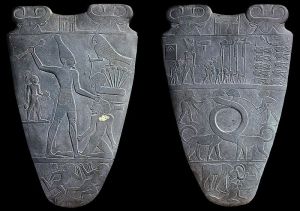
I was reading a book about an ancient Near Eastern religion the other day. For me it’s an occupational hazard. Those of us who have studied this stuff for a living keep on cranking out the books and somebody has to read them. Amid all the blue light from all the devices I often feel like I should be in a museum myself. It was with great surprise then, that my eye wandered onto the book next to me that day. I really couldn’t help it, you see. The woman who sat next to me and was using her cell phone to shed light on her book (the overhead lights don’t always work). She went to make a phone call but forgot to turn off the light so that it hit me right in the eye. Realizing her faux pas, she quickly turned it off, but my attention had been caught. In the book in front of her was a picture of the Narmer Palette. Narmer was the king who united ancient Egypt, according to the lore, and this stone ornament was the commemoration of his achievement. Anyone who’s studied ancient Near Eastern history would instantly recognize it. What were the chances? Two people sitting on a bus, reading actual books, both about the ancient Near East?

800px-Narmer_Palette

Bus etiquette, as I understand it, doesn’t allow me to ask a stranger, “What’re you reading?” It’s kind of a personal question, really. I’ve been doing this commute for going on five years now. The number of books next to me has been negligible. But one related to the very topic I was reading about? Was this one of those “if you see something, say something” things? Instead I practiced custody of the eyes and went back to my own book. Then the other unthinkable: she talked to me. “Do you know where,” she began—“ancient Egypt!” I thought. But then she asked where a certain restaurant was. I apologized. I never pay attention to the businesses along the highway. I’ve always got a book to read. I thought about asking her about the book. She had, after all, breeched the dam of silence. Instead I turned back to my own book and didn’t notice when the bus reached a restaurant whose name I didn’t even know. That’s what etiquette demands.


Writers and Readers

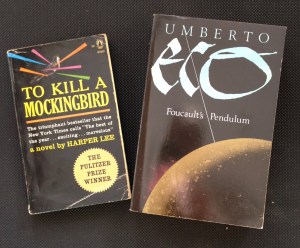
Writers are immortals. Well, at least as long as our species lasts. As a mere internet writer, I suppose that I’m not alone in wanted published books to my name. Solid books that don’t disappear in a power outage. There’s an immortality, no matter how mildewed or mouse chewed, to being in a book. Just two days ago Harper Lee died. And Umberto Eco. On the same day. Like many American kids, I was assigned To Kill a Mockingbird in school. Although I would go for decades without re-reading it, the novel stayed with me powerfully, the way that classics do. When it was assigned to my daughter’s high school class, I read it again, reinforcing the story that held me captive when I was a teen. In many ways it was an introduction into that confusing and convoluted world of adults. It was true, like most fiction is.

Umberto Eco I discovered in seminary. The Name of the Rose was one of the choices for assigned reading in Medieval Church History. Although less of a classic, it was no less real for all that. The work that hit closer to home, however, came when living in the Medieval city of Edinburgh. Foucault’s Pendulum was frightening in its conspiratorial intensity. Esoteric fanatics gather in an unholy profusion. Then, in the midst of reading it, a package, hand-addressed, arrived in my student mailbox. From Germany. Curious, I opened it only to discover a mound of tracts on Satanism, all the scarier for being written in German. They seemed to point to a conspiracy, just as I was reading about in Eco’s novel. Only after much searching (there was no internet to speak of in those days) did I trace them to the Schiller Institute. How they got my name, I never did learn.

IMG_2678

I haven’t read all the works of Lee or Eco. In fact, there are few writers whose entire oeuvre I’ve managed to read. That doesn’t mean that I love them any the less. All it takes is a powerful novel and you can be hooked for life. I leaned this in a profound way reading Moby-Dick in seminary. If there is another book that should be added to the Bible, that is the one. Writers are one of our least appreciated resources. They are, however, among the true immortals of our breed. Harper Lee and Umberto Eco left this world on the same day, only never really to leave it at all.


Universal Universities

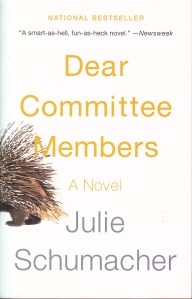
DearCommitteeHaving been in academia for nearly two decades, and having watched from the sidelines ever since being benched, I found Dear Committee Members a little too true to life. This novel by Julie Schumacher is presented as a series of letters of recommendation by an embattled English professor at Payne University. Set over the course of an academic year, the reader watches as the fictional university eviscerates the humanities to make the life of more “practical” departments like Economics much more comfortable. Sarcastic, bitter, and full of pathos, the novel is frequently funny, but it runs so true to life that it would be difficult to say whether it is indeed fiction or not. The book was a national bestseller, but universities continue down this very road, with all seriousness.

I have said before: it is time for those of us who really believe in education to take on, challenge, and overthrow this paradigm. Education is not about making money. There is more to life than that. My reading, which coalesces somewhat coincidentally around these themes (Dear Committee Members was recommended to me by a bookseller that I don’t know personally), paints a larger picture that is disturbing. The capitalist economy is growing out of control, its own dictates now excluding human decision (see my post on At the Altar of Wall Street earlier this week), and one of its strongest investors is higher education. It is a business, you see. The utter and complete devotion to the economy cannot take place without new generations of students indoctrinated into money as the meaning of life. Some of us—many of us—disagree, but we are not organized and we have no funding. We are the human resistance.

Setting out to make money was never my goal in entering the professorate. Motivated by finding authentic meaning in life, I have found that those departments where such a search resides—religion, philosophy, English, music, the arts—are under siege and constantly have to justify their existence to the administration. Dear Committee Members is funny in its overstatement, and in having a protagonist actually say what many of us think. And thinking is what it is all about. Education is about learning to think. Not earning a mint. We are in need of an altar call. The only ones with power to take back education from corporations are people. Who’s willing to join the cause with me? At this point I’d even be willing to consider sympathetic robots.


Steel Pennies

409px-CasablancaPoster-Gold

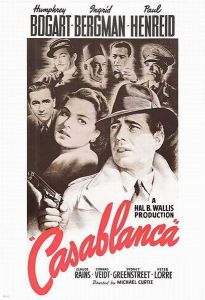
I remember seeing my first steel penny. At first I didn’t think it was real. Like many poor kids, I was a collector. I collected anything cheap: cancelled stamps, bottle tops from glass pop bottles, fossils, just to name a few free trinkets. And I’d started coin collecting, with pennies. I’d noticed the difference between wheat backs and Lincoln Memorial pennies, and I knew that the former might be worth something some day. There was a hobby store in town and by thumbing through the collectors’ books, before being shooed out, I’d learned that keeping an eye out for wheaties was a kind of investment. Just hold onto it long enough, and it’ll grow in value. I never saw a 1943 penny, though, until a fellow collector traded me one. During the war, he explained, copper was too valuable to use for pennies. Wartime, it turns out, changes lots of things. About the same time as these steel pennies were being minted, Casablanca was still showing in theaters.

As I sat down to watch Casablanca again last night, some new thoughts occurred to me. A wary eye can spot the cost-cutting measures of a wartime movie. Somethings never change. Nazis were bad guys, obviously, but we still didn’t know who’d win the war by then. And refugees flooded to Casablanca to try to escape Europe for America. The movie makes quite a lot of this endless waiting. It’s hot in the desert. People are waiting to go somewhere better. And there are elements of torture there as corrupt officials cooperate with Nazis, even though this is Free France. It occurred to me that this is an allegory of Purgatory. I’m pretty sure it’s not intentional, but here are lost souls waiting for deliverance. The plane to Lisbon is the soul’s escape to Heaven. Meanwhile the relentless waiting.

For a movie approaching 75 years old, Casablanca holds up remarkably well. The extras on our DVD tell us the plane in the final scenes is a cheap cutout just a few feet away on a sound stage. The mechanics attending it are little people to bring it into perspective. Tucked away in some box somewhere I’ve got a few steel pennies. These days coins change so frequently that I wonder just how stable this world really is. While the “Middle East” still has us as worried as ever, our money is, for all practical purposes, only virtual. Paychecks are mere electrons and I’m just a temporary repository between my employer and those who claim increasingly more of my pretend money. We seem to be caught between two worlds. In one nothing is really real at all. Rick’s Café Americain feels somehow very familiar, as we spend our time waiting for passage on a plane to Lisbon.